
Short Answer
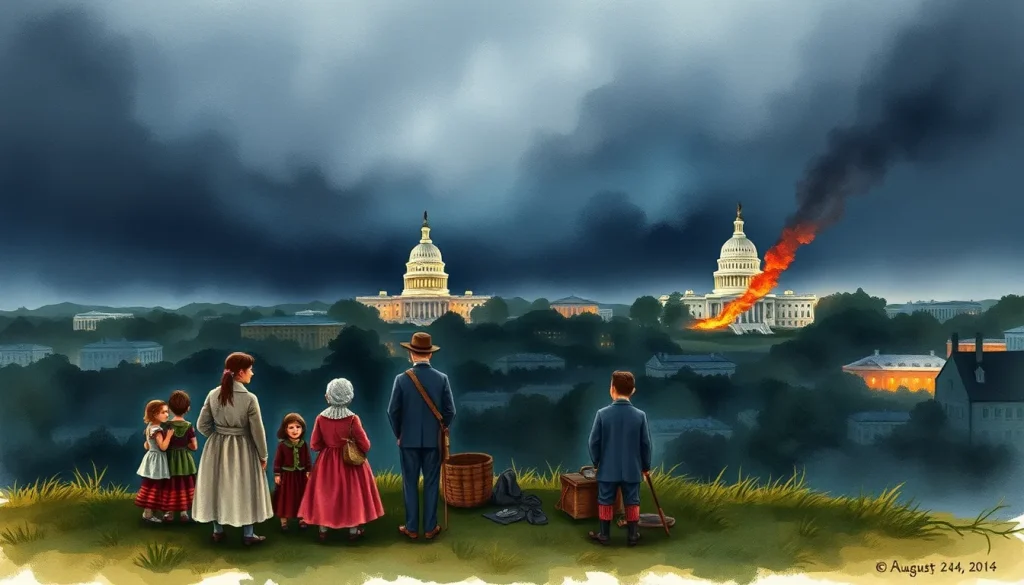
The burning of Washington by British forces on August 24, 1814, during the War of 1812, profoundly affected the city’s civilian residents, who faced evacuation, fear, and the destruction of public buildings that symbolized their young nation. Although the attack caused no American military casualties and limited private property damage, it dealt a severe psychological blow and disrupted the lives of the capital’s approximately 10,000 inhabitants. The event forced residents to confront the vulnerability of their new republic and left lasting scars on the city’s social and political fabric.
Historical Context
The War of 1812 had reached a critical juncture by mid-1814. With Napoleon’s defeat in Europe, Britain was finally able to spare veteran troops for operations against the United States. A British fleet under Vice Admiral Sir Alexander Cochrane entered Chesapeake Bay with the goal of diverting American resources from Canada and retaliating for American destruction of public buildings in Upper Canada, including York (now Toronto) in April 1813. Washington, D.C., was a relatively small and defenseless federal city of about 10,000 residents, including enslaved African Americans and a significant number of free blacks, Irish immigrants, and government clerks. Its population was heavily dependent on the federal government, and its public buildings—the Capitol, Executive Mansion, and other offices—were symbols of national ambition still under construction.
What Happened
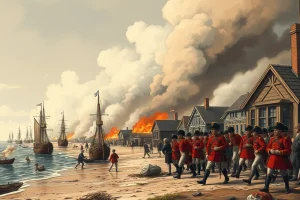
On August 19, 1814, approximately 4,500 British regulars under Major General Robert Ross landed at Benedict, Maryland, and began marching overland toward Washington. Secretary of State James Monroe, who had volunteered to scout the enemy, sent urgent warnings to President James Madison, advising him to remove government records. American militia and regulars under Brigadier General William H. Winder massed at Bladensburg, Maryland, but were routed swiftly on August 24 in the Battle of Bladensburg. Following their victory, the British entered Washington unopposed. That evening, they set fire to the Capitol, the White House, the Treasury, the War Office, and the Navy Yard, which the Americans themselves burned to prevent capture. Many residents had already fled the city, while others watched from rooftops and nearby hills. A violent thunderstorm on the evening of August 25 extinguished some fires but also added to the confusion. The British withdrew on August 25, having occupied the city for less than 24 hours.
Why It Matters
The burning of Washington had immediate and long-term consequences. It was a stunning humiliation for the United States, demonstrating the vulnerability of the capital. President Madison and his cabinet were forced to flee, and First Lady Dolley Madison famously saved a portrait of George Washington and state papers. The destruction of the Capitol and other public buildings ignited debates about whether the capital should remain in Washington, but Congress ultimately voted to stay and rebuild. The event also fueled anti-British sentiment and contributed to a determined American defense at Baltimore shortly thereafter. In the longer term, the burning became a symbol of the nation’s resilience and a key episode in American historical memory, while for civilians it marked a moment of terror and dislocation.
Definition
The burning of Washington refers to the deliberate destruction by British forces on August 24, 1814, of the principal public buildings of Washington, D.C., including the Capitol, the Executive Mansion (White House), and the departments of State, War, Navy, and Treasury. It was the only time in U.S. history that a foreign power captured and burned the nation’s capital.
Background
By 1814, the War of 1812 had reached a stalemate, but Britain’s victory over Napoleon freed veteran troops for a North American campaign. Admiral Cochrane and Rear Admiral George Cockburn planned a Chesapeake strategy to disrupt American trade and divert forces from Canada. Washington was chosen because it was poorly defended and its capture could deal a psychological blow. The British were also eager to retaliate for American burnings at York and other Canadian frontier towns. The city’s population, which had grown quickly but remained small, had little experience of warfare; many residents relied on government employment and feared for their livelihoods. The attack occurred during a humid August, and the British troops, already exhausted and weakened by sea travel, marched overland through oppressive heat.
How Civilians Were Affected
Civilians experienced the burning of Washington in a variety of ways. The most immediate effect was panic and flight. As British troops approached, many residents packed their belongings and fled to the countryside, seeking refuge with relatives or in nearby towns like Georgetown and Alexandria. Those who remained often hid in cellars or watched the fires from a distance. The destruction of public buildings meant the loss of workplaces for clerks and laborers, and many government offices were temporarily relocated to other cities. Property destruction was not limited to public buildings; British soldiers and local looters ransacked private homes, stealing valuables and destroying household goods. Enslaved African Americans faced an additional dimension—many took the opportunity to escape to British lines, hoping to gain freedom; others were forced to accompany their enslavers or serve as labor. Women and children were particularly vulnerable, as the collapse of municipal authority left them without protection. The psychological impact was severe: residents described feelings of shame, anger, and despair, and the spectacle of the burning Capitol—a monument to American aspirations—was described by one eyewitness as “a sight, so repugnant to my feelings, so dishonorable; so degrading to the American Character.” The chaos also exposed social tensions, as free and enslaved African Americans, Irish laborers, and wealthy federal officials experienced the event through the lens of their various social positions.
Competing Viewpoints
Historians have debated the severity and intentionality of the attack on civilians. Contemporary British accounts, such as that of Lieutenant George Robert Gleig, emphasized that the British targeted only public buildings and did not deliberately harm civilians; Gleig described the invasion as a military operation rather than a crime against civilians. However, American accounts often stressed that British soldiers looted private property and threatened residents, and that the destruction was an act of vandalism designed to terrorize the civilian population. Modern historians generally agree that the burning was a calculated act of retaliation and psychological warfare, but they differ on whether it crossed the line into an attack on civilians. Some argue that the lack of civilian casualties indicates restraint, while others point to the widespread looting and the psychological terror as evidence of cruelty. The role of the storm is also debated—some saw it as God’s intervention, while others saw it as a natural disaster that compounded the misery. The official British position, articulated by Admiral Cochrane, was that the attack was justified as retaliation for American destruction in Canada, but that civilians were not targeted.
Role in the War of 1812
Strategically, the burning of Washington had little impact on the war’s outcome. It failed to force the United States to withdraw from Canada, and the British soon withdrew from the Chesapeake region. However, it did have important symbolic and diplomatic consequences. The capture of the American capital was a moral victory for Britain and a humbling defeat for the United States. It fueled American resentment and determination to continue the struggle, demonstrated by the successful defense of Baltimore in September 1814 and the naval victory at Plattsburgh. The attack also influenced peace negotiations at Ghent; some British commissioners initially demanded territorial concessions, but the American resilience and the broader war situation eventually led to the Treaty of Ghent, which restored the status quo antebellum. The burning of Washington is thus often viewed as a turning point in American consciousness, transforming the war from a distant conflict into a direct assault on the nation’s heart.
Consequences and Historical Interpretation
In the immediate aftermath, the city of Washington lay in ruins, with the Capitol and White House reduced to shells. Congress voted to rebuild on the same locations, and the reconstruction, completed in the 1830s, gave the city a new architectural character. The event also prompted a national discussion about the location of the capital, but ultimately the decision to stay in Washington reinforced the federal character of the new republic. For civilians, the burning left lasting memories that were passed down through family narratives and community stories. Over time, the burning of Washington has been interpreted as both a national humiliation and a testament to American resilience. In the 200th anniversary commemorations of 2014, historians emphasized the civilian experience, highlighting the diversity of those who lived through the attack, including enslaved individuals who used the chaos to seek freedom. The event remains a powerful reminder of the vulnerability of national symbols and the human cost of war.
Primary Sources
Several contemporary accounts document the burning of Washington and its effect on civilians. Lieutenant George Robert Gleig, a British officer in General Ross’s command, published a memoir in 1821 that provides a detailed eyewitness description of the Battle of Bladensburg and the subsequent burning of the capital. His account offers a British perspective but must be read critically, as he may have downplayed excesses. An American source is Secretary of State James Monroe’s urgent letter of August 22, 1814, to President Madison, in which he warned of the British advance and advised removing records; this illustrates the panic among government officials. Stephen Pleasonton, a State Department clerk, later recounted (around 1848) how he saved the Declaration of Independence and the Constitution by moving them to a gristmill and then to Leesburg, Virginia. Another key source is Dolley Madison’s letter to her sister on August 23-24, 1814, describing her preparations to leave. These sources are valuable but reflect the perspectives of elite whites; accounts from enslaved people or free blacks are rare, though some are preserved in the memoirs of African Americans who sought British protection.
Further Reading
For further reading, consider Anthony Pitch’s *The Burning of Washington: The British Invasion of 1814* (2000), which provides a detailed narrative. Adam Goodheart’s *Washington Burning* (2012) offers a journalistic account and was adapted from a Washingtonian article. The National Park Service’s online resources on the War of 1812 include articles on the Chesapeake campaign and the civilian experience. The National Archives’ Prologue blog is also useful for primary source discussions. For a broader context, J.C.A. Stagg’s *The War of 1812: Conflict for a Continent* (2012) places the event in strategic perspective.
References
- National Park Service, “The Ravages of War: Targeting Civilians in the Anglo-American Conflict,” https://www.nps.gov/articles/ravages-of-war.htm.
- World History Encyclopedia, “Burning of Washington,” https://www.worldhistory.org/article/2631/burning-of-washington/.
- National Archives, “The Burning of Washington,” Pieces of History, https://prologue.blogs.archives.gov/2014/08/18/the-burning-of-washington/.
- Adam Goodheart, “Washington Burning: The 200th Anniversary of The War of 1812,” Washingtonian, July 19, 2012, https://washingtonian.com/2012/07/19/washington-burning-the-200th-anniversary-of-the-war-of-1812/.
- George Robert Gleig, “War of 1812: ‘To the Inhabitants of Washington…A Night of Terror and Dismay,’” American Battlefield Trust, https://www.battlefields.org/learn/primary-sources/war-1812-inhabitants-washington-night-terror-and-dismay.
FAQ
Did the British intentionally target civilians during the burning of Washington?
The British officially aimed to destroy public buildings only, but there were instances of looting and property damage in private homes. Contemporary reports vary; some British officers claimed restraint, while American accounts described theft and vandalism. The attack deliberately targeted symbols of American government, which created terror among civilians, but there were no military attacks on the civilian population itself.
What happened to the enslaved people in Washington during the burning?
Many enslaved African Americans took advantage of the chaos to escape to British lines, where they were offered freedom. British forces evacuated a number of these refugees to British colonies after the war. The burning accelerated the flight of enslaved people from the Washington area, weakening the institution of slavery in the region, though it remained legal until the District of Columbia was abolished in 1862.
Why did the British choose to burn Washington despite its limited strategic value?
The primary motives were retaliation for American destruction of public buildings in Upper Canada (especially York and Newark) and a desire to deal a psychological blow to American morale. The British also hoped to force the United States to divert troops from Canada and to strengthen their negotiating position in peace talks.
How did the burning affect the decision to keep the capital in Washington?
In the aftermath, some members of Congress proposed moving the capital to a more defensible location. However, Congress ultimately voted to remain and rebuild, partly because of the investments of property owners and the symbolic importance of staying put. The decision reaffirmed the federal city as the nation's permanent seat of government.
Leave a Reply