
Short Answer
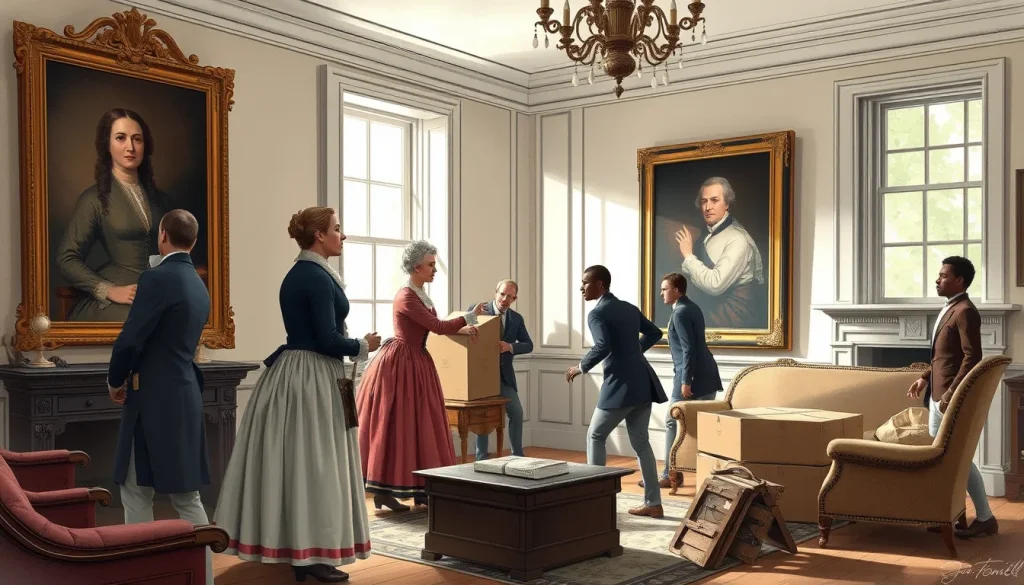
The question of whether Dolley Madison saved George Washington’s portrait from the British during the War of 1812 is a celebrated but frequently oversimplified episode. On August 24, 1814, as British troops advanced on Washington, D.C., the First Lady gave decisive orders to secure the full-length Gilbert Stuart portrait of George Washington from the White House. However, the actual removal involved a group of individuals, including an enslaved servant named Paul Jennings, a French steward, and an Irish gardener—contributions often omitted from popular narratives. This article examines the events of that day, the competing historical accounts, and how the story became a cornerstone of American memory.
Historical Context
By the summer of 1814, the War of 1812 had reached a critical point. After defeating Napoleon, Britain redirected military resources to North America, launching a campaign against the United States. A British naval squadron sailed into the Chesapeake Bay, and by mid-August a force of about 4,000 veteran troops began landing in Maryland, intent on seizing the nation’s capital. Washington, D.C. was a young city of roughly 8,000 residents, with no fortifications and a militia force that was poorly trained and outnumbered.
President James Madison, who had left Washington to observe American forces at Bladensburg, instructed his wife to flee if necessary. Dolley Madison, determined to protect valuables and documents, remained in the White House until the last moment. The city was in chaos; many residents had already evacuated. The threat was real, and the political and symbolic importance of the capital made it a likely target.
What Happened
On August 24, 1814, after the American defeat at the Battle of Bladensburg, British troops marched toward Washington. In the late morning, Dolley Madison was still in the White House, overseeing the packing of state papers and silver. She later wrote to her sister that she insisted on waiting for the portrait of General Washington to be secured. The full-length painting, known as the Lansdowne portrait, hung in the White House’s state dining room and was a national treasure.
According to accounts from both Dolley Madison and other witnesses, the task of removing the portrait required breaking its frame, which had been screwed into the wall. The painting was too large and heavy to be taken down whole. The First Lady ordered the frame broken and the canvas removed. White House steward Jean Pierre Sioussat (also called French John), gardener Thomas McGrath, and enslaved valet Paul Jennings were among those who physically lowered the painting and rolled it up. Two New Yorkers, Jacob Barker and Robert G. L. De Peyster, arrived at the White House and offered assistance; Dolley entrusted them with the portrait, which they transported to a farmhouse in Montgomery County, Maryland, and then to Baltimore for safekeeping. Dolley herself fled just before British troops entered the mansion.
The British burned the White House, the Capitol, and other public buildings that evening, but the portrait survived. It was later returned to the White House and has been displayed there ever since.
Why It Matters
The saving of the Washington portrait has immediate significance as a tangible preservation of an iconic American image during a moment of national crisis. More broadly, it illuminates the social dynamics of the early republic: an elite white woman directed the rescue, while enslaved and immigrant laborers provided the physical effort. The story also raises questions about historical memory—how one act becomes a legend that obscures the contributions of others. For historians, the episode demonstrates the importance of multiple perspectives, especially those of enslaved people like Paul Jennings, whose testimony corrected later exaggerations of Dolley’s role.
Definition
The claim “Dolley Madison saved George Washington’s portrait” refers to the incident on August 24, 1814, during the British invasion of Washington, D.C., when the full-length Gilbert Stuart portrait of George Washington was removed from the White House to prevent its destruction. The term “saved” typically implies that Madison herself physically cut and carried the painting, but historical evidence shows she directed others to do so.
Background
The portrait, a 1797 replica of Gilbert Stuart’s Lansdowne painting, was one of the most recognizable images of the first president. It had hung in the White House since 1800. When the British threatened Washington, the portrait’s fate became a matter of national pride. The building itself was a symbol of the young republic, and its destruction—including the painting—would have been a profound loss.
How It Worked
The portrait was bolted to a wall, and the frame was too large to fit through doorways if removed intact. According to Dolley Madison’s own account, she initially ordered the painting to be unscrewed, but when time ran short she ordered the frame broken and the canvas cut out. This task required a ladder or steps to reach the top. Sources indicate that Paul Jennings and others worked to release the canvas. Once rolled, the painting was placed in the hands of Jacob Barker and Robert De Peyster, who transported it to safety. The practical details—cutting, rolling, and carting—were carried out by servants, not by Madison herself.
Competing Viewpoints
Two main versions of the story exist. Dolley Madison’s letter to her sister, written around the event (though some scholars suspect it was later polished), describes her ordering the frame to be broken. She does not claim to have cut the canvas herself. Later accounts, including some by Andrew Jackson and Daniel Carroll, credited other men, such as John Mason or Charles Carroll, with the rescue. Paul Jennings, in his 1865 memoir A Colored Man’s Reminiscences of James Madison, explicitly stated that Dolley did not cut the portrait out of the frame and did not carry it off. He credited John Susé (Sioussat) and Magraw (McGrath) with taking it down and sending it off on a wagon. These differing versions highlight the politics of memory: each individual had a stake in being associated with the heroic act, while contributions of enslaved people were often minimized.
Role in the War of 1812
The incident occurred during the Burning of Washington, a humiliation for the United States and a low point of the war. The preservation of the Washington portrait provided a small but potent symbolic victory. It reinforced the idea that American heritage could survive even when the capital was torched. The story enhanced Dolley Madison’s reputation and gave the war’s narrative a moment of personal courage, even though the act was collaborative. In the broader context of the war, the burning of Washington ultimately rallied American resolve and contributed to the diplomatic and military outcomes that followed.
Consequences and Historical Interpretation
The immediate consequence was that the portrait survived and was reinstalled in the restored White House. Over time, the story crystallized into a myth of individual heroism, often depicted in popular culture as Dolley Madison cutting the painting from its frame and fleeing with it under her arm. Historians have challenged this simplification, noting that the contributions of enslaved and immigrant workers were erased from many accounts. The episode has become a case study in how American historical memory can obscure the collective nature of a famous event and the agency of marginalized people. Paul Jennings’s memoir is now recognized as a crucial corrective, and in 2009 his descendants were invited to the White House to see the portrait their ancestor had helped save.
Primary Sources
The most direct primary source is Dolley Madison’s letter to her sister, written on August 23–24, 1814, describing the events as they unfolded. The original letter is lost; a transcript survives, first published in The National Portrait Gallery of Distinguished Americans (1836–1846). Historian David Mattern has identified it as a later copy, possibly edited by Madison herself. The letter provides the basis for her version of events.
Another key source is Paul Jennings’s memoir, A Colored Man’s Reminiscences of James Madison (1865), which offers a first-hand account from an enslaved person. Jennings explicitly denies that Madison carried off the portrait and names the individuals who did. His account is valuable but must be read with awareness of his position and the memoir’s purpose.
Additional contemporary accounts include letters from Jacob Barker and Robert De Peyster, who described their role in transporting the portrait. These sources collectively demonstrate the collaborative nature of the rescue and the variety of perspectives.
Further Reading
- Allgor, Catherine. A Perfect Union: Dolley Madison and the Creation of the American Nation. Henry Holt, 2006.
- Pitch, Anthony. The Burning of Washington: The British Invasion of 1814. Naval Institute Press, 1998.
- White House Historical Association. “Saving the Washington Portrait.” https://www.whitehousehistory.org/saving-the-washington-portrait
- National Park Service. “Summer 1814: Dolley Madison saves Washington’s portrait, with some help.” http://www.nps.gov/articles/dolley-madison-washingtons-portrait.htm
References
- National Park Service. “Summer 1814: Dolley Madison saves Washington’s portrait, with some help.” http://www.nps.gov/articles/dolley-madison-washingtons-portrait.htm
- Smithsonian Institution. “Smithsonian Curators Help Rescue the Truth From These Popular Myths.” https://www.smithsonianmag.com/smithsonian-institution/smithsonian-curators-help-rescue-truth-popular-myths-180974200/
- White House Historical Association. “Saving the Washington Portrait.” https://www.whitehousehistory.org/saving-the-washington-portrait
- National Park Service. “Dolley Madison.” https://nps.gov/people/dolley-madison.htm
- Our White House. “Primary Sources: Dolley Madison’s Letter to Her Sister About the Burning of the White House.” https://ourwhitehouse.org/primary-sources-dolley-madisons-letter-to-her-sister-about-the-burning-of-the-white-house/
FAQ
Did Dolley Madison physically cut the portrait from its frame?
No, contemporary accounts, including that of Paul Jennings, indicate she ordered the frame broken, but the physical act was carried out by servants and others. She did not cut or carry the painting herself.
Why is the story of Dolley Madison saving the portrait so often told in simplified form?
The simplified story emphasizes individual heroism and patriotic sentiment, which is appealing to national narratives. It also reflects historical tendencies to erase the contributions of enslaved and working-class individuals.
Where is the portrait today?
The Gilbert Stuart portrait of George Washington hung in the White House and is the same item that was saved in 1814; it remains on display in the White House (as of 2023).
Leave a Reply