
Short Answer
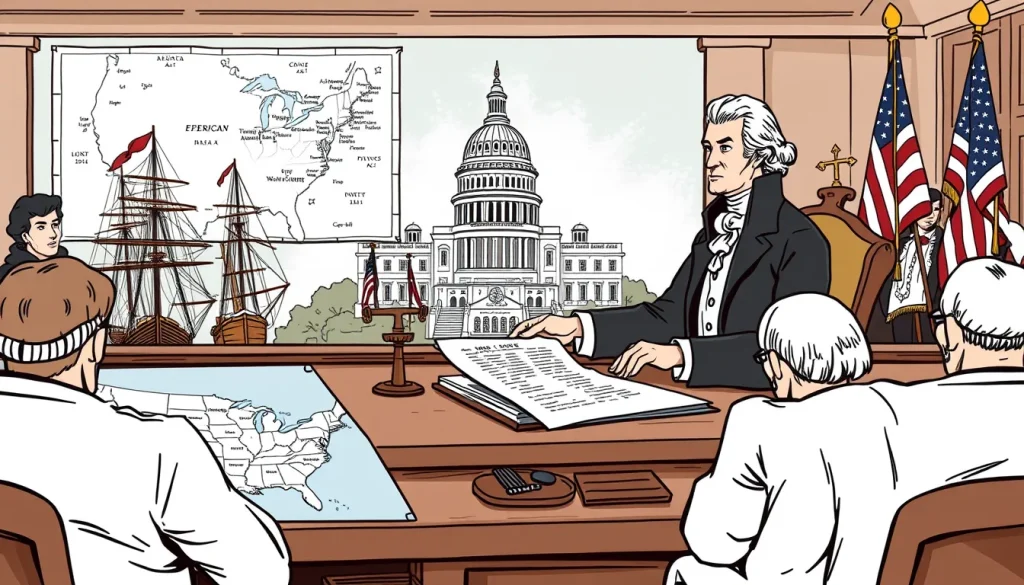
The Embargo Act of 1807 was a United States law, enacted on December 22, 1807, that prohibited American ships from departing for foreign ports, effectively halting U.S. export trade. President Thomas Jefferson imposed it in response to British and French harassment of American merchant shipping during the Napoleonic Wars, including British impressment of American sailors and the Chesapeake–Leopard affair. Jefferson hoped economic coercion would force the belligerents to respect American neutrality without resorting to war, but the embargo instead caused severe domestic economic distress and contributed to the tensions that culminated in the War of 1812.
Historical Context
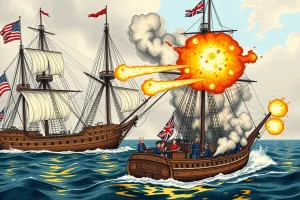
The Napoleonic Wars (1803–1815) between Britain and France created a diplomatic and economic crisis for the United States. Both belligerents sought to cut off the other’s trade with neutral nations. Britain issued Orders in Council (beginning in 1806 and expanded in November 1807) that blockaded European ports and required neutral ships to obtain licenses and pay duties if they traded with France or its allies. France retaliated with the Berlin Decree (1806) and Milan Decree (1807), declaring that any neutral vessel that complied with British regulations was subject to capture. American merchant ships, caught between these rival decrees, risked seizure by either side. Adding to the injury, the Royal Navy enforced its policy of impressment—stopping American ships to search for British deserters and often taking American citizens into naval service. The practice peaked during this period; an estimated 10,000 men were impressed from American ships, with only about 1,000 proven to be British subjects. The crisis escalated on June 22, 1807, when HMS Leopard fired on the American frigate USS Chesapeake off Norfolk, Virginia, killing three and wounding eighteen sailors, after the American captain refused to allow a search for deserters. The Chesapeake Affair inflamed American public opinion and brought the two nations to the brink of war.
What Happened
Jefferson faced a decision after the Chesapeake Affair. He had reduced the military to control spending and feared war would crush his republican program and lead to an expensive standing army. Instead, he proposed an economic embargo. In a message to Congress on December 17, 1807, Jefferson recommended “an inhibition of the departure of our vessels from the ports of the United States” to protect American ships, sailors, and merchandise. Congress passed the Embargo Act on December 22, 1807, barring American ships from clearing for foreign ports and prohibiting the export of goods on land or sea. The initial act had few enforcement provisions, and smuggling soon became endemic, especially along the Canadian border and in New England coastal communities. Jefferson issued a proclamation on April 19, 1808, ordering military action against smugglers after receiving reports of armed resistance on Lake Champlain. Congress then passed supplementary enforcement acts in 1808 and early 1809, but evasion and domestic opposition grew. The embargo collapsed under its economic weight. American exports fell from $108 million in 1807 to $22 million in 1808, and imports declined by more than half. Port cities suffered widespread unemployment and bankruptcy. New England, which depended heavily on maritime trade, became the center of resistance, with Federalists denouncing the embargo as a violation of states’ rights and a favor to France. On March 1, 1809, Congress replaced the embargo with the Non-Intercourse Act, which reopened trade with all nations except Britain and France, and Jefferson’s successor James Madison inherited the unresolved disputes.
Why It Matters
The embargo was a defining moment in the early republic. It demonstrated the limitations of economic coercion as a tool of statecraft and exposed sharp regional and political divisions over the role of federal power. Its failure discredited Jeffersonian commercial diplomacy and pushed the United States toward the War of 1812. The embargo also stimulated, modestly, domestic manufacturing as import substitution, particularly in textiles and other goods previously imported from Britain. Historians have debated whether the embargo caused greater harm to Britain or the United States; most agree that it inflicted more self-inflicted damage. Douglas Irwin’s economic estimate places the welfare cost at about 5 percent of 1807 gross national product, a severe shock. The embargo set a precedent for later American economic sanctions and highlighted the tension between avoiding war and defending national honor, a debate that remained central to American foreign policy.
Definition
The Embargo Act of 1807 was a federal law that prohibited the departure of American ships from U.S. ports to any foreign destination. It was not a universal prohibition on all trade, but it effectively barred exports because American vessels made up the vast majority of U.S. shipping. The law allowed the president to enforce it through customs officials, and later acts placed bonds on vessels, restricted coastal trade, and authorized military force against smugglers. The embargo aimed to keep American ships and cargoes safe from seizure and to pressure Britain and France to lift their restrictions on neutral trade.
Background
Jefferson’s decision grew from a long string of grievances. Since the early 1800s, the United States had protested British seizures of ships and cargoes under the Rule of 1756 and the Essex decision, and French privateers had also preyed on American commerce. Diplomatic efforts had failed: the Monroe–Pinkney Treaty of 1806, which avoided any mention of impressment, was rejected by Jefferson without submission to the Senate, because it lacked a clause ending the practice. The Non-Importation Act of April 1806, which barred importation of selected British goods, was postponed and never effectively enforced. The Chesapeake Affair of June 1807 brought the crisis to a head, with Jefferson noting that the country had not been so exasperated since the Battle of Lexington. He believed war could be avoided only by removing American ships from the ocean, thereby denying the belligerents the ability to seize them and also denying them American goods. Jefferson and Secretary of State James Madison calculated that Britain, as an industrial power, depended heavily on American raw materials and food, while France was already subject to British blockade. They expected the embargo to coerce Britain especially, but they misjudged the adaptability of the European economies and the resolve of the British government.
How It Worked
The Embargo Act was passed quickly with minimal debate. It prohibited vessels in American ports from clearing for foreign ports and banned the export of merchandise by land or sea. Coastal trade was exempted, but regulations were tightened repeatedly. Treasury Secretary Albert Gallatin warned Jefferser that enforcement would be difficult, and he immediately faced challenges. Smuggling along the Canadian border, particularly on Lake Champlain and the St. Lawrence River, flourished. In April 1808, Jefferson issued a proclamation describing “combinations” on Lake Champlain that were forming insurrections and obstructing the laws; he ordered civil and military officers to suppress them. Congress then passed the first supplementary enforcement act (April 25, 1808), which required bonds for coastal vessels, and later acts in January and March 1809 increased penalties and allowed the seizure of goods suspected of being destined for export. Despite these measures, the embargo’s effectiveness was limited. Federalists in the Northeast evaded it, and even some Republicans in commercial states opposed it. The law reduced official trade dramatically, but it also created a large smuggling economy. The embargo’s domestic costs were immediate: agricultural prices fell, shipyards closed, and unemployment rose in port cities. By early 1809, opposition had grown so intense that Congress voted to replace the embargo with a more limited measure.
Competing Viewpoints
Jefferson and his supporters defended the embargo as a principled alternative to war. They argued that it would protect American lives and property, uphold neutral rights, and demonstrate that the United States could resist British depredations without armed conflict. Jefferson also saw the embargo as a way to avoid the massive debts and standing armies he believed threatened republicanism. Critics, especially Federalists from New England, condemned the embargo as unconstitutional, tyrannical, and biased toward France. They asserted that it destroyed American commerce while having little effect on Britain, which could turn to other suppliers and Latin American markets. Some merchants defied the law, arguing that trade was a natural right and that the government had no authority to prohibit it. Abroad, the embargo was met with indifference; Britain and France continued their policies, and neither altered its maritime rules. Historians have generally agreed that the embargo failed as a coercive tool, though some, like Jeffrey Frankel, have argued that it did inflict meaningful damage on Britain’s economy by cutting off vital grain and cotton supplies, especially in 1808 when Britain had a poor harvest. But that damage was outweighed by the costs to the United States, which lost revenue, prestige, and internal unity.
Role in the War of 1812
The embargo’s failure hardened American frustrations and set the stage for the War of 1812. After its repeal, the Non-Intercourse Act attempted to target Britain and France, but it too was ineffective. The impressment issue remained unresolved, and British Orders in Council were not revoked until just before the war. In 1811, the War Hawks, a new Congressional faction, argued that economic sanctions had failed and only war could vindicate American rights. When President Madison asked for a declaration of war in June 1812, he cited impressment, the Orders in Council, and the British interference with American commerce as principal causes. The embargo also shaped the political landscape: sections of the eastern seaboard that suffered most later opposed the war, while western and southern states, less affected economically, were more willing to resort to arms. The embargo’s legacy included a precedent for using economic sanctions, the erosion of Jefferson’s popularity, and a demonstration that the United States could not defend its neutral trade without a formidable navy and army, lessons that influenced postwar military policy.
Consequences and Historical Interpretation
The immediate consequence of the embargo was economic depression. The drop in exports damaged agriculture, shipping, and the mercantile community. The long-term effects included the growth of domestic manufacturing in New England, a shift in patterns of trade, and a deepening of the sectional divide between the maritime Northeast and the agricultural South and West. Historical interpretation has swung over time. Early 19th-century Federalist historians dismissed the embargo as Jefferson’s naive pacifism, while later progressive historians saw it as a rational attempt to avoid war. Modern economic historians, using trade data and models, have quantified the costs and have refined the analysis of its effectiveness. Most scholars now agree that the embargo was a coherent but unrealistic policy that misjudged both the belligerents’ needs and the capacity of American merchants to comply voluntarily. Some, like Frankel, argue that it did hurt Britain more than is often claimed, but this remains a minority view. The embargo remains relevant as a case study in economic statecraft, illustrating the difficulty of using trade pressure to change the behavior of powerful adversaries.
Primary Sources
The most important primary source is Thomas Jefferson’s message to Congress of December 18, 1807, which recommended the embargo. It is printed in the Annals of Congress, 10th Congress, 1st session, pages 49–50, and available online from the Library of Congress. In it, Jefferson refers to the “great and increasing dangers with which our vessels, our seamen and merchandise are threatened” and recommends an “inhibition of the departure of our vessels.” Another key document is Jefferson’s proclamation of April 19, 1808, which is available on Founders Online from the National Archives. This proclamation describes armed resistance to the embargo on Lake Champlain and orders “all officers having authority civil or military” to suppress insurrections. The Embargo Act itself, enacted December 22, 1807, is printed in the U.S. Statutes at Large, vol. 2, page 451. Letters between Jefferson and Albert Gallatin provide insight into enforcement challenges and debates. Each source must be read with its bias in mind: Jefferson’s message presents the embargo as protective, while the proclamation casts smugglers as insurrectionists, and Federalist newspapers offer an opposing view.
Further Reading
- Louis Martin Sears, Jefferson and the Embargo (Duke University Press, 1927).
- Bradford Perkins, Prologue to War: England and the United States, 1805–1812 (University of California Press, 1961).
- Douglas A. Irwin, “The Welfare Cost of Autarky: Evidence from the Jeffersonian Trade Embargo, 1807–09,” Review of International Economics 13, no. 4 (2005): 631–645.
- Jeffrey A. Frankel, “The 1807–1809 Embargo Against Great Britain,” Journal of Economic History 42, no. 2 (1982): 291–308.
- Donald R. Hickey, The War of 1812: A Forgotten Conflict (University of Illinois Press, 1989).
References
- Britannica, The Editors of Encyclopaedia, “Embargo Act,” Encyclopaedia Britannica, accessed July 2026, https://www.britannica.com/topic/Embargo-Act.
- Monticello, “Embargo Act of 1807,” accessed July 2026, https://www.monticello.org/encyclopedia/embargo-1807.
- Teaching American History, “The Embargo Act,” accessed July 2026, https://teachingamericanhistory.org/document/the-embargo-act/.
- Jeffrey A. Frankel, “The 1807–1809 Embargo Against Great Britain,” Journal of Economic History 42, no. 2 (1982): 291–308, https://doi.org/10.1017/S0022050700027443.
- James J. Tennant, “Jefferson’s Embargo Act (1807-1809),” Encyclopedia of Economic Statecraft, accessed July 2026, https://jamesjtennant.com/entries/jeffersons-embargo-act-1807-1809/.
- Annals of Congress, 10th Congress, 1st session, 49–50, Library of Congress, https://memory.loc.gov/ammem/amlaw/lwac.html.
FAQ
Why did Jefferson choose an embargo instead of war?
Jefferson believed war would lead to large debts, a powerful standing army, and the loss of republican values. He thought economic pressure could protect American interests while avoiding the costs and risks of armed conflict.
Did the embargo succeed?
No. It failed to compel Britain or France to change their policies. It inflicted severe economic hardship on the United States, especially in New England shipping communities, and was repealed in March 1809.
How did the embargo lead to the War of 1812?
The embargo's failure convinced many Americans that economic sanctions were ineffective, paving the way for calls for war to defend national honor. Impressment and trade restrictions remained unresolved, and President Madison eventually asked Congress for a declaration of war in 1812.

Leave a Reply