
Short Answer
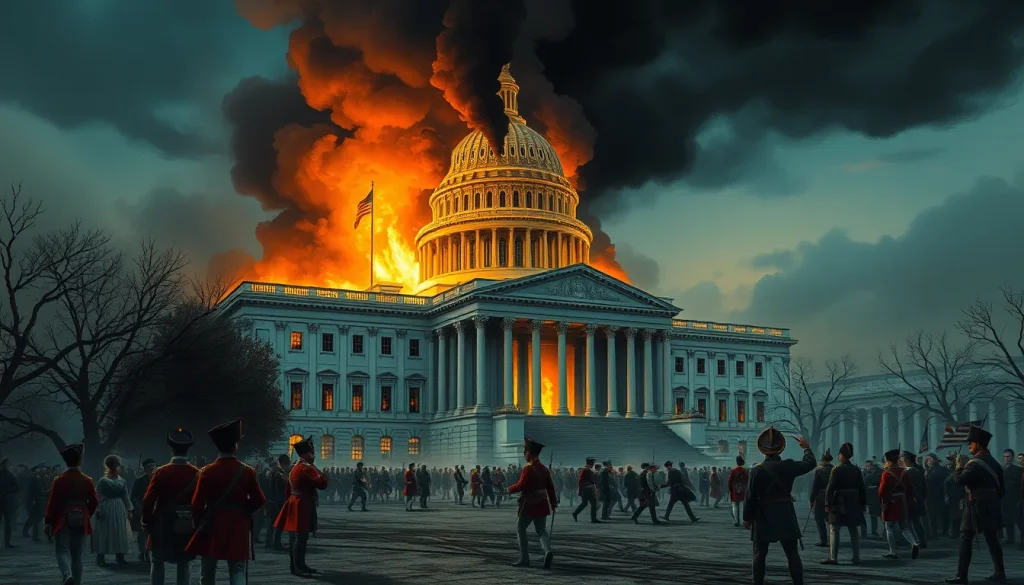
Yes, the U.S. Capitol was effectively destroyed by fire on August 24, 1814, during the War of 1812, when British forces under Major General Robert Ross and Rear Admiral George Cockburn entered Washington, D.C., and set the building ablaze. The Capitol suffered catastrophic damage—its chambers, roof, and interior were gutted—though the exterior stone walls and some columns survived. The attack was part of a larger British campaign in the Chesapeake Bay and was intended to retaliate against American destruction of public buildings in Upper Canada. Congress was forced to meet elsewhere while the structure was rebuilt over the following decades.
Historical Context
The War of 1812, fought between the United States and the United Kingdom from June 1812 to February 1815, arose from unresolved issues including British impressment of American sailors, trade restrictions, and British support for Indigenous peoples resisting American expansion. The United States also harbored ambitions of annexing Canada. By 1814, the war had reached a stalemate on the northern frontier, and British forces, having defeated Napoleon in Europe earlier that year, turned their attention to the United States. As part of a diversionary strategy, a British naval and military expedition under Admiral Sir Alexander Cochrane sailed into the Chesapeake Bay in August 1814. British commanders chose to attack Washington, the symbolic and political center of the Republic, believing that a strike on the capital would demoralize the American public and force a favorable peace.
What Happened
On August 19, 1814, British troops landed at Benedict, Maryland, and advanced toward Washington. They defeated American militia at the Battle of Bladensburg on August 24, opening the road to the capital. That evening, British forces entered Washington. Led by General Ross, they arrived at the Capitol around sunset. Setting fire to both wings of the building—the north wing housing the Senate and the south wing containing the House of Representatives—British soldiers used combustible materials to ignite the structure. The fire consumed the interiors, including the Library of Congress housed in the Capitol. The flames were so intense that they lit the sky, as noted by eyewitnesses. The following day, August 25, the British also burned the President’s House (now the White House), the Treasury building, and other public structures. A powerful thunderstorm that evening extinguished the fires, but the damage was done. George Munger’s watercolor, created shortly after, shows the Capitol’s roofless shell, with the Senate and House wings reduced to burned-out walls, the central rotunda lacking its roof, and the House colonnade propped with timber to prevent collapse.
Why It Matters
The burning of the Capitol was a severe symbolic and practical blow to the young American republic. It demonstrated the vulnerability of the national government to invasion and humiliated the Madison administration. Congress, which had been in recess, could not reconvene in its building; it met in Blodgett’s Hotel, the only suitable structure left in Washington. In the months that followed, Congress debated whether to relocate the capital or to remain and rebuild. Ultimately, it chose to stay, and the Capitol was reconstructed, with the original chambers restored and expanded. The event also influenced American memory of the war, often framed as a low point redeemed by later victories such as the Battle of New Orleans. Historians view the destruction of the Capitol as a pivotal episode that forced the United States to reinforce its national identity and invest in rebuilding its public architecture as a testament to resilience.
Definition
The burning of the U.S. Capitol on August 24, 1814, refers to the deliberate destruction by British forces of the seat of the U.S. Congress during the War of 1812. The term “destroyed” in this context means that the building was rendered unusable and largely gutted by fire, though parts of its structural shell remained. The Capitol was not reduced to a heap of rubble, but its interior and roof were entirely lost, and the building had to be rebuilt.
Background
The Capitol was still unfinished in 1814. The north wing (Senate) and south wing (House) had been completed and used since 1800, while the central rotunda and connecting structure were under construction. The attack occurred as part of a British expedition aimed at the Chesapeake Bay, chosen because of its proximity to Washington and its symbolic value.
How It Worked
The destruction was a military operation carried out by British soldiers and sailors under orders from General Ross and Rear Admiral Cockburn. They methodically set fires within the building, using flammable materials such as gunpowder paste and torches to ignite the wooden interiors. Eyewitness reports describe the flames quickly engulfing the chambers. The following day, a hurricane-force rainstorm helped extinguish remaining fires, but not before the interior was completely gutted.
Competing Viewpoints
Historians have debated the extent to which the destruction was a deliberate retaliation for American actions in Upper Canada, particularly the burning of York (now Toronto) in 1813. British commanders justified the attack as proportionate and justified under the laws of war, while American contemporaries denounced it as vandalism and a violation of civilized conflict. Some modern historians emphasize the strategic aim of breaking American morale, rather than narrow retaliation. The varying interpretations depend on how one weighs immediate military objectives versus broader wartime conduct.
Role in the War of 1812
The burning of the Capitol intensified American war resolve and stiffened public opinion against Britain. It also led to a Congressional investigation into the failure to defend Washington. In military terms, it did not decisively alter the war’s outcome; the Treaty of Ghent, signed on December 24, 1814, largely restored the status quo ante bellum. The destruction nonetheless became a rallying point and highlighted the United States’ determination to persevere despite a devastating setback.
Consequences and Historical Interpretation
Immediately after the fire, Congress temporarily met at Blodgett’s Hotel. In 1815, Congress voted to rebuild and expand the Capitol, employing architects Benjamin Henry Latrobe and later Charles Bulfinch. Reconstruction continued for years, with the Senate and House chambers reopened in 1819 and 1857 respectively. Historical interpretation has evolved: early American accounts cast the event as an outrage, later British histories emphasized military necessity, and modern scholars treat it as an important example of wartime destruction of national symbols. The burning remains a central episode in the War of 1812’s memory, often commemorated in art and on the occasion of the Capitol’s 200th anniversary.
Primary Sources
Contemporary records include British military correspondence, American eyewitness accounts, and visual documentation. Notably, artist George Munger created a watercolor of the Capitol in ruins, now held by the Library of Congress. U.S. Senator and Congressman accounts, such as the letters of Representative Abijah Bigelow, provide personal reactions. Official reports include General Ross’s dispatch to Admiral Cochrane and the American court of inquiry. These sources vary in bias: British accounts emphasize military orders and discipline, while American accounts portray the event as a shock and violation.
Further Reading
- Anthony S. Pitch, The Burning of Washington: The British Invasion of 1814 (1998).
- Donald R. Hickey, The War of 1812: A Forgotten Conflict (1989).
- R. B. Mowat, The Diplomatic Relations of Great Britain and the United States (1925).
- U.S. Capitol Historical Society, “The War of 1812: Congress and the Capitol in 1814.”
- National Archives, “The Capitol in Flames” exhibit.
References
- U.S. Senate, “A Capitol in Ruins,” https://www.senate.gov/about/historic-buildings-spaces/capitol/capitol-ruins.htm.
- National Archives, “The War of 1812: The Capitol in Flames,” https://www.archives.gov/exhibits/treasures_of_congress/text/page8_text.html.
- Library of Congress, “[U.S. Capitol after burning by the British],” https://www.loc.gov/item/2004662324/.
- U.S. Capitol Visitor Center, “The U.S. Capitol after Burning by the British,” https://www.visitthecapitol.gov/artifact/us-capitol-after-burning-british-george-munger-ca-1814-0.
- U.S. Capitol Historical Society, “The War of 1812: Congress and the Capitol in 1814,” https://capitolhistory.org/explore/historical-articles/war-1812-congress-capitol-1814/.
FAQ
Was the U.S. Capitol completely destroyed in 1814?
No, the building's exterior walls and some columns survived, but the interior, roof, and both congressional chambers were devastated by fire. The structure was later rebuilt and expanded.
Why did the British burn the U.S. Capitol?
The British targeted Washington as a diversion to draw American forces away from other fronts and to retaliate for American destruction of public buildings in York (Toronto) in 1813.
Where did Congress meet after the Capitol was burned?
Congress convened at Blodgett's Hotel, which housed the Patent Office, beginning on September 19, 1814, until temporary quarters were arranged.



Leave a Reply