
Short Answer
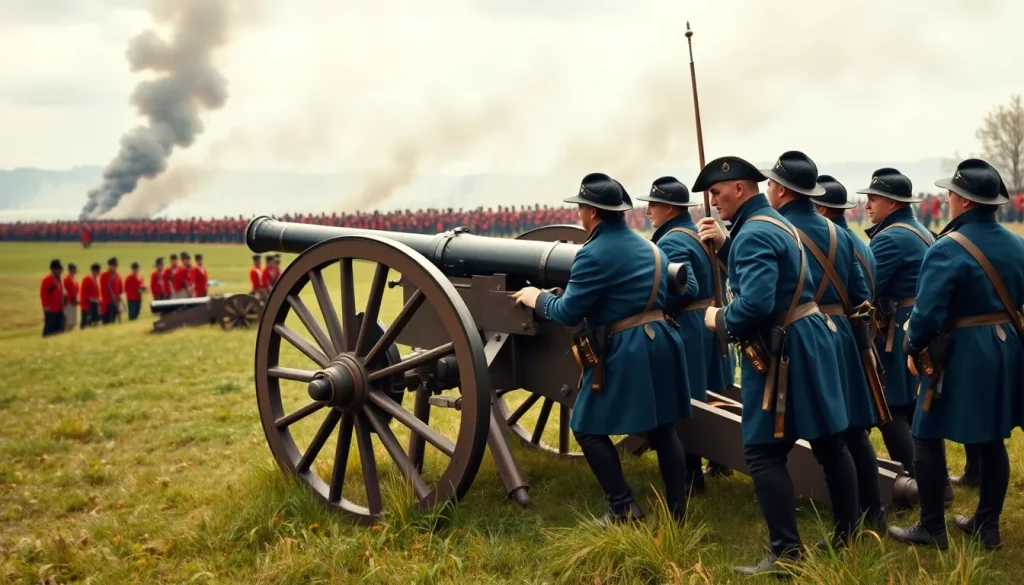
Artillery played a crucial role in the War of 1812, shaping battles, sieges, and naval engagements across the North American continent. Both British and American forces relied on a variety of cannon, howitzers, and mortars, and the conflict tested their effectiveness in diverse terrain. This article examines how artillery was organized, equipped, and tactically deployed during the war, highlighting its achievements, limitations, and long-term influence.
Historical Context
At the dawn of the nineteenth century, artillery had evolved into a highly specialized branch of European armies. The British Royal Artillery, battle-hardened by the Napoleonic Wars, brought professional expertise and advanced tactics to the Canadian theatre. The United States Army, though smaller, had invested in a technically educated officer corps, with many West Point graduates serving in the artillery. Both nations used smoothbore muzzle-loading weapons that fired solid shot, explosive shells, and anti-personnel canister. The war took place across a vast and varied landscape, from the Great Lakes to the Gulf Coast, which influenced how artillery could be brought to bear. Supply lines, road networks, and naval control of waterways often decided whether artillery could be transported to where it was needed.
What Happened
Artillery was employed in nearly every major campaign of the War of 1812. On the Niagara frontier, American and British batteries exchanged fire at the battles of Chippewa and Lundy’s Lane, where field guns maneuvered to support infantry. During the siege of Fort Erie in 1814, both sides used heavy artillery in close-range bombardments. The most famous artillery action was the defense of Fort McHenry in September 1814, where a force of about 90 American artillerists under Captain Frederick Evans withstood a massive British naval bombardment of bombs, rockets, and round shot. Along the Great Lakes, naval gunfire and shore batteries contested control of key routes, as in the Battle of Lake Erie. In the Atlantic and Gulf campaigns, coast artillery and naval guns played decisive roles in operations such as the British attack on Washington and the defense of New Orleans. The war also saw the use of experimental weapons, most notably the Congreve rocket, which the British employed at Fort McHenry and other actions.
Why It Matters
The War of 1812 revealed both the power and the limitations of artillery in early nineteenth-century warfare. American regular artillery units, well-led and drilled, often proved the most effective component of the army, capable of rapid fire and tactical flexibility. However, the conflict also demonstrated that artillery required open ground, trained crews, and robust logistics to be truly decisive; in the dense forests and broken terrain of the upper border, artillery sometimes had limited impact. The war prompted both nations to modernize their artillery branches, leading to innovations in gun design, organization, and tactics that would influence later conflicts. The use of rockets and shrapnel at Fort McHenry foreshadowed new technologies, while the heroism of the American gunners contributed to the national memory and the creation of “The Star-Spangled Banner.” Historians debate whether artillery ever proved decisive in the war, but its presence shaped every major engagement.
Definition
In the War of 1812, “artillery” referred to large-caliber firearms that used gunpowder to propel projectiles. The main types were guns, howitzers, and mortars. Guns fired on a relatively flat trajectory at high velocity, intended for direct fire against infantry or fortifications. Howitzers, with shorter barrels, lobbed shells at higher angles for short-range targets. Mortars, employed mainly in sieges, fired at even higher trajectories. Field artillery denoted mobile pieces designed to accompany field armies, while garrison and naval artillery were heavier and mounted in forts or ships.
Background
Artillery had been a staple of European warfare since the fifteenth century, but by the 1700s, lighter and more maneuverable field pieces were developed. France’s Gribeauval system standardized carriages and calibers, and both Britain and the United States adopted similar designs. At the outbreak of the War of 1812, the British Royal Artillery used the 6-pounder and 9-pounder guns as its primary field pieces, along with the 5.5-inch howitzer. The United States, lacking a large standing army, relied on a mix of iron and bronze guns; American iron pieces were heavier but more durable than British brass. Both nations used the same caliber system, so ammunition was interchangeable.
How It Worked
Field artillery operated through a coordinated crew of six to eight men. Loaders inserted a powder charge and a projectile, while the gunner adjusted elevation and aiming. Common projectiles included solid roundshot, which was effective for long-range fire against massed formations, and canister or grapeshot, which acted like a giant shotgun at short ranges. Explosive shells, including the British-invented spherical case shot (shrapnel), added a lethal fragmentation effect. The standard 6-pounder field gun could fire four to six aimed shots per minute in a well-trained unit. Artillery was positioned to support infantry, often on flanks or in batteries, and could be used for counter-battery fire. In sieges, heavier guns and mortars were placed in parallel trenches to batter fortifications. Naval artillery followed similar principles, with guns mounted on ships’ broadsides to fire on enemy vessels or shore installations.
Competing Viewpoints
Historians differ on the effectiveness of artillery during the War of 1812. Donald E. Graves, a leading scholar, argues that American regular artillery units were the best soldiers in the army, delivering superb service despite being frequently understrength. He notes that at battles like Chippewa and Lundy’s Lane, artillery played a crucial role, but also that the wooded, broken terrain of the northern border often prevented artillery from being fully utilized. Other historians emphasize the importance of British naval artillery, particularly the bombardment at Fort McHenry, which, though ineffective, demonstrated the reach and psychological impact of naval bombardment. Some scholars downplay artillery’s overall significance, pointing to untrained militia gunners and the difficulty of moving heavy guns in the wilderness. These debates center on whether artillery was a decisive arm or merely a supporting component in the conflict.
Role in the War of 1812
Artillery played a central role in many pivotal actions. At the Battle of Lundy’s Lane (July 25, 1814), American and British artillery exchanged intense fire on a hilltop near Niagara Falls, with both sides capturing and recapturing batteries. At Fort McHenry, Captain Evans’s company of the Corps of Artillery manned 24-pounder guns and prevented the British fleet from entering Baltimore harbor, enduring a 25-hour bombardment that included Congreve rockets. The American siege of Fort Erie in 1814 relied on heavy 18-pounder and 24-pounder guns to reduce British positions. On the Great Lakes, naval artillery was decisive in the Battle of Lake Erie (September 10, 1813), where American ships hammered British vessels with carronades and long guns. In the Gulf, Andrew Jackson’s forces used a mix of field and fortress guns at the Battle of New Orleans, where American artillery on the west bank of the Mississippi helped repel the British assault.
Consequences and Historical Interpretation
The war left a lasting imprint on artillery development. The United States reorganized its artillery branch, creating the Light Artillery Regiment and improving training. British artillery, already experienced, continued technological innovations. The conflict showed that artillery was most effective in open terrain with well-drilled crews, and that rockets and new explosive shells, while unreliable, pointed toward future trends. Post-war historians have evaluated the War of 1812 as a transitional period: artillery tactics had not yet reached the sophistication of the later nineteenth century, but the foundation for modern field artillery was being laid. The performance of American regular gunners, often the backbone of their army, was a bright spot in an otherwise uneven conflict, and their legacy influenced the military reforms that followed.
Primary Sources
Important primary sources include the official after-action report of Major George Armistead, commanding the garrison at Fort McHenry, which detailed the bombardment and the effectiveness of the American artillery. The poem “Defence of Fort M’Henry” by Francis Scott Key, written in September 1814, provides a eyewitness account of the “rockets’ red glare” and “bombs bursting in air.” Donald Graves’s article on field artillery, which quotes contemporary manuals and officers, is a valuable synthesis. The letters and memoirs of officers such as Winfield Scott, who began his career in the artillery, offer insight into training and operations. The Royal Artillery records in British archives contain ordnance returns and tactical notes. These sources, however, carry biases: official reports often inflated achievements, while personal accounts reflect individual perspectives and memory.
Further Reading
- Donald E. Graves, “Field Artillery of the War of 1812: Equipment, Organization, Tactics and Effectiveness,” Arms Collecting, Vol. 30, No. 2 (May 1992).
- Donald R. Hickey, The War of 1812: A Forgotten Conflict, bicentennial edition (University of Illinois Press, 2012).
- Boyd L. Dastrup, King of Battle: A Branch History of the U.S. Army’s Field Artillery (United States Army Training and Doctrine Command, 1992).
- Janice E. McKenney, Reorganizing the Arm: The Organizational History of Field Artillery 1775-2003 (Center of Military History, 2007).
References
- Donald E. Graves, “Field Artillery of the War of 1812: Equipment, Organization, Tactics and Effectiveness,” Arms Collecting 30, no. 2 (May 1992), https://www.napoleon-series.org/military-info/Warof1812/2009/Issue12/c_Artillery.html.
- National Park Service, “Corps of Artillery,” Fort McHenry National Monument and Historic Shrine, https://home.nps.gov/fomc/learn/historyculture/corps-of-artillery.htm.
- “Field Artillery and the New Nation: 1784-1815,” Combined Arms Research Library, https://cgsc.contentdm.oclc.org/customizations/collection/p15766coll2/pages/New%20Nation/index.html.
- “Artillery Across Three Wars,” American Battlefield Trust, https://www.battlefields.org/learn/articles/artillery-across-three-wars.
- Donald E. Graves, “For want of this precaution… Official, Semi-Official and Unofficial American Artillery Texts, 1775-1815 Part 10,” The War of 1812 Magazine, Issue 15 (May 2011), https://www.napoleon-series.org/military-info/Warof1812/2011/Issue15/c_Artillery10.html.
FAQ
What types of artillery were most common in the War of 1812?
The 6-pounder field gun and 5.5-inch howitzer were the most common field pieces for both British and American forces. Heavier 12-pounder and 24-pounder guns were used in sieges and fortifications.
How did artillery influence the Battle of Fort McHenry?
American gunners at Fort McHenry used 24-pounder cannons to return fire against the British fleet. The British bombardment included Congreve rockets, but the fort's defenses held, and the surviving American flag inspired Francis Scott Key's poem.
Was artillery effective in the War of 1812?
Artillery proved effective in open terrain and with well-trained crews, as seen at Lundy's Lane and New Orleans. However, in rugged or wooded areas, its mobility and impact were limited, leading historians to debate its overall decisiveness.



Leave a Reply