
Short Answer
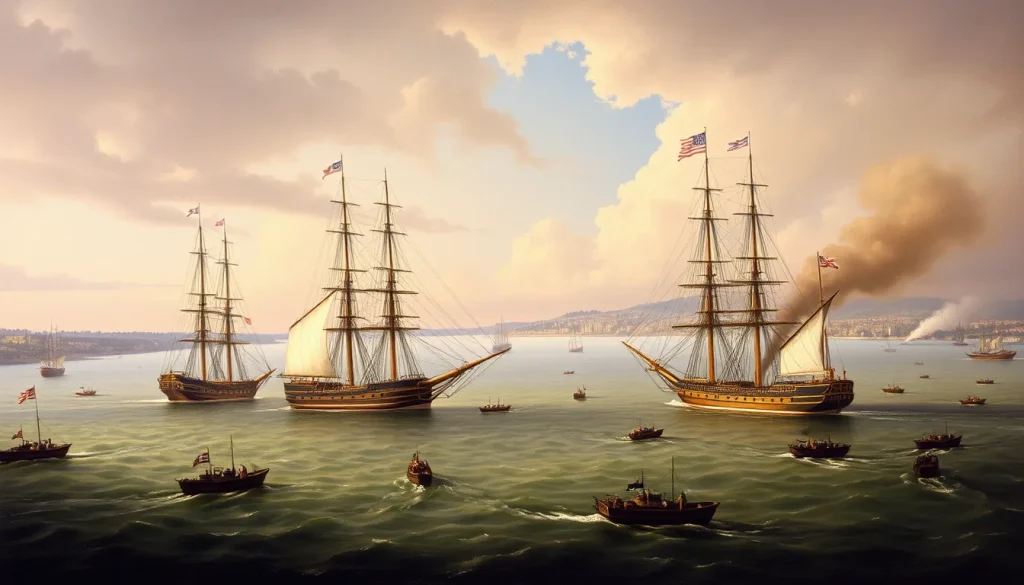
Plattsburgh, New York, situated on the northwestern shore of Lake Champlain, was the focal point of the final British invasion of the northern United States during the War of 1812. In September 1814, a combined British Army and naval squadron converged on the town, leading to the Battle of Plattsburgh (also known as the Battle of Lake Champlain) on 11 September 1814. The American victory there not only repelled the invasion but also influenced the peace negotiations then underway at Ghent.
Historical Context
When the United States declared war on Great Britain in June 1812, the conflict stemmed from British maritime practices—including impressment and restrictions on neutral trade—and from tensions on the western frontier where British support for Indigenous nations conflicted with American expansion. For the first two years, the war was largely stalemated along the Canadian border, with both sides launching raids and counter-raids. By 1814, with Napoleon’s abdication in April, Britain was able to transfer veteran troops from Europe to North America. The British planned a series of offensives along the American coast and the Canadian frontier, with the main effort aimed at invading New York via Lake Champlain. The lake provided a natural invasion route from Canada into the northern United States, and control of it would sever New England from the rest of the country politically and militarily. The British high command sought to capture territory to use as bargaining chips in the peace negotiations that were expected to begin soon.
What Happened
In September 1814, a British army of about 11,000 men under Lieutenant-General Sir George Prevost, Governor-in-Chief of Canada, advanced south along the Richelieu River and into New York. The force included seasoned Peninsular War veterans, along with Canadian regulars and militia. Prevost’s objective was Plattsburgh, which was defended by a scratch American force of about 1,700 regulars, 700 New York militia, and roughly 2,500 Vermont militiamen under Brigadier-General Alexander Macomb. The American naval squadron on Lake Champlain, commanded by Master Commandant Thomas Macdonough, consisted of one corvette, one brig, one schooner, one sloop, and ten gunboats, positioned in Plattsburgh Bay.
British naval support came from a squadron under Captain George Downie, which had been newly built at Isle aux Noix. Both armies skirmished along the Saranac River from 6 to 10 September. On the morning of 11 September, Downie’s flagship HMS Confiance attacked Macdonough’s fleet in Plattsburgh Bay. The close-quarters naval battle lasted over two hours. Macdonough used a clever anchoring technique, allowing his ships to swing on their cables to bring fresh broadsides to bear. Downie was killed early in the action. The British squadron was crippled, and the Confiance surrendered. With the loss of naval superiority, Prevost, who had been waiting to coordinate with Downie, cancelled the planned land assault and ordered a retreat back to Canada. The British retreat was conducted in good order, but many officers believed the attack should have been pressed regardless.
Why It Matters
The American victory at Plattsburgh had immediate strategic consequences. It ended the last major British invasion of the northern United States and prevented the British from gaining a foothold in New York. More importantly, the battle influenced the ongoing peace negotiations at Ghent. At the time, British negotiators had hoped to claim territory they occupied under the principle of uti possidetis, but the defeats at Plattsburgh and Baltimore stripped them of that leverage. The Treaty of Ghent, signed on 24 December 1814, restored the status quo ante bellum. While the war officially ended in a return to pre-war boundaries, the battle is remembered as a crucial American defensive triumph. Historians have noted that both sides had already been war-weary, and the outcome at Plattsburgh helped solidify a stalemate that led to the treaty.
Historical Map Context
Lake Champlain stretches about 125 miles north to south, connecting to the Richelieu River, which flows into the Saint Lawrence River. The lake formed a natural highway between Canada and the Hudson River valley. Plattsburgh sits at the northwestern corner of the lake, just south of the Canadian border. The Saranac River flows into the lake at Plattsburgh, providing a defensive line for the town. In 1814, control of the lake was essential for supply and communication; whichever navy ruled Lake Champlain could dominate the region.
Modern Location
Plattsburgh is a city in Clinton County, New York, on the western shore of Lake Champlain. It is about 60 miles south of Montreal and today lies just off Interstate 87, the Northway. The town’s historic district retains many buildings from the early nineteenth century. The site of the battle is commemorated by several monuments and a museum. Nearby Crab Island, where a military hospital operated during the battle, is accessible by boat.
Events at the Site
During the War of 1812, Plattsburgh served as a staging area for American forces on the northern frontier. The town was temporarily occupied by American troops under Major-General Wade Hampton in 1813 and later fortified by Macomb’s command in 1814. The British invasion in September 1814 brought large numbers of soldiers to the area; skirmishes occurred along the Saranac River. The decisive battle took place both on the water in Plattsburgh Bay and on land around the town. After the battle, the British retreated northward, leaving Plattsburgh in American hands. The town also became a base for the American fleet and a depot for supplies.
Associated People
Key figures associated with Plattsburgh during the War of 1812 include Master Commandant Thomas Macdonough, commander of the American naval squadron; Brigadier-General Alexander Macomb, commander of the American land forces; Lieutenant-General Sir George Prevost, the British governor and commander; and Captain George Downie, the British naval commander who was killed in action. Other notable participants include American officers such as Robert Henley and the commanders of the British brigades, Major-Generals Frederick Philipse Robinson, Thomas Brisbane, and Manley Power.
Surviving Monuments and Site
Today, the War of 1812 Museum in Plattsburgh interprets the battle and the region’s wartime experience. Operated by the Battle of Plattsburgh Association, the museum is located on the grounds of the former Plattsburgh Barracks. Exhibits include a large diorama of the battle, ship models, paintings, and artifacts recovered from the lake. The Soldiers and Sailors Monument on Crab Island marks the mass grave of over 150 American and British combatants. The battlefield itself is partly preserved within the city, and interpretive plaques mark key locations. The State of New York has recognized the site for its historical significance, and the museum is open to the public.
Primary Sources
Contemporary accounts of the Battle of Plattsburgh survive in official reports and personal letters. Thomas Macdonough’s after-action report to Secretary of the Navy William Jones, dated 13 September 1814, describes the naval engagement and the condition of his squadron. Brigadier-General Alexander Macomb also filed a report on the land operations and the defense of Plattsburgh. On the British side, Lieutenant-General George Prevost’s dispatches to the Earl of Bathurst detail his decisions and the retreat. These documents are held in the U.S. National Archives and the British National Archives. A notable personal view is found in the journal of H.K. Averill, Sr., a local resident, which was later edited and published. While these sources are invaluable, they each reflect the perspectives and biases of their authors; Macdonough and Macomb emphasized American skill and courage, while Prevost sought to justify his cautious tactics.
Further Reading
- Herkalo, Keith. The Battles at Plattsburgh: September 11, 1814. The History Press, 2012.
- Lee, Wayne E. “Plattsburgh 1814: Warring for Bargaining Chips.” In Between War and Peace: How America Ends Its Wars, ed. Matthew Moten. Free Press, 2011.
- Ridler, Jason. “Battle of Plattsburgh.” The Canadian Encyclopedia, 2011 (revised 2026).
- “War of 1812 Gem.” Naval History Magazine 27, no. 2 (2013), U.S. Naval Institute.
References
- Ridler, Jason. “Battle of Plattsburgh.” The Canadian Encyclopedia, 2011 (updated 2026). https://thecanadianencyclopedia.ca/index.php/en/article/battle-of-plattsburgh
- Lee, Wayne E. “The Battles of Plattsburgh and Ending the War of 1812.” FPRI, 2012. https://www.files.ethz.ch/isn/170254/1704.201205.lee_.plattsburgh-ending-war-1812.pdf
- Caiella, James M. “War of 1812 Gem.” Naval History Magazine, Vol. 27, No. 2 (2013). https://www.usni.org/magazines/naval-history-magazine/2013/march/war-1812-gem
- Herkalo, Keith. “The Battle of Plattsburgh.” WCNY, n.d. https://www.wcny.org/education/war-of-1812/the-battle-of-plattsburgh/
FAQ
What was the significance of the Battle of Plattsburgh?
The American victory at Plattsburgh halted the last major British invasion of the northern United States and denied British negotiators territorial claims at the peace talks, contributing to the restoration of pre-war borders in the Treaty of Ghent.
Who commanded the American forces at Plattsburgh?
The American naval squadron was commanded by Master Commandant Thomas Macdonough, and the land forces by Brigadier-General Alexander Macomb.
Why did the British retreat after the naval defeat?
British Lieutenant-General George Prevost cancelled the land attack after the naval squadron was defeated at Plattsburgh Bay, believing that without control of the lake, any captured position would be impossible to supply.



Leave a Reply