
Short Answer
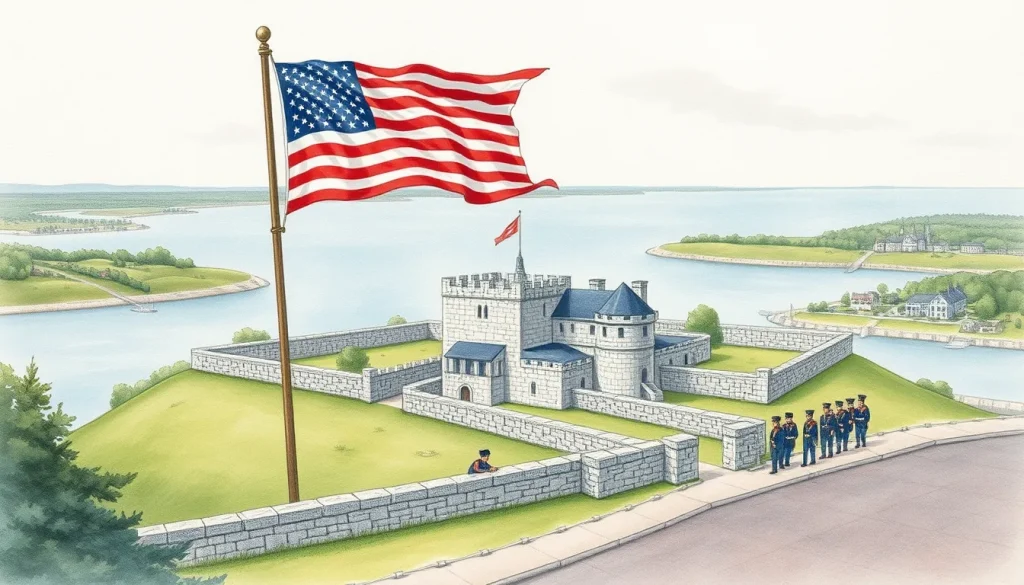
Fort Niagara, located at the mouth of the Niagara River on Lake Ontario, was a pivotal American stronghold during the War of 1812. From 1812 to 1813 it served as a base for American operations on the Niagara frontier and traded artillery fire with the British Fort George across the river. In December 1813 it was captured in a daring British night assault and remained under British control until the Treaty of Ghent restored it to the United States in 1815.
Historical Context
Fort Niagara had controlled access to the Great Lakes and the crucial portage around Niagara Falls since the French built a stone castle there in 1726–27. After changing hands during the French and Indian War and the American Revolution, the fort was transferred to the United States in 1796 following Jay’s Treaty. The British then erected Fort George on the opposite bank, creating a standing rivalry. When war broke out in 1812, the Niagara frontier became a primary invasion route between Upper Canada and the United States. Fort Niagara’s position at the river’s mouth made it the key to controlling both the lake and the land route along the Niagara River.
What Happened
During the opening months of the war, American forces at Fort Niagara, under the command of Captain Nathaniel Leonard, prepared for action. In October and November 1812, Fort Niagara and Fort George exchanged heavy artillery fire in a series of furious but indecisive bombardments. These cannonades caused damage on both sides but did not alter the strategic situation. On 27 May 1813, American troops launched a successful amphibious assault across the river and captured Fort George. Fort Niagara served as the staging area for this operation, providing troops and artillery support. However, after the American army failed to pursue the retreating British, the advantage was lost. By December, American forces had abandoned Fort George and, under orders from Brigadier General George McClure, burned the nearby town of Newark (present-day Niagara-on-the-Lake) on 10 December 1813, leaving hundreds of civilians homeless in midwinter.
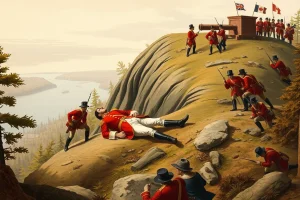
This destruction prompted British Major General Gordon Drummond to retaliate. On the night of 18–19 December 1813, a force of about 550 British regulars, Canadian militia, and Indigenous warriors, led by Colonel John Murray, crossed the Niagara River in boats and attacked Fort Niagara. Using the captured password, they surprised the garrison and overran the fort within twenty minutes. The American garrison of roughly 400 regulars and militia suffered 65 killed, 14 wounded, and about 340 captured; British losses were only 6 killed and 5 wounded. Captain Leonard was later court-martialed for negligence. The British held Fort Niagara for the remainder of the war, using it as a base for raids along the American shore, including burning Lewiston, Black Rock, and Buffalo. After the Treaty of Ghent (signed December 1814) was ratified in February 1815, the fort was returned to the United States.
Why It Matters
The capture of Fort Niagara was a turning point on the Niagara frontier. It eliminated the last American foothold on the Canadian side of the river and gave the British control over the entire Niagara River corridor. The cycle of destruction initiated by the burning of Newark and completed by the capture of Fort Niagara contributed to the broader pattern of retaliation that culminated in the British burning of Washington in August 1814. For the United States, the loss of the fort was a humiliating check on its northern invasion strategy, while for British and Canadian forces it was a vindication of their defensive posture. In historical memory, the fort’s capture is often cited as an example of the dangers of overextension and poor preparation, and it remains a significant episode in the shared heritage of the Niagara region.
Historical Map Context
Fort Niagara sat at the eastern end of Lake Ontario, where the Niagara River flows into the lake. It lay opposite Fort George, on the Canadian shore, which was constructed in 1796 after the British vacated Fort Niagara. The surrounding terrain included the Niagara Escarpment, the river’s mouth, and the important portage route around Niagara Falls to the south. Maps from the period depict the fort’s star-shaped earthworks and the nearby village of Youngstown (founded in 1811). The fort’s position commanded the main approach to the Niagara frontier from the east, and its capture deprived the Americans of a defensive bastion on their own soil.
Modern Location
Old Fort Niagara is located at 102 Morrow Plaza, Youngstown, New York, within Fort Niagara State Park. The site is operated by the Old Fort Niagara Association in cooperation with the New York State Office of Parks, Recreation and Historic Preservation. The original French Castle, built in 1726, still stands, along with later military buildings and earthworks. The fort is open as a museum and historic site, with interpretive displays covering its French, British, and American periods.
Events at the Site
During the War of 1812, Fort Niagara hosted a garrison of American regulars and militia. It was the assembly point for the invasion that captured Fort George in May 1813. In December 1813, it was the target of the successful British night assault. During the British occupation, the fort served as a base for raids on American territory, including the destruction of nearby towns. After the war, the fort returned to American control and was later used as a border post and during the American Civil War. It was abandoned by the U.S. Army in 1963 and is now a historic site.
Associated People
Several individuals played significant roles at Fort Niagara during the war. American Captain Nathaniel Leonard commanded the fort at the time of its capture and was later court-martialed for neglect of duty. British Colonel John Murray led the successful assault. Lieutenant General Gordon Drummond, who ordered the attack, was the British commander on the Niagara frontier. Brigadier General George McClure, although not directly at the fort, ordered the burning of Newark that provoked the British response. Indigenous warriors, especially from Haudenosaunee communities, were part of the British force that captured the fort, reflecting the ongoing alliance between the British and Indigenous nations in the region.
Surviving Monuments and Site
Today, Old Fort Niagara is a National Historic Landmark and part of the Colonial Niagara Historic District. The French Castle, built in 1726, is the oldest building in the Great Lakes region and is a preserved museum piece. The fort’s grounds include the original stone redoubts, a powder magazine, and later American casemates. A visitor center houses artifacts, including the American flag that was flying when the fort was captured and later recovered. Annual re-enactment events and living history programs help interpret the fort’s role in the War of 1812.
Primary Sources
Contemporary sources for Fort Niagara during the War of 1812 include official military reports and correspondence. Colonel John Murray’s report of the capture (December 1813) provides a detailed British account. American court-martial proceedings for Captain Leonard offer insight into the failures that led to the fort’s fall. Newspapers on both sides of the border reported the bombardment and the later capture. The most famous physical artifact is the so-called “Star-Spangled Banner” flag of Fort Niagara, which was taken by the British and later repatriated; it is now displayed at the site. A careful reading of these sources reveals the challenges of command, the brutality of the frontier war, and the centrality of the Niagara route in the conflict.
Further Reading
- Benn, Carl. The Iroquois in the War of 1812. University of Toronto Press, 1998.
- Dale, Ronald J., and Robert S. Allen. “Fort Niagara.” The Canadian Encyclopedia, 2011 (updated 2026).
- Hickey, Donald R. The War of 1812: A Forgotten Conflict. University of Illinois Press, 2012.
- Latimer, Jon. 1812: War with America. Harvard University Press, 2007.
- Old Fort Niagara Association. Old Fort Niagara and the War of 1812. Official site resources.
References
- Old Fort Niagara Association. “Old Fort Niagara’s Long History.” Accessed 2026. https://www.oldfortniagara.org/old-fort-niagara-s-long-history.
- Dale, Ronald J., and Robert S. Allen. “Fort Niagara.” The Canadian Encyclopedia, 2011 (updated 2026). https://www.thecanadianencyclopedia.ca/en/article/fort-niagara.
- New York State Parks and Historic Sites. “Old Fort Niagara State Historic Site.” Accessed 2026. https://parks.ny.gov/visit/historic-sites/old-fort-niagara-state-historic-site.
- “Capture of Fort Niagara – War of 1812.” thewarof1812.org. Accessed 2026. https://thewarof1812.org/battles/capture-of-fort-niagara/.
- “The Niagara Campaign – War of 1812.” thewarof1812.org. Accessed 2026. https://thewarof1812.org/campaigns/the-niagara-campaign/.
FAQ
Why was Fort Niagara captured by the British in December 1813?
The immediate cause was the American burning of Newark on December 10, 1813, ordered by Gen. McClure. British Lt. Gen. Drummond retaliated by launching a night assault on Fort Niagara, which was poorly prepared and taken by surprise.
What role did Indigenous warriors play in the capture of Fort Niagara?
Indigenous warriors, primarily from Haudenosaunee communities, were part of the British assault force. Their knowledge of the terrain and nighttime tactics contributed to the surprise attack.
When was Fort Niagara returned to the United States after the War of 1812?
After the Treaty of Ghent was ratified in February 1815, British forces withdrew from Fort Niagara and it was returned to American control in that year.


Leave a Reply