
Short Answer
The Treaty of Ghent, signed on December 24, 1814, in the city of Ghent (then part of the Austrian Netherlands, now in present-day Belgium), formally ended the War of 1812 between the United States and the British Empire. The treaty established peace without resolving many of the issues that had caused the war, leading to a virtual return to the pre-war status quo. This guide provides a detailed article-by-article analysis of the treaty’s provisions and their implications.
Historical Context
The War of 1812 arose from British trade restrictions, impressment of American sailors into the Royal Navy, and British support of Indigenous nations resisting American expansion. The United States declared war in June 1812, expecting a quick victory against British forces in Canada. Instead, the conflict became a stalemate, with both sides suffering defeats and victories. By 1814, both nations were weary of war; Britain was increasingly preoccupied with the final defeat of Napoleon, and the United States faced economic hardship and federalist dissent. Peace negotiations began in Ghent in August 1814, with both sides initially demanding concessions. The British sought a buffer state for Indigenous peoples and boundary changes, while the Americans demanded an end to impressment and maritime rights. As negotiations dragged on, the British military position in North America became less favorable, and the failure of the Chesapeake campaign and the burning of Washington D.C. were balanced by American successes at Baltimore, Plattsburgh, and later New Orleans. The negotiators ultimately abandoned their maximalist demands and settled on a return to the status quo ante bellum, with all captured territory to be restored.
What Happened
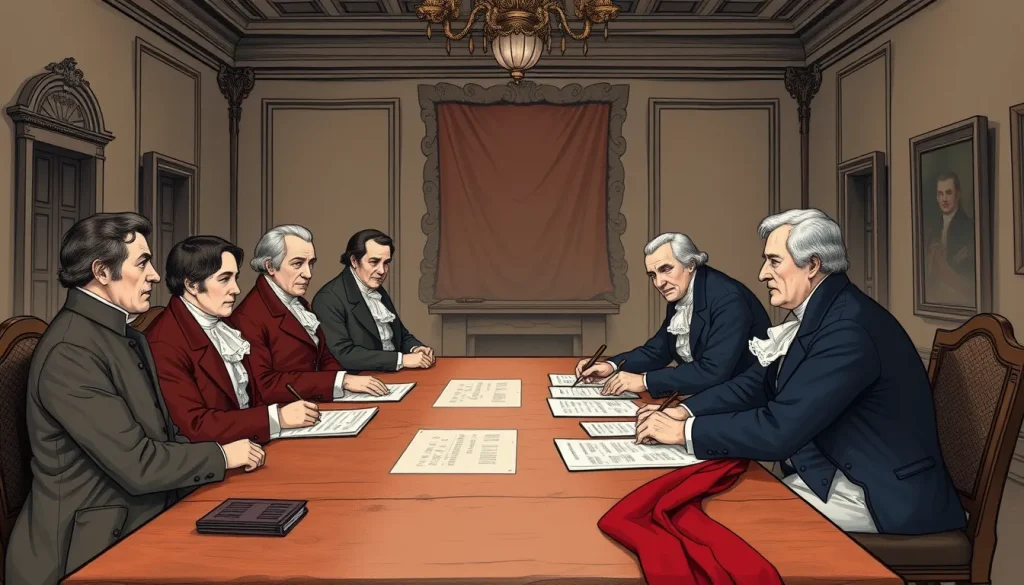
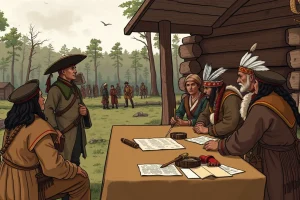
On August 8, 1814, British and American negotiators met for the first time in Ghent. The American delegation comprised John Quincy Adams, James A. Bayard, Henry Clay, Jonathan Russell, and Albert Gallatin. The British delegation was led by Admiral James Lord Gambier, Henry Goulburn, and William Adams. The talks were protracted, with the British initially demanding, among other things, a permanent Indigenous buffer state in the Northwest, a revision of the U.S.-Canadian border, and exclusive control of the Great Lakes. The Americans, under instructions from President James Madison, rejected these demands, and the British eventually dropped them—particularly after news of the burning of Washington, which was offset by American victories at Baltimore and elsewhere. On December 24, 1814, the commissioners signed the treaty, which was essentially a compromise that restored all conquered territory and established commissions to resolve boundary disputes. The British Parliament ratified the treaty on December 30, 1814; the U.S. Senate voted unanimously to ratify on February 16, 1815, and President James Madison signed it on February 17, 1815, with ratifications exchanged later that day. News of the treaty did not reach the United States until after the Battle of New Orleans (January 8, 1815), which was fought and won by the Americans before the peace was widely known.
Why It Matters
The Treaty of Ghent is historically significant because it formally ended the War of 1812, restoring peace between the United States and Britain and establishing a framework for negotiating unresolved boundary disputes. It also had lasting consequences: it marked the end of the British-American conflict that had persisted since the American Revolution, and it laid the groundwork for the demilitarization of the Great Lakes through later agreements (such as the Rush-Bagot Agreement of 1817). The treaty did not address impressment, trade restrictions, or the rights of neutral nations—issues that had led to war—and for that reason it is often described as a return to the status quo ante bellum. For Indigenous peoples, however, the treaty had devastating effects: their British allies abandoned them, and the treaty’s clauses ignored Indigenous sovereignty, leaving them exposed to expanded American settlement. The treaty also established a precedent for peaceful arbitration of boundary disputes, which would shape later U.S.-Canadian relations. Historians disagree about the treaty’s significance: some view it as a diplomatic failure because it did not resolve the war’s causes, while others see it as a successful compromise that preserved national sovereignty and opened the way for lasting peace. The Battle of New Orleans, fought after the signing but before ratification, contributed to a perception of an American victory and fostered a sense of national pride, even though it had no impact on the treaty’s terms.
Document
The Treaty of Ghent is a formal international agreement titled “Treaty of Peace and Amity between His Britannic Majesty and the United States of America.” It consists of a preamble and eleven articles, each addressing specific aspects of the peace settlement. The original document is written on parchment, in English, and bears the signatures and seals of the six British and American plenipotentiaries. It is preserved in the National Archives of the United States.
Date
The treaty was signed on December 24, 1814, in Ghent, then part of the Austrian Netherlands (modern-day Belgium). It was ratified by Britain on December 30, 1814, and by the United States on February 16, 1815, with ratifications exchanged on February 17, 1815.
Author
The treaty was authored by the diplomatic delegations of both nations. The British signatories were Admiral James Lord Gambier, Henry Goulburn (Under Secretary of State), and William Adams (Doctor of Civil Laws). The American signatories were John Quincy Adams, James A. Bayard, Henry Clay, Jonathan Russell, and Albert Gallatin, all appointed by President James Madison with the advice and consent of the Senate.
Historical Context
The treaty was negotiated against the backdrop of the final Napoleonic Wars and the British-American conflict. From the British perspective, the war with the United States was a secondary theatre; after Napoleon’s first abdication in April 1814, Britain could devote more resources to North America. The American negotiators, meanwhile, sought to end the war without conceding any territory or key demands. The military situation at the time of negotiation was mixed: the British had burned Washington, but had failed at Baltimore and Plattsburgh; the American South and Gulf region were in turmoil. These circumstances influenced the British decision to abandon their initial demands for a Native American buffer state and other concessions, leading to a compromise that essentially restored the pre-war boundaries.
Transcript
The full original text of the treaty is available online through several authoritative sources. For this guide, the transcript is based on the U.S. Senate’s official record and the American Battlefield Trust’s transcription. The treaty’s opening lines are: “His Britannic Majesty and the United States of America, desirous of terminating the war which has unhappily subsisted between the two Countries, and of restoring upon principles of perfect reciprocity, Peace, Friendship, and good Understanding between them…” The complete text, including all articles, can be accessed at the URLs provided in the References.
Modernized Transcript
Since the treaty’s original language is largely legible to modern English speakers, a full modernized transcript is not necessary. However, the following article-by-article summary provides a plain-language explanation of each provision.
What the Document Tells Us
Preamble: The preamble states the intention to restore peace and friendship on principles of reciprocity, and names the plenipotentiaries.
Article the First: Establishes a firm and universal peace between the parties, with all hostilities ceasing upon ratification. It orders the restoration of all territory, places, and possessions taken during the war, with certain exceptions for islands in Passamaquoddy Bay. It also calls for the return of archives, records, and private property, including slaves or other private property, and prohibits carrying away artillery or other public property originally captured.
Article the Second: Specifies the timeline for the cessation of hostilities and the restoration of prizes taken at sea after ratification. It sets different time periods (e.g., twelve days for North American coastal waters, thirty days for the Atlantic north of the Equator, etc.) after which any captured vessels must be returned.
Article the Third: Provides for the release of prisoners of war, with each side paying off any debts prisoners incurred during captivity, and reciprocal advances for their sustenance.
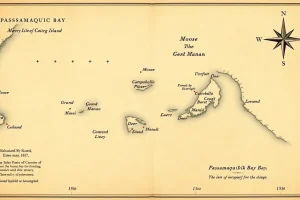
Article the Fourth: Establishes a commission to resolve the boundary dispute over islands in the Bay of Passamaquoddy and Grand Menan, referencing the 1783 Treaty of Paris. Two commissioners (one British, one American) are to decide ownership; if they disagree, the matter is referred to a friendly sovereign or state.
Article the Fifth: Creates a commission to agree on the boundary line between the United States and British North America (Canada) from the Atlantic Ocean to the St. Lawrence River region, specifically the portion between Nova Scotia and Maine, based on the Treaty of 1783. The commission’s decision is final.
Article the Sixth: Establishes a commission to assign and certify the boundary line through the Great Lakes, from St. Regis to Lake Huron, using a defined method to determine the middle of each lake.
Article the Seventh: Appoints a commission to decide the boundary from Lake Huron to the Lake of the Woods, and to draw a line through the water communication between them, with details on navigation.
Article the Eighth: Instructs all commissions to meet, hire secretaries and surveyors, and cooperate; decisions are by majority vote, with the possibility of referring disagreements to a friendly sovereign. It also ensures that private property and land grants made before the war are honored.
Article the Ninth: States that the United States will cease hostilities with Indigenous nations with whom it is at war at the time of ratification, and will restore to those tribes all possessions and rights enjoyed in 1811, provided they cease hostilities and do not renew attacks.
Article the Tenth: Both parties agree to use their best efforts to end the international slave trade, which had been declared illegal by both nations prior to the war.
Article the Eleventh: The treaty is to be ratified by both parties, and the ratifications are to be exchanged, with the treaty taking effect upon that exchange. It is signed and sealed by the plenipotentiaries.
Limitations and Bias of the Source
The Treaty of Ghent is a diplomatic instrument, and as such it reflects the political goals and compromises of the two sovereign states that negotiated it. It does not address the concerns of Indigenous peoples or enslaved individuals, both of whom were profoundly affected by the war and the peace. The treaty’s language often assumes the legal fiction of complete restoration to the status quo, which in practice erased the wartime losses of many individuals, particularly enslaved people who were either forcibly returned or left in ambiguous situations. Moreover, the treaty’s boundary commission mechanisms were designed to resolve disputes, but they relied on interpretation and could be challenged, as evidenced by later boundary controversies.
Citation
The original treaty is held by the National Archives of the United States. A certified transcript is available from the U.S. Senate: https://www.senate.gov/about/powers-procedures/treaties/treaty-of-ghent/transcript-treaty-of-ghent.htm. A historical transcription with annotations is provided by JSTOR Daily: https://daily.jstor.org/the-treaty-of-ghent-annotated/. The American Battlefield Trust also hosts a transcription: https://www.battlefields.org/learn/primary-sources/treaty-ghent.
Primary Sources
In addition to the treaty text itself, key primary sources include the diplomatic correspondence and journals of the American negotiators, especially John Quincy Adams’s diary, which offers daily commentary on the negotiations. The official British instructions to its negotiators are held in the British National Archives. The U.S. State Department’s records include the ratification process and the president’s communications with the Senate. Letters and reports from military commanders, such as Andrew Jackson’s report on the Battle of New Orleans, also illuminate the timing of the peace. Each of these sources provides insight into the treaty’s context, but they are colored by the authors’ perspectives and the diplomatic stakes involved.
Further Reading
- Hickey, Donald R. The War of 1812: A Forgotten Conflict. University of Illinois Press, 1989.
- Roosevelt, Theodore. The Naval War of 1812. G.P. Putnam’s Sons, 1882.
- Stagg, J.C.A. The War of 1812: Conflict for a Continent. Cambridge University Press, 2012.
- Black, Jeremy. The War of 1812 in the Age of Napoleon. University of Oklahoma Press, 2009.
- The Avalon Project at Yale Law School offers an online edition of the treaty text: Treaty of Ghent.
References
- JSTOR Daily, “The Treaty of Ghent: Annotated,” https://daily.jstor.org/the-treaty-of-ghent-annotated/.
- U.S. Senate, “Transcript: Treaty of Ghent,” https://www.senate.gov/about/powers-procedures/treaties/treaty-of-ghent/transcript-treaty-of-ghent.htm.
- American Battlefield Trust, “Treaty of Ghent,” https://www.battlefields.org/learn/primary-sources/treaty-ghent.
- Shmoop, “Treaty of Ghent: The Text” and “Treaty of Ghent: Structure,” https://www.shmoop.com/study-guides/historical-texts/treaty-of-ghent/.
FAQ
Did the Treaty of Ghent end impressment?
No. The treaty did not mention impressment, which was one of the primary causes of the war. This omission was deliberate, as the British and American negotiators were unable to reach an agreement on the issue.
Why was the Battle of New Orleans fought after the treaty was signed?
The treaty was signed on December 24, 1814, but word had not reached the United States by the time of the battle on January 8, 1815. Both sides fought on in ignorance of the peace.
What did the Treaty of Ghent do for Indigenous peoples?
Article 9 of the treaty promised to restore possessions and rights to Indigenous peoples that they enjoyed in 1811, provided they ceased hostilities. However, this was not enforced, and the treaty's failure to secure an independent Indigenous territory is widely seen as a major setback for Native nations.

Leave a Reply