
Short Answer
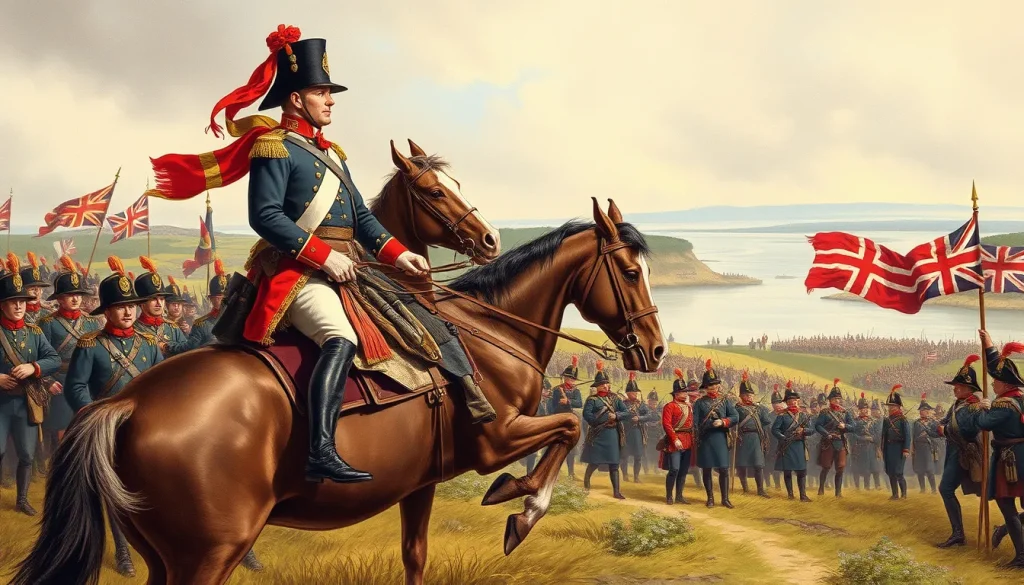
Gordon Drummond (1772–1854) was a British army officer and colonial administrator who served as lieutenant general commanding the forces in Upper Canada during the War of 1812. He is best known for his leadership of the Niagara Campaign of 1814, including the Battle of Lundy’s Lane and the subsequent siege of Fort Erie, which helped check the American invasion of Upper Canada. Born in Quebec and raised in Britain, Drummond was the first Canadian-born officer to hold both military and civil command in British North America.
Historical Context
The Niagara frontier, a narrow strip of land along the Niagara River between Lake Erie and Lake Ontario, was a critical theatre in the War of 1812. Control of this region allowed either side to threaten the other’s supply lines and territory. By late 1813, the British had recovered from earlier losses and had captured Fort Niagara, while American forces remained in Canada only at Fort George. In December 1813, Drummond succeeded Francis de Rottenburg as commander of Upper Canada, inheriting a difficult position with severe supply shortages and an unstable civilian population. The American government planned a major invasion for 1814, aiming to gain control of Lake Ontario and the Niagara peninsula.
What Happened
Drummond took command on 3 December 1813 and immediately adopted an aggressive posture. After the American burning of Newark, he ordered a retaliatory attack on Fort Niagara, which was captured on 19 December 1813. British forces then raided Lewiston, Black Rock, and Buffalo, driving the Americans from the frontier. In 1814, an American army under Major General Jacob Brown crossed the Niagara River and captured Fort Erie on 3 July. After defeating the British at Chippawa on 5 July, Brown advanced northward. Drummond, having concentrated his forces, engaged the Americans at Lundy’s Lane on 25 July, where the two armies fought one of the bloodiest battles of the war. The Americans withdrew to Fort Erie, where Drummond laid siege. A failed British assault on 15 August cost hundreds of casualties, and after a prolonged siege, the Americans abandoned and destroyed Fort Erie in November. The frontier remained unchanged.
Why It Matters
The Niagara Campaign of 1814 demonstrated the increasing professionalism of American regulars and the resilience of British forces under Drummond. The heavy casualties at Lundy’s Lane and the siege of Fort Erie highlighted the futility of the invasion attempts, as neither side achieved lasting territorial gains. The campaign also solidified Drummond’s reputation as an able commander and reinforced British control over Upper Canada. For Americans, the campaign contributed to the broader stalemate that led to the Treaty of Ghent. The events shaped the post-war development of the Niagara region and left a lasting memory in both countries.
Early Life
Gordon Drummond was born in Quebec City on 27 September 1772, the son of a Scottish army paymaster. After his father’s death in 1776, his family returned to England. He entered the British Army in 1789 and rose rapidly, becoming lieutenant colonel of the 8th Foot by 1794. He served in the Netherlands and Egypt, gaining military experience that would serve him in North America.
Role Before the War
After service in Jamaica and various garrison duties, Drummond returned to Canada as a brigadier general in 1808 under Governor General Sir James Henry Craig. He was promoted to lieutenant general in 1811. In 1813, he was sent to Upper Canada to take command, arriving at Kingston in December after the defeats at Lake Erie and Moraviantown.
Role During the War
As commander of Upper Canada, Drummond was responsible for defending the province against American invasion. He instituted harsh measures against American sympathizers and managed supply shortages. His winter campaign of 1813–1814 stabilized the frontier, and his leadership during the 1814 invasion, particularly at Lundy’s Lane and the siege of Fort Erie, was decisive in blocking the American advance.
Major Actions
Among Drummond’s key actions were the capture of Fort Niagara on 19 December 1813, the retaliatory raids on American settlements, the concentration of forces to meet Brown’s invasion, and the counterattack at Lundy’s Lane. He was wounded twice during that battle but remained in command. His decision to lay siege to Fort Erie and the assault of 15 August, though unsuccessful, demonstrated his determination.
Contemporary Accounts
Contemporary reports from British officers and officials praised Drummond’s energy and leadership, though some criticized his decisions at the siege of Fort Erie. American accounts acknowledged the strength of his defensive positions. The Documentary History of the Campaign on the Niagara Frontier in 1814, compiled by Ernest Cruikshank, includes many official letters and orders that illuminate his thinking.
Later Life
After the war, Drummond served as administrator of Upper Canada and later as lieutenant governor. He returned to England in 1816 and was knighted. He continued his army career, eventually becoming a full general. He died in London on 10 October 1854.
Historical Legacy
Drummond is remembered as the first Canadian-born officer to command both military and civil government in British North America. His leadership during the Niagara Campaign is seen as crucial in preventing the American conquest of Upper Canada. However, some historians debate his tactics at Lundy’s Lane, noting that the battle was nearly a defeat. His legacy is complex, reflecting both the achievements and the brutal nature of the war on the Niagara frontier.
Primary Sources
The most important primary source collection is The Documentary History of the Campaign on the Niagara Frontier in 1814, edited by Captain Ernest Cruikshank and published by the Lundy’s Lane Historical Society. It contains official correspondence, orders, and reports from both British and American sides. Drummond’s own letters and dispatches are preserved in the British National Archives and the Library and Archives Canada. The contemporary accounts of soldiers and civilians provide firsthand perspectives on the battles and sieges.
Further Reading
- Cruikshank, Ernest. The Documentary History of the Campaign on the Niagara Frontier in 1814. Welland, 1905.
- Hickey, Donald R. The War of 1812: A Forgotten Conflict. University of Illinois Press, 1989.
- Latimer, Jon. 1812: War with America. Harvard University Press, 2007.
- Ridler, Jason. “Sir Gordon Drummond,” The Canadian Encyclopedia.
References
- Ridler, Jason. “Sir Gordon Drummond,” The Canadian Encyclopedia, accessed 2025. https://thecanadianencyclopedia.ca/en/article/sir-gordon-drummond
- “The Niagara Campaign – War of 1812,” thewarof1812.org, accessed 2025. https://thewarof1812.org/campaigns/the-niagara-campaign/
- Cruikshank, Ernest, ed. The Documentary History of the Campaign on the Niagara Frontier in 1814. Lundy’s Lane Historical Society, 1905. https://docslib.org/doc/47824/the-documentary-history-of-the-campaign-on-the-niagara-frontier-in-1814
- “Battle of Lundy’s Lane,” Wikipedia, accessed 2025. https://en.wikipedia.org/wiki/Battle_of_Lundy’s_Lane
- Cruikshank, Ernest. “Drummond’s Winter Campaign,” warof1812-bicentennial.info, accessed 2025. http://www.warof1812-bicentennial.info/pamphlets/drummondswintercampaign/dwc-main.php
FAQ
What was Gordon Drummond's role in the Niagara Campaign?
Drummond commanded the British forces in Upper Canada and led the defence against the American invasion of 1814. He directed the capture of Fort Niagara in December 1813 and the major actions at Lundy's Lane and Fort Erie.
Why was the Battle of Lundy's Lane significant?
Lundy's Lane, fought on 25 July 1814, was one of the deadliest battles of the War of 1812, with over 1,700 casualties. It stopped the American advance into Upper Canada and was a turning point of the Niagara Campaign.
How is Gordon Drummond remembered today?
Drummond is remembered as an able and determined British commander, and as the first Canadian-born officer to hold both military and civil command. His leadership helped preserve Upper Canada for the British Empire.
Leave a Reply