
Short Answer
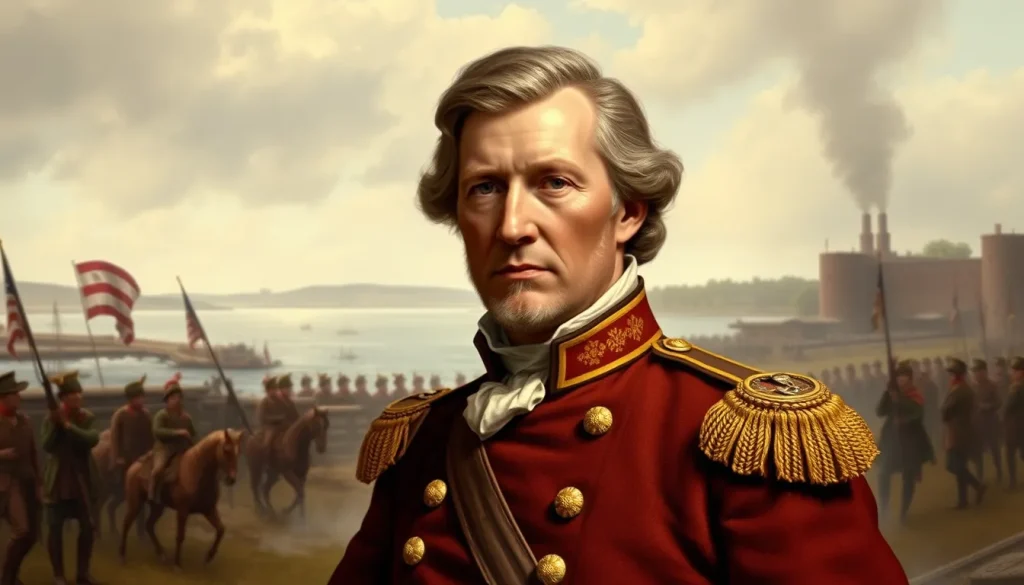
William Hull (1753–1825) was a Connecticut-born soldier, lawyer, and politician who served as the first governor of Michigan Territory and as a brigadier general in the United States Army during the opening campaign of the War of 1812. He is historically significant for his controversial surrender of Fort Detroit to British forces under Major General Isaac Brock on August 16, 1812, a defeat that gave Britain and its Indigenous allies control of the upper Great Lakes and badly shook American confidence. Hull’s subsequent court-martial and death sentence—commuted by President James Madison—made him a symbol of early American military failure and have fueled enduring debate about his competence and judgment.
Historical Context
The War of 1812 began amid long-standing disputes between the United States and Great Britain over impressment, trade restrictions, and British support for Indigenous resistance to American expansion. On the western frontier, the United States sought to annex Canadian territory and end British influence over tribes in the Old Northwest. The strategic importance of the Detroit River corridor was paramount: Fort Detroit guarded the water route connecting Lake Erie to Lake Huron and served as a base for both American invasion plans and British counteroffensives. The American government under President James Madison and Secretary of War William Eustis planned a three-pronged invasion of Canada, with one thrust aimed at the west from Detroit. British forces in Upper Canada, initially outnumbered, relied on militia, a small regular garrison, and alliances with Indigenous nations such as the Shawnee, led by Tecumseh, and the Potawatomi, Ojibwa, and other peoples. Tensions had escalated after the Battle of Tippecanoe in 1811, and both sides understood that control of Detroit would likely decide the fate of the entire northwestern frontier.
What Happened
In early 1812, William Hull, then governor of Michigan Territory, traveled to Washington to lobby for command of the planned western invasion. Madison appointed him brigadier general, and Hull arrived at Detroit on July 5, 1812, with roughly 2,200 regulars and Ohio militia. On July 12, he crossed into Upper Canada at Sandwich (modern Windsor) and issued a proclamation urging Canadians to remain neutral, but he did not advance on Fort Malden at Amherstburg. His supply lines quickly became vulnerable, and he received exaggerated reports of British and Indigenous strength. On August 8, Hull ordered his force to withdraw back to Detroit, abandoning the invasion. British commander Major General Isaac Brock, with about 1,300 men, including Tecumseh’s warriors, crossed the Detroit River on August 15 and took up positions near the fort. That night, British artillery bombarded Detroit. The next morning, Brock sent a demand for surrender, warning that his Indigenous allies would be beyond control if he had to storm the fort. Hull, fearing a massacre of the garrison, the civilian population, and the fort’s women and children, surrendered without a significant fight. The surrender included about 2,500 troops, the fort, and a large quantity of military supplies. It was a stunning victory for the British and a humiliating disaster for the United States. Hull was paroled and returned to the east, where he faced a court-martial.
Why It Matters
The surrender of Detroit had immediate and long-term consequences. Strategically, it gave Britain control of the Michigan Territory, encouraged Indigenous resistance, and opened the door for a possible British campaign into Ohio. For the Americans, it shattered the initial confidence in the war effort and led to a wave of recrimination. William Hull was court-martialed in 1814 on charges of cowardice, neglect of duty, and treason; the treason charge was dropped, but he was convicted of cowardice and neglect of duty and sentenced to death. President Madison, citing Hull’s distinguished Revolutionary War record, commuted the sentence and permitted his discharge. Hull spent the rest of his life trying to clear his name, publishing his memoirs and arguing that his surrender was a humane act dictated by circumstances. Historians have been divided: some condemn Hull as a timid and incompetent commander, while others point to the mismanagement by the War Department, poor logistical support, and the genuine threat of a massacre as mitigating factors. The event also shaped the careers of Brock and Tecumseh and reinforced the importance of Indigenous alliances in the war. In the broader memory of the War of 1812, Hull’s surrender remains a cautionary tale about leadership under pressure.
Early Life
William Hull was born in Derby, Connecticut, on June 24, 1753. He graduated from Yale College in 1772, studied law, and was admitted to the bar in 1775. His legal career was interrupted by the American Revolutionary War, in which he served with distinction in the Connecticut militia and Continental Army, rising to the rank of lieutenant colonel. He fought at White Plains, Trenton, Princeton, Stillwater, Saratoga, Fort Stanwix, Monmouth, and Stony Point. After the war, he settled in Newton, Massachusetts, practiced law, served as a judge and state senator, and helped suppress Shays’ Rebellion in 1787. He was also an original member of the Society of the Cincinnati.
Role Before the War
From 1786 to 1805, Hull engaged in state politics and legal practice. In 1805, President Thomas Jefferson appointed him governor of Michigan Territory and Indian agent. As governor, Hull negotiated the Treaty of Detroit in 1807, obtaining cessions of land from the Ojibwa, Odawa, Potawatomi, and Wyandot peoples in present-day southeastern Michigan and northwestern Ohio. He also oversaw the initial territorial administration and worked to encourage settlement, though his policies increasingly alarmed Indigenous leaders, especially Tecumseh, who opposed further land cessions.
Role During the War
In early 1812, Hull was in Washington seeking command of the projected invasion of Canada. President Madison appointed him brigadier general, and he took command of the Army of the Northwest at Detroit. His campaign was plagued by poor logistics, uncertain communications, and a militia that was often undisciplined and reluctant to serve far from home. Hull’s decision to retreat from Canada and his subsequent surrender at Detroit defined his military role in the war. He was exchanged as a prisoner in 1814 and later discharged from the army following his court-martial.
Major Actions
Hull’s most significant actions during the War of 1812 were the invasion of Upper Canada in July 1812, the issuance of a proclamation to the Canadian population, and the surrender of Fort Detroit on August 16, 1812. His earlier career included a celebrated Revolutionary War record, but his Detroit campaign overshadowed all previous achievements.
Contemporary Accounts
Contemporary reactions to Hull’s surrender were overwhelmingly negative. Captain Thomas Jessup of the 4th U.S. Infantry reportedly called Hull a coward, and many officers, including Colonel Lewis Cass, were outraged by the decision to give up the fort without a fight. Hull himself wrote detailed letters and a later memoir defending his actions, claiming he acted to prevent a massacre of the garrison and civilians by Tecumseh’s warriors. British accounts, including Brock’s official report, emphasized the psychological deception that led Hull to believe his force was far larger than it was. The surrender terms, signed by Hull and Brock, were preserved and are now an important primary source.
Later Life
After his court-martial and commutation, Hull was dismissed from the army and returned to Newton, Massachusetts. He spent his remaining years publishing appeals and a book in an attempt to rehabilitate his reputation. He died on November 29, 1825, at the age of 72, without achieving vindication.
Historical Legacy
William Hull’s legacy is largely defined by the surrender of Detroit. For many Americans, he remains a symbol of cowardice and incompetence, while for others he is a scapegoat for a poorly prepared war effort. Modern historians have offered a more balanced assessment, emphasizing the difficult logistical circumstances, the failure of the War Department to provide support, and the genuine threat of an Indigenous assault. His court-martial set a precedent for military accountability, and his case is often cited in discussions of leadership under stress and the challenges of commanding volunteer forces.
Primary Sources
Key primary sources include Hull’s own correspondence and memoir, Memoirs of the Campaign of the North Western Army of the United States, A.D. 1812 (1824); the articles of capitulation signed by Hull and Brock on August 16, 1812, held in the Archives of Ontario; Brock’s official dispatches to British military authorities; the court-martial proceedings of 1814, which were published; and statements from junior officers such as Captain Jessup and Colonel Cass. These documents provide firsthand perspectives, but each carries the author’s personal interests and biases. Hull’s memoir, in particular, is a defense of his decision, while the court-martial transcript records the prosecution’s and defense’s arguments.
Further Reading
- Hickey, Donald R. The War of 1812: A Forgotten Conflict (University of Illinois Press, 1989).
- Benn, Carl. The Iroquois in the War of 1812 (University of Toronto Press, 1998).
- Tunis, Barbara R. William Hull and the Surrender of Detroit (Michigan Historical Review, 2004).
- Canadian Encyclopedia article on William Hull (online).
- Detroit Historical Society, “Hull, William” (encyclopedia entry).
References
- Britannica, The Editors of Encyclopaedia. “William Hull.” Encyclopedia Britannica, June 20, 2026. https://www.britannica.com/biography/William-Hull.
- National Park Service. “He is a coward.” March 5, 2015. https://www.nps.gov/articles/surrender-of-detroit.htm.
- Ridler, Jason. “William Hull.” The Canadian Encyclopedia, March 8, 2011. https://thecanadianencyclopedia.ca/en/article/william-hull.
- Detroit Historical Society. “Hull, William.” https://www.detroithistorical.org/learn/online-research/encyclopedia-of-detroit/hull-william.
- Wikipedia contributors. “William Hull.” Wikipedia, The Free Encyclopedia. https://en.wikipedia.org/wiki/William_Hull.
FAQ
Why did William Hull surrender Fort Detroit?
Hull claimed he surrendered to prevent a massacre of the garrison and civilian population by Tecumseh's warriors, who were allied with the British. He also faced a British force that he believed was larger than it actually was, while his own supply lines were cut and morale was low.
What was the outcome of Hull's court martial?
Hull was court-martialed in 1814 on charges of cowardice, neglect of duty, and treason. The treason charge was dropped, but he was convicted of cowardice and neglect of duty and sentenced to death. President Madison commuted the sentence, allowing Hull to be discharged from the army.
How do historians view Hull's actions today?
Modern historians are more balanced than contemporaries. Many emphasize the poor logistical support, the failure of the War Department to communicate and reinforce, and the genuine threat of an Indigenous assault, while still acknowledging Hull's tactical errors and lack of aggressive leadership.



Leave a Reply