
Short Answer
James Lawrence (October 1, 1781 – June 4, 1813) was a United States Navy captain who gained lasting fame for his command of the frigate USS Chesapeake during a single-ship action against HMS Shannon on June 1, 1813, in the War of 1812. Mortally wounded early in the engagement, Lawrence is remembered for his reported last words, “Don’t give up the ship,” which were later stitched onto a battle flag and carried by Oliver Hazard Perry at the Battle of Lake Erie. His death captured the young republic’s imagination, transforming a tactical defeat into a symbol of American naval resolve.
Historical Context
At the outbreak of the War of 1812, the United States Navy was small and outmatched by the Royal Navy’s global fleet. Nevertheless, American frigates and sloops won several notable single-ship victories early in the war, including USS Constitution’s captures of HMS Guerriere and HMS Java and USS United States’ capture of HMS Macedonian. These successes boosted American morale and encouraged a belief that well-handled American vessels could overcome British ships of nominally similar size. By 1813, the Royal Navy responded by tightening a blockade along the American Atlantic coast, including the port of Boston, where HMS Shannon, commanded by Captain Philip Broke, took station. The Royal Navy also remained sensitive to impressment and desertion issues, and British officers were eager to redeem their service’s reputation after the earlier defeats.
What Happened
James Lawrence had already distinguished himself as commander of the sloop USS Hornet, capturing the privateer Dolphin in July 1812 and sinking the British sloop HMS Peacock on February 24, 1813. After returning to the United States, Lawrence was promoted to captain and given command of USS Chesapeake, a 38-gun frigate then fitting out at Boston. On June 1, 1813, despite the fact that his crew was largely new and untrained, Lawrence sailed Chesapeake out of Boston harbor to engage HMS Shannon, which was blockading the port.
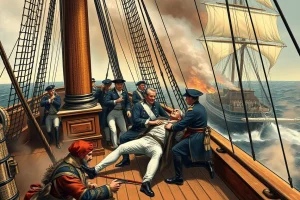
The two frigates met in a close-range, furious exchange. Within the first few minutes, British gunfire destroyed the Chesapeake’s wheel, shot away her rigging, and inflicted heavy casualties on her officers and crew. Lawrence was struck by a musket ball or grapeshot and was carried below, reportedly calling out to his men, “Don’t give up the ship. Fight her till she sinks.” The British boarders then overwhelmed the disoriented American crew, and Chesapeake was captured and taken to Halifax, Nova Scotia. Lawrence died on June 4, 1813, while the ship was en route to Halifax.
News of the defeat and Lawrence’s death spread quickly. His friend and fellow officer, Oliver Hazard Perry, ordered a large blue flag stitched with “DONT GIVE UP THE SHIP” and flew it from his flagship at the Battle of Lake Erie on September 10, 1813, where the American squadron defeated the British. Lawrence was buried with honors in Halifax, but his remains were later reinterred in Trinity Church Cemetery in New York City.
Why It Matters
Immediate consequences included the loss of one of the U.S. Navy’s finest frigates and a temporary setback to American naval confidence. But the longer-term significance lies in the way Lawrence’s dying command became a rallying cry for the U.S. Navy and for the nation. The phrase was invoked at Lake Erie, and it has remained a watchword of the U.S. Navy to this day. Scholars note that the battle itself was a British tactical victory that demonstrated the value of disciplined gunnery and a seasoned crew, but that memory of Lawrence’s courage and words overshadowed the military defeat, helping to shape the narrative of American perseverance. Historians also debate the exact wording and context of Lawrence’s last command, as eyewitness accounts vary, but the phrase’s cultural power is undisputed.
Early Life
James Lawrence was born on October 1, 1781, in Burlington, New Jersey, the son of John and Martha Lawrence. His mother died when he was an infant, and his father, a Loyalist, fled to Canada during the American Revolution, leaving Lawrence to be raised by his half-sister. He attended Woodbury Academy and initially studied law, but at age eighteen he entered the U.S. Navy as a midshipman in 1798.
Role Before the War
Lawrence served during the Quasi-War with France aboard USS Ganges and USS Adams in the Caribbean, receiving a lieutenant’s commission in 1802. He then served in the First Barbary War, joining Stephen Decatur’s expedition to destroy the captured frigate USS Philadelphia in Tripoli harbor in 1804. Over the following years, he commanded the ships USS Vixen, USS Wasp, and USS Argus, gaining a reputation as a capable and aggressive officer.
Role During the War
As commander of the sloop USS Hornet from late 1811, Lawrence was active from the start of the war. He captured the British privateer Dolphin in July 1812 and, on February 24, 1813, engaged and sank the British sloop HMS Peacock in a decisive action off the coast of Brazil. Upon his return to the United States in March 1813, he learned of his promotion to captain and was soon given command of the frigate USS Chesapeake.
Major Actions
Lawrence’s major action was the single-ship duel with HMS Shannon on June 1, 1813. Despite his crew’s lack of experience, he sailed out to meet the British frigate. The battle was short and devastating: Shannon’s guns disabled Chesapeake quickly, and Lawrence was wounded by small-arms fire. His famous order, either “Don’t give up the ship. Fight her till she sinks” or “Tell the men to fire faster! Don’t give up the ship,” was spoken as he was carried below. The British boarding party then captured the ship, but Lawrence’s defiance in the face of death transformed the loss into an inspirational legend.
Contemporary Accounts
Eyewitness accounts of Lawrence’s exact words vary, and historians have noted that the phrase may have been reconstructed by his officers. The earliest printed versions appeared in newspapers and in the later memoirs of participants. The NPS and other sources quote it as “Don’t give up the ship,” but the fuller context remains uncertain. British accounts emphasize that the crew of Chesapeake did not formally surrender even as the boarders seized the ship, which some American observers later claimed as a point of honor. The battle itself was the subject of official reports by both Captain Broke and American officers, and these provide the most reliable framework for the engagement.
Later Life
James Lawrence did not survive the battle; he died on June 4, 1813. Initially buried in Halifax, Nova Scotia, his remains were later reinterred at Trinity Church Cemetery in New York City, where a monument was erected in his honor. He was survived by his wife, Julia Montaudevert Lawrence, and infant daughter. Julia later successfully petitioned President Abraham Lincoln in 1862 to consider her nephew for a military commission, citing her husband’s sacrifice.
Historical Legacy
Lawrence’s legacy was defined by his final command. The phrase “Don’t give up the ship” was incorporated into Oliver Hazard Perry’s battle flag at Lake Erie, where Perry’s squadron defeated the British in a turning-point victory. The original flag is preserved at the U.S. Naval Academy Museum. Lawrence was posthumously awarded a Congressional Gold Medal and the Thanks of Congress. Numerous places and ships have been named for him, and his dying words remain a staple of U.S. Navy tradition and American historical memory. The battle also entered the wider debate over the War of 1812’s meaning: for Americans, Lawrence’s courage symbolized the nation’s refusal to capitulate, while British historians see it as a tactical vindication of Royal Navy professionalism.
Primary Sources
Contemporary documents include Captain Philip Broke’s official despatch describing the capture of Chesapeake, and the American court-martial records from the loss. The diary of Midshipman William W. F. Gray and other survivor accounts provide some of the best detail, though they were written later and may be shaped by memory and national pride. A letter from Julia Lawrence to Abraham Lincoln, written December 29, 1861, and Lincoln’s endorsement on it, are important later primary sources that demonstrate the lasting power of Lawrence’s name. The original flag with “DONT GIVE UP THE SHIP” is itself a primary artifact, now at the U.S. Naval Academy Museum.
Further Reading
- Theodore Roosevelt, The Naval War of 1812 (1882).
- Roy and Lesley Adkins, Don’t Give Up the Ship! (related article, HistoryNet, 2008).
- Henry Adams, The War of 1812, ed. Major H. A. DeWeerd (1999).
- Donald R. Hickey, The War of 1812: A Forgotten Conflict (1989).
- U.S. Naval Academy Museum, “Don’t Give Up the Ship” flag collection.
References
- “James Lawrence,” National Park Service, www.nps.gov/people/james-lawrence.htm.
- “James Lawrence,” American Battlefield Trust, www.battlefields.org/learn/biographies/james-lawrence.
- “James Lawrence,” Wikipedia (accessed 2023).
- Daniel Worthington, “Don’t Give Up the Ship,” Abraham Lincoln Presidential Library and Museum, March 30, 2021.
- Roy and Lesley Adkins, “Don’t Give Up the Ship,” HistoryNet, August 2008.
FAQ
What were James Lawrence's last words?
Variously reported, but the commonly quoted phrase is "Don't give up the ship. Fight her till she sinks," uttered as he was carried below during the battle with HMS Shannon.
In what battle did James Lawrence die?
The single-ship action between USS Chesapeake and HMS Shannon on June 1, 1813, near Boston Harbor.
How did "Don't Give Up the Ship" become famous?
Oliver Hazard Perry adopted Lawrence's dying command as a battle cry, printing it on his blue battle flag that flew at the Battle of Lake Erie in September 1813, and it has since become a U.S. Navy motto.


Leave a Reply