

Short Answer
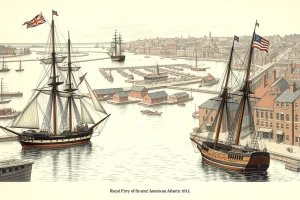
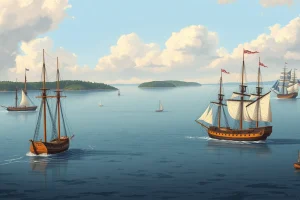
Single-ship duels in the War of 1812 were naval engagements fought between individual warships, most famously heavy frigates, that occurred primarily in the Atlantic Ocean between 1812 and 1814. These contests pitted the small professional United States Navy against the massive Royal Navy, producing several striking American victories and a few British successes. Though strategically limited in their impact on the war’s outcome, these duels had an outsized psychological and symbolic effect, shaping national pride, naval doctrine, and public perceptions of maritime power on both sides of the Atlantic.
Historical Context
In June 1812, when the United States declared war on Great Britain, the Royal Navy was the dominant naval force in the world, having defeated the French and Spanish fleets at Trafalgar in 1805 and maintained a near-constant blockade of European ports. The U.S. Navy, by contrast, was minuscule: it fielded fewer than twenty oceangoing vessels, including only three heavy frigates of 44 guns and three lighter 36-gun frigates, all built under the Naval Armament Act of 1794. These American frigates were designed to be larger, heavier, and more powerfully armed than their European counterparts, in effect making them super-frigates. The war’s naval theatre also included the Great Lakes, where both nations built squadrons to control interior waterways, but the Atlantic single-ship duels became the most celebrated naval events of the conflict. For the British, the war was an unwelcome distraction from their global struggle against Napoleon; for the Americans, the navy’s performance offered a rare source of pride against overwhelming odds.
What Happened
The first major frigate duel occurred on 19 August 1812, about 400 miles southeast of Halifax, Nova Scotia. The USS Constitution, commanded by Captain Isaac Hull, encountered the British 38-gun frigate HMS Guerriere, under Captain James Richard Dacres. After a short chase and an exchange of broadsides, the Constitution closed to point-blank range. British shot bounced off the Constitution’s dense live-oak hull, inspiring the nickname “Old Ironsides.” The heavier American 24-pounder guns wrecked the Guerriere, which lost her mizzenmast, foremast, and mainmast; Dacres surrendered after roughly thirty minutes. The Guerriere was too damaged to save and was burned. American losses were 7 killed and 7 wounded; the British suffered 15 killed and 63 wounded.
On 25 October 1812, the USS United States, commanded by Captain Stephen Decatur, found the British frigate HMS Macedonian in the mid-Atlantic near Madeira. In a two-hour engagement fought at longer ranges, the superior gunnery of the American ship took down the Macedonian’s mainmast and severely damaged her hull. The Macedonian struck, becoming the first British frigate ever brought into an American port as a prize. American casualties were 12 killed and 15 wounded; the British lost 36 killed and 68 wounded. This victory was particularly celebrated in the United States, as the Macedonian was towed to New London, Connecticut, and later served in the U.S. Navy.
On 29 December 1812, the USS Constitution, now under Captain William Bainbridge, encountered HMS Java off the coast of Brazil. The Java was a 38-gun frigate with an experienced crew, but the Constitution’s heavier broadside repeatedly battered her. After a brutal engagement in which the Java lost all three masts and suffered heavy casualties, including her captain mortally wounded, the British ship surrendered. She too was burned after being deemed unrepairable. The Constitution suffered 34 casualties, while the Java lost over 150. These three victories—against Guerriere, Macedonian, and Java—stunned the British public and naval establishment, which had grown accustomed to naval supremacy.
The streak of American victories ended on 1 June 1813 off Boston Harbor, when the USS Chesapeake, commanded by Captain James Lawrence, sortied out to meet the HMS Shannon, under Captain Philip Broke. Broke, a meticulous gunnery instructor, had sent a written challenge to Lawrence, but Lawrence sailed before receiving it. Both frigates were roughly equal in size, but the Shannon’s crew was far better drilled. In a sharp fifteen-minute exchange, the Shannon’s broadsides devastated the Chesapeake’s quarterdeck, mortally wounding Lawrence (who reportedly shouted “Don’t give up the ship!”). British boarding parties then swept the American decks, forcing the Chesapeake to strike. This was the first loss of an American frigate in the war, and it gave the Royal Navy a much-needed victory. Lawrence died four days later.
Beyond these frigate duels, several smaller single-ship actions occurred. On 13 August 1812, the USS Wasp captured HMS Frolic in the Atlantic, only to be captured later that day by a British ship of the line. In early 1813, the USS Hornet defeated HMS Peacock off the coast of Guyana, and in 1814 the USS Wasp took HMS Reindeer. These sloop duels rarely had strategic weight but further shaped the image of a determined American navy.
Why It Matters
The immediate effects of these duels were largely psychological and diplomatic. In the United States, the victories provided a much-needed morale boost and helped counterbalance military defeats on land, such as the surrender of Detroit earlier in 1812. They also damaged British prestige, embarrassing the Admiralty and prompting public debate in Britain about the quality of their warships and crews. The British response included a stricter blockade of American ports and a determined effort to avoid further one-on-one losses, while the U.S. Navy continued its sporadic cruising strategy. In the longer term, these duels influenced naval architecture and tactics, leading both navies to reinforce frigate designs and gunnery training. Historians such as Andrew Lambert argue that while the American victories were tactically impressive, they had no impact on the war’s strategic outcome; the Royal Navy’s overwhelming numerical superiority ensured that the blockade and control of sea routes remained firmly in British hands. Nevertheless, the duels became foundational myths in American naval history, celebrated in literature, painting, and commemorative culture, and they continue to shape national narratives of American exceptionalism at sea.
Definition
In the naval context of the Age of Sail, a single-ship duel was a combat engagement between two individual warships, usually without support from other vessels. These encounters often involved frigates or smaller cruisers and were governed by formal and informal codes of honor, including the exchange of written challenges. In the War of 1812, single-ship duels typically occurred when a lone American cruiser encountered an equal or inferior British vessel and chose to engage, or when a British captain deliberately sought action to restore prestige.
Background
Single-ship duels had a long tradition in naval warfare, rooted in the chivalric ideals of the sailing navy. Officers were expected to demonstrate courage and to seek combat with enemies of similar size to prove their ship’s superiority. By the early nineteenth century, the Royal Navy’s dominance had made such duels rare; most actions involved squadrons or fleets. The U.S. Navy, too small to challenge British fleets, adopted a strategy of dispersing its frigates as commerce raiders and seeking occasional single-ship victories. This approach was both practical and politically appealing, as each duel could showcase American professionalism.
How It Worked
In practice, a single-ship duel began with the sighting of an enemy vessel. Both captains would clear for action, shortening sail and preparing guns and boarding parties. Engaging involved complex shiphandling, as captains sought favorable wind and angle to fire broadsides or to rake the enemy’s bow or stern. The superior weight of the American heavy frigates—mounting 24-pounder long guns over the British 18-pounders—proved decisive in several early duels. British crews, though often battle-hardened from the Napoleonic Wars, faced a disadvantage in long-range gunnery and hull strength. Occasionally, captains issued written challenges, as did Philip Broke before the Chesapeake-Shannon action, though such notes were often overtaken by events.
Competing Viewpoints
American contemporaries celebrated these duels as evidence of superior naval skill and national destiny. British observers, however, attributed the losses to material inferiority, inadequate British frigate design, and the fact that the American ships were “oversized” for their rate. Modern historians debate the significance of these engagements. Some, like Donald Hickey, emphasize their psychological and propaganda value, while others, such as Andrew Lambert, stress that they were isolated tactical successes without strategic consequence. The duels also raised questions about the effectiveness of the British blockade and the readiness of the Royal Navy in the face of an untested rival.
Role in the War of 1812
Within the broader war, these single-ship duels fit into a U.S. naval strategy of disrupting British commerce and boosting domestic morale. They did not alter the Royal Navy’s ability to impose a blockade that severely damaged American trade, nor did they affect military operations on land. However, they forced the British to divert resources to hunt down American cruisers and to improve the quality of their frigate squadrons. For the Americans, the duels legitimized the navy’s existence and contributed to the postwar “navalist” movement that pushed for a larger permanent fleet.
Consequences and Historical Interpretation
The historical legacy of these duels is complex. In the United States, they became foundational naval legends, with ships like the Constitution preserved as national memorials. The phrase “Don’t give up the ship” and the nickname “Old Ironsides” entered American culture permanently. In Britain, the losses prompted court-martials and official inquiries, but also a determination to avenge the defeats. Subsequent naval development in both nations was influenced by the perceived lessons of these engagements, particularly regarding frigate design, gunnery, and crew training. Interpretations of the duels continue to evolve as historians reassess the naval balance of power and the impact of single-ship actions on the war’s strategic narrative.
Primary Sources
The most valuable primary sources are the official after-action reports written by the commanding officers. Captain Isaac Hull’s detailed dispatch to Secretary of the Navy Paul Hamilton, dated 28 August 1812, recounts the Constitution-Guerriere action, while Captain Dacres’s report to the Admiralty offers a British perspective. Similarly, Captain Stephen Decatur’s report on the United States-Macedonian engagement and Captain William Bainbridge’s report on the Java battle provide contemporary details. For the Chesapeake-Shannon engagement, both Captain Philip Broke’s report and the surviving accounts from the Chesapeake’s surviving officers illuminate the battle. The memoir of Constitution gunner Moses Smith, published years later, contributes vivid personal recollections, including the famous “Old Ironsides” anecdote. The London Times editorial of October 1812, condemning the Guerriere loss, captures British public reaction. These sources vary in accuracy and bias; official reports often emphasized enemy material superiority to explain defeats, while personal memoirs romanticized events.
Further Reading
- Hickey, Donald R. The War of 1812: A Forgotten Conflict. University of Illinois Press, 1989.
- Lambert, Andrew. The Challenge: America, Britain and the War of 1812. Faber & Faber, 2012.
- Roosevelt, Theodore. The Naval War of 1812. G.P. Putnam’s Sons, 1882.
- McCranie, Kevin D. “Dueling with Warships to Satisfy Honour: The Use of Naval Challenges in the War of 1812.” International Journal of Maritime History 25, no. 2 (2013): 61–84.
- Toll, Ian W. Six Frigates: The Epic History of the Founding of the U.S. Navy. W.W. Norton, 2006.
References
- “Naval Duels War of 1812.” WarHistory.org. Accessed [date]. https://warhistory.org/article/naval-duels-war-of-1812.
- Desy, Margherita M. “America’s Frigate Triumphs.” Naval History Magazine 26, no. 3 (June 2012). https://www.usni.org/magazines/naval-history-magazine/2012/may/americas-frigate-triumphs.
- “Naval Engagements in the War of 1812.” American Battlefield Trust. Accessed [date]. https://www.battlefields.org/learn/articles/naval-engagements-war-1812.
- McCranie, Kevin D. “Dueling with Warships to Satisfy Honour: The Use of Naval Challenges in the War of 1812.” International Journal of Maritime History 25, no. 2 (2013): 61–84. https://journals.sagepub.com/doi/10.1177/084387141302500208.
- “USS Constitution vs HMS Guerriere – War of 1812.” The War of 1812. Accessed [date]. https://thewarof1812.org/battles/uss-constitution-vs-hms-guerriere/.
FAQ
Why did American frigates win so many early duels?
American heavy frigates like the Constitution were larger, carried 24-pounder long guns, and had hulls of dense live oak, giving them a material advantage over British frigates rated at 38 guns with 18-pounders. Additionally, American crews were well-drilled, and British complacency played a role.
How did the British respond to the loss of the Guerriere, Macedonian, and Java?
The Admiralty and press reacted with shock and indignation. They launched court-martials for the surrendered captains, who were acquitted, and ordered improvements to frigate design and gunnery. The British also tightened their blockade of American ports to prevent further American sorties.
What was the significance of the Chesapeake-Shannon duel?
The Chesapeake-Shannon action on June 1, 1813, ended the American string of frigate victories. It demonstrated the importance of crew training and discipline, as the Shannon's well-drilled crew overwhelmed the Chesapeake's less-prepared men. The loss was a setback to American morale and led to a more cautious U.S. strategy.
Did single-ship duels affect the outcome of the War of 1812?
No. While they boosted American morale and embarrassed the British, they did not alter the strategic balance. The Royal Navy maintained control of the seas and imposed a damaging blockaded, while the U.S. Navy remained too small to threaten maritime supremacy. The duels were tactically significant but strategically inconsequential.
Leave a Reply