
Short Answer
Sir Edward Pakenham (1778–1815) was a British army officer who commanded the British expedition against New Orleans during the War of 1812. His death on the battlefield on January 8, 1815, marked the climax of a campaign that ended in a decisive American victory and became a defining event in the war’s final months. The battle, fought after the Treaty of Ghent had been signed but not yet ratified, cemented Andrew Jackson’s reputation and shaped the historical memory of the conflict.
Historical Context
By early 1814, Great Britain had defeated Napoleon and could turn its full military attention to the war with the United States. British leaders sought to capture New Orleans, the gateway to the Mississippi River and a vital commercial center controlling one-third of American produce. Control of the city would secure the entrance to the Mississippi, cripple American westward expansion, and strengthen Britain’s negotiating position at the peace talks in Ghent. In June 1814, Vice Admiral Sir Alexander Cochrane proposed an expedition to seize New Orleans, and the British government approved it. The death of Major General Robert Ross, the original invasion commander, after the Battle of Baltimore in September 1814, led to the appointment of Sir Edward Pakenham, a well-regarded officer and brother-in-law of the Duke of Wellington.
What Happened
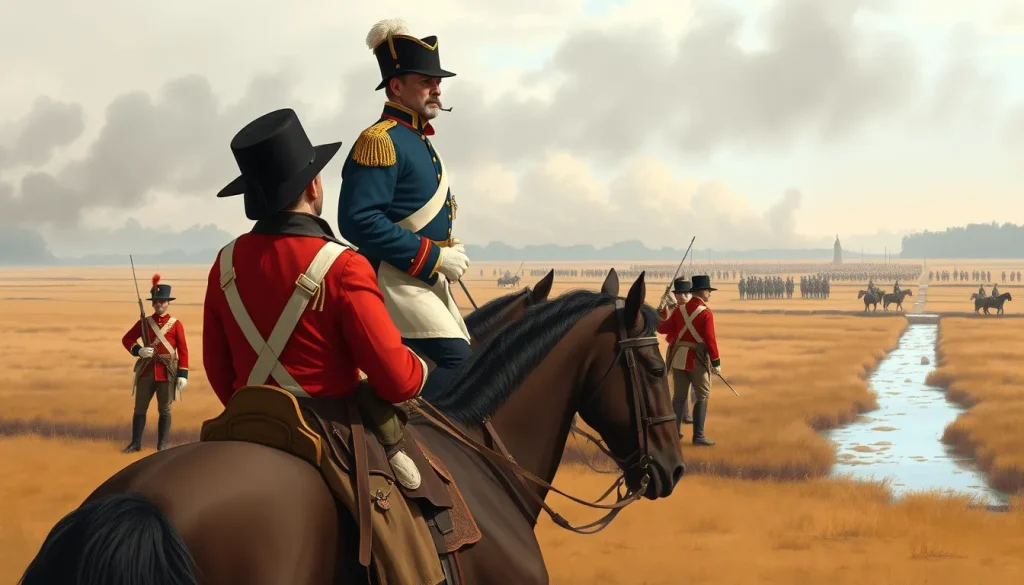
Pakenham arrived at the British army’s camp on Christmas Day, 1814, about fourteen kilometers from New Orleans. The British had already fought a sharp night action with American forces under Major General Andrew Jackson on December 23 and had probed Jackson’s defensive line at Chalmette. Pakenham reorganized the army into brigades and attempted an artillery bombardment on New Year’s Day, but American counter-battery fire proved superior. He then decided on a full frontal assault. On the morning of January 8, 1815, Pakenham launched a two-pronged attack: a main thrust against the American center-left (Line Jackson) and a supporting crossing of the Mississippi to capture an American battery on the west bank. The assault was delayed and disorganized, and the British infantry advanced across open ground into heavy artillery and rifle fire. Pakenham was wounded by grapeshot in the knee and arm while trying to rally his men, then struck in the chest and killed. Within about thirty minutes, the British suffered over 2,000 casualties, including many senior officers. The west-bank attack briefly succeeded, but the failure of the main assault compelled his successor, Major General John Lambert, to withdraw. The British re-embarked and sailed away on January 18.
Why It Matters
The Battle of New Orleans was the last major battle of the War of 1812. Although the Treaty of Ghent had been signed on December 24, 1814, it was not until February 1815 that the U.S. Senate ratified it and the news reached New Orleans in March. The American victory, achieved with a diverse force of regulars, militia, African Americans, Native Americans, and Baratarian pirates, boosted American morale and became a national legend. Pakenham’s death made him a symbol of the British defeat and of the cost of underestimating the American position. The battle also helped Andrew Jackson gain national fame and eventually the presidency.
Early Life
Edward Michael Pakenham was born on March 19, 1778, on his family’s estate in County Westmeath, Ireland. He was part of the Anglo-Irish aristocracy, descended from English settlers. His sister Catherine married Arthur Wellesley (the future Duke of Wellington) in 1806, a connection that advanced his career. Pakenham purchased a commission as a lieutenant in the 92nd Foot in May 1794, at age sixteen, and quickly rose through the ranks—becoming a captain, then a major in the 33rd Light Dragoons, and later a lieutenant-colonel.
Role Before the War
Pakenham saw service in Ireland during the 1798 rebellion and in the West Indies in 1801–1803, where he was wounded during the capture of St Lucia. He commanded the 7th Royal Fusiliers at the Battle of Copenhagen (1807) and then served in Nova Scotia before fighting in the Peninsular War under Wellington. He distinguished himself in several engagements and earned a reputation as a capable and well-liked officer. By 1814, he had been promoted to major general.
Role During the War
Pakenham was personally opposed to the North American war but accepted the command of the New Orleans expedition in October 1814. The force was scattered, and adverse winds delayed his arrival in Jamaica until mid-December, after the advance brigade had already left for Louisiana. He reached the army on Christmas Day, just as Jackson was fortifying his lines along the Rodriguez Canal. Pakenham reorganized the troops into four brigades and prepared for a deliberate assault, but his plan was compromised by delays, poor coordination, and strong American defenses.
Major Actions
Pakenham’s major action was the assault of January 8, 1815. He planned a night crossing of the Mississippi by a detachment under Colonel William Thornton to silence an American battery on the west bank, while the main force attacked Line Jackson from the east. The crossing was delayed, so the main attack proceeded without the promised support from the captured guns. The British infantry advanced in close order across 600 meters of open ground under heavy artillery and rifle fire. Pakenham, seeing the attack falter, rode forward to rally his men and was mortally wounded. His death was a turning point, and the assault collapsed.
Contemporary Accounts
American accounts, particularly Andrew Jackson’s official report, described the battle as a decisive victory and praised his troops’ discipline and firepower. Jackson wrote that the British “withstood it as long as could be expected from the most determined bravery,” but were forced to flee. British participants, including subordinate officers, later commemorated Pakenham as a noble soldier who “in the discharge of his duty to his king and country, so eminently upheld the character of a true British soldier” (as recorded in an essay published during the 1940s). While these sources vary in tone, they agree on the basic sequence: a costly frontal assault against a fortified position, with Pakenham killed while trying to inspire his men.
Later Life
Pakenham did not survive the battlefield. His body was returned to Ireland and buried in the family vault in Killucan, County Westmeath. He left a widow and no children. His death ended a promising career that might have continued in the post-war British army.
Historical Legacy
Pakenham is remembered primarily for his defeat and death at New Orleans. Historians have debated whether his plan was inherently flawed or executed too hastily, but most agree that the British faced formidable obstacles: an entrenched army, powerful artillery, and the advantage of prepared defenses. The battle is often cited as a demonstration of the impact of defensive firepower and the importance of logistics and intelligence. Pakenham’s legacy is intertwined with the broader narrative of the War of 1812, where the American victory at New Orleans, although strategically irrelevant after the Treaty of Ghent, secured a final triumph that masked the war’s overall stalemate.
Primary Sources
Key contemporary sources include Major General Andrew Jackson’s official report to Secretary of War James Monroe, written on January 9, 1815, which details the battle from the American perspective. British eyewitness accounts, such as the recollections of Lieutenant George Gleig of the 85th Foot, provide a British viewpoint and acknowledge the heavy casualties. Maps of the battlefield, like those held at the Library of Congress, illustrate the troop positions. The New Orleans Historical project and the National Park Service offer digital access to these materials, though researchers should note that all such accounts carry inherent biases based on nationality and rank.
Further Reading
- Remini, Robert V. The Battle of New Orleans. Penguin Books, 1999.
- Fonzo, Stephen. The Battle of New Orleans: America’s Last Great Battle. Westholme Publishing, 2015.
- Ridler, Jason. “Battle of New Orleans.” The Canadian Encyclopedia, 2011 (online).
- National Park Service. “Sir Edward Pakenham.” Accessed 2025.
- American Battlefield Trust. “Battle of New Orleans: The Last Battle of the War of 1812.” Online.
References
- National Park Service. “Sir Edward Pakenham.” https://www.nps.gov/people/edward-pakenham.htm
- American Battlefield Trust. “Battle of New Orleans: The Last Battle of the War of 1812.” https://www.battlefields.org/learn/articles/battle-new-orleans-last-battle-war-1812
- Grodzinski, John R., and Tabitha de Bruin. “Edward Pakenham.” The Canadian Encyclopedia, 2011. https://thecanadianencyclopedia.ca/en/article/edward-pakenham
- Wegmann, Mary Ann. “Battle of New Orleans: Introduction.” New Orleans Historical. https://neworleanshistorical.org/items/show/508
- Ridler, Jason. “Battle of New Orleans.” The Canadian Encyclopedia, 2011. https://thecanadianencyclopedia.ca/en/article/battle-of-new-orleans
FAQ
Why is the Battle of New Orleans considered significant if the war was already over?
The Treaty of Ghent was signed on December 24, 1814, but it had no effect until ratified by both parties. The battle took place on January 8, 1815, before ratification, and news reached New Orleans only in March. It was thus a legal military engagement that shaped public perceptions and national pride.
What were the main causes of the British defeat at New Orleans?
The British faced a strongly fortified American position, well-directed artillery, lack of coordination between the main assault and the flanking force, and delays in troop movements. Pakenham's frontal attack across open ground exposed his soldiers to devastating fire.
How did Edward Pakenham's death affect the British campaign?
His death during the assault, along with the wounding of other senior officers, left Major General John Lambert in command, who immediately called off further attacks. The British withdrew from the field and ultimately evacuated the area.
Leave a Reply