
Short Answer
The Battle of New Orleans, fought on January 8, 1815, was the final major engagement of the War of 1812, despite the signing of the Treaty of Ghent two weeks earlier. A British army under Lieutenant General Sir Edward Pakenham was decisively repulsed by American forces commanded by Major General Andrew Jackson, suffering over 2,000 casualties to fewer than 100 American losses. The British defeat was not the result of timidity or lack of veteran troops, but rather a series of tactical mistakes, inadequate logistics, and the strength of Jackson’s defensive line.
Historical Context
By 1814, the Napoleonic Wars in Europe had ended with the abdication of Napoleon, allowing Great Britain to turn its full military attention to the conflict with the United States. The British planned a series of offensives, including a campaign to capture New Orleans, the gateway to the Mississippi River and a vital commercial hub. Control of New Orleans would have given Britain command of the river and the ability to strangle American western trade and expansion. American forces in the Gulf region were commanded by Major General Andrew Jackson, who had recently defeated the Red Stick Creeks and was aware of the British threat. Jackson arrived in New Orleans on December 1, 1814, and found the city vulnerable to attack. He began constructing defenses along the Rodriguez Canal on the Chalmette Plantation, a position that anchored his left flank on the Mississippi River and his right on an impassable cypress swamp. The British expedition, under Vice Admiral Alexander Cochrane and later General Pakenham, assembled in Jamaica and landed near New Orleans in mid-December 1814.
What Happened
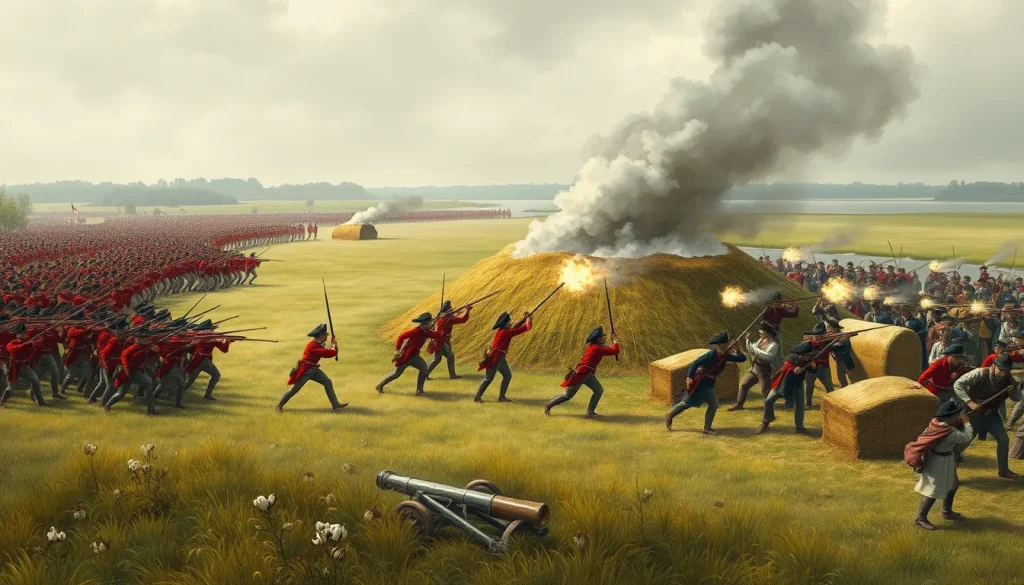
The British campaign began with a naval victory on December 14, 1814, when a British flotilla destroyed the American gunboats on Lake Borgne, giving the British control of the lake. They then moved troops through bayous to reach a point on the Mississippi River, landing at the Villere Plantation on December 23. Jackson, learning of their presence, launched a surprise night attack the same day, which disrupted the British advance and forced them to remain in place while he strengthened his line. On Christmas Day, Pakenham arrived and took command. He initially attempted a bombardment, but on January 1, 1815, a British artillery duel failed to silence the American guns. Pakenham then devised a two-pronged assault for January 8. One column, consisting of light infantry and the 93rd Highlanders, was to attack the American right near the river, while a larger main column, including the 44th and 21st Regiments, was to assault the American center-right near the swamp. A third force was to cross the Mississippi and capture American artillery batteries on the west bank. The plan failed from the outset. The boats for the west bank crossing were delayed, and the ladders and fascines needed to cross the canal and scale the rampart were missing, largely due to Colonel Thomas Mullins’s negligence. The British troops advanced on a narrow front, exposed to heavy American artillery and musket fire. The 93rd Highlanders were diverted to support the main column, masking British fire and becoming entangled with the other troops. The assault collapsed within minutes, with Pakenham himself being mortally wounded by grapeshot. The west bank attack, which initially succeeded in capturing the American battery, was abandoned when the main assault failed. By mid-morning, the British had retired, leaving behind hundreds of dead and wounded.
Why It Matters
The Battle of New Orleans had a profound impact on American national pride. Although the Treaty of Ghent had been signed on December 24, 1814, news of the peace had not yet reached the combatants, so the battle occurred after the war was officially over. When the news of the victory arrived in Washington in early February 1815, it was paired with the announcement of the treaty, creating the public impression that the United States had won the war. The battle made Andrew Jackson a national hero and propelled him to the presidency in 1828. In the broader context of the War of 1812, the battle was strategically irrelevant to the final treaty, but it shaped American historical memory. It also highlighted the effectiveness of American defensive tactics and the importance of artillery and fortification.
Definition
The British defeat at New Orleans refers to the failure of a British expeditionary force to capture the city and its defenses on January 8, 1815, resulting in a catastrophic loss for the attackers.
Background
The British plan to seize New Orleans was conceived by Admiral Cochrane as a strategic move to control the Mississippi River and split the United States. The expedition was assembled with experienced troops from the Peninsula Army, but the operation was complicated by the need to navigate shallow bayous and the lack of proper naval support for the final assault.
How It Worked
Several specific factors contributed to the British failure. First, the attack was delayed several weeks as the British waited for reinforcements and Pakenham’s arrival, allowing Jackson to fortify his position. Second, the British lacked proper engineering equipment: ladders and fascines were either lost or not delivered, preventing the troops from crossing the canal and scaling the rampart. Third, the tactical coordination between the three assault columns failed. The west bank detachment was late, and the diversion of the 93rd Highlanders disrupted the main column. Additionally, the British artillery was ineffective because it was placed in exposed positions and used inferior carriages. Finally, the American defensive line, with its heavy artillery and clear fields of fire, proved all but impregnable.
Competing Viewpoints
Historians have debated whether the British loss was due to command failures, such as Pakenham’s intricate plan and Mullins’s negligence, or to the inherent strength of the American position and Jackson’s leadership. Some contemporaries, especially Americans, portrayed the victory as proof of the superiority of American frontiersmen over British regulars. Later historians have pointed out that the British veterans were never able to deploy their famed discipline because they were stopped before reaching the American lines. Others argue that the battle was an avoidable mistake, as the troops could have simply bypassed New Orleans via other routes, but the British commanders were overconfident.
Role in the War of 1812
Although the battle took place after the Treaty of Ghent had been signed, it was the last major confrontation of the war. The British had already achieved their primary objective of ending the war with no territorial changes, but the loss at New Orleans did not affect the treaty negotiations. Instead, it strengthened American bargaining position in the ratification process and became a symbol of the war’s outcome for the United States.
Consequences and Historical Interpretation
The immediate consequence was the withdrawal of the British expedition and the end of active operations on land. In the broader historical view, the battle gave Americans a sense of rightful victory and promoted the cult of Andrew Jackson. It also led to the court-martial of Colonel Mullins, who was dismissed from the army for his failure to provide the ladders and fascines. The battle was celebrated as a national holiday for decades, and the site today is preserved as the Chalmette Battlefield. Modern historians interpret the battle as a classic example of the dangers of offensive operations against an entrenched and well-armed opponent.
Primary Sources
The most important primary source is the official report of General Andrew Jackson to the Secretary of War, dated January 9, 1815, which describes the battle and his dispositions. British accounts include the court-martial proceedings of Colonel Mullins, which detail the missing ladders and fascines. Also valuable are the personal journals and letters of British officers, though many were destroyed or remain unpublished. The correspondence between Admiral Cochrane and General Pakenham during the campaign provides insight into British planning. These sources are necessarily biased, as each side sought to explain its actions, but they are the foundation for all later analysis.
Further Reading
- Remini, Robert V. The Battle of New Orleans. Penguin Books, 1999.
- Owsley, Frank Lawrence. Struggle for the Gulf Borderlands: The Creek War and the Battle of New Orleans, 1812–1815. University Press of Florida, 2000.
- Smith, Gene A. Andrew Jackson and the Battle of New Orleans. University Press of Kentucky, 2004.
- National Park Service, Chalmette Battlefield and National Cemetery official website.
References
- Ainsworth, W. L. “An Amphibious Operation That Failed: The Battle of New Orleans.” U.S. Naval Institute Proceedings, February 1945. https://www.usni.org/magazines/proceedings/1945/february/amphibious-operation-failed-battle-new-orleans.
- Brown, Douglas. “Battle of New Orleans, 1815.” The War of 1812 Website. https://www.warof1812.ca/battle-of-new-orleans-1815.htm.
- Heidler, David and Jeanne T. “Things Fall Apart: The Road to ‘Victory’.” National Park Service. https://nps.gov/articles/things-fall-apart.htm.
- Ridler, Jason. “Battle of New Orleans.” The Canadian Encyclopedia, December 20, 2023. https://prod-front.thecanadianencyclopedia.ca/en/article/battle-of-new-orleans.
- American Battlefield Trust. “Battle of New Orleans: The Last Battle of the War of 1812.” https://www.battlefields.org/learn/articles/battle-new-orleans-last-battle-war-1812.
FAQ
Why was the Battle of New Orleans fought after the war was officially over?
The Treaty of Ghent was signed on December 24, 1814, but news of the treaty took weeks to cross the Atlantic. The British and American forces were unaware of the peace and continued fighting.
What was the primary cause of the British defeat?
The assault failed due to a combination of missing ladders and fascines, poor tactical coordination between assault columns, and the strength of the American defensive position with its artillery fire.
How did Andrew Jackson's victory affect his later career?
The victory made Jackson a national hero, elevated him to the presidency in 1828, and contributed to the myth of the "Hunters of Kentucky" as superior to British regulars.



Leave a Reply