Short Answer
Andrew Jackson’s Capture of Pensacola occurred on November 7, 1814, when American forces under Major General Andrew Jackson seized the Spanish-held port city of Pensacola in West Florida. The attack expelled British troops and their Indigenous and enslaved allies who had used Pensacola as a base for operations against the American Gulf frontier. The operation secured the American rear and allowed Jackson to concentrate his army for the defense of New Orleans, culminating in the Battle of New Orleans in January 1815.
Historical Context
During the War of 1812, Great Britain sought to use the strategic Gulf coast to attack American territories and to encourage resistance among enslaved people and Indigenous nations. Spanish Florida, though nominally neutral, was too weak to resist British incursions, and Pensacola, the capital of West Florida, became a significant British hub. British agents, notably Royal Marines Lieutenant Colonel Edward Nicolls and trader George Woodbine, arrived in August 1814 and began recruiting refugees from the Creek War, runaway slaves, and local Indigenous groups. They armed these forces and planned to support a larger British offensive aimed at New Orleans. The Spanish governor, Mateo González Manrique, permitted the British presence under pressure, but the collaboration threatened American security.
Andrew Jackson, having decisively defeated the Creek faction at the Battle of Horseshoe Bend in March 1814, was appointed major general in the U.S. Army and given command of the Seventh Military District. By September 1814, Jackson was ordered by Secretary of War James Monroe to defend New Orleans from a suspected British attack. While moving his forces toward New Orleans, Jackson learned that British troops occupied Pensacola and were actively inciting border violence. He wrote to Washington justifying an attack on neutral Spanish territory, arguing that Spain had allowed its territory to become a base for British operations and that preemption was necessary.
What Happened
Jackson assembled a force of roughly 3,000–4,000 men, including regulars, Tennessee and Kentucky militia, and mounted volunteers. He advanced from Fort Montgomery and Mobile toward Pensacola. On November 2, he received intelligence that the British were planning to attack the United States from Pensacola and that the Spanish were complicit. Jackson departed his camp at Fort Mims, Alabama, on November 2 and marched south.
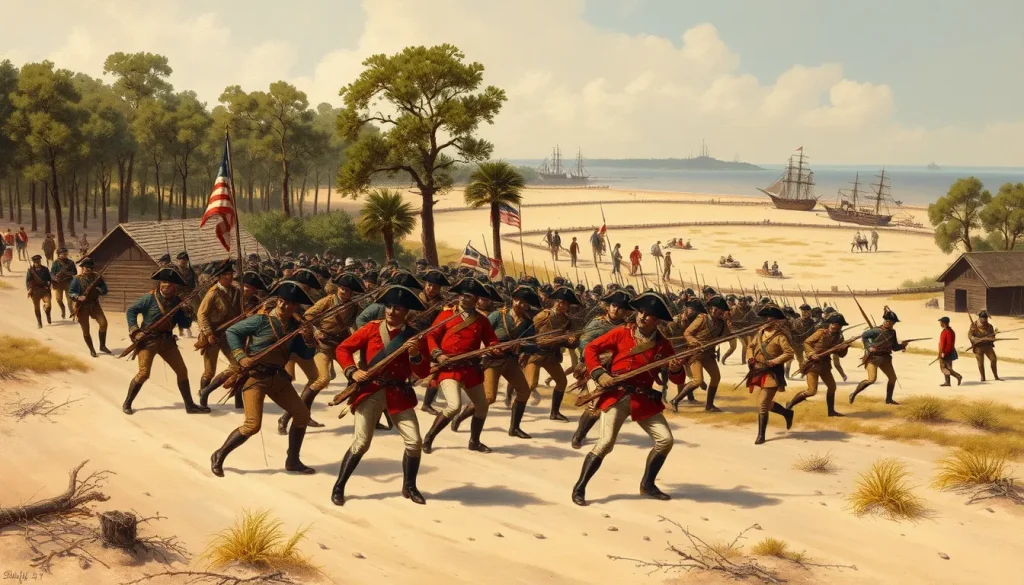
By November 6, Jackson’s army camped about two miles from Pensacola, on a site used by Bernardo de Galvez during the American Revolution. He sent an officer under a flag of truce to demand the surrender of the town and the expulsion of the British. The envoy, however, was fired upon by British or Spanish defenders. British forces, recognizing the American advance, evacuated from their positions to ships in the harbor during the evening, leaving Spanish troops to face Jackson.
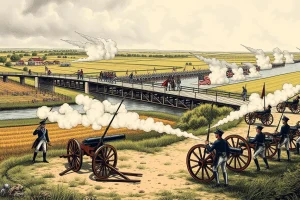
On the morning of November 7, Jackson divided his force. He left about 500 mounted men in camp to keep fires burning as a diversion, while the main body marched north and east around the principal Spanish fortification, Fort San Miguel. The Americans formed near modern Seville Square and launched an attack on a Spanish blockhouse at the corner of modern Palafox and Government Streets. The few Spanish defenders there were quickly overwhelmed. Governor González Manrique then sent a request for terms, and Jackson accepted the surrender. As American troops entered the city, they were fired upon by British marines and some of their Indian allies, but the fire was returned and the British and Indian forces fled to their ships. Some British vessels moved closer to shore and briefly exchanged fire with American artillery before withdrawing.
Jackson’s troops then occupied the town. Over the next two days, American detachments demanded the surrender of outlying Spanish fortifications, including Battery San Antonio and Fort San Carlos. Many of these had already been destroyed by the retiring British, who blew up the forts before departing. Jackson ordered the remaining fortifications rendered unusable. On November 9, after securing the town and its dependencies, Jackson departed for Mobile and then continued toward New Orleans. The British fleet, under Captain William Percy, withdrew from Pensacola Bay, though the British maintained a presence at the Apalachicola River, where they built Fort Prospect Bluff (later known as the Negro Fort).
Why It Matters
The capture of Pensacola removed a significant threat to the American left flank. It prevented the British from using Pensacola as a staging ground for land operations against New Orleans and disrupted their alliance-building with Indigenous nations and enslaved people. Jackson’s move also provided vital intelligence: the Spanish governor told Jackson that the British were planning an attack on New Orleans, confirming the objective. The operation bolstered Jackson’s reputation as a decisive commander and helped to secure the Gulf frontier. In the longer term, the weakening of Spanish authority in West Florida contributed to the eventual transfer of Florida to the United States under the Adams–Onís Treaty of 1819 (ratified 1821). Historians have debated whether Jackson’s invasion of neutral Spanish territory was legally justified, but most agree that it was strategically necessary given British misuse of Spanish soil. The action also exacerbated tensions with Spain and reflected the broader collapse of Spanish power in the Gulf region.
Prelude
The British occupation of Pensacola began in August 1814 when Royal Marines under Major Edward Nicolls arrived, accompanied by a small naval force and supplies. Nicolls and Woodbine raised a mixed force of about 100 British marines, around 500 Creek and Seminole warriors (many displaced from the Creek War), and an estimated 100 armed enslaved men, whom the British freed. They strengthened existing Spanish fortifications, including Fort San Miguel, and built a battery at a site near the later Fort Barrancas. The Spanish governor, initially welcoming or coerced, allowed British use of the port. In early November, Jackson received reports of these activities and decided to act. He left Fort Mims on November 2 with about 4,100 men, but many were on foot and the force was eventually reduced to about 3,600 effective troops. Jackson’s intent was to evict the British and reassert American control over the border area.
Forces and Commanders
American: Commanded by Major General Andrew Jackson. Forces included the 3rd U.S. Infantry, artillery, Tennessee and Kentucky militia, and a volunteer mounted rifle regiment. Total effective strength about 3,000–3,600. Key subordinates included Brigadier General John Coffee (who was not present at Pensacola but commanded cavalry on other operations) and artillery officer Major Louis de la Pena (though his unit is uncertain). Jackson’s force included Choctaw and Cherokee allies, though they played a minor role in the assault.
British: Led by Lieutenant Colonel Edward Nicolls of the Royal Marines, assisted by Captain George Woodbine. Also present was Captain William Percy of the Royal Navy, commanding a squadron of ships in Pensacola Bay. British forces numbered roughly 100 Royal Marines, 500 Indian warriors, and about 100 armed Black volunteers. However, many of the Indian and Black recruits were untrained and poorly equipped.
Spanish: Governor Mateo González Manrique commanded a garrison of about 275 regular troops at Fort San Miguel, plus local militia. The Spanish were caught between British demands and American threats, and their resistance was minimal once Jackson attacked.
Battlefield and Map Context
Pensacola is located on Pensacola Bay, a deep-water harbor on the Gulf of Mexico. In 1814, the town consisted of a small grid of streets, centered on the plaza (later Seville Square) and the Plaza de la Constitución. The principal defensive works included Fort San Miguel, an earth-and-stockade structure on a hill north of the town; a blockhouse near the waterfront; and several batteries along the bay. To the west of the town lay Fort San Carlos and Battery San Antonio, guarding the entrance to the bay near what is now Fort Barrancas. The terrain was generally flat with sandy soil, covered in pine woods. Jackson’s approach from the east avoided the strongest works and funneled him toward the weaker northern side. The bay was deep enough for the Royal Navy squadron, which included two ships of the line and several smaller vessels, but their fire could only reach the waterfront area.
Battle Chronology
November 2–5, 1814: Jackson marched south from Fort Mims, learning of British strength at Pensacola. He sent out scouting parties and wrote to Washington justifying an attack on Spanish territory.
November 6: Jackson’s army camped about two miles from Pensacola. He dispatched a flag-of-truce party to demand the surrender of the Spanish governor and the withdrawal of British forces. The envoy was fired upon, and a skirmish ensued. That evening, British troops evacuated to their ships, which repositioned westward, closer to Jackson’s camp.
November 7 (dawn): Jackson left 500 mounted men with campfires burning and marched the main body around the Spanish fortifications to the northeast. By daylight, his troops assembled near Seville Square on the eastern edge of town. The Americans attacked a Spanish blockhouse near Palafox and Government Streets, which fell quickly. Governor Manrique requested terms and offered surrender. As Jackson’s column moved along the main street, British marines and their allies fired from houses, but were driven off. The Spanish formally surrendered to Jackson. American forces occupied the town and raised the U.S. flag.
November 8: Jackson ordered a detachment to seize the outlying batteries and forts near the bay. The British had destroyed or abandoned these positions, and the Spanish soldiers at Battery San Antonio and Fort San Carlos were taken into custody or dispersed. American engineers supervised the demolition of the remaining fortifications.
November 9: Jackson, satisfied that the British threat was removed, departed Pensacola and marched back toward Mobile and New Orleans.
Casualties and Losses
Exact numbers are uncertain. American casualties were light: perhaps a few killed and wounded, but sources disagree. The Florida Historical Quarterly article cites that Jackson reported only 7 killed and 11 wounded, but some historians suggest higher figures. Spanish casualties were minimal, as they surrendered quickly. British and allied casualties were also low, but their Indian and Black recruits dispersed or retreated with the British. The primary loss for the British was the loss of the base and the credibility among the Indigenous and enslaved population they had courted.
Result
Decisive American tactical and strategic victory. The capture of Pensacola removed a dangerous British and joint-force presence from the American rear. The Spanish garrison capitulated, British forces were forced to evacuate by sea, and the port was secured. American troops destroyed the fortifications before leaving the town in Spanish hands, as Jackson did not intend to permanently occupy it. The British fleet withdrew but continued to operate in the Gulf, and the British later built Fort Prospect Bluff on the Apalachicola River, which would become the Negro Fort.
Strategic Consequences
The capture of Pensacola directly facilitated Jackson’s defense of New Orleans. With the British flanking threat eliminated, Jackson could concentrate his army on the New Orleans approach without fear of being attacked from behind. It also deprived British plans of a reliable base for recruiting enslaved and Indigenous allies, although the British continued efforts at Prospect Bluff. In a broader context, the operation exposed the weakness of Spanish Florida and contributed to American confidence and expansionism. The subsequent Treaty of Ghent (ratified February 1815) ended the war, but Jackson’s actions at Pensacola were instrumental in shaping the southeastern borderlands and American public opinion. The episode also heightened Anglo-American tensions and underscored the difficulty of neutral rights during wartime.
Primary Accounts
Key contemporary accounts include Andrew Jackson’s correspondence with the Secretary of War. On November 14, 1814, Jackson wrote to James Monroe explaining his decision to attack Pensacola and describing the capture. He claimed that the Spanish governor had been coerced and that the British had been expelled. A Spanish account from Governor González Manrique to the Captain General of Cuba narrates the surrender and blames the British for abandoning the town. The British side is recorded in reports from Captain Percy and Colonel Nicolls to their superiors, which detail the withdrawal and their continued plans. The diary of an American officer, John Banks (who served in Jackson’s 1818 expedition, not 1814), is not directly applicable, but there are scattered diaries and pension applications. The official report from Jackson is printed in The Papers of Andrew Jackson. No full transcript is provided here; for primary source access, see the Library of Congress’s Jackson Papers or the University of Tennessee Press edition.
Battlefield Today
Modern Pensacola retains elements of its historic streetscape. Seville Square, the attack point, is a public park. Fort San Miguel is gone, but Fort Barrancas, a later 19th-century fort, stands on the site of the Spanish battery. The National Park Service administers the Fort Barrancas Historic District, which includes interpretive signs and exhibits about the 1814 battle. The Pensacola Historical Society maintains a museum and archives. Visitors can walk parts of the old colonial town and see markers explaining the events of November 7, 1814. The exact locations of the 1814 blockhouse and earthworks are marked in some places, though the original structures have greatly eroded or been rebuilt.
Primary Sources
Key primary sources include:
- Andrew Jackson’s letter to James Monroe, November 14, 1814, in The Papers of Andrew Jackson, Vol. 3 (University of Tennessee Press). This letter provides Jackson’s official justification and report of the capture.
- Governor Mateo González Manrique’s correspondence with the Spanish governor of Cuba, describing the British occupation and the surrender, held at the Archivo General de Indias in Seville, Spain.
- British naval and marine reports from Captain William Percy and Lieutenant Colonel Edward Nicolls, held in the British National Archives (ADM 1/4973 and WO 1/145). They detail the British evacuation and their subsequent operations.
- The diary of an anonymous American soldier printed in the NPS article “Andrew Jackson in Pensacola” (referenced above) provides a ground-level view, though its provenance is unclear.
These sources must be weighed for bias: Jackson sought to justify a controversial invasion of neutral territory; Spanish officials complained of British and American violations of neutrality; British officers downplayed their losses and emphasized plans for future operations.
Further Reading
- Robert V. Remini, Andrew Jackson and the Course of American Empire, 1767–1821 (New York: Harper & Row, 1977).
- John Sugden, “The Southern Indians in the War of 1812: The Closing Phase,” Florida Historical Quarterly 60 (January 1982): 273–312.
- Nathaniel Millett, “Britain’s 1814 Occupation of Pensacola and America’s Response: An Episode of the War of 1812 in the Southeastern Borderlands,” Florida Historical Quarterly 84, no. 2 (Fall 2005): 157–181.
- Frank Owsley, Struggle for the Gulf Borderlands: The Creek War and the Battle of New Orleans (Gainesville: University Press of Florida, 1981).
- James R. McGovern, ed., Andrew Jackson and Pensacola (Pensacola: Jackson Day Sesquicentennial Committee, 1971).
- National Park Service, “Andrew Jackson in Pensacola,” available at https://www.nps.gov/articles/jackson-pensacola.htm.
- Civil War Trust (now American Battlefield Trust), “Battle of Pensacola, FL, November 7–9, 1814,” map and chronology, available at https://www.battlefields.org/sites/default/files/atoms/files/Pensacola%20–%20November%207-9%201814%20(March%202017).pdf.
References
- National Park Service. “Andrew Jackson in Pensacola.” Accessed October 2023. https://www.nps.gov/articles/jackson-pensacola.htm.
- American Battlefield Trust. “Battle of Pensacola, FL, November 7–9, 1814.” PDF map and chronology. https://www.battlefields.org/sites/default/files/atoms/files/Pensacola%20–%20November%207-9%201814%20(March%202017).pdf.
- Millett, Nathaniel. “Britain’s 1814 Occupation of Pensacola and America’s Response: An Episode of the War of 1812 in the Southeastern Borderlands.” Florida Historical Quarterly 84, no. 2 (2005): 157–181.
- “Floripedia: Jackson, Andrew.” From A History of Florida (1904). https://fcit.usf.edu/Florida/docs/j/jacks04.htm.
- McGovern, James R., ed. Andrew Jackson and Pensacola. Pensacola: Jackson Day Sesquicentennial Committee, 1971. Reviewed in Hispanic American Historical Review 52, no. 4 (1972): 712.
FAQ
Why did Andrew Jackson attack Pensacola, a neutral Spanish territory?
Jackson attacked Pensacola because British troops and their Indigenous and enslaved allies were using the town as a base to threaten American territory and undermine border security. Spain was too weak to enforce neutrality, and Jackson argued that eliminating the British threat was necessary to defend the Gulf frontier before the expected attack on New Orleans.
What was the outcome of the capture of Pensacola?
The American forces under Jackson captured Pensacola on November 7, 1814, forcing the British to evacuate by ship. The Spanish garrison surrendered, and Jackson’s army destroyed the fortifications before departing. The operation removed the immediate British threat and allowed Jackson to march to New Orleans without a hostile base on his flank.
Did the capture of Pensacola affect the Battle of New Orleans?
Yes. The capture of Pensacola eliminated a potential staging area for British land operations against New Orleans. It also provided Jackson with intelligence about the British intention to attack New Orleans, allowing him to prepare defenses. Historians consider the Pensacola operation a crucial preliminary to the American victory at New Orleans.
How is the capture of Pensacola remembered today?
The event is commemorated in Pensacola with historic markers, particularly around Seville Square and the Fort Barrancas area. The National Park Service and the American Battlefield Trust provide interpretive materials. Historians view it as a significant but often overshadowed episode in the War of 1812 that demonstrated Jackson’s boldness and the instability of Spanish Florida.


Leave a Reply