
Short Answer
The Battle of North Point, fought on September 12, 1814, was a significant engagement in the Chesapeake Campaign of the War of 1812. Occurring on the North Point peninsula in Baltimore County, Maryland, it pitted a British invasion force under Major General Robert Ross against American militia commanded by Brigadier General John Stricker. The battle delayed the British advance on Baltimore and witnessed the death of Ross, contributing to the eventual British withdrawal from the region.
Historical Context
Following the British capture and burning of Washington, D.C. in August 1814, British forces under Major General Robert Ross and Rear Admiral George Cockburn shifted their attention to Baltimore, a major commercial and shipbuilding center. The British aimed to deliver a decisive blow that could end the war. The Royal Navy under Vice Admiral Sir Alexander Cochrane supported the army, while the Americans prepared extensive defensive works around Baltimore, particularly at Hampstead Hill. The Battle of North Point was the land component of the larger Battle of Baltimore, which also included the naval bombardment of Fort McHenry.
What Happened
On the early morning of September 12, 1814, British troops began landing at the tip of North Point, a peninsula jutting into the Patapsco River southeast of Baltimore. Roughly 4,700 soldiers, mariners, and Colonial Marines came ashore under General Ross. Aware of the landing, Brigadier General John Stricker, commanding the 3rd Brigade of Maryland militia, deployed approximately 3,000 men along the Patapsco Neck at Godly Wood (also spelled Godley Wood), about halfway between North Point and Baltimore. The American position was flanked by Bear Creek on the right and Bread and Cheese Creek on the left, with thick woods protecting the flanks.
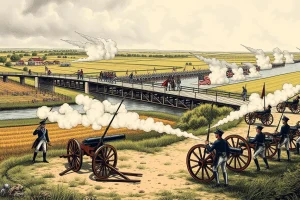
Ross advanced inland with a forward party. Around midday, his force encountered American skirmishers from the 5th Maryland Regiment, including Captain Edward Aisquith’s Sharpshooters. In the ensuing exchange, Ross was shot and mortally wounded; he died while being evacuated to the fleet. Command devolved to Colonel Arthur Brooke of the 44th Foot. Brooke continued the advance, and around 3 p.m. the main forces clashed at Godly Wood. The British launched an attack with the 4th Foot, Royal Marines, and seamen against the American left, while the 21st Fusiliers advanced along the road. The American right, anchored by the 5th Maryland, held firm despite artillery and Congreve rocket fire. After about an hour of combat, Stricker ordered a withdrawal, covered by the 5th Maryland. The British held the field but did not pursue, having suffered heavy casualties. The Americans retreated to Baltimore’s defenses, while the British encamped on the battlefield. The next day, Brooke’s troops advanced to within sight of the formidable earthworks at Hampstead Hill and, realizing an assault would be costly and with the navy unable to pass Fort McHenry, withdrew.
Why It Matters
The Battle of North Point, while a tactical British victory, achieved the American strategic objective of delaying the enemy advance and allowing the completion of Baltimore’s defenses. The determined resistance of militia, particularly the 5th Maryland, against British regulars boosted American confidence and contradicted the belief that militia would always flee. The death of General Ross deprived the British of a respected commander. The battle, combined with the failed bombardment of Fort McHenry, led to the British withdrawal from the Chesapeake and contributed to the end of the war. The defense of Baltimore became a source of American pride and inspired Francis Scott Key’s “Star-Spangled Banner.” Historians view North Point as a critical defensive engagement that changed the course of the final campaign.
Prelude
After the burning of Washington, British forces re-embarked and sailed up the Chesapeake Bay toward Baltimore. Baltimore was the third-largest U.S. city, a hub for privateers, and a strategic target. The American commander, Major General Samuel Smith, supervised the construction of extensive defensive lines, including entrenchments at Hampstead Hill. On September 11, 1814, Brigadier General John Stricker led his 3rd Brigade out of Baltimore to delay the expected British landing. He positioned his force near Godly Wood, a wooded area on the Patapsco Neck peninsula, which dominated the only road to Baltimore. The British landed at North Point in the early hours of September 12, beginning their march inland.
Forces and Commanders
British: Commanded by Major General Robert Ross, the force comprised approximately 4,700 men, including veterans of the Peninsular War, the 4th (King’s Own) Foot, the 21st Fusiliers (Royal North British Fusiliers), detachments of Royal Marines, seamen, and a contingent of Colonial Marines (freed African Americans who had joined the British). Rear Admiral George Cockburn accompanied Ross and coordinated naval support. After Ross’s death, Colonel Arthur Brooke took field command.
American: Commanded by Brigadier General John Stricker of the Maryland militia, the 3rd Brigade consisted of about 3,000 men, including the 5th, 6th, 27th, 39th, and 51st regiments of Maryland militia, plus a rifle battalion and cavalry. The 5th Maryland, which had fought at the Battle of Bladensburg, was the most experienced unit. Captain John Montgomery’s Union Artillery provided four six-pounder cannon.
Battlefield and Map Context
The battlefield was on the Patapsco Neck, a narrow peninsula between the Patapsco River to the west and southwest, and the Chesapeake Bay to the east. The main road (now Old North Point Road) ran along the peninsula’s spine. The American line stretched from Bear Creek to Bread and Cheese Creek, with thick forest providing cover. The British marched north from North Point, through the Gorsuch farm, past the skirmish site, and encountered the main American line at Godly Wood. Modern coordinates are approximately 39.25° N, 76.45° W, within present-day Dundalk, Maryland.
Battle Chronology
12 Sep 1814, early morning: British landing begins at North Point. Ross and Cockburn land with the first wave.
Mid-morning: Ross orders Colonel Brooke to hasten the landing and then advance. Ross and Cockburn move ahead with a covering party.
About 11 a.m.: Ross’s party encounters American skirmishers near the Aisquith farm. In a brief exchange, Ross is shot through the right arm into the chest. He is carried back to the fleet, where he dies.
Early afternoon: Brooke completes the landing and begins the advance with the main body.
c. 3 p.m.: British arrive at the American main line at Godly Wood. Brooke sends the 4th Foot and Marines against the American left, and the 21st Fusiliers against the center/road. Congreve rockets are fired, causing confusion but no rout. The 5th Maryland holds the right flank.
c. 4 p.m.: After about an hour of fighting, Stricker orders a withdrawal. The 5th Maryland covers the retreat. The British halt after being surprised by the American resistance.
Evening: The Americans retreat to Cook’s Tavern, then under nightfall to Baltimore defenses. The British bivouac on the battlefield, planning to resume the advance the next day.
13 Sep: Brooke moves toward Baltimore but seeing the formidable fortifications at Hampstead Hill and without naval support (the navy was engaged at Fort McHenry), he decides on withdrawal.
Casualties and Losses
Reports vary slightly, but the best-documented figures from the National Park Service state British casualties were 46 killed and 295 wounded. American casualties were 24 killed, 139 wounded, and 50 captured. These numbers reflect the intensity of the engagement, particularly considering the relatively short duration. The 5th Maryland suffered heavy losses while holding the line.
Result
The British held the battlefield at nightfall, making the engagement a tactical British victory. However, they failed to pursue the retreating Americans, and the delay proved costly. The battle accomplished the American goal of buying time for the consolidation of Baltimore’s defenses. Strategically, the result was a British repulse, as they ultimately abandoned the campaign without capturing the city.
Strategic Consequences
The battle and the subsequent bombardment of Fort McHenry (September 13–14, 1814) convinced the British that Baltimore could not be taken without unacceptable losses. The British withdrew, ending the Chesapeake campaign. The defense of Baltimore restored American morale after the loss of Washington and strengthened the United States’ negotiating position in the peace talks that led to the Treaty of Ghent. The death of Ross also removed an effective commander from the British expedition.
Primary Accounts
Primary sources include the official report of Brigadier General John Stricker to Major General Samuel Smith, dated September 13, 1814, describing the battle and his withdrawal. British officer accounts include those in the London Gazette dispatches, though often less detailed. American newspaper accounts, such as those in Niles’ Weekly Register, provided immediate reporting. A notable eyewitness letter from a British soldier, published in a local English newspaper, also survives. These sources vary in bias and accuracy, with each side emphasizing its own courage and the enemy’s retreat.
Battlefield Today
The site of the Battle of North Point is now part of the Star-Spangled Banner National Historic Trail, administered by the National Park Service. A memorial obelisk was erected in 1914 to commemorate the battle and is located along Old North Point Road. The battlefield is partly developed, but the topography remains recognizably similar. The National Park Service provides interpretive signage and exhibits. The surrounding area is now suburban, with some green spaces preserved, including the battlefield site and adjacent parkland.
Primary Sources
Stricker’s after-action report is a critical document, located in the Maryland Historical Society’s records. The British official dispatches from Vice Admiral Cochrane and Major General Ross (before his death) are preserved in the British National Archives and published in the London Gazette. American newspapers from September 1814, such as the Baltimore Federal Gazette and Niles’ Weekly Register, contain reports and casualty lists. The National Park Service provides curated transcriptions of some of these sources online.
Further Reading
- George, Christopher T. By the Blood of Men: The Battle of North Point and the Defense of Baltimore, 1814. 2012.
- Whitehorne, Joseph A. The Battle for Baltimore, 1814. 1997.
- National Park Service, Star-Spangled Banner National Historic Trail: Battle of North Point webpage.
- Fort McHenry National Monument and Historic Shrine, articles on North Point Part 1 and Part 2.
References
- National Park Service, “Battle of North Point,” Star-Spangled Banner National Historic Trail, accessed October 2023, https://www.nps.gov/stsp/learn/historyculture/battle-of-north-point.htm.
- National Park Service, “The Battle of North Point Part 2,” Fort McHenry National Monument and Historic Shrine, accessed October 2023, https://www.nps.gov/fomc/learn/historyculture/north-point-pt-2.htm.
- National Park Service, “The Battle of North Point Part 1,” Fort McHenry National Monument and Historic Shrine, accessed October 2023, https://www.nps.gov/fomc/learn/historyculture/north-point-pt-1.htm.
- U.S. Army Center of Military History, “Battle of North Point,” National Guard Heritage Series, accessed October 2023, https://history.army.mil/art/a&i/northpt.htm.
- National Park Service, “Baltimore and North Point,” Star-Spangled Banner National Historic Trail, accessed October 2023, https://www.nps.gov/stsp/learn/historyculture/baltimore-and-north-point.htm.
FAQ
Why is the Battle of North Point important?
It delayed the British advance on Baltimore, allowed American defenses to strengthen, and led to the death of British commander Robert Ross, contributing to the eventual British withdrawal.
Who commanded the American forces at North Point?
Brigadier General John Stricker of the Maryland militia, leading the 3rd Brigade of about 3,000 men.
What were the casualties at the Battle of North Point?
British casualties were 46 killed and 295 wounded; American casualties were 24 killed, 139 wounded, and 50 captured.


Leave a Reply