Short Answer
The Battle of Bladensburg, fought on August 24, 1814, in Maryland, was a decisive British victory during the Chesapeake campaign of the War of 1812. A British force of regulars and Royal Marines routed a larger combined American force of regulars and militia, opening the way for the capture and burning of Washington, D.C. The defeat, sometimes mockingly called the “Bladensburg Races,” stands as a low point in American military history and the only time the national capital fell to a foreign invader.
Historical Context
For the first two years of the War of 1812, Britain was preoccupied with the Napoleonic Wars in Europe. After Napoleon’s abdication in April 1814, thousands of veteran British troops became available for service against the United States. Vice Admiral Sir Alexander Cochrane, commander of the Royal Navy’s North American Station, and Rear Admiral George Cockburn had already conducted a campaign of raids and blockades in the Chesapeake Bay since 1813. In August 1814, a brigade of about 4,500 veterans under Major General Robert Ross was dispatched to Bermuda and then to the Chesapeake to carry out a diversionary attack on the American coast. The British aimed to weaken American morale, destroy public property, and potentially capture a major city. Washington, the young republic’s capital, was an attractive target because of its symbolic value and strategic insignificance, though U.S. Secretary of War John Armstrong initially believed Baltimore was more likely to be attacked.
What Happened
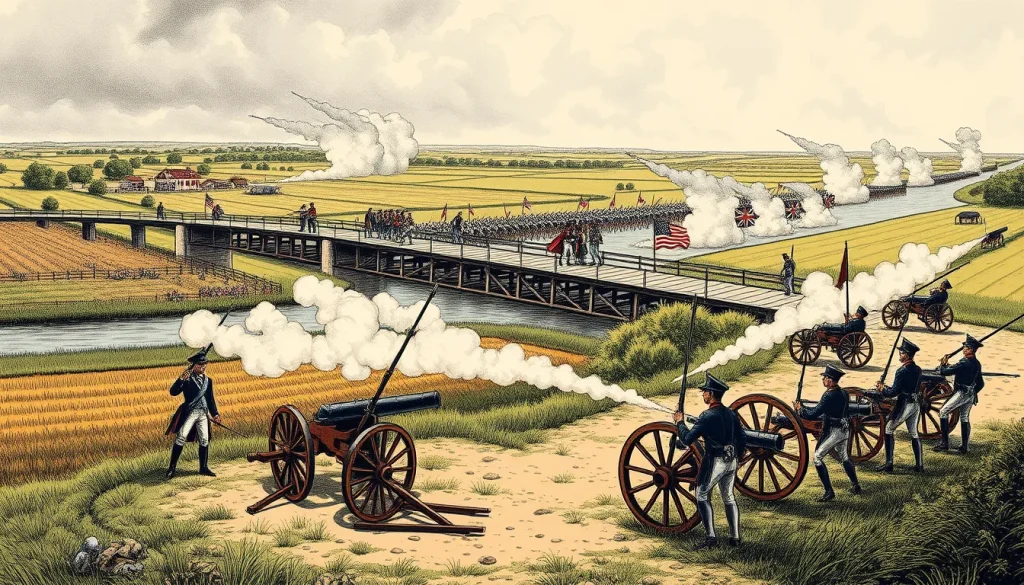
British troops landed at Benedict, Maryland, on August 19, 1814, and advanced inland. American Brigadier General William H. Winder, commander of the Tenth Military District, was uncertain whether the target was Washington or Baltimore. By August 23, it was clear the British were heading for Washington. Secretary of State James Monroe, acting as a scout, reported their approach and urged preparations. American forces, numbering between 6,000 and 7,000, were hastily assembled at Bladensburg, a town on the Eastern Branch of the Potomac River (now the Anacostia River). They occupied low heights west of the town, with the single bridge over the river as a natural bottleneck. On August 24, the British arrived and, after a brief bombardment, stormed the bridge and also forded the river upstream. The American militia, positioned in three successive lines that could not support each other, broke under British artillery and Congreve rockets. Only the third line, commanded by Commodore Joshua Barney with about 400 flotillamen and 114 U.S. Marines, put up a stiff resistance. Barney’s men inflicted heavy casualties on the British before they were outflanked and Barney was wounded and captured. The American retreat became a rout, with soldiers fleeing toward Washington. President James Madison, who had watched from the field, retreated with his cabinet. That evening, British troops entered Washington and burned the Capitol, White House, and other public buildings.
Why It Matters
The Battle of Bladensburg had immediate and long-lasting significance. It exposed the weaknesses of American defense, particularly the reliance on untrained militia and poor coordination between regular forces and state troops. The capture and burning of Washington was a humiliating blow to American pride and morale. However, it also galvanized American resolve and prompted a thorough investigation into the failures. Strategically, the British victory encouraged further attacks, including the assault on Baltimore in September 1814, which was repulsed. Historians later saw the battle as a turning point that strengthened American determination and contributed to the eventual peace negotiations in Ghent. The phrase “Bladensburg Races,” coined by the press, became a lasting symbol of American unpreparedness.
Prelude
After the fall of Napoleon, British war plans called for a series of coastal raids to draw American forces away from Canada and weaken public support for the war. Major General Robert Ross, a veteran of the Peninsular War, commanded a brigade of regulars, Royal Marines, and a detachment of Royal Artillery. The fleet assembled in Bermuda and entered the Chesapeake, landing at Benedict on the Patuxent River. The British force moved overland, brushing aside small American skirmishes. Meanwhile, the Americans struggled to assemble troops. Winder, a lawyer with limited military experience, had been captured at Stoney Creek in 1813 and only recently exchanged. He had a vague sense of the British route and initially believed Baltimore was the target. Secretary Armstrong dismissed Washington’s vulnerability. By the time the British were confirmed to be heading for Bladensburg, the Americans had little time to prepare a coherent defense. Monroe, who had ridden out to gather intelligence, recommended the Bladensburg position, but the lines were poorly placed and units lacked cohesion.
Forces and Commanders
The British force numbered approximately 4,370 to 4,500 men, including the 4th, 21st, 44th, and 85th Regiments of Foot, as well as Royal Marines and a contingent of Royal Artillery with 3 guns and 60 rockets. They were commanded by Major General Robert Ross, with Rear Admiral George Cockburn overseeing naval support and coordinating seaborne landings. American forces numbered over 6,000, consisting of militia from Maryland and the District of Columbia, a small number of U.S. Regulars, and about 500 Marines and sailors under Commodore Joshua Barney. Barney’s flotilla men were experienced from earlier actions on the Chesapeake. The overall American commander was Brigadier General William H. Winder. Other key officers included Brigadier General John Stricker of Maryland militia and Colonel William Beall. Barney’s contingent formed the core of the most effective resistance.
Battlefield and Map Context
The battlefield lay along the eastern branch of the Potomac River (Anacostia) at Bladensburg, Maryland, about six miles northeast of Washington, D.C. The river was about 80 yards wide at the bridge, and the surrounding area consisted of open fields and woods. The American defense was established west of the river on a gentle slope, with three successive lines. The first line held the bridge and nearby fords; the second line was about half a mile back; the third line was on a low hill near the present-day intersection of Baltimore Avenue and 49th Street. The terrain favored the defenders if they could hold the bridge, but gaps in the lines and lack of mutual support proved fatal. Modern visitors can see the battlefield area at Bladensburg Waterfront Park and the nearby Anacostia River, which retains its 1814 course.
Battle Chronology
The British arrived at Bladensburg around 11:00 AM on August 24. Ross sent a brigade to ford the river upstream while the main body demonstrated against the bridge. At about 12:30 PM, British artillery and rockets opened fire on the American first line. The militia, largely untrained and exposed to the terrifying Congreve rockets, began to break. British light companies crossed the ford, turning the American left flank. As the first line collapsed, the second line also wavered and soon joined the retreat. Barney’s third line, positioned on a rise, held for a time, inflicting heavy casualties on the British as they advanced. His sailors and Marines fought with precision, repelling several attacks. However, British infantry outflanked his position, and Barney was wounded in the thigh. His men were forced to surrender, though many escaped. By 4:00 PM, the American army had disintegrated, and the road to Washington was open. British soldiers entered the capital at about 8:00 PM.
Casualties and Losses
Exact casualty figures vary by source. The British reported 64 killed and 185 wounded. American losses are generally given as 10 to 26 killed, 40 to 51 wounded, and 100 to 120 captured. The disparity reflects the American retreat and the effectiveness of British fire. Some American accounts claim higher numbers, but the official returns recorded these figures. Barney’s stand cost the British many of their casualties. The small number of American dead suggests that most losses were from the breakdown of command and the panic that followed, rather than from combat.
Result
The Battle of Bladensburg was a clear British victory. British forces routed the American army, captured several guns and supplies, and suffered only modest losses. The victory opened the way for the occupation of Washington, D.C., which occurred the same evening. It was the first and only time a foreign power captured the United States capital. The American defeat was total and humiliating, leading to immediate recriminations and a congressional investigation.
Strategic Consequences
The immediate consequence was the burning of Washington’s public buildings. British troops under Ross and Cockburn set fire to the Capitol, the White House, the Treasury, and other structures on August 24 and 25. The British withdrew the following day, as the destruction was intended to break American morale rather than occupy territory. The attack had the opposite effect in the long run: it united Americans and strengthened resolve to continue the war. It also led to the dismissal of Secretary of War Armstrong and increased reliance on trained regulars. British forces then turned to Baltimore, where they met stiffer resistance at North Point and Fort McHenry. The failure to take Baltimore, combined with the burning of Washington, influenced the peace negotiations at Ghent, where British demands were moderated. Some historians argue that the battle and burning strengthened American bargaining position by demonstrating British aggressiveness, which may have contributed to the eventual peace without territorial changes.
Primary Accounts
Contemporary accounts include Secretary of State James Monroe’s urgent letter to Madison on August 23, reporting the British advance. British officer accounts, such as those in the diary of Ensign George Gleig, described the flight of the Americans. American reports, including Winder’s report to Secretary Armstrong, acknowledged the collapse of the militia. A famous anonymous poem, “The Bladensburg Races,” published in January 1815, satirized Madison’s flight. Commodore Joshua Barney’s account of his stand was reprinted in newspapers. These sources provide varying perspectives, but all confirm the rapid American defeat.
Battlefield Today
The battlefield is not preserved as a national park, but sites associated with the battle remain. Bladensburg Waterfront Park, operated by Prince George’s County, Maryland, offers a view of the Anacostia River and historical markers. The Star-Spangled Banner National Historic Trail includes the battle site. The village of Bladensburg has grown, but the bridge and general terrain are still recognizable. A small parking lot and trail at the park include interpretive panels detailing the battle’s events, and a statue honors Commodore Barney’s Marines. The site is accessible to visitors interested in the War of 1812.
Primary Sources
Relevant primary sources include: 1) James Monroe’s letters and reports to President Madison, August 22–23, 1814, which provide intelligence on British movements. 2) Commodore Joshua Barney’s report to the Secretary of Veterans Affairs (or his account in Niles’ Weekly Register), describing his stand and capture. 3) British officer accounts, such as those in George R. Gleig’s memoir, “A Narrative of the Campaigns of the British Army in Washington and New Orleans,” published in 1821. 4) U.S. Army official returns, which list casualties. 5) Newspaper accounts of the day, including the anonymous poem “The Bladensburg Races.” These sources vary in reliability; American commanders often minimized their own errors, while British accounts emphasized their enemy’s cowardice. Together they provide a balanced, if partisan, view.
Further Reading
- Pitch, Anthony. “The Burning of Washington: The British Invasion of 1814.” Naval Institute Press, 1998.
- Hickey, Donald R. “The War of 1812: A Forgotten Conflict.” University of Illinois Press, 1989.
- Whitehorne, Joseph A. “The Battle of Bladensburg.” U.S. Army Center of Military History, 1989.
- NPS Star-Spangled Banner National Historic Trail, “Battle of Bladensburg,” https://www.nps.gov/stsp/learn/historyculture/battle-of-bladensburg.htm.
References
- National Park Service. “Battle of Bladensburg.” Star-Spangled Banner National Historic Trail. https://www.nps.gov/stsp/learn/historyculture/battle-of-bladensburg.htm
- National Park Service. “Summer 1814: American troops flee in humiliation, leaving Washington exposed.” https://www.nps.gov/articles/bladensburg-races.htm
- Britannica, T. Editors of Encyclopaedia. “Battle of Bladensburg.” Encyclopedia Britannica. https://www.britannica.com/topic/Battle-of-Bladensburg
- American Battlefield Trust. “Bladensburg Battle Facts and Summary.” https://www.battlefields.org/learn/war-1812/battles/bladensburg
- Wikipedia. “Battle of Bladensburg.” https://en.wikipedia.org/wiki/Battle_of_Bladensburg (accessed 2024; used for consolidated data, cross-referenced with primary sources).
FAQ
Why did the Americans lose the Battle of Bladensburg despite superior numbers?
The American forces were mostly untrained militia who lacked experience and discipline. Their defensive lines were poorly positioned and could not support each other. British veterans, using rockets and flanking maneuvers, broke the militia's morale, leading to a panic-stricken retreat.
What was the significance of the Battle of Bladensburg?
The battle opened the way for the British capture of Washington, D.C., the only time the U.S. capital was occupied by a foreign enemy. It was a severe blow to American prestige and led to the burning of public buildings, but it also rallied American resistance and contributed to the peace negotiations that ended the war.
Who was Commodore Joshua Barney, and what role did he play?
Commodore Joshua Barney commanded a flotilla of gunboats on the Chesapeake. At Bladensburg, he led a combined force of about 400 flotillamen and 114 U.S. Marines in a determined stand that delayed the British. He was wounded and captured, but his troops inflicted significant casualties on the British and were the only American forces to fight effectively.


Leave a Reply