
Short Answer
The Chesapeake Campaign of 1814 was a British amphibious offensive in the Chesapeake Bay region during the War of 1812, aimed at diverting American forces from the Canadian frontier and striking at the heart of the U.S. government. It culminated in the burning of Washington, D.C., and a failed attack on Baltimore, Maryland, and is perhaps most remembered for Francis Scott Key’s composition of “The Star-Spangled Banner.”
Historical Context
The War of 1812 had reached a stalemate by 1814. American invasions of Canada had failed, but the British were still heavily engaged in Europe against Napoleon. The defeat of Napoleon in April 1814 freed about 14,000 experienced British troops for service in North America. The British government planned a three-pronged strategy: an attack along the Hudson River to divide New England, an assault on New Orleans to control the Mississippi, and a campaign to bring economic and political pressure on the Chesapeake region—the seat of the U.S. government. The Chesapeake Bay had already suffered British raids and blockades since February 1813, when Admiral Sir John Borlase Warren’s squadron entered the bay. By 1814, the region was vulnerable: the regular U.S. Army was concentrated on the Canadian border, leaving Maryland and Virginia defended mainly by untrained militia. Britain’s goal was to demonstrate that the United States, which had invaded Canada and burned York (Toronto), could not protect its own capital, thereby forcing the Americans to negotiate favorable terms at the peace talks in Ghent.
What Happened
The campaign began in earnest in June 1814. British forces under Rear Admiral George Cockburn and Major General Robert Ross, both veterans of the Peninsular War, entered the Chesapeake. They attacked the U.S. Chesapeake Flotilla under Commodore Joshua Barney at St. Leonards Creek in June, forcing the flotilla to take refuge. On August 19–20, a British force of about 4,500 troops landed at Benedict, Maryland, on the Patuxent River. They advanced overland toward Washington, D.C. On August 24, they defeated a larger American force of approximately 6,500 militia and regulars at the Battle of Bladensburg, a rout known derisively as the “Bladensburg Races.” Only Barney’s flotillamen and a company of Marines put up determined resistance. The British entered Washington that evening and burned the Capitol, the President’s House, and other public buildings, while President James Madison and his cabinet fled. The occupation lasted only a day, but it was a humiliating blow. Simultaneously, a British squadron sailed up the Potomac River, forcing the evacuation of Fort Washington, and occupied Alexandria, Virginia, from August 28 to September 3, seizing 21 ships and large quantities of flour, tobacco, and cotton. After withdrawing from Washington, the British moved toward Baltimore, a major port and privateering center. On September 12, they landed about 4,500 troops at North Point and marched toward the city, but were delayed by American militia under Major General Samuel Smith; General Ross was killed by a sniper. The British fleet bombarded Fort McHenry on September 13–14, but the American defenders, reinforced by militia and naval gunners, held. The British withdrew, ending the campaign.
Why It Matters
The Chesapeake Campaign had immediate and lasting consequences. The burning of Washington exposed American military weakness and fueled calls for reform, but the successful defense of Baltimore—culminating in Francis Scott Key’s writing of “The Star-Spangled Banner”—boosted American morale and provided a symbol of resolve. The campaign also influenced the Treaty of Ghent. Although British forces had occupied parts of the United States, their failure to capture Baltimore and the ongoing stalemate in the north encouraged both sides to accept a return to status quo ante bellum. Historians interpret the campaign as a demonstration of Britain’s ability to project power anywhere along the American coast, yet also as proof that well-prepared American defenses, even relying on militia, could resist veteran British troops. The campaign’s legacy is preserved in the Star-Spangled Banner National Historic Trail and Fort McHenry National Monument.
Prelude
The British plan for the Chesapeake was devised after Napoleon’s abdication in April 1814. The Admiralty and War Office directed that a strong force be sent to the Chesapeake to divert American troops from Canada and to punish the nation that had burned Upper Canada’s parliament buildings. Rear Admiral Cockburn, who had conducted raids along the bay since 1813, provided detailed knowledge of the shallow waters and rivers. In June 1814, a squadron under Commodore John Nourse and later Captain James Gordon moved up the Patuxent River to eliminate the American flotilla. By August, the main invasion fleet under Vice Admiral Sir Alexander Cochrane had arrived with transports carrying 4,500 troops commanded by Major General Robert Ross, a respected Peninsular War officer. The selection of Benedict as the landing point avoided heavily defended areas and allowed a direct advance on Washington.
Forces and Commanders
British: The land force consisted of about 4,500 regulars from the Peninsular Army, including the 4th, 21st, 44th, and 85th Foot, plus artillery and rocket detachments. Command was held by Major General Robert Ross, with Rear Admiral George Cockburn overseeing naval coordination. The fleet included ships of the line, frigates, bomb vessels, and transports under Vice Admiral Sir Alexander Cochrane overall.
American: Defenders of the Chesapeake were primarily militia from Maryland, Virginia, and the District of Columbia, along with some regular Army units and Navy personnel. Brigadier General William Winder commanded the Tenth Military District, but Major General Samuel Smith of the Maryland militia effectively directed the defense of Baltimore. Commodore Joshua Barney’s flotillamen provided veteran fighting sailors. At Bladensburg, the American force numbered about 6,500; at North Point, about 3,200 militia and regulars opposed the British advance.
Battlefield and Map Context
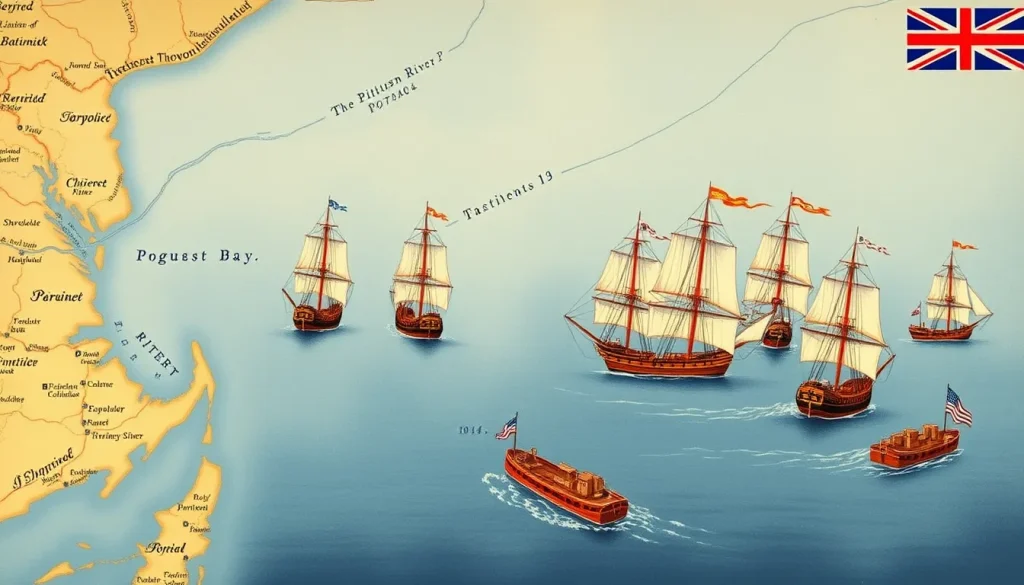
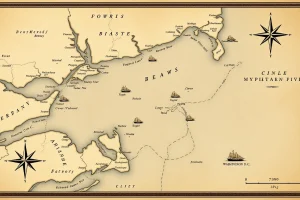
The Chesapeake Bay is the largest estuary in the United States, stretching roughly 200 miles from the Susquehanna River to the Atlantic Ocean. Its numerous rivers—Patuxent, Potomac, Patapsco—provided both invasion routes and hiding places for British raiders. The terrain around Washington featured low hills, farmland, and the difficult crossing at Bladensburg over the Eastern Branch of the Potomac. Baltimore lay at the head of the Patapsco River, protected by the fortified bastion of Fort McHenry and the shallow approaches that limited large ships. The British used their control of the bay to move troops and supplies, while the Americans relied on fortifications and militia reinforcements. Maps of the period, such as the 1819 survey by Lewis Brantz and Fielding Lucas, Jr., show the strategic importance of the river systems.
Battle Chronology
June 1–10, 1814: The U.S. Chesapeake Flotilla, commanded by Commodore Joshua Barney, is pursued by a vastly superior British squadron and takes refuge in the Patuxent River.
June 19–26: Battles of St. Leonards Creek occur; Barney’s flotilla exchanges fire with British barges but is blockaded.
August 19–20: British troops land at Benedict, Maryland, and begin marching overland toward Washington.
August 24: Battle of Bladensburg; the British rout the American force, opening the path to Washington.
August 24–25: British troops burn the Capitol, President’s House, and other public buildings in Washington, D.C. President Madison flees.
August 27: Fort Washington on the Potomac is destroyed by its garrison; British naval squadron moves upriver.
August 28–September 3: Alexandria, Virginia, capitulates; British occupy the town and seize merchant ships and cargoes.
August 31: Battle of Caulk’s Field: Maryland militia repel a British landing attempt on the Eastern Shore.
September 12: Battle of North Point: American militia delay the British advance on Baltimore; Major General Robert Ross is killed.
September 13–14: Bombardment of Fort McHenry: British bomb vessels fire for 25 hours; the fort holds, and the British fleet withdraws.
Casualties and Losses
Exact casualty figures for the campaign are uncertain, but estimates exist for each engagement. At Bladensburg, British casualties were roughly 250 killed and wounded; American losses were about 100 killed, wounded, and captured. The burning of Washington caused no military casualties but destroyed public buildings. At North Point, the British suffered about 350 casualties, including General Ross; the Americans lost about 160. The bombardment of Fort McHenry caused only minor American casualties—possibly 4 killed and 24 wounded—but the British lost at least one bomb vessel. The raid on Alexandria yielded 21 captured ships and an estimated $245,000 worth of goods. The overall campaign saw perhaps 500 British and 400 American military casualties, not counting enslaved persons who escaped to British lines.
Result
The Chesapeake Campaign was a British tactical victory in terms of capturing and burning the U.S. capital, and it achieved the strategic goal of diverting American attention and resources. However, the campaign failed to force the United States to sue for peace. The British withdrew after failing to capture Baltimore, and they subsequently returned to the fleet. The campaign ended in September 1814, with the British focusing on the Gulf Coast and the north. The American defense of Baltimore, epitomized by Fort McHenry, was celebrated as a victory and contributed to national pride.
Strategic Consequences
The campaign had several strategic effects. It exposed the vulnerability of the American capital and the inefficiency of relying on untrained militia, prompting reforms in the Army and coastal defenses. It also demonstrated that Britain could strike anywhere along the coast, but that local defenses, when well-led, could inflict serious resistance. The burning of Washington allowed the British to claim a symbolic victory, yet the failure at Baltimore strengthened the American position at the Treaty of Ghent, which restored the prewar borders. The campaign also had a human cost: thousands of enslaved African Americans in the Chesapeake seized the opportunity to escape to British lines, with several hundred serving in the Colonial Marines. Their liberation is a topic of growing historical interest.
Primary Accounts
Primary sources include the official reports of Rear Admiral Cockburn and Major General Ross to the Admiralty, published in the London Gazette; American correspondence from General Winder and Secretary of War John Armstrong; the diary of Dolley Madison, recounting her escape from the White House; and the British naval records of Vice Admiral Cochrane. The poem by Francis Scott Key, “Defence of Fort McHenry,” written on September 14, 1814, is a firsthand account of the bombardment from a British truce ship. These sources reflect the different perspectives of each side, but all are filtered by personal motivations and official censorship. For example, British reports emphasize the disciplined burning of public buildings, while American accounts stress the trauma of invasion.
Battlefield Today
Many sites of the campaign are preserved. The Star-Spangled Banner National Historic Trail connects significant locations in Maryland, Virginia, and Washington, D.C., from Benedict and Bladensburg to Baltimore. Fort McHenry is a national monument and historic shrine, featuring the flag that inspired the anthem. The White House and Capitol were rebuilt and remain standing. The U.S. Navy Yard in Washington was restored. At North Point, a monument commemorates the battle, and at Caulk’s Field, a state historical marker notes the engagement. The National Park Service and the Maryland Historical Trust administer these sites, which are accessible to the public.
Primary Sources
Useful primary sources include: (1) Rear Admiral George Cockburn’s dispatches to the Admiralty, describing the campaign and the burning of Washington; (2) Major General Robert Ross’s official report to Vice Admiral Cochrane after the capture of Washington; (3) Commodore Joshua Barney’s account of his defense at Bladensburg; (4) Dolley Madison’s letters describing her escape; and (5) the poem “The Star-Spangled Banner.” Each source offers a distinct perspective: British military reports justify their actions as retaliation; Barney’s account provides a hero’s narrative; and Key’s poem is a highly partisan American view. Researchers should compare these with American militia records and local histories to understand the campaign’s full impact.
Further Reading
- The Chesapeake Campaign, 1813–1814, by Charles P. Neimeyer (U.S. Army Center of Military History, 2014)
- The War of 1812: A Forgotten Conflict, by Donald R. Hickey (University of Illinois Press)
- 1812: War with America, by Jon Latimer (Harvard University Press)
- The Star-Spangled Banner: The Making of an American Icon, by Lonn Taylor and Kathleen M. Kendrick (Smithsonian Books)
- National Park Service, Star-Spangled Banner National Historic Trail (official website)
References
- Neimeyer, Charles P. The Chesapeake Campaign 1813–1814. U.S. Army Center of Military History, 2014. govinfo.gov.
- National Park Service. “1814 Chesapeake Campaign.” Star-Spangled Banner National Historic Trail. Accessed 2023. nps.gov.
- National Park Service. “War in the Chesapeake.” Star-Spangled Banner National Historic Trail. Accessed 2023. nps.gov.
- Vergun, David. “War of 1812: Chesapeake Campaign concludes with American victories.” U.S. Army, September 4, 2014. army.mil.
- “The Chesapeake Campaign.” The War of 1812 Website. Accessed 2023. thewarof1812.org.
FAQ
Why did the British attack the Chesapeake in 1814?
After Napoleon's defeat, Britain freed troops to attack the United States. The Chesapeake was chosen because it contained the U.S. capital and was a major commercial center. The goal was to divert American forces from Canada and force a favorable peace.
What was the outcome of the Chesapeake Campaign?
The British captured and burned Washington, D.C., but failed to take Baltimore. The campaign ended in a British withdrawal after the failed bombardment of Fort McHenry, boosting American morale and contributing to the Treaty of Ghent.
How did the campaign affect the writing of the Star-Spangled Banner?
Francis Scott Key, detained on a British ship during the bombardment of Fort McHenry, saw that the American flag still flew at dawn on September 14, 1814, and wrote the poem that became the national anthem.
What was the role of enslaved African Americans in the campaign?
The British promised freedom to enslaved people who escaped to their lines. Thousands did so, and several hundred enlisted in the Colonial Marines. This caused economic and social disruption in the Chesapeake region.
Leave a Reply