Short Answer
The Battle of Big Sandy Creek took place on May 30, 1814, near the mouth of Big Sandy Creek on the southeastern shore of Lake Ontario, in what is now Jefferson County, New York. American riflemen and Oneida warriors, supported by local militia and dragoons, ambushed a British naval expedition after it pursued an American supply flotilla into the narrow creek. The British force, sent to intercept naval stores bound for the American shipyard at Sackets Harbor, was almost entirely killed, wounded, or captured. The action removed a direct threat to the supplies and allowed their eventual overland movement to Sackets Harbor, making it a significant tactical success in the Lake Ontario theater.
Historical Context
During the spring of 1814, the naval struggle on Lake Ontario centered on the construction of large warships at Sackets Harbor, New York, and Kingston, Upper Canada. British and American commodores, Sir James Yeo and Isaac Chauncey, each sought to gain numerical superiority over the other by building more heavily armed ships. After a British amphibious force captured Fort Oswego on May 5–6, 1814, British warships were able to patrol the eastern lake and intercept American commerce. The American shipyards at Sackets Harbor needed heavy ordnance, cables, and rigging that had been transported by inland waterways from New York City to Oswego. Moving those supplies from Oswego to Sackets Harbor by water meant passing within view of British cruising squadrons; any delay would retard the outfitting of the new American brigs and frigate.
What Happened
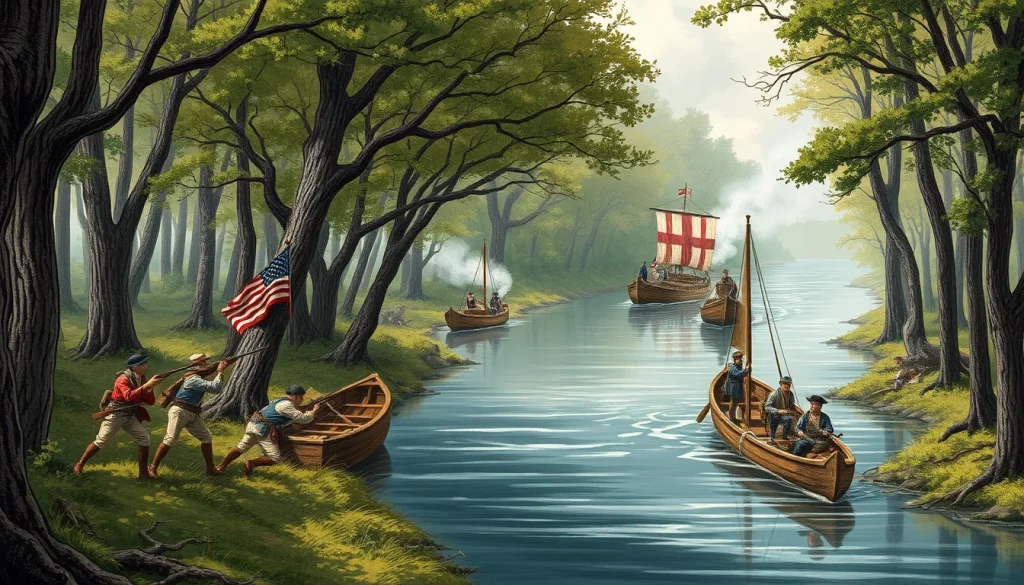
On the night of May 28, Lieutenant Melancthon T. Woolsey assembled a flotilla of nineteen bateaux at Oswego, loaded with guns and naval stores, and accompanied by Major Daniel Appling’s 150 men of the United States Rifle Regiment. Oneida warriors, numbering perhaps 120 to 130, marched along the shore to provide reconnaissance. In the dark, one boat became separated and was taken by the British; its crew revealed the existence of the larger convoy. Woolsey and Appling, aware that they had been discovered, pushed on and turned into Big Sandy Creek on the morning of May 29. The creek was narrow and bordered by dense trees, which offered an excellent defensive position. They rowed as far upstream as possible and began unloading.
Meanwhile, Captain Stephen Popham, commanding a force of sailors and Royal Marines, entered the creek with three gunboats and four smaller cutters, expecting to overwhelm or capture the Americans. On May 30, at about 8 a.m., the British opened fire with their guns from the creek mouth. As the boats worked upstream, the American soldiers and Oneidas, hidden in the woods, held their fire until the British were close. Around 10 a.m., when the leading boats reached the bend where the supplies had been landed, the American line rose and opened a close-range fire. The British could not deploy in the confined channel and suffered heavy casualties. Within perhaps ten minutes, Popham, who had been wounded, surrendered his entire force.
Why It Matters
Although a small engagement, the result gave the Americans unhindered use of Big Sandy Creek and allowed them to move the supplies overland. The captured British sailors and marines reduced Yeo’s pool of trained seamen, and the boats they surrendered—three gunboats, two cutters, and a gig—were prizes useful to the Americans. The British fleet, after learning of the loss, eventually withdrew to Kingston, ending the immediate blockade of Sackets Harbor. The battle also demonstrated the value of Oneida participation; this was one of the few actions in the war where Indigenous warriors and regular American troops fought side by side in New York territory. In later historical memory, the engagement is often overshadowed by larger naval actions, but it is remembered locally as an example of effective planning and concealment.
Prelude
After the British capture of Fort Oswego on May 5–6, the American naval command at Sackets Harbor decided to rush forward the munitions and equipment required for USS Superior and other ships under construction. Commodore Chauncey ordered Lieutenant Woolsey to proceed to Oswego, collect the supplies, and move them north by small boats. Woolsey left Oswego on the evening of May 28 with Appling’s riflemen and the Oneida contingent. The accidental discovery of a lost boat by the British on May 29 forced a change of plan and led directly to the choice of Big Sandy Creek as a refuge.
Forces and Commanders
American
- Lieutenant Melancthon T. Woolsey, U.S. Navy, commander of the expedition.
- Major Daniel Appling, 1st U.S. Rifle Regiment, commander of the escort.
- Oneida warriors, under local chiefs; estimates range from 120 to 130.
- Local militia and a detachment of United States dragoons arrived during the morning of May 30.
- Strength estimates: roughly 150 regular riflemen, 120–130 Oneidas, and an uncertain number of militia (often reported as 275 combined).
British
- Captain Stephen Popham, Royal Navy.
- Commander Francis Brockell Spilsbury, Royal Navy.
- 185–200 sailors and Royal Marines, in three gunboats, two cutters, and one gig.
Battlefield and Map Context
The battlefield lies near the modern hamlet of Ellisburg, about twenty miles south of Sackets Harbor. Big Sandy Creek, also called South Sandy Creek, is a winding, shallow stream that discharges into Lake Ontario through a marshy area. In 1814 it was enclosed by thick woods, which gave concealed firing positions close to the water. A mile or so from the lake the creek narrows and bends, making boat movement difficult and presenting excellent fields of fire from both banks. The Americans positioned themselves approximately half a mile below the landing point, near the place now commemorated by the Great Lakes Seaway Trail marker. After the battle, the supplies had to be carried overland along what is now New York State Route 3 and local roads to Sackets Harbor.
Battle Chronology
- May 28, night: Woolsey’s flotilla leaves Oswego.
- May 29: Lost boat discovered by the British; the American mission is revealed.
- May 29, noon: Americans enter Big Sandy Creek and begin unloading.
- May 29, afternoon: Woolsey scouts, sees British vessels; militia and dragoons arrive.
- May 30, 8 a.m.: British vessels begin cannonade at the creek mouth.
- May 30, 10 a.m.: British boats reach the ambush site; American force opens fire.
- After a short action, Popham surrenders.
Casualties and Losses
Casualty figures are not uniform in contemporary sources. American officers reported about 14 killed and 28–30 wounded among the British, with 142–143 prisoners, including several officers. A British source suggested 19 killed. The historical marker erected by the Great Lakes Seaway Trail states 18 killed and 50 wounded. American losses were minimal: one Oneida was killed and one rifleman wounded according to an early report, though other accounts say no Americans were killed. Three gunboats, two cutters, and one gig were captured.
Result
The British expedition was entirely captured; only their boats changed hands. The battle is therefore classed as a decisive American–Oneida victory. It did not, however, give the Americans command of Lake Ontario, because the main British fleet remained intact and at large.
Strategic Consequences
The immediate consequence was that the supply convoy could be unloaded safely; the British survivors were marched to prisoner-of-war camps after being disarmed. Because British warships still cruised the lake, the Americans decided to move the remaining stores—particularly a massive 9,600-pound anchor cable—overland to Sackets Harbor. Local farmers supplied ox carts, and two hundred men carried the cable in relays over twenty miles, an event known as "carrying the great cable." The supplies enabled the Americans to complete outfitting USS Superior, USS Mohawk, and other vessels, although no decisive fleet engagement followed. The loss of experienced sailors and marines weakened Yeo’s squadron at a time when replacing trained manpower was almost impossible. By June 6 the British fleet had withdrawn to Kingston, ending the immediate threat to the American supply line.
Primary Accounts
Important contemporary documents include Major Appling’s report to Brigadier General Edmund P. Gaines dated May 30, 1814, which listed captured officers and casualties. Brigadier General Gaines issued General Orders on June 1, 1814, later republished in the Niles Weekly Register of June 18, 1814. Commodore Isaac Chauncey also wrote to Secretary of the Navy William Jones on June 2, 1814, describing the operation and the Oneida contribution. These accounts are American and necessarily reflect the perspective of the victors. No complete British after-action report is known, but the losses were reported in the British press and in later histories. A limitation of American accounts is their interest in emphasizing the complete nature of the victory and the number of prisoners, while perhaps downplaying their own losses.
Battlefield Today
The site is marked by a Great Lakes Seaway Trail historical marker located in a roadside park on New York State Route 3 near Ellisburg, Jefferson County. The marker includes a numbered narrative of the engagement and a map of the cable-carrying route. Nearby markers recall "After the Battle of Big Sandy" and the "Carrying Cable Route." The creek itself remains accessible for paddling and fishing, but no battlefield fortifications survive. The area is a recognized War of 1812 heritage site on the Seaway Trail.
Primary Sources
Key contemporary sources are Major Appling’s letter to Edmund Gaines of May 30, 1814; the U.S. Army General Orders of June 1, 1814, printed in Niles Weekly Register; and Commodore Chauncey’s letter to William Jones of June 2, 1814. Each is American in origin and therefore emphasizes the success of the ambush. No detailed British official report on the engagement has been published, but British naval officers’ subsequent correspondence and logbooks often describe the loss of the boats and men. These private records are less easy to consult and have not been collected into a single modern edition.
Further Reading
- Elting, John R. Amateurs, to Arms! A Military History of the War of 1812. Algonquin Books, 1991.
- Hickey, Donald R. The War of 1812: A Forgotten Conflict. University of Illinois Press, 1989.
- Hitsman, J. Mackay. The Incredible War of 1812: A Military History. University of Toronto Press, 1965.
- Malcomson, Robert. Lords of the Lake: The Naval War on Lake Ontario, 1812–1814. Osprey, 2002.
- Wilder, Patrick. The Battle of Sackett’s Harbour, 1813. McFarland, 2011.
References
- Appling, Daniel. Letter to Brigadier General Edmund P. Gaines, May 30, 1814. As cited in Lossing, Benson. The Pictorial Field-Book of the War of 1812, 1868.
- Chauncey, Isaac. Letter to Secretary of the Navy William Jones, June 2, 1814. Isaac Chauncey Letterbooks.
- General Orders, June 1, 1814. Published in Niles Weekly Register, June 18, 1814.
- Hitsman, J. Mackay. The Incredible War of 1812: A Military History. University of Toronto Press, 1965.
- Great Lakes Seaway Trail, "The Battle of Big Sandy" historical marker, Ellisburg, NY.
- Sandy Creek History Center, "The Battle of Big Sandy and Carrying the Great Cable," sandycreeknyhistory.com. Accessed 2025.
FAQ
What was the Battle of Big Sandy Creek?
It was a War of 1812 engagement on May 30, 1814, in which American riflemen and Oneida warriors ambushed a British naval force that pursued an American supply flotilla into Big Sandy Creek near Ellisburg, New York. The British expedition was nearly all captured.
Who fought and who won?
American forces under Lt. Melancthon T. Woolsey and Maj. Daniel Appling, including Oneida warriors and local militia, fought against a British force of sailors and Royal Marines under Capt. Stephen Popham. The Americans and Oneidas won a decisive victory.
Why was the battle important?
It protected crucial naval supplies destined for the American squadron at Sackets Harbor, captured a large number of British sailors and marines, and allowed the Americans to continue outfitting their Lake Ontario warships. The British fleet later withdrew to Kingston.


Leave a Reply