
Short Answer
The Battle of the Thames, also known as the Battle of Moraviantown, was fought on October 5, 1813, near the Moravian community on the Thames River in Upper Canada (present-day Ontario). It was a decisive American victory over a combined British and Indigenous force, marking the end of British control in the Western District. The battle is particularly significant for the death of the Shawnee war chief Tecumseh, whose pan-Indigenous confederacy dissolved following his death.
Historical Context
The War of 1812 saw British forces and their Indigenous allies, led by Tecumseh, capture Detroit in August 1812. Major General William Henry Harrison took command of the American Army of the Northwest and aimed to retake Detroit and invade Upper Canada. The British supply lines depended on control of Lake Erie. In September 1813, American captain Oliver Hazard Perry defeated the British squadron at the Battle of Lake Erie, giving the Americans control of the lake and severing the British supply route. Major General Henry Procter, commanding British forces west of Burlington, decided to evacuate the region and retreat up the Thames River, despite Tecumseh’s strong objections.
What Happened
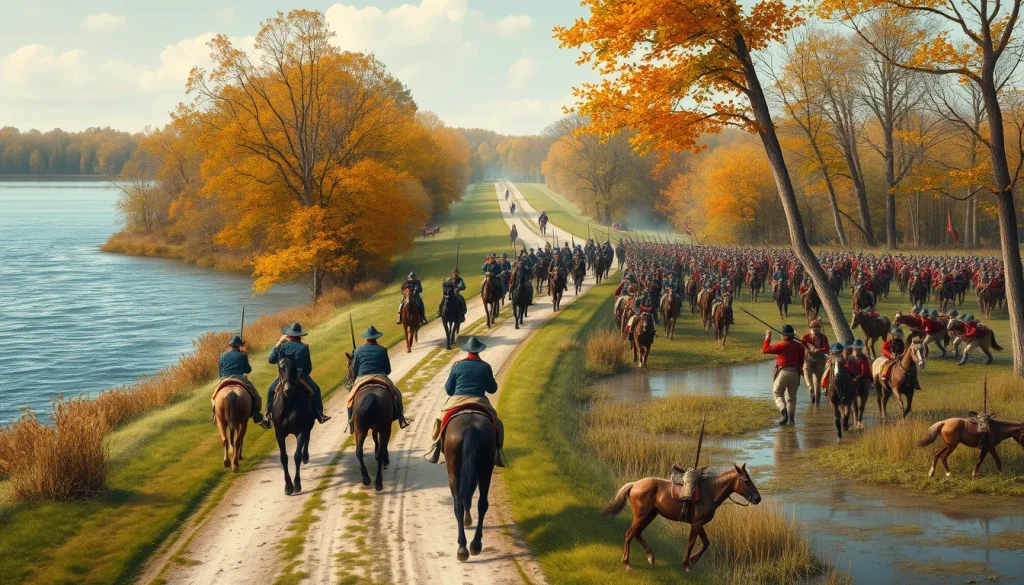
Procter’s retreat began in late September, with about 800 regulars and 500 warriors under Tecumseh. The column was slow and poorly managed, with supplies and equipment lost or destroyed. Harrison pursued with an army of about 3,500 men, including Colonel Richard Mentor Johnson’s mounted Kentucky riflemen. On October 5, Procter chose a position near Moraviantown to make a stand. He placed his regulars along the road, with warriors positioned in a swamp on the right. Johnson’s mounted infantry charged the British line, which broke almost immediately, causing many regulars to surrender or flee. The warriors resisted fiercely but ultimately retreated after Tecumseh was killed during the fighting. Procter escaped with a small force, leaving most of his command captured.
Why It Matters
The American victory secured the Northwest frontier. The British lost control of the Western District of Upper Canada, and Detroit and the Michigan Territory remained in American hands. The battle’s most profound consequence was the death of Tecumseh. His leadership had united many Indigenous nations in an alliance with Britain; without him, the confederacy collapsed. Subsequent treaties between the United States and individual Indigenous groups led to the loss of lands and facilitated American westward expansion. For the British, Procter was court-martialed for his conduct and his military career ended. The battle also contributed to the broader narrative of the war, which ended in a stalemate but with significant implications for Indigenous peoples.
Prelude
After the Battle of Lake Erie on September 10, 1813, the British position at Amherstburg and Detroit became untenable. Procter planned to retreat to Burlington Heights to link with other British forces. Tecumseh opposed the retreat, fearing for Indigenous homelands. Eventually, Tecumseh agreed to follow, but only after Procter promised to make a stand. The retreat began on September 27, with American forces landing at Amherstburg the same day. Procter’s column moved up the Thames, but the withdrawal was disorderly, with delays, lack of supplies, and the capture of many stragglers by American forces.
Forces and Commanders
American forces were led by Major General William Henry Harrison. The army consisted of about 3,500 men, including Colonel Richard Mentor Johnson’s mounted Kentucky riflemen, some regular troops, and militia. British forces were commanded by Major General Henry Procter, with about 800 regulars (primarily the 41st Foot) and approximately 500 Indigenous warriors led by Tecumseh and other chiefs such as Stiahta (Roundhead) of the Wyandot. The numbers are approximate and vary by source.
Battlefield and Map Context
The battle took place on the north bank of the Thames River, a few miles west of Moraviantown, a Delaware (Lenape) community. The terrain included a road paralleling the river, with a large swamp on the inland side. This swamp became the main area of fighting between American mounted infantry and Indigenous warriors. The modern location is near the community of Thamesville in Chatham-Kent, Ontario, where the site is marked by interpretative panels and monuments.
Battle Chronology
On the morning of October 5, the American forces approached the British position. Harrison deployed Johnson’s mounted infantry as the lead element. The British formed a line across the road, with the 41st Foot in the center and warriors in the swamp on the right. Johnson ordered a charge; the cavalry broke through the British line, which quickly collapsed. Many British soldiers were captured or fled. Procter himself escaped toward Burlington. Meanwhile, the mounted infantry dismounted to engage the Indigenous warriors in the swamp. The fighting was fierce, and it was during this stage that Tecumseh was killed, possibly by a shot from American forces. The warriors continued to resist but eventually withdrew after learning of Tecumseh’s death.
Casualties and Losses
Casualty figures vary by source. American losses were relatively light: between 7 and 12 killed, and 22 wounded. British casualties among the regulars were approximately 12 to 18 killed, 22 to 36 wounded, and about 600 captured or missing (many taken prisoner). Indigenous casualties are estimated between 16 and 33 killed, with an unknown number wounded. The loss of Tecumseh was immeasurable for the confederacy.
Result
The battle was a decisive American victory. The British Right Division was effectively destroyed as a fighting force in the West. Procter’s escape did not diminish the scale of defeat. The Americans secured full control of the territory east of Detroit and the Thames River valley, and the threat of British attack on the Northern frontier subsided.
Strategic Consequences
The victory allowed the Americans to re-establish control over Detroit and the Michigan Territory. The British and Indigenous alliance in the region collapsed. Procter was court-martialed in December 1814 for neglect of duty during the retreat and battle, and he was suspended from the army. The death of Tecumseh destroyed the pan-Indigenous confederacy, which was never revived. In subsequent years, American treaties with various Indigenous nations led to land cessions and the removal of Indigenous peoples from the Old Northwest. The battle thus had far-reaching consequences for the future of the American Midwest.
Primary Accounts
Several contemporary accounts exist. Major General Harrison sent a detailed report to Secretary of War John Armstrong, describing the battle and his estimate of casualties. Colonel Richard Mentor Johnson and other officers wrote letters describing their actions. The court martial of Henry Procter provides a lengthy testimony outlining the decisions and conduct of the British command. Indigenous accounts exist in oral traditions, though they were not recorded in writing at the time.
Battlefield Today
The site of the Battle of the Thames is now a National Historic Site of Canada. It is administered by Parks Canada and features a commemorative monument to Tecumseh and the warriors who fought there. Interpretive panels explain the course of the battle. The battlefield is located near the present-day Thamesville, Ontario. The nearby Moravian of the Thames First Nation community holds an annual memorial to commemorate the battle and Tecumseh’s legacy.
Primary Sources
Key primary sources include Harrison’s official dispatch of October 9, 1813, to Secretary of War John Armstrong, which gives the American perspective and casualty figures. Procter’s court-martial transcript provides a detailed British account of the retreat and battle, albeit with a defensive bias. Several letters and journals of American soldiers, such as that of Lieutenant James Johnson, offer eyewitness details. Tecumseh’s death has been a subject of controversy, with multiple claims made by participants. These sources must be evaluated for their national and personal biases.
Further Reading
- Donald R. Hickey, The War of 1812: A Forgotten Conflict (1989)
- Alan Taylor, The Civil War of 1812: American Citizens, British Subjects, Irish Rebels, and Indian Allies (2010)
- John Sugden, Tecumseh: A Life (1997)
- Jon Latimer, 1812: War with America (2007)
- Carl A. Christie, “Battle of the Thames (Moraviantown),” The Canadian Encyclopedia (2011).
References
- Christie, Carl A. “Battle of the Thames (Moraviantown).” The Canadian Encyclopedia, edited by Jason Ridler, 2015. https://thecanadianencyclopedia.ca/index.php/en/article/battle-of-the-thames-moraviantown
- “Battle of the Thames.” Wikipedia, Wikimedia Foundation. https://en.wikipedia.org/wiki/Battle_of_the_Thames
- “Battle of the Thames.” War of 1812, thewarof1812.org. https://thewarof1812.org/battles/battle-of-the-thames/
- “Guns Across the Lakes: Battle of the Thames.” National Park Service video transcript. https://www.nps.gov/media/video/view.htm?id=BE8D19AF-E4C0-485E-CCE2BEFAC7B84A8A
FAQ
Why is the Battle of the Thames also called the Battle of Moraviantown?
The battle took place near the Moravian mission village of Moraviantown, a Delaware settlement. Both names are used, with 'Battle of Moraviantown' common in Canadian and British sources.
How did Tecumseh die?
The exact circumstances of Tecumseh's death are disputed. He was killed during the fighting in the swamp, but it is uncertain whether he died from a gunshot wound or other causes, and which individual American soldier killed him. Colonel Richard Mentor Johnson claimed credit, but the claim remains unverified.
What were the consequences of the battle for Indigenous peoples?
The death of Tecumseh and the defeat at the Thames destroyed the pan-Indigenous confederacy, leading to the collapse of a unified Indigenous resistance. In the following decades, American treaties and policies resulted in the cession and loss of Indigenous lands in the Old Northwest.


Leave a Reply