Short Answer
On April 27, 1813, during the War of 1812, American Brigadier General Zebulon Pike was killed by debris from a massive magazine explosion while leading troops in the capture of York, the capital of Upper Canada (present-day Toronto). His death, at the moment of a significant American victory, underscored the war’s human cost and contributed to a chain of destruction that culminated in the British burning of Washington in 1814. Pike’s demise and the subsequent American burning of York’s public buildings became a symbol of the conflict’s escalating violence.
Historical Context
The War of 1812 began in June 1812 with American invasions of British North America, aiming to secure territorial concessions and address maritime grievances. By 1813, the United States sought control of Lake Ontario, a vital naval frontier. York, as the provincial capital of Upper Canada, was a key objective because it housed a naval shipyard and the under-construction warship Sir Isaac Brock. American plans for the 1813 campaign included a joint army-navy operation to seize York, neutralize the warship, and capture military stores. The American force, about 1,700 regulars under Brigadier General Zebulon Pike, was transported across the lake by Commodore Isaac Chauncey’s squadron. Defending York was Major General Roger Sheaffe with approximately 750 men, including British regulars, Canadian militia, and Ojibwe and Mississauga warriors.
What Happened
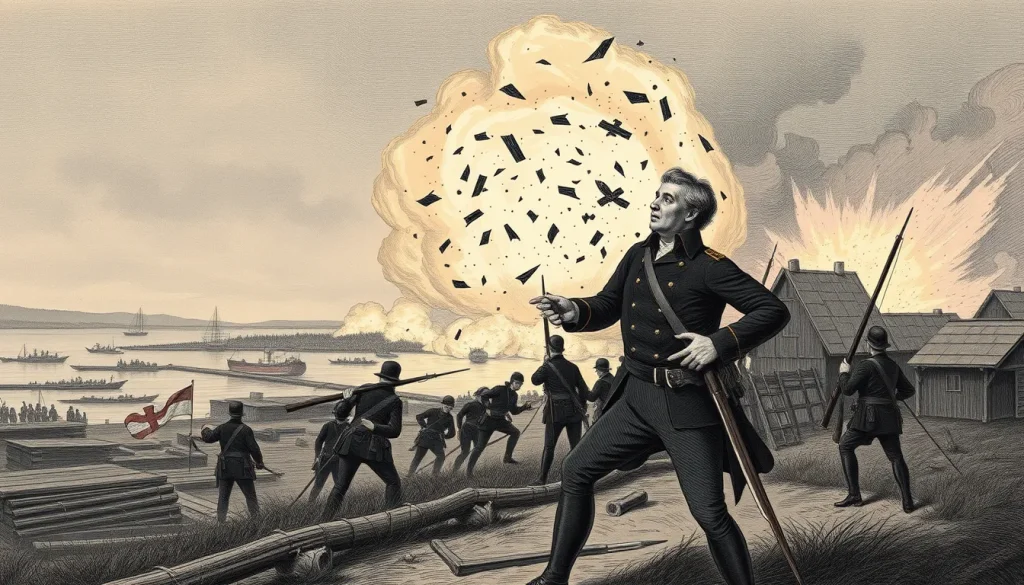
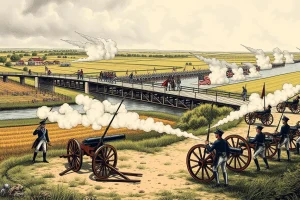
On the morning of April 27, 1813, American troops disembarked west of York, supported by naval gunfire. Pike personally led the assault, advancing through the woods against the British defenses. Sheaffe’s outnumbered forces fought a delaying action but were gradually pushed back. As the Americans approached the main fortifications near the citadel, a large magazine exploded. The blast hurled stones and timbers into the air, causing heavy casualties on both sides. Pike, struck by falling debris, was mortally wounded and died shortly after being carried aboard a ship.
With the British position untenable, Sheaffe retreated eastward toward Kingston with his regulars, leaving the militia and civilians to surrender. The Americans occupied York, and in the following days, they burned the parliament buildings, looted public and private property, and destroyed the Sir Isaac Brock. The explosion killed or wounded more than 200 Americans; total American casualties were about 55 killed and 265 wounded. British and allied losses were roughly 82 killed, 112 wounded, and 274 captured. The town was later evacuated by the Americans in early May.
Why It Matters
Pike’s death was a severe blow to the American army; he was a respected and capable officer whose loss was lamented. The capture of York was a tactical victory for the United States, providing temporary control of Lake Ontario and destroying a warship. However, the burning of the provincial parliament and other buildings—an act of retaliation for alleged British atrocities and partly a result of anger over Pike’s death—became a central element in the war’s cycle of retaliation. British forces explicitly cited the destruction at York as justification for the burning of the Capitol and White House in Washington in August 1814. This chain of events is essential to understanding the war’s escalation.
In addition, Sheaffe’s failure to hold York led to his removal from command. The battle demonstrated the vulnerability of the Upper Canadian capital and the importance of naval supremacy on the lake. Pike’s death and the destruction at York were memorialized in contemporary prints and were later seen as examples of the war’s tragic and futile violence.
Early Life
Zebulon Montgomery Pike was born on January 5, 1779, in Lamberton, New Jersey, into a military family. His father was a Revolutionary War officer, and Pike followed into the army, receiving a commission at an early age. His formative years were spent on the frontier, where he developed skills in exploration and survival.
Role Before the War
Pike gained national fame as an explorer. In 1805–06, he led an expedition to seek the source of the Mississippi River. In 1806–07, he headed an expedition to the West that reached the Rocky Mountains, and a peak later named Pike’s Peak was climbed by his expedition. These missions, though not without controversy, established his reputation as a daring and skilled officer. He also served in the prewar period during Tecumseh’s War, notably at the Battle of Tippecanoe in 1811, where he was promoted to brigadier general.
Role During the War
With the outbreak of the War of 1812, Pike was assigned to the northern theater. In early 1813, he was placed in command of the land forces for the expedition against York, as part of a broader campaign to seize strategic points on Lake Ontario. His role was to lead the assault and oversee the capture of the town and its military installations.
Major Actions
The Battle of York was Pike’s final and most significant action. He personally led the landing and the advance on the British batteries. His troops captured two redoubts before the fatal explosion. His leadership was instrumental in securing the beachhead and pressing the assault, even as the fighting was brief but intense.
Contemporary Accounts
Contemporary accounts provide vivid details of Pike’s death. David Thompson, in his History of the Late War between Great Britain and the United States, wrote that Pike was wounded by the fall of timbers and stones from the explosion. American sources also reported that he was carried to the fleet, where he died a few minutes later. The print Death of General Pike at L. York by Oliver Tarbell Eddy, a hand-colored etching from about 1813, shows the general being lifted from the battlefield, capturing the dramatic event for public memory.
Later Life
Pike died on April 27, 1813, at the age of 34. He left no surviving later life in the sense of postwar career; his death cut short a promising military path. He was survived by his wife and family, but his legacy would be shaped by his explorations and the manner of his death.
Historical Legacy
Pike’s death became a rallying point for the American public. He was celebrated as a martyr of the war, and his name was attached to locations in the American West, most notably Pike’s Peak. However, the broader legacy of the York raid is controversial. The burning of the parliament buildings and the looting of the town were condemned by contemporaries and later historians as excessive behavior, and they provided the British with a clear justification for the destruction of Washington. Pike’s death, therefore, is not just a biographical detail but a moment that influenced the war’s trajectory. His memory is intertwined with the debate over the war’s conduct and consequences, as well as the complex relationship between Canadian and American history during the conflict.
Primary Sources
Several contemporary documents and accounts illuminate the event. David Thompson’s History of the Late War offers a Canadian perspective on the battle and Pike’s death, emphasizing the accidental nature of the explosion. American official reports, such as those from General Dearborn and Commodore Chauncey, provide details of the operation and casualty figures. The engraving by Oliver Tarbell Eddy, held by the Smithsonian Institution, is a contemporary visual source. These sources must be used carefully: Thompson’s account is a secondary history written shortly after the war, while American reports may reflect official justifications. No verified personal account from Pike himself survives from the battle, as he died on board a ship.
Further Reading
- Berton, Pierre. The Invasion of Canada, 1812–1813. Toronto: McClelland and Stewart, 1980.
- Hickey, Donald R. The War of 1812: A Forgotten Conflict. Urbana: University of Illinois Press, 1989.
- Lambert, Andrew. The Challenge: Britain Against America in the Naval War of 1812. London: Faber and Faber, 2012.
- Latimer, Jon. 1812: War with America. Cambridge, MA: Harvard University Press, 2007.
- Stagg, J.C.A. The War of 1812: Conflict for a Continent. Cambridge: Cambridge University Press, 2012.
References
- American Battlefield Trust. “Zebulon Pike.” Accessed December 2023. https://www.battlefields.org/learn/biographies/zebulon-pike.
- Thompson, David. History of the Late War between Great Britain and the United States. Chapter 23: “Invasion of York, Upper Canada.” http://www.warof1812-bicentennial.info/books/historyofthelatewar/hlw-chapter23.php.
- “Raid on York.” War of 1812. Accessed December 2023. https://thewarof1812.org/battles/raid-on-york/.
- Eddy, Oliver Tarbell. Death of General Pike at L. York, c. 1813. National Portrait Gallery, Smithsonian Institution. https://www.si.edu/object/death-general-pike-l-york%3Anpg_NPG.83.171.
FAQ
How did Zebulon Pike die at York?
Pike was struck by falling debris from a magazine explosion that occurred as American troops approached the British fortifications at York. He was fatally wounded and died shortly after being taken to a ship.
Who commanded the American forces at York?
The American forces at York were led by Brigadier General Zebulon Pike, but the overall expedition was under Major General Henry Dearborn, with naval support from Commodore Isaac Chauncey.
Why did the British burn Washington, DC in 1814?
British forces burned Washington in retaliation for the American destruction of public buildings at York (1813) and Newark (December 1813), which British commanders explicitly cited as justification for their actions.


Leave a Reply