

Short Answer
The River Raisin Massacre refers to the killing of wounded American prisoners by Native American warriors following the Battle of Frenchtown, also known as the Battle of the River Raisin, in January 1813. This episode occurred during the War of 1812 in the Michigan Territory and became a potent symbol of alleged British and Native atrocities, fueling American vengeance and the rallying cry “Remember the Raisin.”
Historical Context
In 1812, the Old Northwest frontier became a key theater of the War of 1812. After the U.S. declaration of war in June, American forces under Brigadier General William Hull invaded British-held Upper Canada but were forced to retreat. On August 16, 1812, Hull surrendered Detroit and the entire Michigan Territory to British Major General Isaac Brock, a devastating blow to American hopes. President James Madison then appointed William Henry Harrison to command the Northwestern Army with orders to retake Detroit. By late 1812, Harrison assembled troops at the Maumee Rapids, south of present-day Toledo, Ohio, while British and Native forces controlled the Detroit River region. The village of Frenchtown, on the River Raisin near Lake Erie, became a strategic outpost for both sides.
What Happened
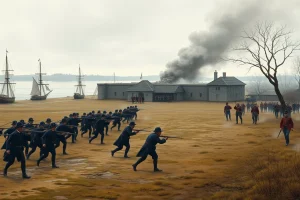
In January 1813, American Brigadier General James Winchester, acting against Harrison’s orders, sent a force under Lieutenant Colonel William Lewis to capture Frenchtown. On January 18, Lewis’s roughly 700 men crossed the frozen Raisin River and drove out a small British and Canadian militia detachment, securing the village. Winchester then moved up with reinforcements, bringing the American force to about 900–1,000 men. On January 22, British Colonel Henry Procter launched a counterattack with a combined force of British regulars, Canadian militia, and over 800 Native warriors from several tribes, including Wyandot, Shawnee, Odawa, Ojibwe, and Potawatomi. Procter’s forces surprised the sleeping Americans at dawn, overwhelming them. The U.S. regulars on the right broke under artillery and infantry assaults, while the Kentucky volunteers on the left fought stubbornly. Winchester was captured and, under a flag of truce, persuaded his surviving troops to surrender. In the aftermath, Procter withdrew with nearly 500 prisoners, leaving about 60 severely wounded men in Frenchtown under the care of local civilians. The following day, Native warriors returned and killed many of the wounded, scalping and mutilating some. This killing of prisoners became known as the River Raisin Massacre.
Why It Matters
The massacre had immediate tactical and far-reaching psychological consequences. It marked the second major American defeat in the Michigan Territory and forced Harrison to postpone his winter campaign to retake Detroit. More importantly, reports of the prisoner killings inflamed public opinion, especially in Kentucky, which had suffered heavy casualties. The cry “Remember the Raisin” became a rallying point for American soldiers, culminating at the Battle of the Thames in October 1813, where Kentucky troops shouted it as they routed Procter’s forces. The event also hardened American attitudes toward Native peoples and shaped war propaganda. Historians debate Procter’s responsibility: whether he failed to protect prisoners or tacitly condoned the killings, and they note that Native warriors had their own reasons for the violence, including retaliation for American atrocities and the logistical difficulty of holding prisoners.
Prelude
After Hull’s surrender, the British established firm control over the Michigan Territory, including Frenchtown, which was largely settled by French Canadians and had a pro-British militia. American settlers and local militia, however, sought liberation. Winchester, despite orders to stay at the Maumee, responded to pleas from Frenchtown residents and ordered Lewis to attack. The first engagement on January 18 was a success, but it left the American force dangerously exposed, without adequate fortifications or warning of a larger British counterattack.
Forces and Commanders
American forces at the second battle included the 17th and 19th U.S. Infantry, the 1st Kentucky Volunteer Regiment, the 1st Kentucky Rifle Regiment, and the 5th Kentucky Volunteer Regiment, roughly 934 men. They were commanded by Brigadier General James Winchester, with Colonel William Lewis leading the initial assault. British forces under Colonel Henry Procter consisted of British regulars from the 41st Regiment, Canadian militia, and Native warriors from at least seventeen tribes, led by the war chief Roundhead. Procter’s total force numbered about 1,400, giving him a significant numerical advantage.
Battlefield and Map Context
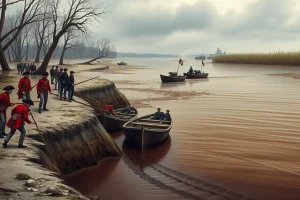
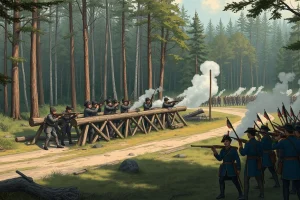
Frenchtown was a small settlement on the banks of the River Raisin, near its mouth at Lake Erie, in what is now Monroe, Michigan. The terrain featured a frozen river, open fields, and a palisade fence around the settlement. The Americans camped in the town and near a puncheon fence, with the 17th Infantry positioned about 200–300 yards outside the main defense line. Procter’s forces approached from the north along a creek called Mason Run, positioning artillery and infantry to launch a coordinated dawn assault.
Battle Chronology
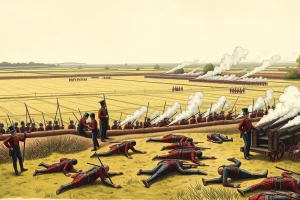
On January 22, before dawn, Procter’s forces advanced silently. A sentry fired, killing a grenadier, but the British quickly opened with artillery and infantry fire. The Kentucky volunteers sheltering behind the puncheon fence resisted fiercely, while the 17th Infantry on the right was exposed to cannon fire and attacks from Wyandot and Shawnee warriors. Within twenty minutes, the regulars began to break and were forced back toward the river. Winchester was captured during the melee. The Kentuckians held on for several hours, but with ammunition running low and the enemy closing in, Winchester, under a flag of truce, ordered a surrender. Many of the surviving soldiers were taken prisoner; some attempted to flee but were killed or captured. Procter then withdrew, leaving the wounded in the town. The following morning, January 23, Native warriors returned and killed many of the wounded, leading to the massacre.
Casualties and Losses
Exact casualty figures are disputed, but most accounts agree that American losses were severe. The American Battlefield Trust reports 934 Americans engaged, with 359 killed, 80 wounded, and 495 missing or captured. British and Native losses were much lighter, estimated at 24 killed, 158 wounded, and 3 missing or captured. The massacre itself involved the killing of perhaps 30 to 60 wounded prisoners, though the exact number is uncertain. These figures vary among primary accounts and modern historians.
Result
This was a clear British and Native victory. The American force was destroyed or captured, and Frenchtown remained in British hands. The victory solidified British control of the Detroit River region and temporarily dashed American hopes of a winter offensive.
Strategic Consequences
The defeat forced Harrison to abandon his immediate plan to retake Detroit and wait until spring for reinforcements and better weather. It also boosted British morale and Native confidence. However, the massacre galvanized American public opinion, leading to renewed enlistments and a thirst for revenge. In September 1813, Harrison recaptured Detroit, and in October, he defeated Procter at the Battle of the Thames, where the cry “Remember the Raisin” was shouted by the Kentucky cavalry. The massacre thus contributed to the eventual American recovery of the Northwest.
Primary Accounts
Contemporary accounts include official reports from Colonel Procter to British superiors, letters from American prisoners, and newspaper articles. Procter’s report claimed the Native warriors acted without his approval and were difficult to control. American survivors, such as those from the Kentucky regiments, gave emotional testimony about the killings. These accounts often varied in details and were shaped by propaganda purposes. The British and Americans each sought to portray the events in ways that suited their military and political narratives.
Battlefield Today
The site is now the River Raisin National Battlefield Park, established in 2009, located in Monroe, Michigan. The park preserves portions of the battlefield, interprets the events, and commemorates the soldiers, volunteers, Native warriors, and civilians involved. It has a visitor center, walking trails, and monuments. The park emphasizes the massacre and its legacy, offering educational programs and events related to the War of 1812.
Primary Sources
Relevant primary sources include: (1) Colonel Henry Procter’s official report of January 23, 1813, which described the battle and addressed the prisoner killings; (2) the testimony of American prisoners and survivors, often circulated in Kentucky newspapers; (3) British military correspondence from Major General Isaac Brock and others regarding the Northwest; and (4) a hand-colored engraving titled “Massacre of the American Prisoners, at French-town, on the River Raisin,” published in 1813, which is a notable primary visual artifact. These sources are biased and should be read carefully; for instance, Procter downplayed his control over Native allies, while American accounts exaggerated atrocities for wartime propaganda.
Further Reading
- Hickey, Donald R. The War of 1812: A Forgotten Conflict. University of Illinois Press, 1989.
- Benn, Carl. The War of 1812. Osprey Publishing, 2002.
- Taylor, Alan. The Civil War of 1812. Alfred A. Knopf, 2010.
- River Raisin National Battlefield Park official website (nps.gov/rira).
- American Battlefield Trust. “River Raisin Battle Facts and Summary” (battlefields.org).
References
- National Park Service. “History & Culture – River Raisin National Battlefield Park.” Accessed January 2025. https://www.nps.gov/rira/learn/historyculture/index.htm.
- American Battlefield Trust. “River Raisin Battle Facts and Summary.” Accessed January 2025. https://www.battlefields.org/learn/war-1812/battles/river-raisin.
- American Battlefield Trust. “A National Calamity” by River Raisin National Battlefield Park Staff. Accessed January 2025. https://www.battlefields.org/learn/articles/national-calamity.
- American Battlefield Trust. “‘Remember the Raisin’”. Accessed January 2025. https://www.battlefields.org/learn/articles/remember-raisin.
FAQ
What was the River Raisin Massacre?
It was the killing of wounded American prisoners by Native warriors after the Battle of Frenchtown on January 23, 1813. The event became a rallying cry for Americans during the War of 1812.
How did the River Raisin Massacre affect the war?
It inflamed American public opinion, especially in Kentucky, and inspired the cry 'Remember the Raisin.' It also delayed William Henry Harrison's campaign to retake Detroit, but ultimately contributed to American resolve and the victory at the Thames.
Were British leaders responsible for the massacre?
Historians debate this. British Colonel Henry Procter claimed he could not control his Native allies, while Americans blamed him for not protecting prisoners. Many scholars see a complex situation with shared responsibility.
Leave a Reply