
Short Answer
The Battle of Detroit (also known as the Siege of Detroit or Surrender of Detroit) was an early and decisive engagement in the War of 1812, fought on 15–16 August 1812 at and around the town of Detroit in the Michigan Territory. A British and Indigenous force under Major General Isaac Brock and the Shawnee leader Tecumseh compelled Brigadier General William Hull to surrender the American garrison and the entire territory without a general action. The victory secured the western frontier of Upper Canada, encouraged Indigenous resistance to American expansion, and radically shifted the military balance in the Old Northwest for more than a year.
Historical Context
In the years before 1812, the United States and Great Britain were in conflict over maritime rights, impressment, and trade restrictions, while on the western frontier settlers and Indigenous nations clashed over land. The Michigan Territory was a strategic borderland, with Detroit located on the Detroit River separating the United States from Upper Canada. The U.S. government planned to invade Canada through Detroit, using Brigadier General William Hull, the territorial governor, to command an army of Ohio militia and regulars. Britain, deeply engaged in the Napoleonic Wars, relied on alliances with Indigenous peoples and local militia to defend Upper Canada. When war was declared on 18 June 1812, both sides raced to reinforce the region. Hull, delayed by poor logistics and the loss of his baggage schooner, arrived in Detroit on 5 July with about 2,500 men. He crossed into Upper Canada on 12 July, but his cautious advance and vulnerability to supply disruptions soon made his position precarious.
What Happened
After Brigadier General Hull’s initial invasion of Upper Canada and his seizure of Sandwich, he failed to press on to the weak post of Amherstburg. He faced supply shortages and constant harassment by British and Indigenous forces. News of the fall of Fort Mackinac and the defeats of his supply escorts at Brownstown and Monguagon convinced Hull to retreat to Detroit by 8 August. Meanwhile, Major General Isaac Brock, the British commander in Upper Canada, moved quickly from York, reaching Amherstburg on 13 August. He conferred with Tecumseh and devised a plan to take Detroit by daring and deception. On 15 August, Brock sent a surrender demand, warning that once fighting began he could not control his Indigenous allies. Hull refused, but Brock’s artillery on the Canadian shore began a bombardment. That night, Indigenous warriors crossed the river in canoes, and on the morning of 16 August, Brock’s force—about 330 regulars, 400 militia (many dressed in red coats), and 600 Indigenous warriors—landed south of Detroit and advanced. Brock employed psychological tactics, such as marching his men in looped columns to magnify apparent numbers and arranging for an intercepted letter suggesting thousands more warriors were coming. After a brief exchange of fire and the explosion of an American 18-pounder that killed several officers, Hull, fearing a massacre of the civilians in the fort, raised the white flag. He surrendered the fort, the town, his entire army, and the Michigan Territory. The captured Americans included about 2,500 men, 33 cannons, and the brig Adams.
Why It Matters
The Battle of Detroit was a strategic catastrophe for the United States. It gave the British and their Indigenous allies control of the entire Michigan Territory, exposed Ohio and Indiana to raids, and shattered the American belief that Canada could be easily conquered. The victory reinvigorated British support in Upper Canada and encouraged many Indigenous nations to ally with them. It also made a hero of Isaac Brock and secured his reputation as the savior of Upper Canada. For the United States, the surrender led to Hull’s court-martial and death sentence (later commuted), and it forced the U.S. to rebuild its northwestern army. The battle’s aftermath saw the British hold Detroit until September 1813, when Oliver Hazard Perry’s victory on Lake Erie and William Henry Harrison’s subsequent campaign forced its evacuation. The humiliation of Detroit haunted American military leaders and shaped later campaigns in the West.
Prelude
The American invasion of Upper Canada in July 1812 stalled almost immediately. Although Hull’s forces were numerically superior, he lacked supplies and reliable militia support. The British–Indigenous victory at Fort Mackinac (17 July) and the attacks on Hull’s supply line, culminating in the ambushes at Brownstown (5 August) and Maguaga (9 August), compelled Hull to retreat to Detroit. Brock, arriving from the east, recognized the opportunity to strike while the Americans were demoralized. He coordinated with Tecumseh, whose warriors had been blockading the American supply route, and assembled a mixed force of regulars, militia, and Indigenous allies. On 15 August, Brock issued his famous demand, and the cannonade began.
Forces and Commanders
American: Brigadier General William Hull commanded about 2,500 men, consisting of the 4th U.S. Infantry, three Ohio militia regiments under Colonels Lewis Cass, Duncan McArthur, and James Findlay, and Michigan territorial militia. The army possessed substantial artillery and the schooner-brig Adams. British and Indigenous: Major General Isaac Brock led about 330 regulars of the 41st Foot, 400 Upper Canada militia, and 600 Indigenous warriors under Tecumseh and other chiefs, including John Norton. British artillery and naval support came from the Provincial Marine vessels General Hunter and Queen Charlotte. Brock also had five field guns.
Battlefield and Map Context
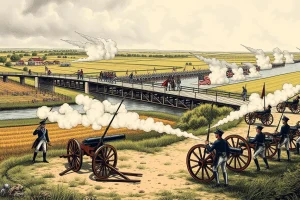
The action centered on the Detroit River, separating Fort Detroit (on the American east bank) from Sandwich in Upper Canada (west bank). Fort Detroit was a palisaded earthwork located on high ground overlooking the river and town. The British positioned artillery on the Canadian shore at Sandwich, about 800 yards from the fort. The river was broad but navigable. The American fort had a blind spot, unable to fire on the river or the opposite bank. The surrounding terrain included woods and a clearing near the fort, which Brock’s forces used to conceal their numbers. A road ran south from Detroit along the river; the British landed south of the town and advanced along this road.
Battle Chronology
- 15 August (late afternoon): Brock sends surrender demand to Hull; Hull refuses.
- Night of 15 August: British artillery opens fire from Sandwich; Indigenous warriors cross the river and land south of Detroit, hidden in the woods.
- 16 August (dawn): British main body crosses the river and advances north along the road. Tecumseh’s warriors emerge from the forest, apparently in overwhelming numbers.
- About 10 a.m.: An American 24-pounder shell hits the officer’s mess, killing four. Hull, fearing a massacre of the civilians, orders the white flag raised.
- Shortly after: British and Indigenous forces accept the surrender; the American garrison stacks arms. The terms include all of the Michigan Territory, the fort, and supplies.
Casualties and Losses
British and Indigenous casualties were minimal, with one source reporting two wounded. American losses were severe: an estimated 7 killed and 2,493 captured, along with all their weapons, 33 cannons, and a large quantity of stores. Many of the captured Ohio militia were paroled, while the regulars were transported to Quebec as prisoners of war.
Result
The result was a total British–Indigenous victory. The entire American army surrendered, and the Michigan Territory passed under British control. The British occupation lasted until early 1813, when it was abandoned after the American naval victory at Lake Erie. The battle is often called the surrender of Detroit to emphasize the lack of a large-scale engagement.
Strategic Consequences
The fall of Detroit transformed the war in the West. It gave the British a base for further operations and encouraged Indigenous nations from the Great Lakes region to take up arms against the United States. The Americans lost a key bastion, and the frontier was pushed back to Ohio. The British and their allies were able to threaten Ohio and Indiana, leading to the later campaigns of Fort Wayne and Fort Meigs. For the United States, the disaster led to a re-evaluation of military leadership and the eventual recapture of Detroit in September 1813 after the Battle of Lake Erie, which forced the British to retreat eastward. The victory also solidified the alliance between Brock and Tecumseh, which, though short-lived due to Brock’s death at Queenston Heights in October 1812, had a lasting effect on Indigenous–British cooperation.
Primary Accounts
Key primary sources include the official correspondence and reports of William Hull and Isaac Brock. Hull’s surrender letter and the subsequent court-martial record provide detailed testimony. Brock’s dispatches to the British government describe his strategy and the surrender. Additionally, the captured American mail, including letters that revealed Hull’s anxiety, was used by Brock to gauge American morale. The British side also left several memoirs, such as the account of Captain John Norton, who fought with the Grand River Iroquois. These sources must be read critically, as Hull sought to justify his actions and Brock emphasized his success, but together they provide a rich picture of the events.
Battlefield Today
The site of Fort Detroit and the battlefield are now located within the city of Detroit, Michigan. The original fort has long been demolished, but a historic marker and a replica of the fort’s gate exist in the area near present-day Campus Martius Park. The British battery position at Sandwich (now Windsor, Ontario) is also marked. The Detroit River itself remains a prominent landmark. Several museums, including the Detroit Historical Museum and the Canadian Windsor’s Chimczuk Museum, offer exhibits on the battle and the War of 1812. The site is part of the National Park Service’s War of 1812 heritage trail.
Primary Sources
Relevant contemporary documents include Hull’s official report to Secretary of War William Eustis (dated August 26, 1812), Brock’s report to Governor General Prevost, and the various proclamations issued by both sides. The log of the schooner Cayahoga, captured on 2 July 1812, also provides insight into the American plans. Additionally, the surrender terms themselves, which were signed and exchanged, are preserved in the U.S. National Archives and the British National Archives. These documents give an authoritative account of the events, though each reflects its author’s perspective: Hull’s report defends his decision, while British reports emphasize their cleverness and the inevitability of victory.
Further Reading
- Hitsman, J. Mackay. The Incredible War of 1812: A Military History (rev. ed.). Toronto: University of Toronto Press, 1965.
- Latimer, Jon. 1812: War with America. Harvard University Press, 2007.
- Hickey, Donald R. The War of 1812: A Forgotten Conflict. University of Illinois Press, 1989.
- Taylor, Alan. The Civil War of 1812: American Citizens, British Subjects, Irish Rebels, & Indian Allies. Alfred A. Knopf, 2010.
- Antal, Sandy. A Wampum Denied: Procter’s War of 1812. Carleton University Press, 1997.
References
- Wikipedia: Siege of Detroit, https://en.wikipedia.org/wiki/Battle_of_Detroit
- History of War: Battle of Detroit, 16 August 1812, https://www.historyofwar.org/articles/battles_detroit.html
- The Canadian Encyclopedia: Capture of Detroit, War of 1812, https://thecanadianencyclopedia.ca/en/article/capture-of-detroit-war-of-1812
- American Battlefield Trust: The Detroit Frontier in the War of 1812, https://www.battlefields.org/learn/articles/detroit-frontier-war-1812
- The War of 1812 Website: The Fall of Detroit, https://thewarof1812.org/battles/the-fall-of-detroit/
FAQ
Why did William Hull surrender at Detroit?
Hull feared a massacre of the fort's civilian population by Indigenous warriors if the British assaulted, and he had been convinced by Brock's deception that the attacking force was far larger than it was. His lack of confidence and the bombardment's effect on his officers contributed to his decision.
What were the casualty figures at the Battle of Detroit?
British and Indigenous losses were minimal, with only 2 wounded reported. American losses were about 7 killed and 2,493 captured, with the entire garrison taken prisoner.
How did the Battle of Detroit affect the War of 1812?
It gave the British control of the Michigan Territory, boosted British and Indigenous morale, and forced the United States to rebuild its northwestern army. The setback delayed American plans and contributed to the eventual American push to recapture Detroit in 1813 after the Battle of Lake Erie.


Leave a Reply