
Short Answer
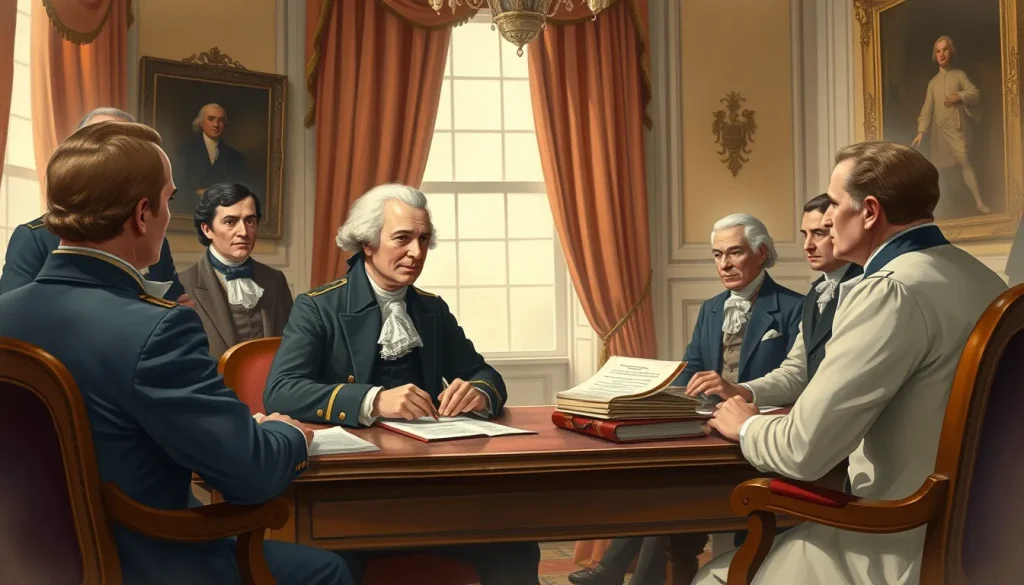
The Declaration of War of 1812 was a joint resolution of Congress, signed by President James Madison on June 18, 1812, that declared war between the United Kingdom of Great Britain and Ireland and the United States of America. It was the first declaration of war issued under the U.S. Constitution and marked the formal beginning of the War of 1812. The document was the culmination of years of diplomatic friction over maritime rights, impressment, and frontier security, and it remains a central primary source for understanding the conflict’s causes and the constitutional process of declaring war.
Historical Context
During the Napoleonic Wars (1803–1815), Britain and France imposed restrictive measures on neutral shipping to cut off each other’s trade. The Royal Navy, needing sailors, impressed alleged British deserters from American merchant vessels, often seizing American citizens by mistake. In response, the United States passed the Embargo Act of 1807 and later the Non-Intercourse Act, but these economic measures failed to change British policy and caused domestic hardship. Britain also issued the Orders in Council (1807–1809), blockading European ports under French control, and seized American ships violating these orders. On the frontier, British officials and traders supplied arms to Indigenous nations resisting American expansion, heightening tensions in the Northwest Territory. By late 1811, the Twelfth Congress, dominated by “war hawks” like Henry Clay and John C. Calhoun, pushed for armed conflict, arguing that American sovereignty and honor required resistance.
What Happened
On June 1, 1812, President James Madison sent a special message to Congress enumerating grievances against Great Britain: impressment of American sailors, illegal blockades, the Orders in Council, and Britain’s alleged encouragement of Indigenous attacks on American settlers. He concluded that Britain had “a state of war against the United States” but left the decision to Congress, as the Constitution assigns the power to declare war to the legislative branch. The House Foreign Relations Committee, led by Henry Clay, issued a report on June 3—often called the “War Manifesto”—recommending war. On June 4, the House passed the declaration by a vote of 79 to 49. The Senate debated for nearly two weeks, at one point considering a more limited naval war, but on June 17 it approved the House resolution 19 to 13. Madison signed the act on June 18, and a proclamation announced the declaration on June 19. The final document declared war “between the United Kingdom of Great Britain and Ireland and its dependencies, and the United States of America and their territories,” authorizing the president to use military force and to issue letters of marque to privateers.
Why It Matters
The Declaration of War of 1812 was a milestone in American constitutional history: it was the first and only time Congress exercised its power to declare war against a foreign nation until the Mexican-American War in 1846. The vote was deeply partisan, with all Federalists opposed and Republicans divided; the 79–49 and 19–13 margins were the closest in American history for any war declaration. The war itself went poorly for the United States early on, with failed invasions of Canada and the burning of Washington in 1814, yet it ended with the Treaty of Ghent in 1815 restoring the pre-war status quo. Historians interpret the declaration differently: some view it as an impulsive act driven by expansionist war hawks and partisan politics; others see it as a principled defense of neutral rights and national sovereignty. The declaration’s text, emphasizing British maritime abuses and frontier intrigue, highlights the issues contemporaries considered most pressing, while its brevity (no list of specific grievances—those were in Madison’s earlier message) reflected the legislative compromises needed to secure a majority.
Document
The declaration is formally titled “An Act declaring War between the United Kingdom of Great Britain and Ireland and the Dependencies thereof, and the United States of America and their Territories.” It is a single-sentence act, passed by Congress and signed by the President.
Date
The act was passed by the Senate on June 17, 1812, by the House on June 4, 1812, and signed by President James Madison on June 18, 1812. It took effect immediately.
Author
The legislation was drafted in Congress, notably by the House Foreign Relations Committee. Speaker of the House Henry Clay and President pro tempore of the Senate William H. Crawford signed the enrolled bill, and President James Madison approved it.
Historical Context
In the early 1810s, the United States was a young republic facing European power struggles. Britain, at war with Napoleon, enforced a blockade of Europe and impressed sailors from American ships. The United States, as a neutral, sought to trade with both sides but was caught between British Orders in Council and French decrees. Frontier tensions with Indigenous peoples, who resisted American expansion, were exacerbated by British-supplied arms from Canada. Domestic political debates pitted Federalists, who favored Britain and peace, against Republicans, many of whom advocated war to defend national rights and expand territory. The declaration emerged from these pressures.
Transcript
The complete text of the declaration is:
Be it enacted by the Senate and House of Representatives of the United States of America in Congress assembled, That war be and the same is hereby declared to exist between the United Kingdom of Great Britain and Ireland and its dependencies, and the United States of America and their territories; and the President of the United States is hereby authorized to use the whole land and naval force of the United States to carry the same into effect, and to issue to private armed vessels of the United States commissions or letters of marque and general reprisal, in such form as he shall think proper, and under the seal of the United States, against the vessels, goods, and effects of the government of the said United Kingdom of Great Britain and Ireland, and its dependencies.
Modernized Transcript
The text is already in early nineteenth-century legal English; a modern paraphrase would be: “The United States declares that a state of war exists with Great Britain. The President is authorized to employ all U.S. military forces, and to license private armed vessels, to fight against British ships and property.” It does not include a list of grievances; those were set forth in President Madison’s message of June 1, 1812.
What the Document Tells Us
The declaration itself is notable for its brevity and lack of justification. It simply asserts that war exists and grants the President broad authority. This suggests that Congress agreed on the fact of war without enumerating causes, leaving the reasons to be articulated in the pre-war debates and Madison’s message. The authorization to issue letters of marque underscores the importance of privateering in American naval strategy, given the small regular navy. The document also demonstrates the constitutional process: the President proposed, Congress disposed, and the declaration was signed into law—establishing a precedent for future conflicts.
Limitations and Bias of the Source
The declaration is a legal instrument that presents only the American position; it does not address British justifications for impressment (the need for experienced sailors) or the Orders in Council (retaliation against Napoleon’s Continental System). It also omits any reference to Indigenous sovereignty, treating British support for Indians as a grievance without acknowledging that Indigenous nations had legitimate claims to their lands. As an official record, it reflects the political compromises of the vote rather than a comprehensive argument; the full reasoning lies in the congressional debates and the committee report, which are more openly partisan.
Citation
“An Act declaring War between the United Kingdom of Great Britain and Ireland and the Dependencies thereof, and the United States of America and their Territories,” 2 Stat. 755 (1812). The original enrolled bill is in the Records of the U.S. House of Representatives, National Archives and Records Administration, Washington, D.C. A facsimile and transcription are available online via the National Archives and the U.S. Capitol Visitor Center.
Primary Sources
Key contemporary documents include:
- James Madison’s special message to Congress, June 1, 1812, which enumerated the grievances and urged a declaration.
- The House Foreign Relations Committee report (“War Manifesto”), June 3, 1812, which argued for war and was used in debates.
- The declaration itself, signed June 18, 1812.
- Madison’s proclamation of June 19, 1812, which publicly announced the war.
- Congressional debates as recorded in the Annals of Congress, which reveal arguments for and against war.
Each source is biased: Madison’s message is persuasive, the committee report is explicitly polemical, and the debates reflect partisan stances. The declaration itself is the most neutral in tone but also the least explanatory.
Further Reading
- Donald R. Hickey, The War of 1812: A Forgotten Conflict (University of Illinois Press, 1989).
- J.C.A. Stagg, Mr. Madison’s War: Politics, Diplomacy, and Warfare in the Early American Republic, 1783–1830 (Princeton University Press, 1983).
- Alan Taylor, The Civil War of 1812: American Citizens, British Subjects, Irish Rebels, & Indian Allies (Alfred A. Knopf, 2010).
- National Archives, “1812: Congress’s First Declaration of War Under the Constitution,” lesson plan with primary sources.
- U.S. Capitol Visitor Center, artifact page for the House Declaration of War.
References
- “House Declaration of War, June 4, 1812, with Senate Amendments, June 17, 1812,” U.S. Capitol Visitor Center, https://www.visitthecapitol.gov/artifact/house-declaration-war-june-4-1812-senate-amendments-june-17-1812.
- “1812: Congress’s First Declaration of War Under the Constitution,” National Archives, https://www.archives.gov/legislative/resources/education/1812.
- James Madison, “Special Message to Congress on the Foreign Policy Crisis (War Message), June 1, 1812,” Miller Center, University of Virginia, https://millercenter.org/the-presidency/presidential-speeches/june-1-1812-special-message-congress-foreign-policy-crisis-war.
- “1812 Senate Bill. Report of the Committee of the Senate of Massachusetts…,” State Library of Massachusetts, https://archives.lib.state.ma.us/handle/2452/819802.
- James M. Lindsay, “The United States Declares War on Britain in 1812,” Council on Foreign Relations, June 18, 2012, https://www.cfr.org/articles/the-united-states-declares-war-on-britain-in-1812.
- Donald R. Hickey, The War of 1812: A Forgotten Conflict (Urbana: University of Illinois Press, 1989).
FAQ
Why did the United States declare war on Britain in 1812?
The immediate causes were British impressment of American sailors, illegal blockades, the Orders in Council, and British support of Indigenous resistance on the frontier, as outlined in President Madison's war message.
What was the exact wording of the declaration of war?
The act read: 'Be it enacted... That war be and the same is hereby declared to exist between the United Kingdom of Great Britain and Ireland and its dependencies, and the United States of America and their territories...' and authorized the President to use military force and issue letters of marque.
How did Congress vote on the declaration?
The House passed it 79–49 on June 4, 1812, and the Senate passed it 19–13 on June 17, 1812. The votes were strictly partisan: all Federalists opposed, while Republicans were divided.


Leave a Reply