
Short Answer
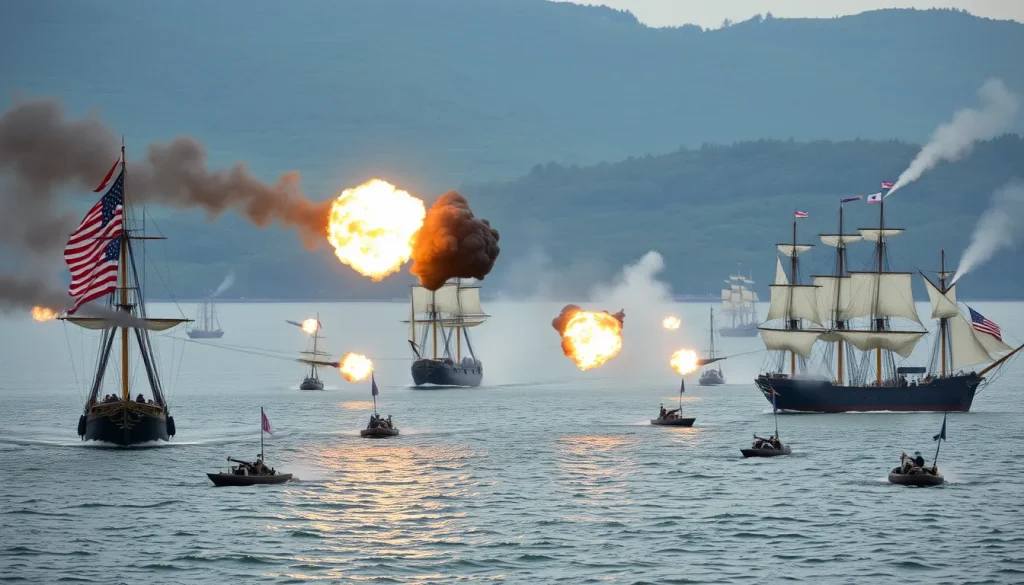
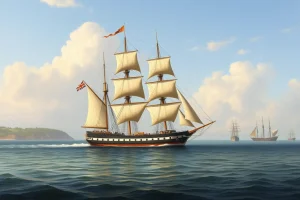
HMS Confiance, a 36-gun fifth-rate frigate, served as the flagship of Captain George Downie during the Battle of Lake Champlain on 11 September 1814. The engagement, also known as the Battle of Plattsburgh, was a decisive American naval victory that thwarted a British invasion from Canada and helped shape the peace negotiations at Ghent.
Historical Context
In the late summer of 1814, with the Napoleonic Wars over, Britain turned its full attention to the war in North America. A major British offensive planned to invade the United States via Lake Champlain, the traditional invasion corridor between Canada and New York. Governor General Sir George Prevost commanded an army of about 10,000 regulars, many of them veterans of the Duke of Wellington’s Peninsular campaigns, massed near the Canadian border. To support the army’s advance, the Royal Navy needed to gain control of Lake Champlain. The Americans, under Master Commandant Thomas Macdonough, had built a credible squadron at Plattsburgh, New York. In response, the British constructed a powerful new frigate, HMS Confiance, at the Ile aux Noix naval yard in Quebec, launching her on 25 August 1814. The ship was intended to tip the balance of naval power on the lake.
What Happened
On 8–9 September 1814, Captain Downie sailed the newly launched Confiance down the Richelieu River to join the British squadron already on the lake. The British force included the brig Linnet, sloops Chubb and Finch, and a dozen gunboats. On the morning of 11 September, the British squadron rounded Cumberland Head and entered Plattsburgh Bay, where Macdonough had anchored his vessels in a line across the entrance. The American fleet comprised the corvette Saratoga, the brig Eagle, the schooner Ticonderoga, the sloop Preble, and ten gunboats. Downie’s flagship Confiance, still unfinished and with a largely untrained crew, anchored close to Saratoga and engaged in a murderous cannonade. Captain Downie was killed early in the fight when an American shot dismounted a cannon, which struck him. The battle raged for about two and a half hours, with heavy losses on both sides. Using spring anchors to turn his ships, Macdonough gained a tactical advantage and forced the British vessels to surrender one by one. Confiance, already battered, struck her colors, along with Linnet, Chubb, and Finch. The gunboats escaped up the lake. The American victory was complete.
Why It Matters
The Battle of Lake Champlain was a turning point in the War of 1812. Combined with the American defense of Baltimore at Fort McHenry (also on 13–14 September), the defeat at Plattsburgh undermined British military leverage in the peace negotiations at Ghent. British territorial ambitions in northern New York collapsed, and the American position was strengthened. The battle also demonstrated the importance of naval command on freshwater lakes and showcased Macdonough’s tactical skill, particularly his use of spring lines to outmaneuver the British. For the Royal Navy, the loss of HMS Confiance and her squadron was both a strategic setback and a humiliating end to an ambitious shipbuilding effort.
Prelude
The build-up to the battle was marked by a race to complete ships. Macdonough’s squadron at Plattsburgh was hastily assembled, while Confiance was rushed from the stocks at Ile aux Noix. Captain Downie repeatedly complained of the ship’s incompleteness and its inexperienced crew, but Sir George Prevost pressed for immediate action, fearing the onset of winter. On 9 September, Prevost’s army began its advance toward Plattsburgh, and the naval squadron was ordered to cooperate in a combined attack. Downie’s ships arrived off Cumberland Head on the morning of 11 September, and at about 8 a.m. Downie scaled his guns as a signal to the army that he was ready to engage.
Forces and Commanders
British: Captain George Downie (flagship HMS Confiance, 36 guns), Commander Daniel Pring (brig Linnet, 16 guns), Lieutenants James McGhie and William Hicks (sloops Chubb and Finch, each about 11-16 guns), plus a dozen gunboats armed with long 24 or 18-pounders and carronades. Total armament roughly estimated at 95 guns, with about 1,000–1,100 men.
American: Master Commandant Thomas Macdonough (flagship USS Saratoga, 26 guns), Captain Robert Henley (brig Eagle, 20 guns), Lieutenant Stephen Cassin (schooner Ticonderoga, 17 guns), Lieutenant Charles Budd (sloop Preble, 7 guns), and ten gunboats. Total armament about 86 guns, with roughly 882–915 men.
Both commanders were experienced officers, but Macdonough had the advantage of preparing his squadron in a defensive position, while Downie was forced into a cramped bay with an unworked-up ship.
Battlefield and Map Context
The battle took place in Plattsburgh Bay (also called Cumberland Bay), a shallow indentation on the western shore of Lake Champlain, near the mouth of the Saranac River. The American squadron anchored from north to south across the bay, between Cumberland Head and Crab Island. Macdonough placed his ships with springs on their anchor cables, allowing them to pivot and bring broadsides to bear without changing position. The British had to approach from the north, rounding Cumberland Head, and were forced to engage at close range against the anchored American line. The bay’s sheltered waters reduced the effectiveness of the British long guns, while Macdonough’s force used shorter, heavier carronades to advantage.
Battle Chronology
About 9:00 a.m. – The British squadron rounds Cumberland Head in line abreast: Linnet, Chubb, Confiance, Finch, and gunboats.
About 9:30 a.m. – Downie anchors Confiance within 300–500 yards of Saratoga and opens fire. The first broadside devastates Saratoga, killing and wounding a fifth of its crew.
Within 15 minutes – Captain Downie is killed when a cannonball strikes the muzzle of a gun, knocking it onto him.
10:00 a.m. onward – The battle becomes a ship-to-ship artillery duel. Confiance suffers heavy damage, losing both bow anchors and most of her rigging. British sloops Chubb and Finch are crippled; Chubb surrenders and Finch runs aground.
About 11:00 a.m. – Macdonough, using his spring lines, brings Saratoga’s undamaged broadside to bear and forces Confiance to strike. Linnet also surrenders shortly afterward.
Late morning – The surviving British gunboats flee up the lake. Prevost’s army abandons its attack on Plattsburgh and retreats to Canada.
Casualties and Losses
Exact casualty figures vary. The American squadron suffered about 52 killed and 58 wounded. British losses were heavier: Confiance alone had roughly 40 killed and 60 wounded out of a complement of about 300; Linnet lost about 10 killed and 20 wounded; Chubb and Finch each reported comparable losses. Total British killed and wounded exceeded 200. The entire British squadron except the gunboats was captured. All casualties are approximations based on contemporary reports; many of the wounded later died. The high number of untrained men on Confiance contributed to the severity of losses.
Result
Decisive American victory. Captain Thomas Macdonough’s squadron captured HMS Confiance, Linnet, Chubb, and Finch. The British army under Sir George Prevost, seeing the naval defeat, abandoned its invasion and retreated to Canada. Macdonough’s force remained intact and in control of Lake Champlain.
Strategic Consequences
The American victory at Lake Champlain prevented a large British army from penetrating into New York and northern New England. It also denied Britain a crucial bargaining chip at the Ghent peace negotiations (which concluded with the Treaty of Ghent in December 1814). The battle helped secure the Great Lakes and Lake Champlain boundary region for the United States. For the British, the loss of Confiance and the failure of the expedition was a serious embarrassment and contributed to Prevost’s recall. The ship itself was taken to the United States, later placed in ordinary at Whitehall, New York, and ultimately sank there; it was demolished as a hazard to navigation in 1873.
Primary Accounts
Contemporary accounts include Macdonough’s official report to the Secretary of the Navy, dated 11 September 1814, in which he famously wrote: “The Almighty has been pleased to Grant us a signal victory on Lake Champlain in the capture of one Frigate, one Brig, and two sloops of war of the enemy.” The British side is documented in letters from Captain Daniel Pring and Commodore Sir James Lucas Yeo to the Admiralty. Midshipman Lee, a survivor of Confiance, described the intense fire in a letter quoted in American newspapers. These accounts provide detailed insights into the battle, though they must be read with the biases of wartime reporting.
Battlefield Today
The battlefield at Plattsburgh Bay is now part of the Plattsburgh Memorial State Park in Plattsburgh, New York. The site includes a memorial monument to Macdonough and interpretive displays. The sunken remains of HMS Confiance were largely removed or dispersed, but the location is marked. The Valcour Island area and other related sites along the Champlain Valley are also preserved. The American ships’ anchors and artifacts have been recovered and are displayed at local museums, including the Clinton County Historical Association.
Primary Sources
Key primary sources include: Thomas Macdonough’s report (11 September 1814) to Secretary of the Navy William Jones, published in American State Papers; Captain Daniel Pring’s letter to Commodore Yeo (12 September 1814), describing the battle from the British perspective; Commodore James Lucas Yeo’s letter to the Admiralty (24 September 1814), which criticized the hurried nature of the attack; and contemporary newspaper accounts, such as the Plattsburgh Republican of 24 September 1814, which printed a British officer’s account of the action. These documents are available at the Library of Congress, the National Archives (UK), and in published documentary collections.
Further Reading
- Roosevelt, Theodore. The Naval War of 1812 (1882).
- Hickey, Donald R. The War of 1812: A Forgotten Conflict (1989).
- Malcomson, Robert. Lords of the Lake: The Naval War on Lake Ontario, 1812–1814 (1998).
- Webb, John. The Battle of Plattsburgh: A Study in Combined Operations (1971).
- National Park Service, Plattsburgh Memorial State Park interpretive materials.
References
- Brenckle, Matthew. “A Victorious September.” USS Constitution Museum, 11 Sept 2014, link.
- “Particulars of the late disastrous affair on Lake Champlain, &c.” Plattsburgh Republican, 24 Sept 1814, via War of 1812 Bicentennial, link.
- “The war on Lake Champlain” (essay), mlloyd.org, link.
- “HMS Confiance (1814).” Wikipedia, link.
- Roosevelt, Theodore. The Naval War of 1812. New York: G.P. Putnam’s Sons, 1882. Excerpt from The Man in the Arena: Selected Writings, link.
FAQ
Why was HMS Confiance unfinished at the battle?
The British navy rushed the frigate because Sir George Prevost wanted to launch the invasion before winter. Confiance was launched on 25 August 1814, only weeks before the battle, and still had workmen aboard when she fought.
What happened to HMS Confiance after the battle?
Captured by the Americans, she was taken to Whitehall, New York, and placed in ordinary. Later sold and abandoned, she sank at her moorings and was destroyed by dynamite in 1873 as a navigation hazard.
How did Thomas Macdonough achieve victory?
He anchored his ships with spring lines, allowing them to pivot and bring fresh broadsides to bear. This technique outmaneuvered the British, who were forced to attack in a confined bay.


Leave a Reply