
Short Answer
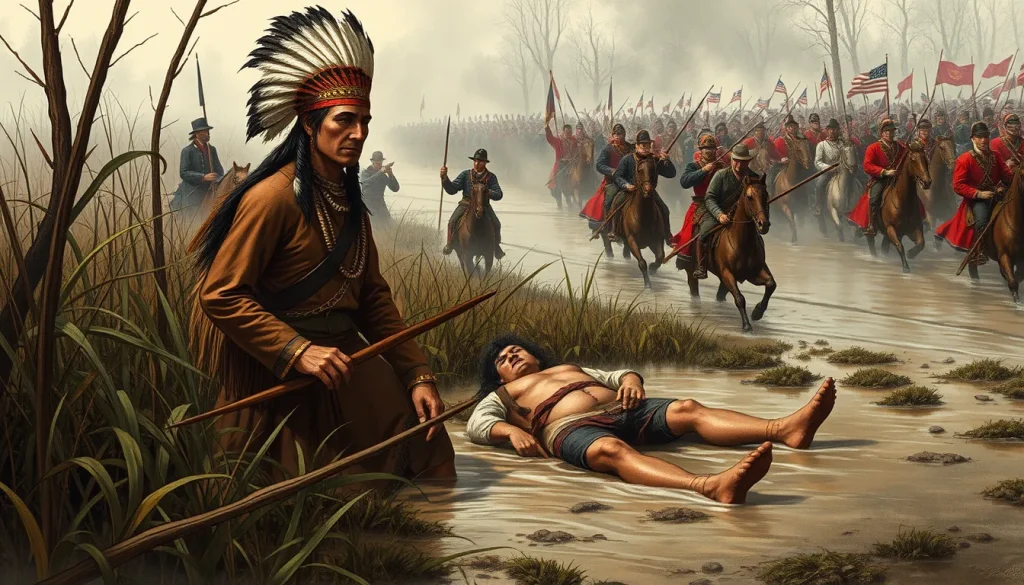
On October 5, 1813, at the Battle of the Thames near Moraviantown (present-day Thamesville, Ontario), Shawnee leader Tecumseh was killed while fighting alongside British forces against an American army led by Major General William Henry Harrison. Tecumseh’s death marked the ruin of his pan-Indigenous confederacy and the end of organized Indigenous resistance in the Northwest, a decisive turning point in the War of 1812 with lasting consequences for Indigenous nations and American expansion.
Historical Context
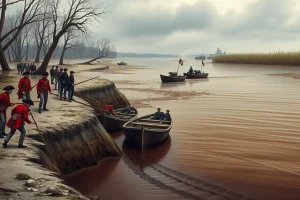
After the American naval victory at the Battle of Lake Erie on September 10, 1813, the British position in the western theatre collapsed. Without control of the lake, the British garrison at Amherstburg and Fort Detroit could not be supplied, and Major General Henry Procter, commanding the British forces in the region, decided to retreat eastward up the Thames River. Tecumseh, who had allied with the British to defend Indigenous lands from American encroachment, strongly opposed the retreat, viewing it as a betrayal of his warriors and their cause. During a council, he reportedly compared the retreating Procter to a fat animal carrying its tail between its legs, a bitter reproach that underlined the deepening distrust between the allies.
American forces under Harrison recaptured Detroit and pursued the fleeing British column. Harrison’s army, composed largely of Kentucky mounted volunteers under Colonel Richard Mentor Johnson, caught up with Procter’s forces on the morning of October 5 near Moraviantown, a settlement of the Moravian Christian Munsee community.
What Happened
The battle opened with a mounted charge by Johnson’s Kentucky cavalry against the British regulars. The British line, formed across the road, broke almost immediately; the 41st Foot, exhausted and demoralized from the retreat, surrendered in large numbers. Procter fled the field with about 250 cavalrymen, leaving the troops and their Indigenous allies behind.
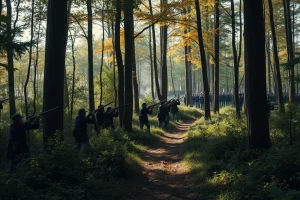
Tecumseh and his warriors, stationed in a swampy thicket on the British right flank, did not retreat. They fought with determination as American infantry and dismounted cavalry pushed into the underbrush. The fighting was close and bloody. During this phase, Tecumseh was killed, although the precise circumstances remain uncertain. Several American participants later claimed to have slain him, most prominently Colonel Johnson, who asserted the claim for the rest of his life. When Tecumseh’s warriors learned of his death, they withdrew, and the battle ended.
Why It Matters
Tecumseh’s death was the most significant consequence of the battle. His confederacy, built through years of diplomacy and military leadership, dissolved without him. No successor possessed his combination of political vision and martial authority, and many Indigenous nations made separate accommodations with the advancing American frontier. The battle also solidified William Henry Harrison’s reputation as a hero and helped propel him to the presidency in 1840. For Indigenous peoples, the defeat at the Thames and Tecumseh’s death marked the beginning of a long era of removal and dispossession, as American expansion moved decisively into the Northwest and beyond.
Prelude
After losing naval control on Lake Erie, Procter initially delayed his withdrawal, hoping to maintain the alliance with Tecumseh, but eventually ordered the evacuation from Detroit. The retreat was poorly organized, with inadequate supplies and low morale. Tecumseh and his warriors accompanied the British column, but their trust in British leadership was shattered. Harrison, eager to exploit the enemy’s weakness, launched a rapid pursuit, hoping to destroy the British force before it could rendezvous with reinforcements on the Niagara frontier.
Forces and Commanders
American forces under Major General William Henry Harrison numbered approximately 3,500 men, including the Kentucky mounted regiment of Colonel Richard Mentor Johnson and a brigade of regular infantry. British forces consisted of roughly 1,300 men, including about 800 regulars of the 41st Foot and 500 Indigenous warriors under Tecumseh. The British commander was Major General Henry Procter, with Tecumseh leading the Indigenous contingent.
Battlefield and Map Context
The battle took place on the north side of the Thames River, about two miles west of Moraviantown, in a landscape of open fields and swampy thickets. The British line straddled the main road along the river, with regulars in the centre and Tecumseh’s warriors positioned in a wet, wooded area on the right flank. The swamp provided cover for the Indigenous fighters but limited cavalry effectiveness. The site is now part of the Battle of the Thames National Historic Site of Canada.
Battle Chronology
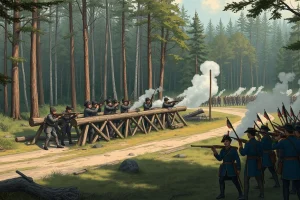
The engagement began early in the morning when American scouts located the British camp. Johnson’s cavalry charged down the road, striking the British regulars before they could fully deploy. Many British soldiers surrendered almost without resistance. Meanwhile, American infantry and dismounted cavalry moved against Tecumseh’s position in the swamp. The fighting there lasted longer, as the dense undergrowth slowed the American advance and the Indigenous warriors resisted fiercely. Tecumseh was killed during this phase, and his death led to the collapse of the resistance. The entire battle lasted only about an hour.
Casualties and Losses
Casualty figures vary among sources. The American Battlefield Trust reports American losses of 27 killed and 57 wounded, while other sources list 7 killed and 22 wounded. British losses are recorded as 12 killed, 22 wounded, and about 600 captured, though some estimates give higher numbers of killed and wounded. The discrepancy reflects the chaos of the battle and the difficulty of accurate record-keeping. Tecumseh’s body was never positively identified; his remains were likely buried by his warriors or concealed, and the exact circumstances of his death remain a matter of historical dispute.
Result
The battle was a decisive American victory. It destroyed the last significant British threat in Upper Canada’s western frontier and eliminated Tecumseh’s confederacy as a political and military force. The American victory secured control of the Detroit region and opened the way for further American operations in the Northwest.
Strategic Consequences
In the short term, the victory gave the United States control over the western Great Lakes and facilitated the abandonment of British posts in Michigan Territory. The destruction of Tecumseh’s confederacy also removed the principal barrier to American westward expansion. Historians such as Alan Taylor have emphasized that the War of 1812 was a catastrophe for Indigenous peoples, as the death of Tecumseh and the collapse of his movement led directly to the removal policies and land cessions that followed in the 1820s and 1830s. The battle also ended the active British alliance with Indigenous nations in the Northwest, as British authorities were unwilling to renew commitments to a shattered confederacy.
Primary Accounts
Eyewitness accounts of the battle include the official report of Major General William Henry Harrison to the U.S. War Department, describing the victory and the pursuit. Colonel Richard Mentor Johnson claimed in his report that he personally killed Tecumseh, a claim that became a centerpiece of his political career. British accounts, including Procter’s report and the court-martial testimony that followed, provide a counterpoint but are less detailed. A well-known engraving by Nathaniel Currier, c. 1846, depicts the battle and Tecumseh’s death, though it is a later artistic interpretation. The absence of a confirmed body and the conflicting claims have made Tecumseh’s death a subject of enduring fascination and debate.
Battlefield Today
The battlefield is commemorated as Battle of the Thames National Historic Site of Canada, located near Thamesville in southwestern Ontario. A monument and interpretive panels mark the site, and portions of the battlefield are preserved. The exact location of Tecumseh’s death is not marked, as it remains uncertain. The site is a destination for visitors interested in the War of 1812 and Indigenous history.
Primary Sources
Key primary sources include Harrison’s official report to the Secretary of War, dated after the battle, which provides an American military overview. Johnson’s report and subsequent letters outline his claim to have killed Tecumseh. Procter’s report and the records of his court-martial reveal the British perspective and the disorganization of the retreat. A number of letters and journals from Kentucky soldiers describe the battle and the conditions of the campaign. The Canadian Encyclopedia and other official sources point to the interpretive resources at the battlefield site.
Further Reading
- Hickey, Donald R. The War of 1812: A Forgotten Conflict.
- Taylor, Alan. The Civil War of 1812: American Citizens, British Subjects, Irish Rebels, and Indian Allies.
- Lambert, Andrew. The Challenge: Britain Against America in the Naval War of 1812.
- Berton, Pierre. The Invasion of Canada, 1812–1813.
- Marsh, James H., and Tabitha de Bruin. “Tecumseh.” In The Canadian Encyclopedia.
References
- American Battlefield Trust. “Battle of the Thames | Battle Facts and Summary.” https://www.battlefields.org/learn/war-1812/battles/battle-thames
- Canadian Encyclopedia. “Tecumseh.” https://thecanadianencyclopedia.ca/en/article/tecumseh
- War of 1812. “Battle of the Thames.” https://thewarof1812.org/battles/battle-of-the-thames/
- United States Capitol Visitor Center. “Death of Tecumseh.” https://www.visitthecapitol.gov/artifact/death-tecumseh
- Smithsonian American Experience. “Tecumseh and the War of 1812.” PDF.
FAQ
Did Richard Mentor Johnson actually kill Tecumseh?
Johnson claimed to have killed Tecumseh, but the evidence is inconclusive. Several American participants made similar claims. Johnson’s claim was politically motivated and remains unverified.
Why was Tecumseh’s death so important?
Tecumseh was the leader of a pan-Indigenous confederacy that threatened American westward expansion. His death led to the collapse of the confederacy and opened the Northwest to American settlement and later removal of Indigenous peoples.
What happened to Tecumseh’s body?
No body was ever positively identified. After the battle, his warriors reportedly removed his remains to prevent desecration, but the exact location is unknown.
Leave a Reply