
Short Answer
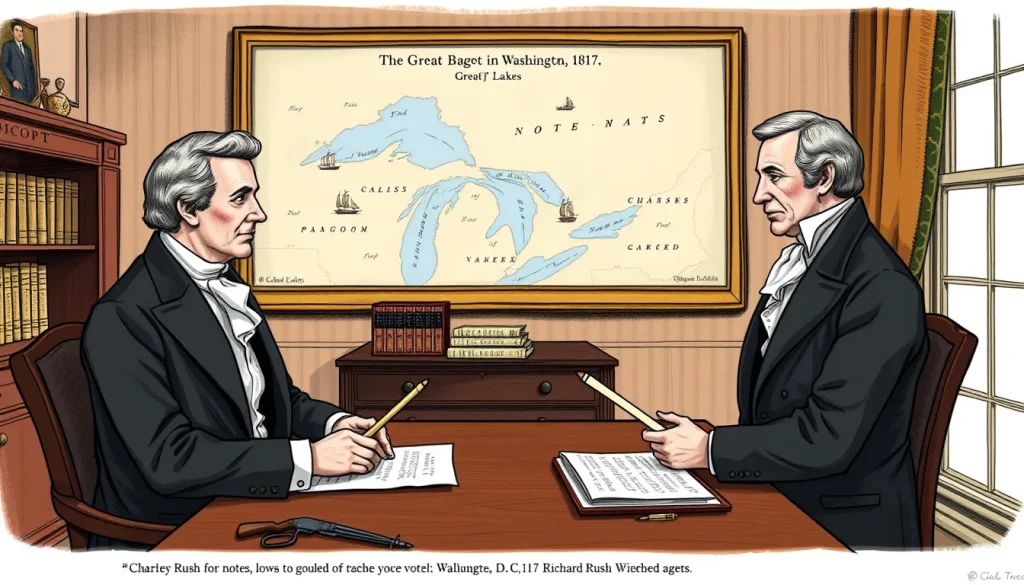
The Rush–Bagot Agreement was an exchange of notes between the United States and Great Britain in 1817 that restricted military naval vessels on the Great Lakes and Lake Champlain. Directly emerging from the naval arms race of the War of 1812, it helped defuse tensions and became a cornerstone of Anglo-American disarmament diplomacy.
Historical Context
During the War of 1812, both the United States and Great Britain constructed substantial fleets on Lakes Erie and Ontario, engaging in several significant naval battles. Although the Treaty of Ghent (1814) ended the war, it left the issue of naval forces on the lakes unresolved. The postwar period saw both nations wary of each other’s military strength, sparking an expensive shipbuilding race. However, both governments also sought to reduce military expenditures. American political leaders had earlier proposed disarmament during the Jay Treaty negotiations, but Britain rejected it. After the war, trade recovered, and British officials increasingly saw the United States as a valuable trading partner while recognizing that British North America would be costly and difficult to defend in another conflict.
What Happened
In 1816, U.S. Secretary of State James Monroe proposed to British Foreign Secretary Lord Castlereagh a mutual limitation of naval forces on the lakes. Castlereagh responded favorably, and Sir Charles Bagot, the British minister in Washington, met informally with Monroe and then with Acting Secretary of State Richard Rush. On April 28–29, 1817, Bagot and Rush exchanged formal notes, reaching an agreement. The terms limited each side to one vessel of no more than 100 tons, armed with a single 18-pounder cannon, on Lake Ontario; two similar vessels on the Upper Lakes; and one similar vessel on Lake Champlain. Both nations agreed to dismantle all other armed vessels on these waters and to build no new warships there. Either party could annul the agreement after six months’ notice. The U.S. Senate gave its advice and consent on April 16, 1818, and the agreement was proclaimed on April 28, 1818. The British government considered the exchange of notes sufficient to make the arrangement effective.
Why It Matters
The Rush–Bagot Agreement effectively ended the naval arms race on the Great Lakes and Lake Champlain, reducing expenditures and signaling improved Anglo-American relations. It is frequently cited as the diplomatic origin of the friendly, largely undefended border between the United States and Canada. Although both nations continued to build land fortifications along the frontier for decades, the agreement set an enduring precedent for mutual disarmament and symbolized the peaceful resolution of a contentious issue stemming from the war. By the twentieth century, it had become an international model of arms control, though its provisions were sometimes violated or reinterpreted over time.
Definition
The Rush–Bagot Agreement is a diplomatic understanding, embodied in an exchange of notes between the United States and Great Britain, that limited the number and size of armed vessels each country could maintain on the Great Lakes and Lake Champlain. It is often called a treaty, but technically it is an executive agreement ratified by the U.S. Senate.
Background
Following the War of 1812, both nations retained significant naval forces on the lakes, creating a costly and tense situation. The Treaty of Ghent contained no disarmament provisions, but it established commissions to resolve border disputes. President James Madison’s administration, seeking to reduce military spending and avoid future conflict, proposed naval limitations. British interests in economy and a desire to improve relations with the United States led to a favorable reception.
How It Worked
Under the agreement, each side was allowed one vessel on Lake Ontario, two on the Upper Lakes (Erie, Huron, Michigan, and Superior), and one on Lake Champlain. Each vessel could not exceed 100 tons and could carry only one 18-pounder cannon. All other armed vessels had to be dismantled, and no new warships were to be built on these waters. Both parties also agreed to restrict the retained vessels to duties that would not interfere with the other side. The agreement could be terminated by six months’ notice from either party.
Competing Viewpoints
Historians have interpreted the agreement in differing ways. Some view it as a straightforward disarmament success that prevented a naval arms race and laid the foundation for the peaceful border. Others point out that the agreement was frequently violated in practice—vessels were replaced, tonnage limits were exceeded, and new types of armed ships appeared—and that land fortifications continued to be built for decades. By the 1920s, however, the agreement had become a symbol of the “undefended border,” celebrated internationally as a model. The shift from a rigid compact to a symbolic narrative is a key focus of modern scholarship.
Role in the War of 1812
The agreement was a direct consequence of the war’s naval arms race on the Great Lakes. Both sides had learned that competition on inland waters was costly and destabilizing. The Rush–Bagot Agreement addressed the immediate postwar naval buildup and sought to prevent future conflicts that could escalate into another war.
Consequences and Historical Interpretation
Immediately, the agreement led to the reduction of naval forces on the lakes, saving money and reducing tensions. In the long term, it helped usher in an era of improved Anglo-American relations and contributed to the gradual demilitarization of the Great Lakes frontier. Although it did not stop the construction of land fortifications, it set a precedent for arms control and became a cornerstone of the U.S.–Canada security relationship. Later historians and politicians have celebrated it as an early example of successful disarmament and as a symbol of the peaceful coexistence between the United States and Canada.
Primary Sources
The most important primary sources are the original exchange of notes between Richard Rush and Charles Bagot, dated April 28 and 29, 1817. The notes spell out the agreed limits on vessels, tonnage, armament, and the dismantling of others. The text is available in the Avalon Project at Yale Law School and in Hunter Miller’s Treaties and Other International Acts of the United States of America. The U.S. Senate’s resolution of approval (April 16, 1818) and President’s proclamation (April 28, 1818) are also accessible. These documents are official and show the precise terms and the intent of both governments. A limitation of these sources is that they reflect the executive and diplomatic perspectives, not the views of local inhabitants or military officers who might have seen the agreement differently.
Further Reading
- Radojewski, Christopher Mark. “The Rush–Bagot Agreement: Canada–US Relations in Transition.” American Review of Canadian Studies 47, no. 3 (2017): 280–299.
- “Rush-Bagot Pact, 1817 and Convention of 1818.” Office of the Historian, U.S. Department of State. https://history.state.gov/milestones/1801-1829/rush-bagot.
- “Rush-Bagot Agreement.” The Canadian Encyclopedia, 2006, updated 2023.
- Avalon Project. “Exchange of Notes Relative to Naval Forces on the American Lakes.” Yale Law School. https://avalon.law.yale.edu/19th_century/conv1817.asp.
References
- Office of the Historian. “Rush-Bagot Pact, 1817 and Convention of 1818.” U.S. Department of State. Accessed 2025. https://history.state.gov/milestones/1801-1829/rush-bagot.
- Sprague, D.N., and Michelle Filice. “Rush-Bagot Agreement.” The Canadian Encyclopedia, February 7, 2006, last edited February 6, 2023. https://thecanadianencyclopedia.ca/en/article/rush-bagot-agreement.
- Avalon Project. “Exchange of Notes Relative to Naval Forces on the American Lakes.” Yale Law School. https://avalon.law.yale.edu/19th_century/conv1817.asp.
- Radojewski, Christopher Mark. “The Rush–Bagot Agreement: Canada–US Relations in Transition.” American Review of Canadian Studies 47, no. 3 (2017): 280–299. doi:10.1080/02722011.2017.1370721.
FAQ
What did the Rush–Bagot Agreement actually do?
It limited each country to one small armed vessel on Lake Ontario, two on the Upper Lakes, and one on Lake Champlain, all under 100 tons and with a single 18-pounder cannon. All other armed vessels were to be dismantled, and no new warships were to be built on these waters.
Why was the Rush–Bagot Agreement signed?
After the War of 1812, both the U.S. and Britain had built large fleets on the Great Lakes, leading to an expensive arms race. The agreement aimed to reduce tensions and military expenditures.
Is the Rush–Bagot Agreement still in effect?
Technically, the agreement has never been formally terminated. Although its provisions have been violated or reinterpreted over time, it remains a symbol of the peaceful U.S.–Canada security relationship.



Leave a Reply