
Short Answer
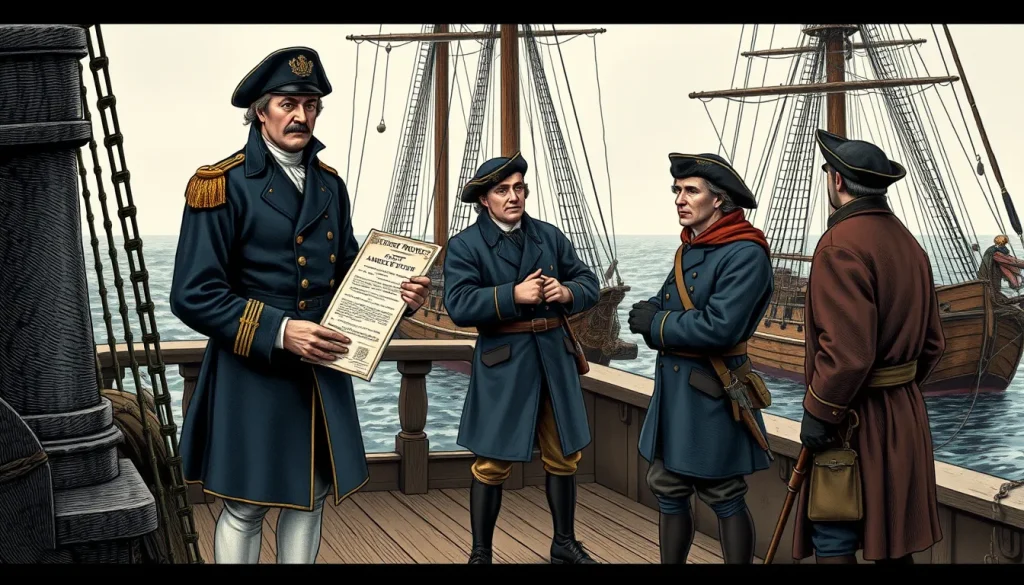
Impressment was the British practice of seizing men and forcing them to serve in the Royal Navy, and between 1793 and 1815 the Royal Navy carried that practice onto American merchant ships on the high seas and into Atlantic and Caribbean ports. Because Britain claimed lifelong allegiance to anyone born a British subject, naval officers removed men from American vessels even when the men carried American citizenship papers or seamen’s protection certificates. The dispute over sailors’ rights became one of the leading maritime grievances behind the United States declaration of war on 18 June 1812, and the slogan “Free Trade and Sailors’ Rights” tied the issue to the wider Anglo-American quarrel over neutral trade. The war did not formally settle the question: the Treaty of Ghent of 24 December 1814 made no mention of impressment, and the practice ended only as the Napoleonic Wars closed.
Historical Context
The impressment controversy grew out of the manpower demands of Britain’s wars against Revolutionary and Napoleonic France, which began in 1793 and continued, with a brief interruption in 1802–1803, until 1815. The Royal Navy expanded enormously to blockade French and allied ports and to protect British commerce. Figures cited by the United States National Park Service place the number of seamen required by the Royal Navy at roughly 36,000 in 1793 and about 114,000 by 1812, and the same source states that as many as half of the men manning the fleet had been impressed at some point in their service. Historians give differing proportions, and these figures should be treated as estimates rather than precise records, but the direction of the change is not in dispute: voluntary enlistment could not supply the fleet.
At the same time the United States was the largest neutral carrier in the Atlantic. Its merchant fleet grew during the European wars, and American shipowners employed large numbers of experienced British-born sailors, including deserters from the Royal Navy, because such men were skilled and readily available. Congress passed naturalization acts in 1790, 1795 and 1802, and in 1796 it created a system of seamen’s protection certificates issued by American consuls and customs officials to document the citizenship of American sailors. British law and Admiralty practice, by contrast, rested on the doctrine that allegiance was perpetual and could not be renounced, so a man born a British subject remained one in British eyes regardless of naturalization abroad.
Diplomacy failed repeatedly. British ministers declined to treat impressment as a question separable from the Orders in Council and the blockade measures adopted against Napoleon, while American administrations insisted that the right to search American vessels for deserters was itself an affront to sovereignty. The Chesapeake–Leopard affair of 1807, the Embargo Act that followed it, and the abortive Anglo-American agreements of 1809 and 1810 hardened positions on both sides in the years immediately before the war.
What Happened
From 1793 onward, Royal Navy squadrons in the West Indies, off Halifax and on the North Atlantic station stopped American merchant vessels and mustered their crews in search of deserters and British-born seamen. Officers frequently rejected or discounted American protections, arguing that the documents were fraudulent or that a certificate could not change the nationality a man was born with. American consuls in Britain and the Caribbean compiled lists of seized seamen and petitioned the Admiralty for their release, with limited success. Estimates of how many Americans were impressed during the Napoleonic Wars vary widely: the National Museum of American History gives a figure of as many as 6,000, while the National Park Service cites about 10,000, reflecting the incompleteness of surviving records.
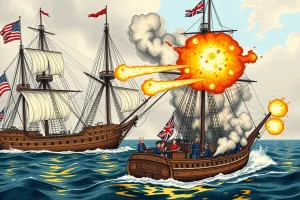
The most explosive single incident came on 22 June 1807, when HMS Leopard fired on the United States frigate Chesapeake off the Virginia coast after Commodore James Barron refused to allow his crew to be mustered for deserters. The British ship carried away four men whom British officers claimed had deserted from Royal Navy vessels. Americans treated the attack as an assault on national honor as well as an act of impressment, and the affair pushed President Thomas Jefferson toward the embargo policy of late 1807.
Between 1807 and 1812 the seizures continued, alongside the trade restrictions that followed the British Orders in Council of November 1807 and Napoleon’s counter-measures. A further naval confrontation, the Little Belt affair of 16 May 1811, added to the tension. On 1 June 1812 President James Madison sent Congress a message listing the violation of the American flag and the seizure of persons sailing under it among the injuries the United States had suffered; Congress declared war on 18 June 1812.
During the war the competition for seamen continued in several forms. American naval and merchant officers recruited British deserters, and the National Park Service notes that American naval officers also pressed men into service themselves. Black sailors, who formed a substantial minority of American crews, were especially vulnerable to seizure, and British forces in the Chesapeake region recruited formerly enslaved people into colonial marine units. Impressment of American seamen declined sharply after Napoleon’s abdication in April 1814, before the peace talks concluded; the Treaty of Ghent, signed on 24 December 1814, was silent on the subject, and the practice lapsed as the Royal Navy demobilized after 1815.
Why It Matters
For Americans in 1812, impressment was less a matter of numbers than of standing. Seizing men from American decks implied that the United States was not an equal in international relations and that its citizenship laws could be set aside by a foreign navy, and the grievance fed the language of a second war of independence. For Britons, the press was an unpleasant but indispensable instrument of a war for national survival, and the Royal Navy’s ability to man its ships was treated as a strategic necessity rather than a negotiable concession.
The issue was never settled by negotiation. Impressment disappeared because the wars that made it necessary ended, not because either government yielded. Historians disagree about how much weight to give the grievance. Reginald Horsman and others have emphasized Western expansion and the influence of the War Hawks, J. C. A. Stagg and Donald Hickey treat the maritime disputes as one element among several causes, and Paul A. Gilje has argued that sailors’ rights were central to American political culture and to the war’s meaning. Denver Brunsman locates the controversy in a broader conflict between imperial claims to perpetual allegiance and an emerging nation’s claim to define its own citizens.
Definition
Impressment, often called the press, was the compulsory recruitment of men into naval service. It operated both ashore, through press gangs that swept dockside districts and taverns for able-bodied seamen, and at sea, where warships stopped merchant vessels and removed men from their crews. British practice rested on the state’s claim to the service of its subjects in time of war rather than on statute alone, and impressed men received a small advance known as prest money on entering the ship.
Background
The Royal Navy had used impressment in earlier wars, but the scale of the French Revolutionary and Napoleonic conflicts transformed it. Ships were kept at sea for long periods, disease and desertion thinned crews, and the demand for trained seamen outran both volunteers and the capacity of the merchant marine to spare men. Impressment was administered by the Admiralty through warrants issued to particular captains, and British officers regarded the practice as inseparable from the maintenance of the fleet.
How It Worked
A press warrant authorized a named captain to seize as many men as he needed for his ship or for other ships of the fleet, and each man taken in this way was to receive a shilling as prest money; a surviving example from 1794 authorized Captain John Thomas Duckworth of HMS Orion in these terms. Admiralty instructions of the same year set conditions for impressing men, but the National Museum of American History notes that British warships routinely bent those rules.
At sea, a boarding party from a warship examined the protections or citizenship papers of a merchant crew, mustered the men, and carried away those it judged to be British subjects or deserters. The men were taken to a receiving ship or tender and then distributed to vessels short of hands. A man who could prove alien status might be discharged, but proof was difficult, consular certificates carried little weight with naval officers, and the burden fell on the sailor himself.
American Objections
The United States objected on grounds of sovereignty, law and interest. American officials argued that a vessel on the high seas was subject to the jurisdiction of its flag, that naturalization lawfully transferred allegiance, and that the right to search American ships for British deserters had no basis in the law of nations. Shipowners and seaports complained of the loss of trained men. Politically, the issue was framed in the republican language of sailors’ rights, and it carried particular weight because it appeared to deny the practical value of the Revolution itself.
British Rationale and Context
British governments defended the press as essential to the fleet that protected Britain and its trade from France. Naval officers argued that desertion was widespread, that American protections were frequently forged or purchased, and that men born British remained British. A remark the National Park Service attributes to Admiral Horatio Nelson — that without a press he had no idea how the fleet could be manned — expresses the operational view that shaped British policy. The practice was controversial within Britain as well, where press gangs provoked riots and parliamentary criticism, and British authorities extended it to British merchant ships and port towns, not only to foreign vessels.
Role in the War of 1812
Impressment was among the grievances Madison listed in his war message of 1 June 1812, and it supplied the war with one of its most durable phrases, “Free Trade and Sailors’ Rights,” associated with the naval officer David Porter. The issue shaped the war’s political language more than its military operations: because the British had already reduced the practice after Napoleon’s abdication, impressment was no longer an active bargaining point by the time commissioners met at Ghent. The manpower contest nevertheless continued throughout the war, as both sides recruited from the other’s sailors and as the British drew formerly enslaved people into their ranks.
Consequences and Historical Interpretation
Impressment was neither renounced nor abolished in the peace settlement. The practice declined as the Royal Navy reduced its establishment after 1815, and it was not revived on the same scale. The underlying disagreement over expatriation and dual allegiance persisted in Anglo-American relations well after the war, and the British doctrine of perpetual allegiance was gradually abandoned in international practice over the nineteenth century.
Historians continue to debate whether impressment caused the war or chiefly symbolized a broader conflict over neutral trade and continental expansion. The most common position is that impressment was a genuine and widely felt grievance whose political force derived from what it seemed to say about American sovereignty, while the vote for war in June 1812 was also shaped by the Orders in Council, the failure of commercial restriction, and Western and frontier pressures. The practice also complicates any simple narrative of American victimhood, since American officers and shipowners recruited British deserters and American naval officers pressed men as well.
Primary Sources
The documentary record for impressment is scattered but substantial, and it preserves both official policy and the experience of individual sailors.
- British Admiralty press warrant, 1794, authorizing Captain John Thomas Duckworth of HMS Orion to impress as many men as he required; held in the collection of the National Museum of American History. It shows the administrative machinery of impressment and the shilling prest money paid to pressed men.
- British Admiralty instructions for impressment, 1794, also in the National Museum of American History, which set procedural conditions that naval officers frequently disregarded.
- Seamen’s protection certificates issued under the United States act of 1796 and consular correspondence concerning impressed seamen, now found in the records of the Department of State at the National Archives and in scattered museum and library collections. These documents record individual claims of citizenship and are limited by the fact that consular agents collected them to support claims against Britain.
- Correspondence and official papers relating to the Chesapeake–Leopard affair of June 1807, printed in American State Papers: Foreign Relations and preserved in British Admiralty and Foreign Office records at The National Archives (United Kingdom). These are partisan in tone on both sides.
- President James Madison’s message to Congress of 1 June 1812, printed in the Annals of Congress and available through the Library of Congress and the Avalon Project. It states the American case for war and should be read as a political argument, not a neutral summary.
- The Treaty of Ghent of 24 December 1814, available through the Avalon Project and in British diplomatic records. Its silence on impressment is itself a key piece of evidence.
No single verified transcript can be treated as representative of the thousands of impressment cases; researchers should work from the printed documentary editions and archival finding aids cited below rather than from reconstructed texts.
Further Reading
- Denver Brunsman, The Evil Necessity: British Naval Impressment in the Eighteenth-Century Atlantic World (University of Virginia Press, 2013).
- Paul A. Gilje, Free Trade and Sailors’ Rights in the War of 1812 (Cambridge University Press, 2013).
- Donald R. Hickey, The War of 1812: A Forgotten Conflict (University of Illinois Press, revised edition).
- Reginald Horsman, The Causes of the War of 1812 (University of Pennsylvania Press, 1962).
- Nicholas Rogers, The Press Gang: Naval Impressment and Its Opponents in Georgian Britain (Continuum, 2007).
- J. C. A. Stagg, Mr. Madison’s War: Politics, Diplomacy, and Warfare in the Early American Republic, 1783–1830 (Princeton University Press, 1983).
- Alan Taylor, The Civil War of 1812: American Citizens, British Subjects, Irish Rebels, and Indian Allies (Alfred A. Knopf, 2010).
- U.S. National Park Service, “Impressment and the War of 1812,” and National Museum of American History, “Impressment,” online exhibitions and reference pages.
- Library of Congress, War of 1812 digital collections; USS Constitution Museum and Canadian War Museum online resources on naval manpower.
References
- U.S. National Park Service, “Impressment and the War of 1812,” https://www.nps.gov/articles/impressment.htm.
- National Museum of American History, “Impressment,” On the Water exhibition, https://americanhistory.si.edu/explore/exhibitions/on-the-water/online/maritime-nation/defending-independence/impressment.
- Denver Brunsman, The Evil Necessity: British Naval Impressment in the Eighteenth-Century Atlantic World (University of Virginia Press, 2013).
- Paul A. Gilje, Free Trade and Sailors’ Rights in the War of 1812 (Cambridge University Press, 2013).
- Donald R. Hickey, The War of 1812: A Forgotten Conflict (University of Illinois Press).
- Reginald Horsman, The Causes of the War of 1812 (University of Pennsylvania Press, 1962).
- Nicholas Rogers, The Press Gang: Naval Impressment and Its Opponents in Georgian Britain (Continuum, 2007).
- J. C. A. Stagg, Mr. Madison’s War (Princeton University Press, 1983).
- Alan Taylor, The Civil War of 1812 (Alfred A. Knopf, 2010).
- James Madison, message to Congress, 1 June 1812, Annals of Congress; Library of Congress and Avalon Project.
- Treaty of Peace and Amity between His Britannic Majesty and the United States of America (Treaty of Ghent), 24 December 1814; Avalon Project.
FAQ
Did impressment cause the War of 1812?
Impressment was one of the leading maritime grievances in President Madison's war message of 1 June 1812 and a powerful political symbol of American sovereignty. Most historians treat it as a genuine cause alongside the Orders in Council, the failure of commercial restrictions, and Western and frontier pressures, but they disagree about its relative weight in the decision for war.
How many American sailors were impressed by the Royal Navy?
Surviving records do not permit an exact count. The National Museum of American History cites as many as 6,000 Americans impressed, while the National Park Service gives a figure of about 10,000. The difference reflects the patchy nature of consular and Admiralty records rather than a settled total.
Did the Treaty of Ghent end impressment?
No. The treaty signed on 24 December 1814 contained no reference to impressment, and American commissioners did not secure a British commitment on the issue. The practice declined sharply after Napoleon's abdication in April 1814 and lapsed as the Royal Navy reduced its fleet after 1815.
Did Americans also force sailors into service?
Yes. American naval and merchant officers recruited British deserters throughout the period, and the National Park Service notes that American naval officers also pressed men into service. The manpower contest was not one-sided, which is one reason historians treat impressment as a dispute between competing claims to loyalty rather than a simple case of victimization.

Leave a Reply