
Short Answer
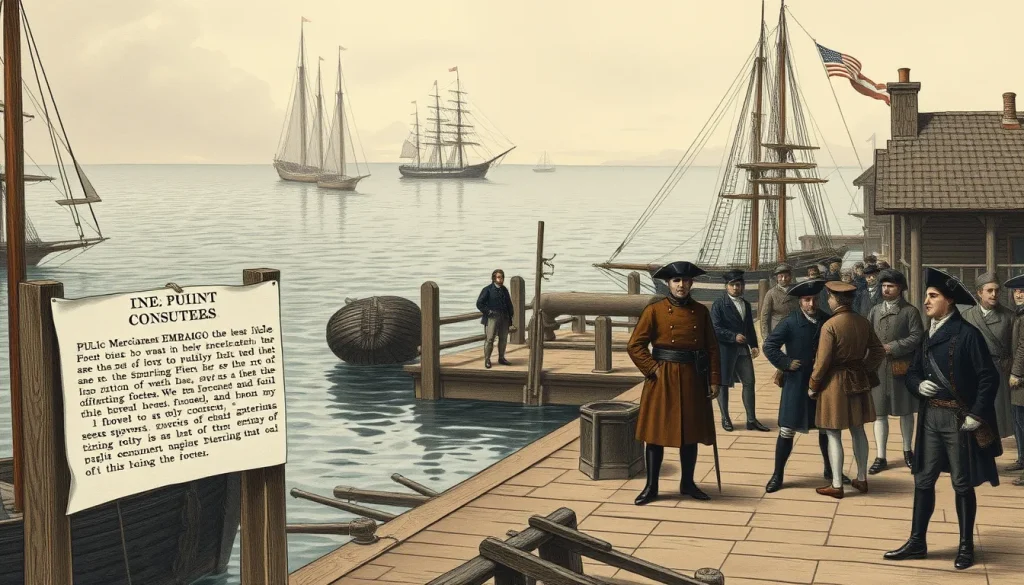
The Embargo Act of 1807 was a general U.S. trade embargo enacted by the 10th Congress and signed into law by President Thomas Jefferson on December 22, 1807. It closed American ports to foreign export shipping and was designed to force Britain and France to respect American neutral trade and maritime rights during the Napoleonic Wars. The policy failed to change European conduct, damaged the American economy, and deepened the Anglo-American tensions that contributed to the War of 1812.
Historical Context
The Embargo Act grew out of the commercial and maritime conflict between Britain and France during the Napoleonic Wars. After the brief Peace of Amiens collapsed in 1803, the two European powers resumed a struggle that became a contest of blockades and counter-blockades. Britain, supreme at sea, issued a series of Orders in Council that restricted neutral trade with France and its allies. France, dominant on land but weaker at sea, responded with decrees such as the Berlin Decree of 1806 and the Milan Decree of 1807, which authorized the seizure of ships that complied with British regulations. American merchant vessels, which had expanded rapidly in the first decade of the nineteenth century, were caught between the two systems.
A second grievance was impressment. The Royal Navy stopped American merchant ships and removed alleged British deserters, sometimes taking American citizens as well. The practice inflamed American public opinion. On June 22, 1807, the British warship HMS Leopard attacked the U.S. frigate USS Chesapeake off the coast of Norfolk, Virginia, after the Chesapeake refused to be searched. The British removed four men, including three Americans, and the incident became a national humiliation. President Jefferson ordered British warships out of U.S. waters, but he recognized that the United States was militarily far weaker than Britain or France.
Rather than risk war, Jefferson and Secretary of State James Madison favored commercial retaliation. The earlier Non-importation Act of 1806 had been ineffective, but the Chesapeake-Leopard affair increased pressure for stronger action. Jefferson believed that Britain and France depended on American raw materials and shipping enough that a comprehensive embargo could compel them to respect neutral rights. The Republican-controlled Congress largely shared that view.
What Happened
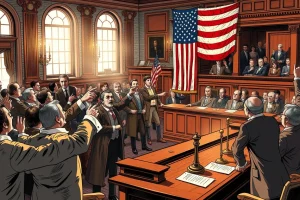
After Jefferson sent a special message to Congress on December 18, 1807, recommending an embargo, Congress moved quickly. The Senate passed the bill 22 to 6 on December 18. The House passed it 82 to 44 on December 21, and Jefferson signed it into law on December 22, 1807. The formal title was An Act laying an Embargo on all ships and vessels in the ports and harbors of the United States.
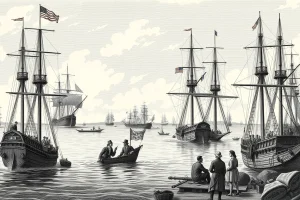
The law prohibited American ships and vessels from obtaining clearance for foreign voyages. It authorized the president to make exceptions for vessels under his immediate direction and to enforce the measure through customs collectors, revenue cutters, and the U.S. Navy. The act did not by itself ban all imports, but the prohibition on outbound voyages and later enforcement measures severely restricted both exports and imports.
Congress passed supplementary enforcement laws in 1808. These gave customs officials broader powers, required bonds for coasting vessels, and made it harder to evade the embargo through coastal trade or false papers. Enforcement nevertheless proved difficult along the extensive American coastline and the Canadian border. Smuggling flourished, especially across the border into British Canada and into Spanish Florida. Merchant ships sometimes sailed under false destinations, and overland trade routes carried goods out of the country.
The embargo became increasingly unpopular in New England and other commercial centers. Federalists condemned it as ruinous and unconstitutional, while some Republicans worried about its economic effects. The Federalist Party gained seats in the 1808 elections. In the final days of Jefferson’s presidency, Congress repealed the Embargo Act on March 1, 1809, and replaced it with the Non-Intercourse Act, which reopened trade with most nations but prohibited commerce with Britain and France.
Why It Matters
The immediate economic effects were severe. American exports fell sharply, by some estimates from about $108 million in 1807 to about $22 million in 1808. New England shipping interests, Southern planters who depended on export markets, and urban workers tied to maritime trade all suffered. At the same time, the cutoff of imported manufactured goods encouraged domestic production, especially in textiles, and marked an early step toward American industrialization.
Politically, the embargo deepened sectional and partisan divisions. New England Federalists saw it as a pro-French, anti-commercial policy that sacrificed their region to Jeffersonian ideology. Republicans defended it as a peaceful alternative to war. The embargo also raised questions about federal power, enforcement, and the limits of presidential authority, as customs officers and naval vessels tried to suppress smuggling.
Historians disagree about the embargo’s significance. Some interpret it as a rational experiment in economic statecraft and a reasonable alternative to a war the United States could not win. Others emphasize its ideological and political motives, including Jefferson’s desire to avoid war and to weaken his Federalist opponents. Many agree that it failed to coerce Britain or France and that its collapse left the United States with fewer diplomatic options, setting the stage for continued commercial restrictions and eventually the War of 1812.
Definition
The Embargo Act of 1807 was an open-ended commercial policy that prohibited American ships from leaving U.S. ports for foreign destinations. It was not a declaration of war and did not permanently ban all trade; it was intended as coercive economic pressure. The law also gave the president authority to make limited exceptions and to use customs and naval forces to enforce the embargo.
Background
By 1807, American neutral trade had become a central issue in the Napoleonic Wars. Britain and France each sought to prevent the other from benefiting from neutral shipping. British Orders in Council and French decrees placed American commerce at risk, while impressment directly challenged U.S. sovereignty over its sailors. The Chesapeake-Leopard affair of June 1807 turned these long-running disputes into a public crisis. Jefferson chose an embargo because he believed commercial pressure was safer and more effective than military confrontation.
How It Worked
The embargo depended on customs collectors to deny clearance to vessels bound for foreign ports. Revenue cutters and the Navy patrolled coastal waters, and the president could authorize exceptions for public or emergency voyages. Enforcement laws added bond requirements and penalties for violations. In practice, the system was porous. Merchants used coastal shipping, false manifests, bribery, and overland routes to move goods to Canada or Florida. The federal government lacked the resources to seal the entire coastline, and local juries sometimes refused to convict violators.
Competing Viewpoints
Republicans argued that the embargo was a moral and peaceful form of resistance. It would avoid war, protect American sailors, and force Britain and France to recognize neutral rights. Federalists and many New England merchants called it ruinous, unconstitutional, and favorable to France. British officials generally dismissed the embargo as ineffective and believed it harmed the United States more than Britain. France continued to seize American ships under its decrees, showing that the policy did not produce the compliance Jefferson expected.
Modern historians offer several interpretations. Some view the embargo as an early and ambitious experiment in economic sanctions. Others stress its political function in Jefferson’s domestic battles with the Federalists. Still others argue that it was a well-intentioned but poorly designed policy that ignored the realities of enforcement and the adaptability of British trade, which found new markets in South America and elsewhere.
Role in the War of 1812
The Embargo Act failed to resolve the neutral rights and impressment disputes. Its repeal and replacement by the Non-Intercourse Act in 1809 continued the strategy of commercial restriction. When that law also failed, Congress passed Macon’s Bill No. 2 in 1810, which reopened trade with Britain and France but authorized the president to reinstate non-intercourse against one power if the other repealed its restrictions. Napoleon manipulated the offer, and the United States reimposed restrictions on Britain in 1811. By then, many Americans had concluded that economic coercion alone could not protect the nation’s rights. The accumulated grievances over trade, impressment, and British support of Indigenous resistance in the Northwest helped lead to the declaration of war on June 18, 1812.
Consequences and Historical Interpretation
In the short term, the embargo caused economic hardship, promoted smuggling, and strengthened the Federalist Party in New England. It was repealed on March 1, 1809. In the longer term, it encouraged domestic manufacturing and demonstrated both the appeal and the limits of economic sanctions as a tool of foreign policy. It also deepened regional divisions that would persist through the War of 1812 and beyond.
Historians continue to debate whether the embargo delayed or hastened the war. Some see it as a sincere attempt to avoid conflict, while others see it as a diplomatic failure that emboldened Britain and left the United States with no peaceful leverage. Its memory is often invoked in later debates over sanctions, neutrality, and presidential power, though its specific context was the unique maritime conflict of the Napoleonic era.
Primary Sources
The most important primary source is the text of the Embargo Act itself, An Act laying an Embargo on all ships and vessels in the ports and harbors of the United States, signed December 22, 1807, and printed in the U.S. Statutes at Large, 2 Stat. 451. It provides the exact legal language and scope of the policy, but it does not reveal the debates or enforcement problems that followed.
Thomas Jefferson’s special message to Congress of December 18, 1807, is a key statement of presidential rationale. It is available through the National Archives Founders Online edition of Jefferson’s papers. It explains why Jefferson preferred commercial coercion but reflects his own perspective and political aims. The Annals of Congress for the 10th Congress record congressional debate and show partisan divisions, though speakers often used rhetoric for public effect. British Orders in Council and French decrees provide the belligerent context, while the hostile etching Embargo by Alexander Anderson, published in 1808, illustrates contemporary opposition. Each source has limitations: official documents omit smuggling and local resistance, while satirical prints exaggerate for effect.
Further Reading
- Burton Spivak, Jefferson’s English Crisis: Commerce, Embargo, and the Republican Revolution (1979).
- Bradford Perkins, Prologue to War: England and the United States, 1805-1812 (1961).
- Dumas Malone, Jefferson the President: Second Term, 1805-1809 (1974).
- Donald R. Hickey, The War of 1812: A Forgotten Conflict (1989; revised edition, 2012).
- J.C.A. Stagg, Mr. Madison’s War: Politics, Diplomacy, and Warfare in the Early American Republic, 1783-1830 (1983).
- National Archives, Founders Online, and Library of Congress, Annals of Congress.
References
- Encyclopaedia Britannica, Embargo Act, https://www.britannica.com/topic/Embargo-Act.
- Wikipedia, Embargo Act of 1807, https://en.wikipedia.org/wiki/Embargo_Act_of_1807.
FAQ
What did the Embargo Act of 1807 do?
It prohibited American ships from leaving for foreign ports and effectively closed U.S. export trade, while authorizing the president to enforce the measure through customs officers and the Navy.
Why did Thomas Jefferson support the embargo?
Jefferson believed the United States was too weak militarily to fight Britain or France directly, so he favored commercial pressure to compel respect for American neutral rights and avoid war.
Did the Embargo Act cause the War of 1812?
It did not by itself cause the war, but it failed to resolve the neutral rights and impressment disputes, damaged the U.S. economy, and led to the Non-Intercourse Act and Macon's Bill No. 2, continuing the path toward war.
How did Americans react to the Embargo Act?
Reactions were divided. Many New England merchants and Federalists bitterly opposed it as ruinous and coercive, while some Republicans defended it as a peaceful alternative to war. Smuggling and evasion were widespread.
When was the Embargo Act repealed?
Congress repealed it on March 1, 1809, replacing it with the Non-Intercourse Act just before James Madison became president.

Leave a Reply