
Short Answer
The Hartford Convention was a secret assembly of Federalist delegates from New England that met at Hartford, Connecticut, from December 15, 1814, to January 5, 1815, while the United States was still fighting Great Britain in the War of 1812. Delegates condemned the war, the trade embargoes that preceded it, and the growing power of the Democratic-Republican administration, and they proposed constitutional amendments intended to protect New England’s commercial and political interests. Because the meetings were closed to the public, and because some Federalists had previously discussed secession, the convention became one of the most politically charged episodes of the war and is widely linked to the decline of the Federalist Party as a national force.
Historical Context
New England’s economy rested heavily on the sea: shipping, fishing, shipbuilding, and the carrying trade with the West Indies and Europe. Those interests were damaged first by British and French wartime restrictions on neutral shipping and then by the American response. President Thomas Jefferson’s Embargo Act of 1807 stopped most American overseas trade; the Non-Intercourse Act of 1809 and subsequent non-importation measures kept restrictions in place against Britain and France. Many New England merchants and shippers, a large share of them Federalists, regarded these policies as ruinous and as favoring the agricultural South and the expanding West at their section’s expense.
The United States declared war on Great Britain on June 18, 1812, over maritime grievances that included the impressment of American sailors and the seizure of ships and cargoes. The war was deeply unpopular across much of New England. Governors there resisted federal requests for militia, often arguing that state troops could not be ordered outside their own states or placed under regular army command. Massachusetts and Connecticut declined to put their militia at the disposal of the War Department, and the federal government in turn refused to pay the states’ expenses, a dispute that critics said left New England exposed to British attack.
By 1814 the war had turned against the United States. With Napoleon defeated in Europe, Britain could send reinforcements to North America and tightened a blockade along the American coast. British forces occupied eastern Maine in the summer and fall of 1814, burned the Capitol and the White House in Washington in August, and advanced along the New York and Vermont frontier in September. Banks outside New England suspended specie payments, customs revenue collapsed, and the federal government approached insolvency. In September 1814, when President James Madison asked Congress for a conscription bill, Federalists treated the proposal as proof that the administration intended to impose military centralization on the country. A related grievance was structural: the Constitution’s three-fifths clause counted enslaved people toward Southern representation in Congress and the Electoral College, while the presidency had been held by Virginia Republicans, Jefferson and then Madison, for nearly fifteen years.

What Happened
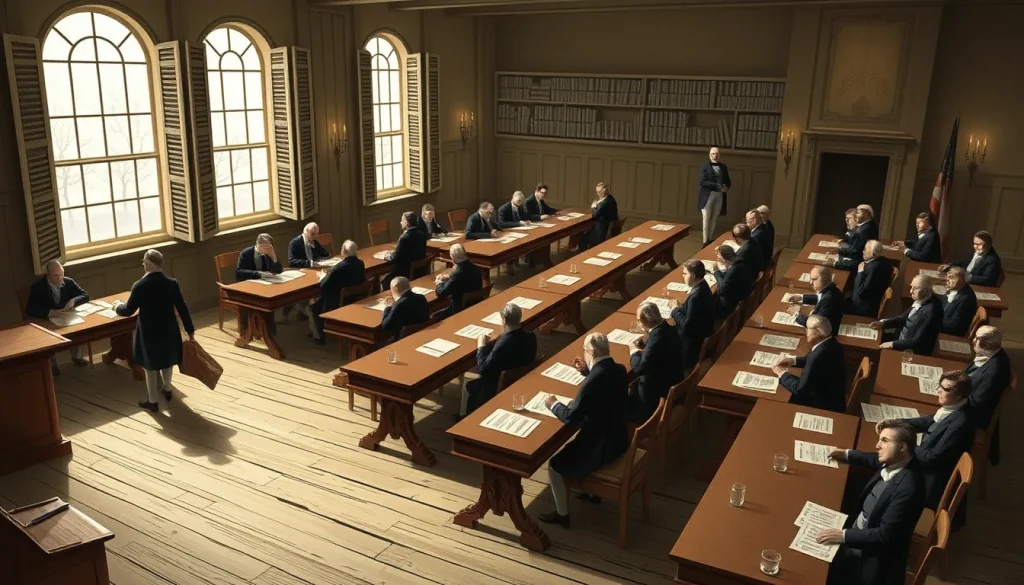
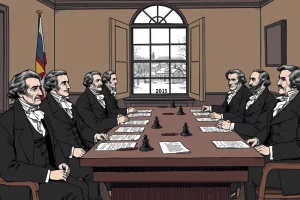
In October 1814 the Massachusetts legislature invited the other New England states to send delegates to a conference on their common grievances. Connecticut, Rhode Island, and New Hampshire responded promptly, while Vermont’s participation was limited. Twenty-six delegates eventually assembled at the Connecticut State House, now the Old State House, in Hartford. According to the standard delegate list, Massachusetts sent twelve, Connecticut seven, Rhode Island four, New Hampshire two, and Vermont one. George Cabot of Massachusetts, a retired senator and merchant, was chosen to preside. Sessions were closed to the public, and the delegates agreed that their deliberations would be recorded in a journal rather than published immediately.
The most divisive question was whether New England should consider leaving the Union. A minority, influenced by the earlier separationist arguments associated with Timothy Pickering and the so-called Essex Junto, favored radical action. The majority, led by Harrison Gray Otis, treated secession as impractical and politically reckless and steered the convention toward a statement of grievances and a demand for constitutional change, a path that followed precedents set by the Virginia and Kentucky Resolutions of 1798 and 1799.
The convention dissolved on January 5, 1815, after adopting a report that mixed protest with constitutional proposals. Its recommendations included apportioning representation and direct taxes among the states without counting enslaved people, effectively repealing the three-fifths clause; requiring a two-thirds majority in both houses of Congress to admit new states, to declare war, and to pass laws restricting commerce; limiting any embargo to sixty days; barring naturalized citizens from holding federal office; and restricting the presidency to a single term while forbidding two successive presidents from the same state. Together these proposals would have made it far harder for a Southern- and Western-dominated majority to make war or trade policy over New England’s objections.
Three commissioners, including Otis, carried the documents to Washington. By the time they arrived the political ground had shifted: the Treaty of Ghent had been signed on December 24, 1814, and Andrew Jackson’s victory at New Orleans on January 8, 1815, had been reported in the press. The commissioners withdrew without pressing their demands, and the convention’s proposals were never seriously debated in Congress.
Why It Matters
In the short term, the Hartford Convention accomplished almost nothing. Its timing, combined with its secrecy, made it easy prey for Republican editors and politicians, who portrayed the delegates as disloyal if not treasonous. The Federalist Party, already weakened, lost further standing in the 1816 election and effectively disappeared as a national organization during the Era of Good Feelings. In the longer term, the convention became a durable reference point in American political argument: an example of sectional grievance, of state-level resistance to federal policy, and of the political dangers of appearing to bargain with an enemy during wartime. Later generations, especially during the nullification and secession crises, invoked it both as a precedent and as a warning.
Historical interpretation of the convention has varied considerably. One older view treats it as evidence of Federalist disloyalty and near-treason. A second, advanced by twentieth-century historians, emphasizes that the delegates were moderates who deliberately rejected secession and worked within constitutional channels. A third stresses that the convention was a partisan disaster rather than an actual conspiracy, and that the Republican press campaign against it did more damage than anything the delegates actually did.
Definition
The Hartford Convention was an extralegal but publicly announced assembly of delegates chosen by the legislatures of several New England states, convened to agree on a joint statement of sectional grievances and to propose changes to the federal Constitution. It was not a session of Congress, a court, or a formal interstate compact. Its authority rested on the participating states’ legislatures rather than on federal law, and its output took the form of a published report, resolutions, and proposed amendments.
Background
Federalist opposition to the war grew out of nearly a decade of conflict over foreign policy and trade. Federalists had lost the presidency in 1800 and never regained it; they survived mainly in New England, parts of New York, and a few coastal cities. New England governors resisted federal militia requisitions throughout the war, and in 1814 Governor Caleb Strong of Massachusetts sent a confidential emissary to Sir John Coape Sherbrooke, the British governor at Halifax, apparently to sound out British intentions regarding Maine and a possible negotiated settlement. The episode remained obscure for decades and its precise purpose is still debated by historians, but it illustrates how far some state officials were willing to go outside normal federal channels.
How It Worked
Each participating state legislature appointed delegates, usually prominent lawyers, merchants, and former officeholders. The convention chose its own presiding officer and secretary, set rules of secrecy, and voted by state delegations rather than by individual delegate, a procedure that gave small states meaningful weight and strengthened the hand of the moderate leadership. Committees drafted a report and a set of amendments; the finished documents were approved by the whole body and then printed for public distribution. Delegates also arranged for commissioners to present the report in Washington. Because no official transcript of the debates was released at the time, later accounts depend on the report, the journal published in 1823 as The Secret Journal of the Hartford Convention, delegates’ private correspondence, and retrospective defenses and attacks.
Competing Viewpoints
Contemporaries disagreed sharply about what the convention meant. Republican newspapers and politicians described it as a gathering of disaffected men contemplating disunion, sometimes linking it to earlier Federalist talk of secession. Federalists insisted that the convention had rejected separation and had offered only constitutional remedies; Otis, the convention’s most visible figure, spent years defending its record, and sympathetic writers such as Theodore Dwight argued that the delegates had acted as loyal citizens. Modern historians generally accept that a secessionist minority existed but did not control the outcome. The main disagreements now concern how serious that minority was, how much the secrecy reflected tactical caution rather than conspiracy, and how much of the convention’s reputation was manufactured by its political opponents. Because the sessions were closed, any claim about hidden motives should be treated as inference rather than documentation.
Role in the War of 1812
The convention’s role in the war was indirect but significant. Massachusetts and Connecticut had already limited the use of their militia, which complicated federal manpower planning and left some coastal defense to state forces. The Massachusetts legislature appropriated funds for a state army, and New England’s governors and legislatures functioned as a running source of resistance to conscription and to federal control of state troops. British officials appear to have considered New England’s disaffection in their strategic thinking, though the extent of any coordinated expectation of cooperation remains uncertain. Ironically, the convention’s timing undercut its own cause: news of the Treaty of Ghent and of Jackson’s victory at New Orleans made continued protest look pointless and unpatriotic, and the war’s end removed the issue that had called the delegates together.
Consequences and Historical Interpretation
The convention’s proposals went nowhere: no amendment was adopted, and the delegation’s petition was never taken up. Its real consequences were political. The Federalist Party never recovered nationally, and the Republican ascendancy that followed the war left little room for organized opposition. Historian James M. Banner Jr. treated the convention as the culmination of Massachusetts Federalism’s long encounter with democratic party politics; other scholars, including Donald R. Hickey and Alan Taylor, situate it within broader wartime dissent, sectional economic conflict, and the fragile politics of a union in which regions experienced the same war very differently. The convention remains a case study in how questions of loyalty, free speech, and sectional interest become entangled during wartime, and how a political meeting whose formal demands were rejected can nonetheless shape a party’s fate and a nation’s memory.
Primary Sources
Report of the Hartford Convention (January 1815). Issued by order of the convention and reprinted widely in newspapers of the day, this document sets out the delegates’ grievances and their proposed amendments. It is the single most important statement of the convention’s public position, but it is a consensus text that suppresses the internal debate over secession.
The Secret Journal of the Hartford Convention (1823). Published eight years after the fact, with the compiler identified only as a gentleman of Connecticut, it supplies procedural detail that the public report omits. Its late date and defensive political context mean it should not be read as a verbatim record of debate.
Harrison Gray Otis, Letters in Defence of the Hartford Convention (1824). Otis was a leading delegate and the convention’s most prominent defender. His letters explain the moderate case for the convention but are necessarily self-interested.
Theodore Dwight, History of the Hartford Convention (1833). A lengthy sympathetic account by a Federalist editor closely associated with the convention’s political circle. Useful for detail, but written nearly two decades later with a clear partisan purpose.
Newspapers. Federalist papers such as the Connecticut Courant of Hartford and the Columbian Centinel of Boston defended the convention, while Republican papers such as the Boston Patriot attacked it. Niles’ Weekly Register of Baltimore reprinted the convention’s documents and provided a national digest. All are partisan, and much of their reporting is secondhand.
State and personal papers. The Massachusetts legislature’s resolutions and Governor Caleb Strong’s correspondence, held in the Massachusetts Archives, document the convention’s origins; the Connecticut State Library and the Connecticut Historical Society hold related Connecticut materials. James Madison’s published correspondence, collected in Letters and Other Writings of James Madison (1865), offers the administration’s perspective. Records of several closed sessions and of the Halifax contact are incomplete, so gaps should be acknowledged rather than filled by inference.
Further Reading
- James M. Banner Jr., To the Hartford Convention: The Federalists and the Origins of Party Politics in Massachusetts, 1789–1815 (New York: Knopf, 1970).
- Donald R. Hickey, The War of 1812: A Forgotten Conflict (Urbana: University of Illinois Press; revised edition, 2012).
- J. C. A. Stagg, Mr. Madison’s War: Politics, Diplomacy, and Warfare in the Early American Republic, 1783–1830 (Princeton: Princeton University Press, 1983).
- Alan Taylor, The Civil War of 1812: American Citizens, British Subjects, Irish Rebels, and Indian Allies (New York: Knopf, 2010).
- Samuel Eliot Morison, The Life and Letters of Harrison Gray Otis, Federalist, 1765–1848 (Boston: Houghton Mifflin, 1913).
- Theodore Dwight, History of the Hartford Convention (New York, 1833).
- American Battlefield Trust, The Hartford Convention: Political Dissent during the War of 1812.
- Connecticut’s Old State House, Hartford, Connecticut — the surviving building where the convention met.
References
- Wikipedia contributors, Hartford Convention, Wikipedia.
- American Battlefield Trust, The Hartford Convention: Political Dissent during the War of 1812.
- James M. Banner Jr., To the Hartford Convention: The Federalists and the Origins of Party Politics in Massachusetts, 1789–1815 (1970).
- Donald R. Hickey, The War of 1812: A Forgotten Conflict (revised edition, 2012).
- Alan Taylor, The Civil War of 1812 (2010).
- J. C. A. Stagg, Mr. Madison’s War (1983).
- Samuel Eliot Morison, The Life and Letters of Harrison Gray Otis, Federalist, 1765–1848 (1913).
- Report of the Hartford Convention (Hartford, January 1815).
- The Secret Journal of the Hartford Convention (1823).
- Harrison Gray Otis, Letters in Defence of the Hartford Convention (1824).
- Theodore Dwight, History of the Hartford Convention (1833).
FAQ
Did the Hartford Convention actually vote to secede from the United States?
No. A minority of delegates was sympathetic to separation, but the majority led by Harrison Gray Otis rejected secession and produced a report of grievances along with proposed constitutional amendments. The convention's reputation for disunionism came largely from its secrecy and from the political attacks of its opponents.
What did the Hartford Convention propose?
Its report recommended apportioning representation and direct taxes without counting enslaved people, requiring two-thirds majorities in Congress to admit new states, declare war, or restrict commerce, limiting embargoes to sixty days, barring naturalized citizens from federal office, and restricting the presidency to one term with no two successive presidents from the same state.
Why did the Hartford Convention fail?
The Treaty of Ghent, signed on December 24, 1814, and Andrew Jackson's victory at New Orleans on January 8, 1815, removed the immediate grievances that had prompted the meeting and made continued protest appear disloyal. Congress never took up the proposed amendments, and the Federalist Party lost national influence soon afterward.


Leave a Reply