
Short Answer
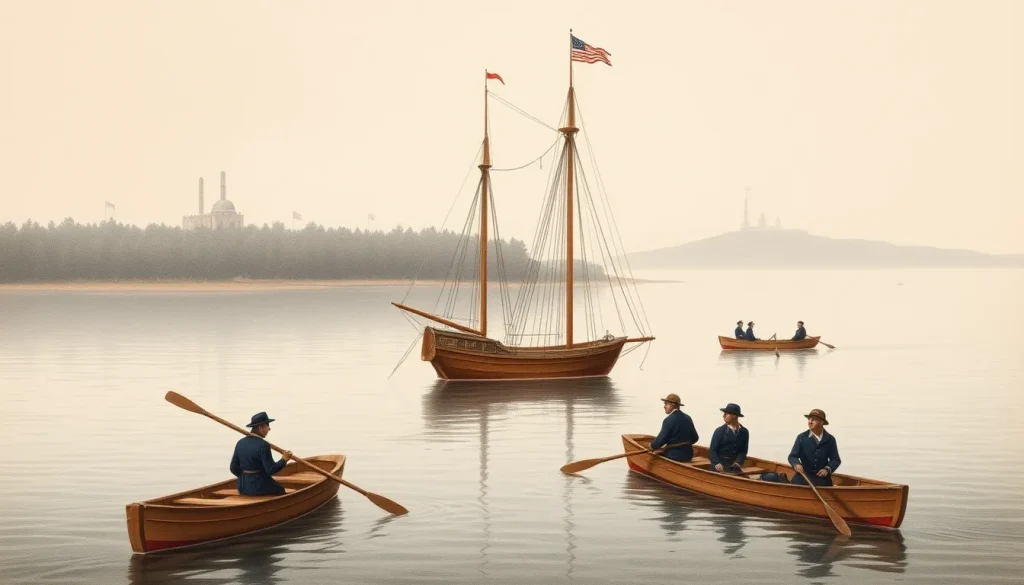
The capture of the Cayahoga (more commonly spelled Cuyahoga) was the seizure of an American transport schooner by British and Provincial Marine forces near Amherstburg, Upper Canada, in the first days of July 1812, in the opening weeks of the War of 1812. The vessel was carrying the personal baggage, official correspondence, and military papers of Brigadier General William Hull, commander of the United States Army of the Northwest and governor of Michigan Territory. Because the captured documents revealed the strength, condition, and internal strains of Hull’s army, the episode became one of the most consequential intelligence losses on the Detroit frontier. This article concerns the 1812 schooner and the fate of Hull’s dispatches; it does not treat the Ohio river of the same name.
Historical Context
The United States declared war on Great Britain on 18 June 1812. In the Northwest, the Madison administration intended to invade Upper Canada from Detroit while a second force crossed the Niagara River, on the assumption that Canadian militia would be reluctant to fight and that British regular strength in the interior was thin. The plan depended on speed, on militia who could be induced to cross an international boundary, and on communications that were slow even in peacetime.
Control of Lake Erie belonged to Britain through the Provincial Marine, a transport and patrol service based principally at Amherstburg, opposite Detroit. The United States had no comparable fleet on the lake in 1812, a deficiency Hull had repeatedly warned about. Detroit itself was an isolated settlement with a small garrison and a decaying fortification, dependent on long supply routes running south through Ohio and the Black Swamp.
William Hull, governor of Michigan Territory since 1805 and a veteran of the Revolutionary War, was commissioned a brigadier general in the spring of 1812 and given command of the Ohio volunteers that Governor Return J. Meigs was directed to raise, together with regulars of the 4th United States Infantry and Michigan militia. Hull accepted the command reluctantly and chiefly, by his own account, to protect Michigan’s inhabitants from a general Indigenous war. British officials at Amherstburg, meanwhile, cultivated alliances with Indigenous nations of the Old Northwest, whose support would prove decisive in the campaign. Major-General Isaac Brock commanded in Upper Canada from York, while the Amherstburg garrison was under Lieutenant-Colonel Thomas St. George of the 41st Foot at the time of the capture, with Matthew Elliott directing the British Indian Department in the district.
What Happened
Hull’s army assembled in Ohio in the late spring of 1812 and marched north from Urbana toward Detroit, cutting a road through the Black Swamp and following the western shore of Lake Erie. The march was slow, and Hull’s force was variously described in returns and later histories as numbering somewhere in the range of roughly fifteen hundred to somewhat over two thousand effective troops, counting Ohio volunteers, regulars, and territorial militia.
Because the overland route was difficult and the water route was faster, Hull shipped his personal baggage and a quantity of official papers along the lake and up the Detroit River aboard a hired transport schooner named for the Cuyahoga River. American accounts, including the nineteenth-century narrative of Benson J. Lossing, indicate that Hull had already received word of the declaration of war while on the march; the widely repeated summary in reference works such as the entry on the surrender of Detroit states that he dispatched the baggage by water before learning that war had been declared. Sources differ on the precise sequence, and the discrepancy is rarely resolved in the surviving literature.
On or about 2 July 1812 — some accounts place the action a day earlier or later — boats from Amherstburg intercepted the schooner in the Detroit River near Fort Malden. Canadian and British tradition credits the boarding party to Lieutenant Frederic Rolette of the Provincial Marine. The vessel was taken without a general engagement, and the baggage and papers were carried into the British post.
What the British found was more valuable than the vessel. Hull’s packet contained correspondence, orders, and returns that disclosed the composition and approximate strength of the American force, the difficulties Hull expected in moving his militia across into Canada, and, by the standard later telling, the fact that the United States had declared war. The loss was reported in American newspapers and became part of the accumulating suspicion surrounding Hull in the weeks that followed.
Why It Matters
The capture mattered in the first instance as intelligence. A packet of routine military correspondence, taken intact and unburned, gave the British command at Amherstburg a clear picture of the army that was about to operate against it, including its numerical limits and the political fragility of its militia. That knowledge shaped British decisions in July and August 1812 and fed into the planning that ended with the surrender of Detroit on 16 August.
The loss also became part of the case against Hull himself. His court-martial, held at Albany in 1814, weighed charges including treason, cowardice, and neglect of duty; he was convicted of cowardice and neglect, sentenced to death, and reprieved by President Madison. Hull’s defenders cited the loss of his papers and baggage among the misfortunes that damaged his army’s morale and his later ability to document his own decisions.
Historians interpret the episode differently. Some treat it as a small but genuinely decisive intelligence windfall that helped compensate for British numerical weakness in the western district. Others argue that British success in 1812 rested mainly on Brock’s boldness, Indigenous alliances, and Hull’s own loss of nerve, with the captured papers an accelerant rather than a cause. The most careful assessments note that the documents certainly informed British officers, while cautioning that the surviving record does not allow the precise influence of any single captured letter to be measured.
Prelude
Hull’s force left Urbana, Ohio, in early June 1812, opened a road through the Black Swamp, and reached the Maumee River before moving on toward Detroit, which the army entered on 5 July. Word of the declaration of war overtook the column in late June or the first days of July, and Hull pressed forward. In the same period, British officers at Amherstburg were awaiting news of American intentions; the colony had not yet received official confirmation of the war from London, whose own knowledge lagged by weeks.
Forces and Commanders
The American side was commanded by Brigadier General William Hull, with a force of Ohio volunteers, regulars of the 4th Infantry, and Michigan militia. The schooner carried no significant combat capability and was crewed by a small civilian crew with whatever passengers or guards were aboard. On the British side, the vessels and boats operating from Amherstburg belonged to the Provincial Marine, supported by soldiers of the 41st Foot and local militia; Lieutenant Frederic Rolette is the officer most consistently named in connection with the boarding. Higher authority rested with Lieutenant-Colonel Thomas St. George at Amherstburg and, in the province at large, with Major-General Isaac Brock at York.
Battlefield and Map Context
The action took place on the Detroit River between Lake Erie and Lake St. Clair, in the narrow channel overlooked by the British post and dockyard at Amherstburg, Upper Canada, and by the American settlement at Detroit on the opposite shore. The river was — and remains — the international boundary. The waterway was the main artery linking the lake to Detroit, which explains both Hull’s decision to use it and the British ability to intercept traffic passing within sight of their own batteries.
Battle Chronology
The episode unfolded over a short span. Hull’s army marched north through Ohio during June. News of the declaration of war reached the American column at the end of June or by 1 July. Hull’s baggage and papers were shipped by water toward Detroit. On or about 2 July 1812, boats from Amherstburg boarded and took the schooner near Fort Malden. The papers were removed to the British post and their contents reported to the Amherstburg command, and the loss was soon known in the United States. Hull’s army reached Detroit on 5 July.
Casualties and Losses
The affair produced no recorded battle casualties. The material losses were the schooner, the baggage, and the official packet, together with the freedom of any crew or passengers taken with the vessel. The number of prisoners is not consistently documented in the standard accounts. The true cost was informational rather than physical, and because the papers have not survived as a single intact archive, the full extent of what the British learned cannot be reconstructed with certainty.
Result
The British retained the captured vessel and papers. The immediate result was an intelligence advantage for the Amherstburg command at the moment when the campaign on the Detroit frontier was beginning. There was no general engagement, and the action was not treated at the time as a battle, but it was widely reported and remembered because of what the documents contained.
Strategic Consequences
British officers at Amherstburg entered July better informed about the American force than they might otherwise have been, and the timing was fortunate for them. When Brock travelled west in August to take charge of the district, he did so with knowledge of the weaknesses in the American position, including the difficulties Hull faced with militia whose terms of service and willingness to cross into Canada were uncertain. The surrender of Detroit on 16 August 1812, without a fight, followed. Historians continue to debate how much weight to assign to the captured dispatches in that outcome, but the intelligence loss is consistently treated as a significant factor in the campaign rather than an incidental mishap.
Primary Accounts
Hull’s own narrative, published as Memoirs of the Campaign of the North Western Army of the United States, A.D. 1812 (1824), presents the loss as one of a series of misfortunes and defends his conduct throughout. The published proceedings of his 1814 court-martial preserve testimony from officers who served in the campaign, including recollections of the missing papers. British and Canadian accounts appear in Brock’s published correspondence, collected by Ferdinand Brock Tupper in 1845, and in the documentary series edited by William Wood in the 1920s. Benson J. Lossing’s Pictorial Field-Book of the War of 1812 (1869) provides the most detailed nineteenth-century American narrative of the episode but relies heavily on recollection and is often uncritical.
Battlefield Today
The waters where the schooner was taken lie in the Detroit River between Amherstburg, Ontario, and the American shore near Detroit, Michigan. Fort Malden National Historic Site at Amherstburg, administered by Parks Canada, interprets the British western district during the War of 1812, including the Provincial Marine, and is the principal public site associated with the episode. No separate monument to the capture of the schooner is recorded here, and the river itself remains a working international waterway.
Primary Sources
The most directly relevant contemporary materials are Hull’s own correspondence and the record of his court-martial. Hull’s Memoirs (1824) is a self-defence written more than a decade after the event; it is valuable for Hull’s reasoning and for his account of the loss of his papers, but it is naturally partisan. The Report of the Trial of Brig. General William Hull (1814) preserves sworn testimony taken closer to the events, though witnesses were recalling circumstances from two years earlier and had reputations at stake.
British and Canadian evidence is scattered through the correspondence of Isaac Brock and the Amherstburg command, published in Ferdinand Brock Tupper’s Life and Correspondence of Major-General Sir Isaac Brock (1845) and in William Wood’s Select British Documents of the Canadian War of 1812 (1920–1928). These letters show how British officers used intelligence about American strength and intentions, but they seldom dwell on the provenance of individual items.
No verified, complete transcript of the captured packet itself is available and it is not reproduced here; reconstructing its contents depends on later references rather than on a single archival document. Contemporary newspapers in the United States and Upper Canada reported the loss and its consequences, but this article does not cite specific issues, and readers seeking the original notices should consult newspaper collections held by the Library of Congress, Library and Archives Canada, or state historical societies. Direct quotation has been avoided throughout, and all descriptions of the documents above are paraphrase.
Further Reading
- Hull, William. Memoirs of the Campaign of the North Western Army of the United States, A.D. 1812. Boston, 1824.
- Report of the Trial of Brig. General William Hull. New York, 1814.
- Lossing, Benson J. The Pictorial Field-Book of the War of 1812. New York, 1869. Chapter XIII, Hull’s Campaign against Canada.
- Tupper, Ferdinand Brock. The Life and Correspondence of Major-General Sir Isaac Brock, K.B. London, 1845.
- Wood, William, ed. Select British Documents of the Canadian War of 1812. Toronto: Champlain Society, 1920–1928.
- Gilpin, Alec R. The War of 1812 in the Old Northwest. East Lansing: Michigan State University Press, 1958.
- Stagg, J. C. A. Mr. Madison’s War: Politics, Diplomacy, and Warfare in the Early American Republic, 1783–1830. Princeton: Princeton University Press, 1983.
- Hickey, Donald R. The War of 1812: A Forgotten Conflict. Urbana: University of Illinois Press.
- Parks Canada. Fort Malden National Historic Site, Amherstburg, Ontario.
References
- Lossing, Benson J. The Pictorial Field-Book of the War of 1812, Chapter XIII, Hull’s Campaign against Canada. 1869. Available at: https://freepages.rootsweb.com/~wcarr1/history/Lossing2/Chap13.html
- Van Deusen, John G., and A. R. Detroit, Surrender of. In Dictionary of American History, reproduced at Encyclopedia.com. Available at: https://www.encyclopedia.com/history/dictionaries-thesauruses-pictures-and-press-releases/detroit-surrender
- Hull, William. Memoirs of the Campaign of the North Western Army of the United States, A.D. 1812. Boston, 1824.
- Report of the Trial of Brig. General William Hull. New York, 1814.
- Tupper, Ferdinand Brock. The Life and Correspondence of Major-General Sir Isaac Brock, K.B. London, 1845.
- Wood, William, ed. Select British Documents of the Canadian War of 1812. Toronto: Champlain Society, 1920–1928.
- Gilpin, Alec R. The War of 1812 in the Old Northwest. East Lansing: Michigan State University Press, 1958.
- Stagg, J. C. A. Mr. Madison’s War. Princeton: Princeton University Press, 1983.
FAQ
What was aboard the Cayahoga when it was captured?
The schooner was carrying Brigadier General William Hull's personal baggage and a packet of official papers, including correspondence, orders, and army returns relating to the force marching to Detroit. Accounts agree on the nature of the cargo; the packet has not survived intact, so its full contents remain only partly documented.
Did the British learn of the declaration of war from Hull's captured papers?
That is the standard later account, presented by nineteenth-century American historians and repeated in reference works, and it was used to explain how British officers at Amherstburg learned so quickly that war had begun. The claim rests on later narrative histories rather than on a single surviving dispatch, and it should be treated as a widely repeated but not fully documented tradition.
Did the loss of his dispatches cause Hull's surrender of Detroit?
Most historians treat the captured papers as an important intelligence advantage for the British rather than the sole cause. The surrender on 16 August 1812 followed a combination of factors, including British and Indigenous superiority in the field, Hull's supply problems, the unreliability of his militia, and Brock's willingness to demand an immediate capitulation.




Leave a Reply