
Short Answer
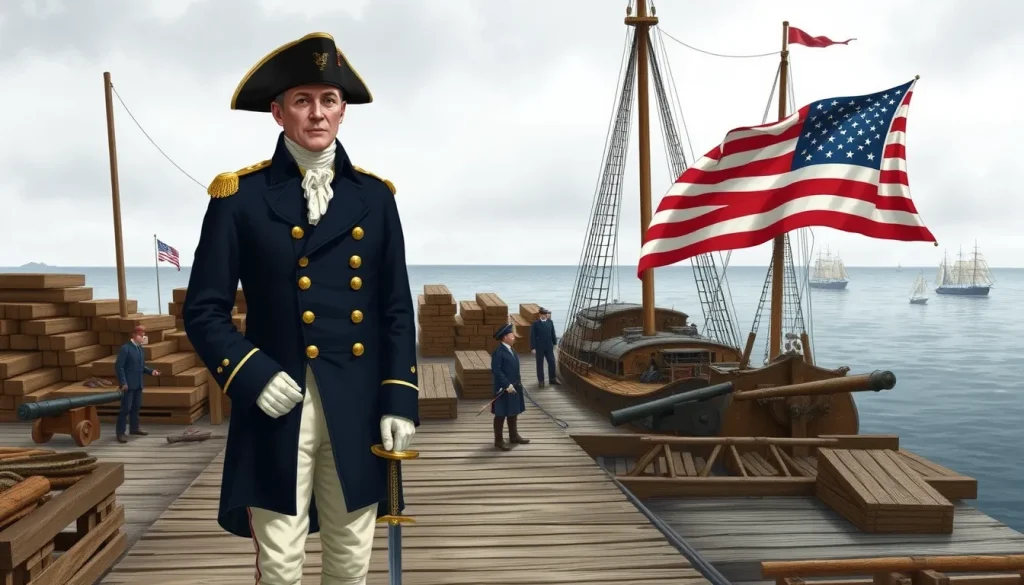
Commodore Isaac Chauncey (February 20, 1779 – January 27, 1840) was a United States Navy officer who commanded American naval forces on Lakes Ontario and Erie during the War of 1812. From his base at Sackets Harbor, New York, he built and administered the U.S. squadron on Lake Ontario and cooperated with American land campaigns against Upper Canada. His command was central to U.S. strategic hopes of controlling the Great Lakes, and his cautious contests with British Commodore Sir James Lucas Yeo made him one of the war’s most debated naval leaders.
Historical Context
The War of 1812 placed the Great Lakes at the center of American and British strategy. After the U.S. declaration of war on June 18, 1812, American leaders sought to invade Canada, while British and Canadian authorities sought to defend Upper and Lower Canada and to use the lakes for movement of troops and supplies. Lake Ontario was especially important because it bordered the principal British base at Kingston, Upper Canada, and the American base at Sackets Harbor, New York. Control of the lake could determine the success of campaigns along the Niagara frontier and the St. Lawrence River corridor.
The United States entered the war with few naval forces on the lakes. The British had the Provincial Marine and Royal Navy support, and they could draw on Kingston’s harbor and shipyard. American planners therefore needed not only sailors and warships but also shipwrights, cannon, timber, and a logistical system far from the seaboard. Secretary of the Navy Paul Hamilton and his successor William Jones looked to a senior officer with shipbuilding experience. They found him in Isaac Chauncey, then commandant of the New York Navy Yard.
What Happened
On August 31, 1812, Secretary of the Navy Paul Hamilton ordered Chauncey to organize and build a naval force to obtain command of Lakes Ontario and Erie. Chauncey established his headquarters at Sackets Harbor and drew on shipwrights, sailors, and materials from New York and elsewhere. He oversaw the construction and conversion of vessels, including the corvette General Pike on Lake Ontario, and he coordinated with the U.S. Army under Major General Henry Dearborn.
In April 1813, Chauncey’s squadron supported the amphibious attack on York, the provincial capital later known as Toronto. In May 1813, it supported the attack on Fort George. On Lake Ontario he faced the Royal Navy squadron of Commodore Sir James Lucas Yeo. The two forces maneuvered, convoyed, and skirmished in 1813, but neither destroyed the other. On August 8, 1813, two American schooners, Hamilton and Scourge, foundered in a squall, a serious loss to Chauncey’s squadron. Later engagements in 1813 were indecisive. In 1814, British completion of the ships Prince Regent and Princess Charlotte at Kingston gave Yeo an advantage. Chauncey’s squadron remained a powerful supporting force, but it did not achieve the decisive command of Lake Ontario that American strategy had envisioned. After the war, Chauncey served on the Board of Navy Commissioners.
Why It Matters
Chauncey’s inability to win a decisive Lake Ontario victory helped produce a strategic stalemate on the northern frontier. U.S. forces could not rely on the lake to move armies and supplies against Kingston and Montreal, while British forces could not use it to threaten Sackets Harbor or the U.S. interior without risk. The shipbuilding race consumed men and material and influenced land campaigns. Chauncey’s reputation became a subject of historical debate.
Nineteenth- and early twentieth-century historians such as Theodore Roosevelt, Henry Adams, and Alfred Thayer Mahan portrayed him as over-cautious and criticized his failure to press Yeo or to support land operations more fully. Later scholars, notably Charles E. Brodine Jr., argue that this verdict underestimates his administrative burden, unreliable subordinate officers, difficult logistics, and the strength of the British squadron. In this view, Chauncey’s failure was less a personal flaw than the product of circumstances. His legacy remains divided between his effectiveness as a fleet builder and his limited record as a tactician.
Early Life
Isaac Chauncey was born on February 20, 1779, at Black Rock, Connecticut. He grew up on the Connecticut shore and went to sea at a young age, reportedly commanding a ship by age nineteen. He entered the U.S. Navy in 1798 and served during the Quasi-War with France. He later served in the Barbary Wars and aboard notable vessels including Constitution, Chesapeake, and President. He became a master-commandant in 1804 and a captain in 1806.
Role Before the War
From 1807 to 1812, Chauncey was commandant of the New York Navy Yard. That post gave him experience in ship construction, repair, recruitment, and logistics. When the Madison administration looked for an officer to create a fleet on the Great Lakes, Chauncey’s administrative and shipbuilding background made him a logical choice.
Role During the War
Ordered on August 31, 1812, to command the lakes, Chauncey held three overlapping responsibilities: he was administrator of shipbuilding and supply, commander of the squadron, and collaborator with U.S. land forces. He made Sackets Harbor the principal American naval station on Lake Ontario. He built, armed, and manned vessels; recruited sailors; and maintained convoys. His command initially included Lake Erie, but Master Commandant Oliver Hazard Perry became the officer most associated with the victorious Erie squadron in 1813. On Lake Ontario, Chauncey’s opponent was Commodore Sir James Lucas Yeo. The two commanders engaged in a shipbuilding race and a series of maneuvers and inconclusive actions.
Major Actions
Chauncey’s squadron supported the April 27, 1813, attack on York, where U.S. forces under Henry Dearborn sought to capture the provincial capital and destroy British naval stores. It also supported the May 27, 1813, attack on Fort George, helping to move and supply American troops along the Niagara frontier. On Lake Ontario, Chauncey and Yeo fought indecisive actions in August and September 1813. The loss of Hamilton and Scourge in a squall on August 8, 1813, weakened Chauncey’s squadron at a critical time. In 1814, British shipbuilding at Kingston gave Yeo the stronger force, and Chauncey remained at Sackets Harbor for much of the campaign. Historians such as Mahan criticized his failure to cooperate more fully with Major General Jacob Jennings Brown on the Niagara Peninsula, though later scholars argue that Chauncey’s fleet was then less capable of forcing a decisive result.
Contemporary Accounts
Chauncey’s official letters to the Navy Department, Yeo’s dispatches to the Admiralty, and newspaper reports provide the main contemporary record. Chauncey often explained his decisions in terms of preserving his fleet and meeting orders; his critics, including some naval officers and officials, claimed he avoided battle unless he had a decided superiority in men and guns. These accounts are valuable but partisan: Chauncey wrote to justify his conduct, Yeo wrote to justify his, and newspaper reports were often incomplete or shaped by local politics.
Later Life
After the War of 1812, Chauncey served as a member of the Board of Navy Commissioners in Washington, D.C., and eventually became its president. He remained in that administrative role until his death on January 27, 1840.
Historical Legacy
Historians have long debated Chauncey’s legacy. The traditional view, expressed by Theodore Roosevelt, Henry Adams, and Alfred Thayer Mahan, treats him as a cautious commodore who failed to use American superiority on Lake Ontario. Charles E. Brodine Jr. and other later scholars argue that this reputation is too simple. They emphasize Chauncey’s success in creating a fleet in a frontier theater, his logistical achievements, and the real constraints imposed by unreliable officers, weather, disease, and a determined British opponent. Chauncey is also overshadowed by Perry’s victory on Lake Erie and Thomas Macdonough’s victory on Lake Champlain. His historical significance therefore lies partly in what he built and sustained, and partly in the unresolved debate over what a more aggressive commander might have achieved.
Primary Sources
- Secretary of the Navy Paul Hamilton’s orders to Chauncey, August 31, 1812, printed in documentary editions of naval correspondence. They define his mission to obtain command of Lakes Ontario and Erie. Limitation: official orders show intent, not results.
- Chauncey’s official letters and reports to the Navy Department, selectively printed in William S. Dudley, ed., The Naval War of 1812: A Documentary History. They reveal his reasoning and difficulties. Limitation: self-justifying.
- Sir James Lucas Yeo’s dispatches and letters to the Admiralty and British commanders. They offer the opposing view of Lake Ontario operations. Limitation: also self-justifying and shaped by British command priorities.
- Contemporary newspapers and naval court records. They provide public reaction and criticism. Limitation: incomplete, politically biased, and often reliant on rumor.
Further Reading
- National Park Service, Isaac Chauncey.
- Charles E. Brodine Jr., The Cautious Commodore?, Naval History 27, no. 5 (October 2013), available online.
- Robert Malcomson, Lords of the Lake: The Naval War on Lake Ontario, 1812–1814 (Annapolis: Naval Institute Press, 1998).
- William S. Dudley, ed., The Naval War of 1812: A Documentary History, 3 vols. (Washington, DC: Naval Historical Center, 1985–2002).
- Theodore Roosevelt, The Naval War of 1812 (New York: G.P. Putnam’s Sons, 1882).
- Alfred Thayer Mahan, Sea Power in Its Relations to the War of 1812 (Boston: Little, Brown, 1905).
References
- National Park Service, Isaac Chauncey.
- Charles E. Brodine Jr., The Cautious Commodore?, Naval History 27, no. 5 (October 2013).
- Robert Malcomson, Lords of the Lake: The Naval War on Lake Ontario, 1812–1814 (Annapolis: Naval Institute Press, 1998).
- William S. Dudley, ed., The Naval War of 1812: A Documentary History, 3 vols. (Washington, DC: Naval Historical Center, 1985–2002).
FAQ
What was Isaac Chauncey's role in the War of 1812?
He commanded U.S. naval forces on Lakes Ontario and Erie, based at Sackets Harbor, New York. He built and administered the Lake Ontario squadron, supported American land operations, and opposed British Commodore Sir James Lucas Yeo.
Was Isaac Chauncey a successful naval commander?
Historians disagree. Chauncey succeeded in creating and sustaining a fleet and supporting land campaigns, but he did not win decisive control of Lake Ontario. Traditional accounts criticize his caution, while later scholars emphasize his logistical achievements and the constraints he faced.
Why was Lake Ontario important in the War of 1812?
Lake Ontario was a major strategic corridor for moving troops, supplies, and naval forces between the United States and Upper Canada. Control of the lake was considered essential for American plans to invade Canada and for British defense of Kingston and the Niagara frontier.

Leave a Reply