
Short Answer
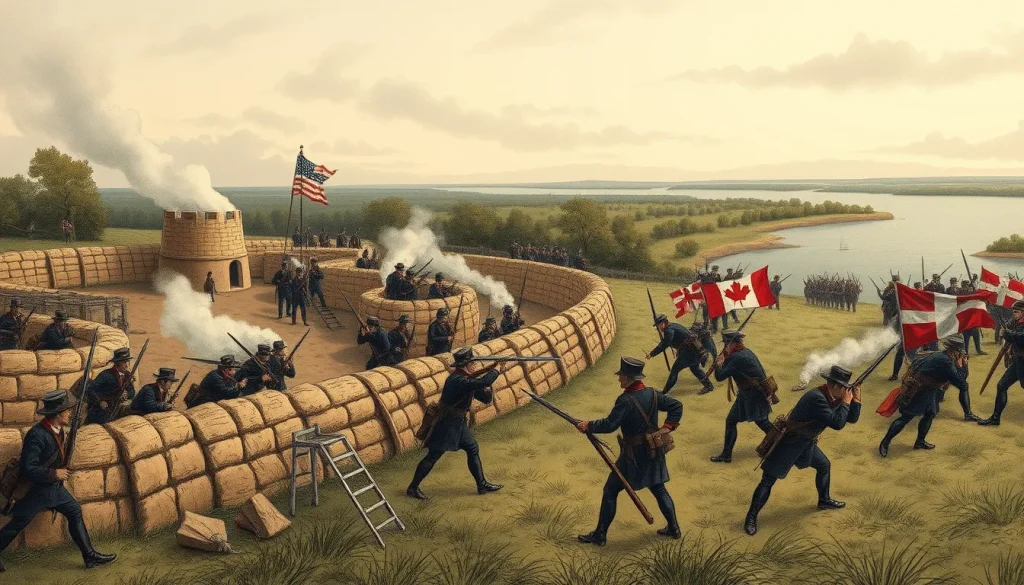
The Siege of Fort Erie (August 4–September 21, 1814) was the British attempt to recapture Fort Erie, Upper Canada, after the American army retreated there following the Battle of Lundy’s Lane. It was a direct aftermath of that bloody engagement and one of the last major military operations of the War of 1812 on the Niagara frontier. Although the British failed to take the fort, the Americans ultimately abandoned and destroyed it in November 1814, leaving the campaign strategically inconclusive. This article treats the 1814 siege, not the earlier American capture of Fort Erie on July 3, 1814.
Historical Context
By 1814, the War of 1812 had settled into a grinding contest along the Canadian-American border. The United States hoped for territorial gains in Upper Canada to strengthen its position in peace talks with Britain, while British and Canadian officials sought to defend the province and preserve Indigenous alliances. The Niagara frontier was one of the war’s most contested corridors. Control of the Niagara River, Lake Erie, and the supply routes to Buffalo and Black Rock shaped every campaign.
In July 1814, a United States army under Major General Jacob Brown crossed the Niagara River and captured Fort Erie on July 3. The Americans then defeated a British force at the Battle of Chippawa on July 5. British Lieutenant-General Gordon Drummond, lieutenant governor of Upper Canada, gathered reinforcements and met the Americans at Lundy’s Lane on July 25. The battle was a bloody stalemate, but it left Brown wounded and his army exhausted. The American commander who succeeded him, Brigadier General Eleazer Wheelock Ripley, withdrew to Fort Erie on July 26. The siege that followed was therefore not a separate campaign but the immediate continuation of Lundy’s Lane.
Fort Erie stood at the mouth of the Niagara River opposite Buffalo, New York, in Upper Canada, now Fort Erie, Ontario. It was small, but its position made it a gateway to the Niagara Peninsula. The surrounding area included Snake Hill, a sand mound about 700 metres south of the fort, and Lake Erie to the west. The British aimed to recapture the post, cut American supply lines, and prevent the last major American invading force from advancing farther north toward Burlington Heights and York. Indigenous allies, including Six Nations and other nations, participated in the British war effort, though their numbers and specific roles at Fort Erie are not consistently documented. Canadian militia and civilians also endured the campaign’s destruction, as the Niagara countryside had already suffered from raids, burning, and displacement.
What Happened
The siege began after the American retreat from Lundy’s Lane. Brown was incapacitated, and Ripley briefly commanded before Brigadier General Edmund Pendleton Gaines arrived to take charge. Gaines rejected withdrawal and ordered the fort strengthened. Because the original fort could not hold the entire American force, the garrison extended earthworks southward, built Battery Towson on Snake Hill, added the Douglass Battery near the lakeshore, dug a dry ditch with sharpened stakes, and felled trees to obstruct attackers. By early August, the American force numbered about 2,800 men.
Drummond arrived outside Fort Erie on August 3 with roughly 3,000 British regulars, Canadian militia, and Indigenous allies. Before fully investing the fort, he sent a detachment under Lieutenant-Colonel John Tucker across the Niagara to raid American supply depots at Black Rock and Buffalo. On August 3, at Conjocta Creek, Tucker’s force was stopped by Major Lodowick Morgan and about 240 New York riflemen who had removed the bridge planks. The British withdrew after suffering casualties. The raid’s failure left Drummond without the quick logistical victory he had hoped for.
The siege formally opened on August 4. British batteries bombarded the fort, especially on August 13 and 14, but the bombardment did little serious damage. Drummond then ordered a night assault for 2:00 a.m. on August 15. Three columns attacked: Lieutenant-Colonel Victor Fischer against Snake Hill, Colonel Hercules Scott against the northern entrenchments, and Lieutenant-Colonel William Drummond against the fort’s northeast bastion. The attack failed. Fischer’s men were detected early and panicked in the darkness. Scott was killed, and William Drummond was killed after briefly entering the bastion. A magazine explosion under the bastion added to British losses. Drummond kept the siege going, but his army was weakened by casualties, sickness, and supply shortages.
On September 17, the Americans launched a major sortie against the British siege lines. The attack captured several batteries and spiked guns before British resistance forced the Americans back. Losses were heavy on both sides. With his siege guns reduced and his ranks depleted, Drummond lifted the siege on September 21 and withdrew north of Chippawa Creek, now the Welland River, about 30 kilometres down the Niagara River. The Americans remained in Fort Erie until November 5, when they abandoned it, crossed to Buffalo, and blew up the fort to prevent its use by the British.
Why It Matters
The siege mattered immediately because it stopped the British from recapturing Fort Erie and destroyed the last major American offensive of 1814 in the Niagara Peninsula. It also marked the end of serious offensive operations on that front. The American defense and the September sortie became symbols of professional resilience for the United States Army, while British and Canadian accounts emphasized the costly failure of the August 15 assault and the strategic containment of the American invasion.
In the longer term, the siege contributed to a military stalemate that shaped the Treaty of Ghent in December 1814. Neither side gained a decisive advantage on the Niagara frontier, and the war ended without territorial changes. The campaign also demonstrated the importance of field fortifications, artillery, logistics, and disease. Thousands of soldiers on both sides fell ill, and the suffering of civilians and Indigenous communities continued after the guns stopped. Historians disagree about how decisive the siege was: some see it as a British strategic success because the Americans never advanced beyond Fort Erie, while others stress that the British failed in their objective of recapturing the fort and that the Americans ultimately withdrew only because the campaign season had ended.
Prelude
The prelude to the siege was the Battle of Lundy’s Lane on July 25, 1814. The battle left around 1,700 killed and wounded on both sides and shattered the American army’s offensive strength. When Ripley withdrew to Fort Erie on July 26, he believed the campaign was over. Brown, though wounded, insisted on holding the fort. Gaines took command and prepared for a British pursuit that began in early August. Drummond’s delay allowed the Americans to strengthen Fort Erie, a decision that proved critical.
Forces and Commanders
American forces included U.S. regulars, New York militia, and volunteers. Major General Jacob Brown was the army’s nominal commander but was wounded at Lundy’s Lane. Brigadier General Eleazer Wheelock Ripley briefly commanded during the retreat. Brigadier General Edmund Pendleton Gaines directed the defense for much of the siege, with Brigadier General Peter B. Porter playing a prominent role in the September sortie. Artillery officers such as Captain Nathan Towson and riflemen under Major Lodowick Morgan were also important.
British and Canadian forces were led by Lieutenant-General Gordon Drummond. Subordinate commanders included Lieutenant-Colonel William Drummond, who was killed in the August 15 assault; Colonel Hercules Scott, also killed; Lieutenant-Colonel Victor Fischer; and Lieutenant-Colonel John Tucker. The British force included regulars, Canadian militia, and Indigenous allies. Exact numbers fluctuated because of reinforcements, sickness, and casualties, but the armies were roughly comparable in size during the siege.
Battlefield and Map Context
Fort Erie sat at the mouth of the Niagara River on the Canadian side, directly opposite Buffalo, New York. The fort was small, so the American defenses extended south toward Snake Hill and north toward Lake Erie. British siege lines and batteries were established outside the American earthworks. The Niagara River was the main supply artery for the Americans, linking Fort Erie to Buffalo and Black Rock. The British withdrawal on September 21 was to Chippawa Creek, now the Welland River, about 30 kilometres north. Conjocta Creek, where Tucker’s raid failed, lay near modern Buffalo.
Battle Chronology
- July 3, 1814: United States forces capture Fort Erie.
- July 5, 1814: Battle of Chippawa.
- July 25, 1814: Battle of Lundy’s Lane.
- July 26, 1814: American army retreats to Fort Erie.
- August 3, 1814: British arrive outside Fort Erie; Tucker’s raid fails at Conjocta Creek.
- August 4, 1814: Siege begins.
- August 13–14, 1814: British bombardment.
- August 15, 1814: British night assault fails with heavy losses.
- September 17, 1814: American sortie against British batteries.
- September 21, 1814: Drummond lifts the siege.
- November 5, 1814: Americans abandon and destroy Fort Erie.
Casualties and Losses
The August 15 assault produced the most dramatic casualties. British losses were about 900 killed, wounded, or missing, while American casualties were about 62. These figures are widely cited, though some accounts differ in detail. The September 17 sortie also caused heavy losses on both sides, but precise totals are less consistent. Disease and exhaustion killed or disabled far more men than combat during the siege. Overall casualty numbers are difficult to separate from the earlier battles of Chippawa and Lundy’s Lane and from sickness in the camps.
Result
The immediate result was a failed British siege. Drummond could not take Fort Erie and withdrew on September 21. The Americans held the fort until November 5, when they abandoned it and blew it up. In tactical terms, the defense was an American success; in strategic terms, the campaign ended in a stalemate. The British had prevented the American army from advancing deeper into Upper Canada, but they had not destroyed it or recaptured the fort while it was occupied.
Strategic Consequences
The siege ended the last major American offensive on the Niagara frontier in 1814. It tied down British and American resources, contributed to the broader military stalemate, and reinforced the logic of a negotiated peace. British naval control on Lake Ontario and the arrival of reinforcements helped contain the Americans, while the American withdrawal in November removed the final threat to the British position on the peninsula. The campaign also influenced how both sides remembered the war: as a story of costly assaults, stubborn defenses, and eventual withdrawal rather than a decisive victory.
Primary Accounts
Contemporary accounts include British Lieutenant-General Gordon Drummond’s dispatches to Governor General Sir George Prevost, American reports from Brown, Gaines, and Ripley to the War Department, and letters and journals by junior officers and soldiers. Ernest Cruikshank’s published documentary collection, The Documentary History of the Campaign upon the Niagara Frontier in the Year 1814, gathers many of these records. These sources are valuable but limited: official reports justify command decisions, inflate enemy losses, and often ignore Indigenous and civilian experiences. Soldier reminiscences, frequently written years later, can preserve vivid detail but also reflect faulty memory and postwar pride.
Battlefield Today
Fort Erie is now a National Historic Site managed by Parks Canada. The site preserves and interprets the fort and the War of 1812 Niagara campaign. Modern Fort Erie, Ontario, and Buffalo, New York, have grown around the historic landscape, but the river, lake, and some earthworks help visitors understand the geography. Monuments and museum exhibits commemorate the siege and the soldiers who fought there, though the full history includes British, Canadian, American, and Indigenous participants whose experiences are not always equally represented.
Primary Sources
Key primary sources include Drummond’s official dispatches to Prevost from August and September 1814; American reports and correspondence from Brown, Gaines, Ripley, and Porter; and the documentary volumes edited by Ernest Cruikshank. These records are held in institutions such as Library and Archives Canada, The National Archives (UK), and the United States National Archives and Records Administration, and many are printed in nineteenth-century documentary editions. A British officer’s account quoted in The Canadian Encyclopedia describes the bombardment as having a trifling effect, while a survivor’s description of the August 15 explosion emphasizes the carnage. Such statements are contemporary or near-contemporary testimony, not neutral summaries. Researchers should compare multiple accounts and treat casualty figures and claims of heroism or cowardice with caution.
Further Reading
- Ernest Cruikshank, ed., The Documentary History of the Campaign upon the Niagara Frontier in the Year 1814 (Welland: Lundy’s Lane Historical Society, 1896–1908).
- Donald E. Graves, Where Right and Glory Lead! The Battle of Lundy’s Lane, 1814 (Toronto: Robin Brass Studio, 1997).
- Donald R. Hickey, The War of 1812: A Forgotten Conflict, bicentennial ed. (Urbana: University of Illinois Press, 2012).
- John R. Elting, Amateurs to Arms! A Military History of the War of 1812 (New York: Da Capo, 1991).
- Alan Taylor, The Civil War of 1812: American Citizens, British Subjects, Irish Rebels, and Indian Allies (New York: Vintage, 2010).
- Parks Canada, Fort Erie National Historic Site, https://parks.canada.ca/lhn-nhs/on/forterie.
- The Canadian Encyclopedia, Siege of Fort Erie, War of 1812, https://thecanadianencyclopedia.ca/en/article/siege-of-fort-erie-war-of-1812.
- World History Encyclopedia, Siege of Fort Erie, https://www.worldhistory.org/article/2621/siege-of-fort-erie/.
References
- Sherman Zavitz, Siege of Fort Erie, War of 1812, The Canadian Encyclopedia, updated December 14, 2013, https://thecanadianencyclopedia.ca/en/article/siege-of-fort-erie-war-of-1812.
- World History Encyclopedia, Siege of Fort Erie, https://www.worldhistory.org/article/2621/siege-of-fort-erie/.
- Alan Taylor, The Civil War of 1812: American Citizens, British Subjects, Irish Rebels, and Indian Allies (New York: Vintage, 2010).
- Donald E. Graves, Where Right and Glory Lead! The Battle of Lundy’s Lane, 1814 (Toronto: Robin Brass Studio, 1997).
- Ernest Cruikshank, ed., The Documentary History of the Campaign upon the Niagara Frontier in the Year 1814 (Welland: Lundy’s Lane Historical Society, 1896–1908).
- Donald R. Hickey, The War of 1812: A Forgotten Conflict, bicentennial ed. (Urbana: University of Illinois Press, 2012).
- John R. Elting, Amateurs to Arms! A Military History of the War of 1812 (New York: Da Capo, 1991).
- Parks Canada, Fort Erie National Historic Site, https://parks.canada.ca/lhn-nhs/on/forterie.
FAQ
What was the Siege of Fort Erie?
It was the British blockade and assault of Fort Erie, Upper Canada, from August 4 to September 21, 1814, after the American army retreated there following the Battle of Lundy's Lane.
Who won the Siege of Fort Erie?
The British failed to capture the fort and lifted the siege on September 21, 1814. The Americans held the fort but abandoned and destroyed it on November 5, 1814, so the campaign ended in a strategic stalemate.
How did the Battle of Lundy's Lane lead to the siege?
The battle on July 25, 1814 left the American army exhausted and its commander Jacob Brown wounded. The Americans retreated to Fort Erie, where they strengthened the defenses; British forces under Gordon Drummond followed and besieged them.
Why did the Americans abandon Fort Erie?
After the British lifted the siege, the campaign season ended, supplies and reinforcements were limited, and the broader war was moving toward peace negotiations. The Americans withdrew to Buffalo on November 5 and destroyed the fort to deny it to the British.
Leave a Reply