
Short Answer
The Battle of New Orleans, fought on January 8, 1815, near Chalmette Plantation downriver from New Orleans, was the climactic American victory of the War of 1812. Its anniversary became known as “The Eighth,” a widely observed civic holiday and, according to later reference accounts, a federal holiday from 1828 until 1861. This article uses “national holiday” in that nineteenth-century sense: a calendrical observance promoted by Congress, the military, and political organizations, not a modern federal holiday that survives today.
Historical Context
The War of 1812 grew out of maritime disputes, trade restrictions, and frontier conflicts between the United States and Great Britain. By 1814, with Napoleon defeated in Europe, Britain could send more regular troops to North America. A British campaign in Chesapeake Bay burned Washington in August 1814 and attacked Baltimore in September. Meanwhile, American and British negotiators met at Ghent in the Austrian Netherlands and signed a peace treaty on December 24, 1814. News of the treaty moved slowly across the Atlantic, so fighting continued into early 1815.
In the Gulf South, British strategists hoped to seize New Orleans and control the lower Mississippi River. Major General Andrew Jackson, already famous for his campaign against the Red Stick Creeks, took command of the region. He fortified the approaches to New Orleans with a mixed force of U.S. regulars, Tennessee and Kentucky militia, Louisiana militia, free men of color, Choctaw allies, and Baratarian privateers associated with Jean Lafitte. The British force, commanded by Major General Sir Edward Pakenham, landed east of the Mississippi and advanced toward the American line along the Rodriguez Canal.
The early American republic had few national holidays. The Fourth of July and Washington’s Birthday provided models for civic celebration, but military victories also became occasions for public memory. Jackson’s victory at New Orleans arrived at a moment of intense national self-consciousness. The Federalist Party was collapsing, the Hartford Convention had damaged its reputation, and Americans sought evidence that the war had ended honorably. January 8 became a day on which that search for honor, and Jackson’s personal popularity, could be publicly performed.
What Happened
The main British assault came on January 8, 1815. Pakenham attacked the American earthworks at Chalmette with columns of regulars, supported by artillery and rockets. The American defenders, protected by cotton bales and earthworks, broke the attack with concentrated fire. Pakenham was killed, along with other senior British officers. British losses were commonly estimated at roughly 2,000 killed, wounded, and missing, while American losses were far lower, often given as about 70. The British withdrew, and New Orleans was secured.
The battle occurred after the Treaty of Ghent had been signed but before news of it reached the armies in the field. The treaty had already ended the war in diplomatic terms, and the battle did not change its terms. Even so, the victory gave Americans a dramatic ending to an otherwise mixed conflict. Jackson became a national hero, and the phrase “second independence” became attached to the outcome of the war in some American memory.
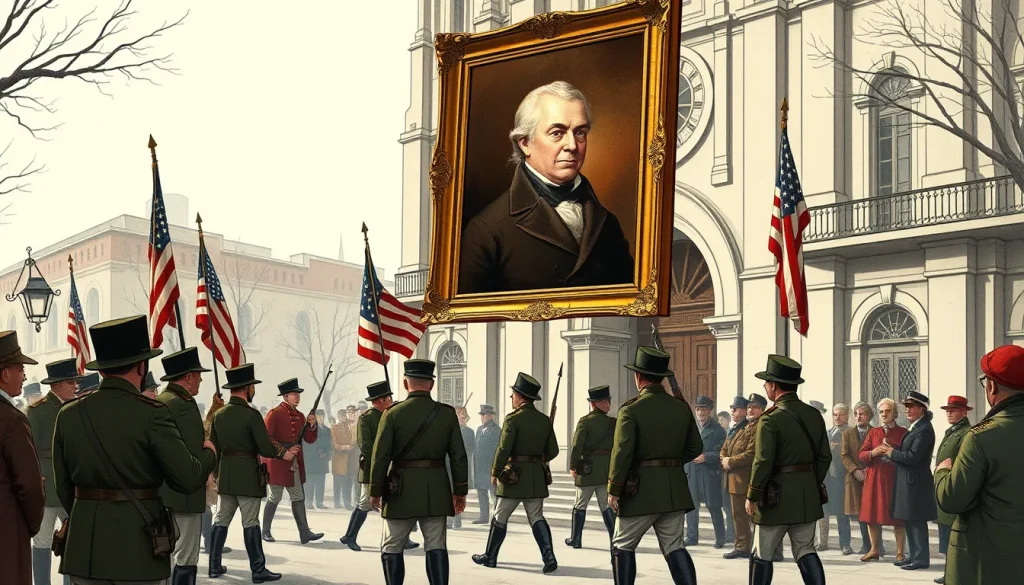
Commemoration began quickly. January 8 was marked in New Orleans and across the South with dinners, balls, militia reviews, sermons, and toasts. According to the National Park Service handbook and later reference accounts, January 8 became an official federal holiday in 1828, following Jackson’s election as president, and continued as such until the Civil War. Celebrations were sometimes described as larger than Christmas and rivaled only by the Fourth of July. After 1861, the holiday faded from national practice, though Louisiana retained a state observance and the date remained important in local memory.
Why It Matters
The holiday mattered because it converted a military event into a civic story. The Battle of New Orleans was not decisive diplomatically, but it was decisive psychologically. It allowed Americans to remember the War of 1812 as a successful defense of national honor rather than an inconclusive conflict. Jackson’s image as a frontier commander who defeated British regulars became a foundation of his political career and of Jacksonian public culture.
January 8 also mattered because it was partisan as well as patriotic. Jackson’s supporters used the anniversary to organize dinners, rallies, and toasts that linked the general’s battlefield success to Democratic Party politics. In the South and West, the holiday reinforced a regional identity built around martial honor, white manhood, and suspicion of eastern elitism. At the same time, the battle’s participants included free people of color, enslaved laborers, Choctaw allies, and foreign-born privateers, groups often pushed to the margins of later celebrations.
Historians disagree about how “national” the holiday really was. Some emphasize its broad reach in the 1820s and 1830s, when it was observed far beyond Louisiana. Others stress that it was strongest in the South and West and that its partisan ties limited its appeal. Most agree that the holiday reveals how military memory becomes political memory. The decline of “The Eighth” after the Civil War reflected sectional division, the rise of new holidays such as Thanksgiving and Memorial Day, and changing assessments of Jackson’s legacy.
Definition
“The Eighth” was the popular name for January 8 as a commemoration of Andrew Jackson’s victory at New Orleans. It was not merely a local anniversary. According to the National Park Service handbook and later accounts, it functioned as a federal holiday from 1828 until 1861, while also being observed as a state and local holiday in Louisiana. Its status was not identical to modern federal holidays such as Christmas or Thanksgiving, and the exact administrative form of its federal observance is less clear than the shorthand “federal holiday” suggests.
Background
The holiday grew from several roots. One was the immediate relief and pride that followed the January 8 victory. Another was the early republic’s habit of marking great events with public ceremonies. A third was Andrew Jackson’s rise. After his 1828 election, the anniversary became a way for his supporters to celebrate both the man and the movement. In this setting, the battle’s meaning expanded from a military engagement into a symbol of popular democracy, frontier virtue, and national independence.
How It Worked
Observances took many forms. In New Orleans and other southern cities, January 8 featured militia parades, artillery salutes, commemorative sermons, public dinners, and elaborate balls. Political organizations held banquets where speakers praised Jackson and drew lessons from the battle. Newspapers printed anniversary addresses and songs. Federal and military offices reportedly marked the day during the period of official observance, though practice varied by region and community. The holiday worked less through a single centralized ritual than through a network of local ceremonies that shared a common date and hero.
Competing Viewpoints
One debate concerns military significance. Some contemporaries treated the battle as the decisive event of the war; later historians note that it was fought after the Treaty of Ghent was signed and therefore did not alter the peace. A second debate concerns the holiday’s politics. Was January 8 a unifying national festival or a partisan Jacksonian ritual? Evidence supports both views: it could bring communities together, but it also served Jackson’s party. A third debate concerns memory and inclusion. The battle involved free men of color, Choctaw warriors, and Baratarian privateers, yet nineteenth-century celebrations often centered on white militia and Jackson himself. British, Canadian, and Indigenous perspectives also complicate the American story, since the war’s outcomes for those nations were not defined by New Orleans.
Role in the War of 1812
The Battle of New Orleans was the last major engagement of the War of 1812. It occurred after the Treaty of Ghent was signed on December 24, 1814, but before the treaty was ratified and before news reached the Gulf. The battle therefore had little effect on the treaty’s terms. Its importance lay in morale, reputation, and memory. By making January 8 a holiday, Americans placed the battle at the center of how they remembered the war. That memory emphasized victory and independence while often overlooking the war’s broader costs and the experiences of British, Canadian, and Indigenous peoples.
Consequences and Historical Interpretation
The holiday helped make Andrew Jackson a national figure and gave his supporters an annual platform for political organizing. It also strengthened a version of American identity that joined military valor, expansion, and popular politics. In Louisiana, January 8 remained a point of civic pride. Nationally, however, the holiday became entangled with sectionalism and partisan conflict. After the Civil War, it lost its federal standing and gradually receded from public memory outside Louisiana.
Historians interpret “The Eighth” as a case study in memory. Joseph F. Stoltz III has shown that the Battle of New Orleans was constantly refashioned for political and cultural purposes. Donald R. Hickey emphasizes the battle’s limited diplomatic and strategic consequences. Robert V. Remini treats it as a powerful psychological victory that shaped Jackson’s career. Together, these interpretations explain why a battle fought after a peace treaty could still become a national holiday: its value was not in changing the treaty, but in changing how Americans understood themselves and the war.
Primary Sources
The Treaty of Ghent, signed December 24, 1814, is the essential diplomatic document. It ended the war without addressing the battle, which had not yet been fought. Andrew Jackson’s official report to the Secretary of War in January 1815 describes the American defense and the British assault, but it is a military report written by the victorious commander and should be read with an awareness of self-justification and celebration.
British dispatches and later accounts by officers such as Admiral Alexander Cochrane and Major General John Lambert provide a counterpoint, emphasizing the difficulties of the assault, artillery failures, and the confusion of the British columns. The Annals of Congress for February 1815 records a House resolution honoring Jackson and his men; it shows how quickly the battle entered official political memory. Newspapers, song sheets such as “Huzza! for General Jackson,” and the folk tune “The Eighth of January” show how the anniversary was popularized in print and performance. These sources are valuable but partial: American accounts tend to be celebratory, British accounts defensive, and casualty figures vary by source.
Further Reading
- Joseph F. Stoltz III, A Bloodless Victory: The Battle of New Orleans in History and Memory (Johns Hopkins University Press, 2017).
- Robert V. Remini, The Battle of New Orleans: Andrew Jackson and America’s First Military Victory (Viking, 1999).
- Donald R. Hickey, The War of 1812: A Forgotten Conflict, bicentennial ed. (University of Illinois Press, 2012).
- National Park Service, The War of 1812: Official National Park Service Handbook (Eastern National, 2013).
- Library of Congress, “Today in History: January 8,” https://memory.loc.gov/ammem/today/jan08.html.
- Historic New Orleans Collection, resources on the Battle of New Orleans and Louisiana history.
- Andrew Jackson Papers, Library of Congress.
References
- Library of Congress, “Today in History: January 8,” https://memory.loc.gov/ammem/today/jan08.html.
- National Park Service, The War of 1812: Official National Park Service Handbook (Fort Washington, PA: Eastern National, 2013), 147.
- “The Eighth (United States),” Wikipedia, https://en.wikipedia.org/wiki/The_Eighth_(United_States).
- Joseph F. Stoltz III, A Bloodless Victory: The Battle of New Orleans in History and Memory (Baltimore: Johns Hopkins University Press, 2017).
- Donald R. Hickey, The War of 1812: A Forgotten Conflict, bicentennial ed. (Urbana: University of Illinois Press, 2012).
- Robert V. Remini, The Battle of New Orleans: Andrew Jackson and America’s First Military Victory (New York: Viking, 1999).
- Annals of Congress, February 1815, in A Century of Lawmaking for a New Nation, Library of Congress.
FAQ
Was January 8 ever a U.S. national holiday?
Yes. Known as “The Eighth,” it was widely celebrated after the War of 1812 and, according to the National Park Service handbook and later accounts, functioned as a federal holiday from 1828 until 1861. Its formal status was not identical to modern federal holidays.
Why did the holiday decline?
The Civil War divided the nation and weakened the holiday’s broad appeal. New civic holidays emerged, Andrew Jackson’s legacy became more contested, and historians increasingly noted that the battle was fought after the Treaty of Ghent was signed.
Did the Battle of New Orleans change the outcome of the War of 1812?
No. The Treaty of Ghent had already been signed, though not yet ratified or widely known. The battle did not alter the treaty’s terms, but it gave Americans a powerful morale victory and made Andrew Jackson a national hero.


Leave a Reply