Short Answer
After the Battle of New Orleans on January 8, 1815, the defeated British army left behind more than 2,000 dead, wounded, or missing soldiers. Of these, several hundred became prisoners of the United States, while many wounded men were captured on the field. Over the next ten days, British and American officers negotiated a local prisoner exchange, formalized in provisional articles signed on January 17, 1815. The episode is significant because it shows how the War of 1812’s final Gulf campaign ended not only with a military defeat but also with practical diplomacy over prisoners before news of the Treaty of Ghent had been ratified.
Historical Context
The Battle of New Orleans was the climax of the British Gulf Campaign of 1814-1815. Britain sought to seize New Orleans, West Florida, and possibly the Louisiana Territory, partly to strengthen its position in peace negotiations at Ghent. The Treaty of Ghent was signed on December 24, 1814, but it was not ratified by the United States until February 16, 1815, so fighting continued in the Gulf. The British expedition, commanded by Vice Admiral Alexander Cochrane and Major General Sir Edward Pakenham, landed east of New Orleans in December 1814. American forces under Brevet Major General Andrew Jackson opposed them.
Prisoner-taking was already part of the campaign before January 8. At the Battle of Lake Borgne on December 14, 1814, British sailors and marines captured the crews of five American gunboats. In later skirmishes, both sides took small numbers of prisoners. The British also held some Americans aboard Royal Navy ships. These earlier captures shaped the negotiations that followed the main battle, because each side had people to exchange.
Prisoner exchange in the War of 1812 generally followed cartel practices inherited from eighteenth-century warfare. Opposing commanders could agree to exchange prisoners rank for rank, to parole prisoners who promised not to fight until exchanged, and to return wounded men who could not serve. Such agreements were military arrangements, not treaties, and they depended on local commanders having authority from their governments.

What Happened
On January 8, 1815, British troops attacked Jackson’s defensive line along the Rodriguez Canal, about five miles southeast of New Orleans in present-day Chalmette, Louisiana. The assault failed. Common returns list British losses as 291 killed, 1,262 wounded, and 484 missing or captured. American losses were much lower, usually given as 13 killed, 39 wounded, and 19 missing or captured. The British commander, Pakenham, was killed, as was his second-in-command, Major General Samuel Gibbs. Major General John Keane was wounded, and Major General John Lambert took command of the British army.
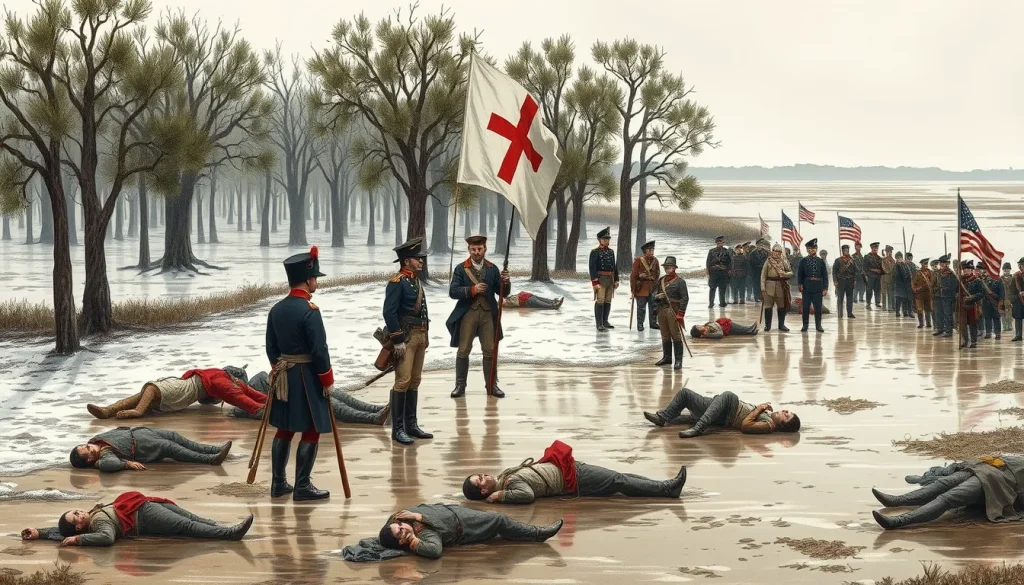
After the battle, the British withdrew to their earlier lines. Many wounded British soldiers remained on or near the battlefield and were taken into American custody. Jackson reported the action to President James Monroe on January 9, 1815, describing the fighting and warning that the British still held a position across the Mississippi River that could affect the wider campaign. The British asked for a truce to bury the dead and collect wounded, which Jackson granted. During this period, American and British officers began discussing an exchange of prisoners.
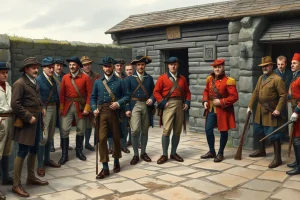
On January 17, 1815, Major Harry George Wakelyn Smith, acting under Lambert’s authority, and Edward Livingston, an aide-de-camp to Jackson, signed provisional articles for a prisoner exchange near New Orleans. A retained copy of the agreement survives. According to the Christie’s catalog description, the agreement covered prisoners on both sides, including Americans confined aboard Royal Navy ships. It was concluded two days before the British broke camp and withdrew from their positions.
The agreement functioned as a local cartel. It allowed British prisoners held by the Americans to be returned or exchanged, and it provided for the release of American prisoners held by the British, including the Lake Borgne gunboat crews and others held on ships. Because many British prisoners were wounded, some may have been exchanged only after receiving medical care or may have been paroled until they had recovered. The surviving document does not record every individual case, so the exact treatment of each prisoner is not fully known.
After the exchange was arranged, the British completed their withdrawal from Louisiana. By late January 1815, the army had reembarked. The exchanged British prisoners who were fit for duty returned to British service; many wounded men remained unfit for months. The American prisoners who had been held by the British were likewise returned. The local exchange therefore ended the prisoner question from the New Orleans battle before the Treaty of Ghent was ratified in February 1815.
Why It Matters
The prisoner exchange mattered immediately because it allowed the British army to recover soldiers and sailors without further fighting and relieved the Americans of the cost and responsibility of holding a large number of wounded prisoners. It also helped both sides maintain military discipline and honor after a bitterly fought engagement. The exchange was not a peace settlement, but it reduced the chance that prisoners would become a separate source of diplomatic conflict in the final weeks of the war.
In the longer term, the episode illustrates how the War of 1812 ended in practice. The Treaty of Ghent called for the restoration of prisoners after ratification, but local commanders in Louisiana arranged an exchange before that formal step. The New Orleans exchange is therefore evidence that the war’s closing phase was messy and localized, with military and diplomatic processes running at different speeds.
Historical memory has tended to focus on Jackson’s victory and the British defeat. The fate of British prisoners is less familiar, but it is important for understanding the battle’s human cost. Historians interpret the exchange in several ways. Some see it as a practical necessity driven by the large number of wounded. Others emphasize that it shows both sides still observed cartel norms even after a failed assault. Some also note that the surviving agreement provides rare documentation of Americans held aboard Royal Navy ships, a detail that is often overlooked in campaign histories.
Definition
For this article, British prisoners of war after the Battle of New Orleans means British soldiers, sailors, and marines captured by United States forces during and immediately after the January 8, 1815 engagement, together with those wounded and taken prisoner on the battlefield. It does not include British dead, men who escaped capture, or the broader population of British prisoners held elsewhere during the War of 1812. The scope is the Gulf campaign and the local exchange that followed the battle.
Background
The New Orleans campaign produced prisoners on both sides before the main battle. The British capture of American gunboat crews at Lake Borgne on December 14, 1814, gave Britain a group of American prisoners. The Americans, in turn, captured British soldiers and sailors in skirmishes and, most importantly, after the failed January 8 assault. Because the British army was far from home and operating in a hostile region, the recovery of its wounded and captured men was a significant concern for Lambert after he took command.
Prisoner exchange was also a practical necessity for the United States. Jackson’s army was a mix of regulars, militia, volunteers, free people of color, and allied Indigenous fighters. Holding and guarding hundreds of British prisoners while also preparing for possible renewed attacks required resources. A local exchange was therefore attractive to both commanders.
How It Worked
The January 17, 1815, provisional articles were a military cartel negotiated by two officers with authority from their commanders. Major Harry Smith represented Lambert, and Edward Livingston represented Jackson. The agreement covered prisoners on both sides and specifically included Americans confined aboard Royal Navy ships. It was signed near New Orleans and was described as having been concluded two days before the British broke camp.
The mechanics of the exchange followed common practice. Prisoners were to be returned to their own armies, often rank for rank, and those who could not be exchanged immediately might be paroled. Wounded prisoners could be transferred once they were fit to travel or after medical care. The agreement did not establish a general peace, and it did not resolve all prisoners from the wider War of 1812. It was limited to the Gulf campaign and to the prisoners held by the opposing forces in Louisiana.
Competing Viewpoints
American accounts of the battle often emphasize the scale of the victory and Jackson’s leadership, with less attention to the exchange. British accounts tend to focus on the disastrous assault, the retreat, and the recovery of the army. Historians disagree about the exact number of British prisoners. The figure of 484 missing or captured is commonly cited, but not all of those men were necessarily taken alive; some may have been killed, wounded, or dispersed. The number of British prisoners actually exchanged is therefore uncertain.
Treatment of the wounded is another point of interpretation. Some British sources suggest that wounded men suffered from neglect or delay, while American sources often claim that the wounded received humane care. The surviving exchange agreement confirms that a formal arrangement was made, but it does not describe conditions in detail. Historians must therefore rely on scattered memoirs, official returns, and medical accounts, which do not always agree.
Scholars also differ on whether the exchange was primarily a humanitarian gesture or a military necessity. Most agree that it was both: the British needed to recover manpower and avoid abandoning wounded soldiers, while the Americans wanted to reduce the burden of guarding prisoners. The agreement reflects pragmatic cooperation between enemies at the end of a campaign.
Role in the War of 1812
The New Orleans prisoner exchange was one of several local cartels used during the War of 1812. It occurred after the Treaty of Ghent was signed but before ratification, so hostilities had not formally ended. The exchange helped the British army complete its withdrawal from Louisiana in an orderly way. Some exchanged prisoners may have rejoined British forces for the final operations at Fort Bowyer in February 1815, though many remained wounded or unfit for duty.
The exchange also affected the war’s diplomatic aftermath. The Treaty of Ghent required the restoration of prisoners after ratification. Because the New Orleans prisoners had already been exchanged locally, they were largely outside the later formal process. The episode shows that the war’s end was not a single moment but a series of local decisions, military movements, and negotiations.
Consequences and Historical Interpretation
In the short term, the exchange prevented British prisoners from becoming a lingering problem for either army. It allowed the British to leave Louisiana without abandoning their captured and wounded men, and it allowed the Americans to return to their defensive positions without maintaining a large prisoner population. In the longer term, the exchange became a minor but revealing episode in the history of the War of 1812.
Historians use the Smith-Livingston agreement to show that local commanders could negotiate practical arrangements even after a major battle. The document also provides evidence about American prisoners held on Royal Navy ships, a subject that is often absent from popular accounts. The prisoner story complicates the familiar narrative of the Battle of New Orleans as a simple American victory. It reminds readers that the battle’s aftermath involved British wounded, American captives, and a negotiated exchange before the peace treaty took effect.
Interpretations of the exchange continue to vary. Some scholars treat it as a routine military procedure. Others see it as a sign of mutual respect between professional officers. Still others emphasize the unequal experience of ordinary soldiers and sailors, whose voices are less visible in the surviving documents. The most defensible conclusion is that the exchange was a practical, limited agreement that returned most British prisoners to their army and most American prisoners to theirs, while leaving many individual experiences unrecorded.
Primary Sources
- Harry Smith, Provisional Articles agreed on between Major Smith and Edward Livingston, January 17, 1815. A retained copy of the prisoner exchange agreement signed near New Orleans. It is the central document for the topic. It records the formal terms but not individual prisoner experiences. Christie’s catalog lot 150 describes the document and its context.
- Andrew Jackson to James Monroe, January 9, 1815. Jackson’s first report on the Battle of New Orleans. It discusses the battle and the British position across the Mississippi River. It reflects the American commander’s immediate perspective and does not focus on British prisoners.
- Arsène Lacarrière Latour, Historical Memoir of the War in West Florida and Louisiana (1816). A participant account by a French engineer who served with the American forces. It provides chronology, casualties, and campaign details. It is valuable but written from an American-allied perspective.
- British official dispatches from Major General John Lambert, January 1815. Lambert’s reports to British authorities describe the retreat and the army’s condition. They are official documents shaped by the need to explain a defeat. Copies are held in British archival collections and are quoted in modern campaign studies.
- Contemporary newspapers, including Niles’ Weekly Register. American newspapers printed reports of the battle and the exchange. They are useful for public reactions but often relied on delayed or partisan information.
Further Reading
- Remini, Robert V. The Battle of New Orleans: Andrew Jackson and America’s First Military Victory. New York: Viking, 1999.
- Hickey, Donald R. The War of 1812: A Forgotten Conflict. Urbana: University of Illinois Press, 1989; revised edition, 2012.
- Latour, Arsène Lacarrière. Historical Memoir of the War in West Florida and Louisiana. Philadelphia: John Conrad, 1816; modern reprint editions available.
- Brown, Wilburt S. The Amphibious Campaign for West Florida and Louisiana, 1814-1815. Tuscaloosa: University of Alabama Press, 1969.
- Hitsman, J. Mackay. The Incredible War of 1812: A Military History. Toronto: University of Toronto Press, 1965.
- Historic New Orleans Collection and Chalmette Battlefield, Jean Lafitte National Historical Park and Preserve. Site archives and exhibits on the Battle of New Orleans.
References
- Christie’s. ‘Exchanging prisoners after the Battle of New Orleans, Harry George Wakelyn Smith, 1815.’ Fine Printed Books and Manuscripts including Americana, lot 150. https://onlineonly.christies.com/s/fine-printed-books-manuscripts-including-americana/exchanging-prisoners-after-battle-new-orleans-150/147452
- ‘Battle of New Orleans.’ Wikipedia. https://en.wikipedia.org/wiki/Battle_of_New_Orleans
- Remini, Robert V. The Battle of New Orleans: Andrew Jackson and America’s First Military Victory. New York: Viking, 1999.
- Hickey, Donald R. The War of 1812: A Forgotten Conflict. Urbana: University of Illinois Press, 1989.
- Latour, Arsène Lacarrière. Historical Memoir of the War in West Florida and Louisiana. Philadelphia: John Conrad, 1816.
FAQ
Were British soldiers taken prisoner at New Orleans?
Yes. Many British wounded and missing soldiers were captured by American forces. Common returns list about 484 missing or captured, though the exact number of prisoners is uncertain because some of the missing may have been killed or dispersed.
What did the January 17, 1815 agreement do?
It arranged a local exchange of prisoners on both sides, including Americans confined aboard Royal Navy ships. Major Harry Smith represented the British commander John Lambert, and Edward Livingston represented Andrew Jackson.
Did the Treaty of Ghent free the prisoners?
The Treaty of Ghent required the restoration of prisoners after ratification, but the New Orleans exchange occurred before U.S. ratification. Most British prisoners from the battle were exchanged locally in January 1815.

Leave a Reply