
Short Answer
The West Bank action of 8 January 1815 was the supporting attack of the Battle of New Orleans, fought on the right (west) bank of the Mississippi River opposite the main American line at Chalmette, roughly six miles below New Orleans. A British force under Colonel William Thornton crossed the river, drove off a mixed force of Louisiana and Kentucky militia, and captured the batteries that Major General Andrew Jackson had established there. The attack succeeded, but it began too late to affect the main battle, in which the British assault on the east bank collapsed in well under an hour. The episode is a case study in how timing can render a tactical success strategically worthless, and historians have debated whether an earlier crossing could have altered the campaign.
Historical Context
The west bank fight can only be understood through the geography of Jackson’s defensive position and the plan the British adopted against it. Late in 1814, with the Napoleonic wars winding down in Europe, Britain sent a veteran expedition to the Gulf of Mexico to take New Orleans and control the lower Mississippi. After landing near Bayou Bienvenue and the Villeré plantation on 23 December 1814, British troops advanced up the east bank of the river. Jackson met them with a line anchored on the Rodriguez Canal at the Chalmette plantation, resting its right on the Mississippi and its left on an impassable cypress swamp.
The river flank was simultaneously the line’s greatest strength and a potential weakness. An enemy who crossed to the west bank could mount artillery that would take Jackson’s earthworks in enfilade, threaten the supporting batteries along the levee, and move on New Orleans from a direction the Americans had not fortified. British commanders recognized this possibility, and so did Jackson. On 25 December 1814 he ordered fortifications begun on the west bank; by the day of the battle the position held several batteries, some of them armed with cannon landed from the American fleet.
The troops available for the west bank were among the weakest in Jackson’s army. Louisiana militia were present, and in the first week of January a large body of Kentucky militia arrived; many of the Kentuckians had no firearms, a supply failure that left part of the position unable to shoot. By 8 January the west bank contained roughly a thousand Kentucky and Louisiana militiamen together with naval gunners, a force that looked substantial on paper but was uneven in training and equipment.
What Happened
Jackson’s Christmas Day order began a two-week effort to fortify the right bank. Earthworks and gun emplacements were built opposite the American line, and cannon from the United States Navy squadron under Commodore Daniel T. Patterson were landed and mounted. British officers, warned by prisoners and reconnaissance, incorporated the position into their plan for 8 January, which combined a frontal assault on Jackson’s east bank line with a flanking attack across the river to seize the west bank batteries and turn them against the American line.
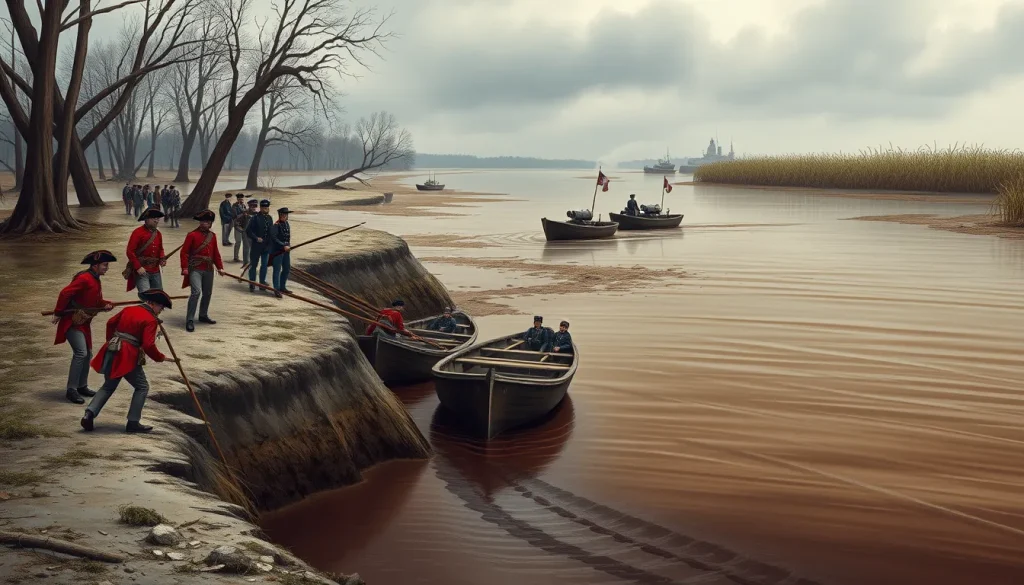
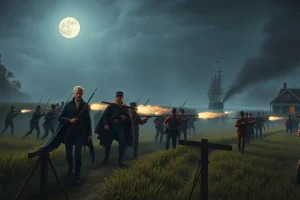
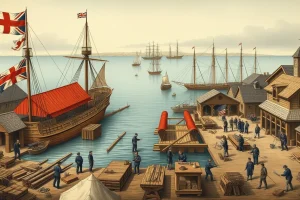
The crossing was assigned to Colonel William Thornton, whose force was made up of the 85th (Bucks) Light Infantry, a composite battalion of Royal Marines, and a naval brigade of sailors and marines. To reach the river, the boats had to be moved through a canal across the levee, and the work went slowly. Hours were lost, and only part of Thornton’s command crossed in the first wave. As a result, while the main assault on the east bank went in around daybreak on 8 January, the west bank attack had barely begun. The militia holding the riverside batteries and the supporting redoubt offered limited resistance, and Thornton’s men carried the position and captured the guns. Thornton himself was wounded in the action.
By that time the main attack had already been destroyed. The British columns on the east bank were cut down by artillery and musket fire, and Pakenham, Major General Samuel Gibbs, and Major General John Keane were killed or severely wounded. Major General John Lambert, who succeeded to command, concluded that the campaign could not continue and ordered Thornton to abandon the captured position and re-cross the river. The captured American guns were left behind, reported in several accounts as spiked or thrown into the river. During the night of 8 to 9 January the British withdrew from the west bank, and American troops reoccupied the position without further fighting. The British army began its retreat toward Lake Borgne and re-embarkation shortly afterward.
Why It Matters
The west bank action decided nothing by itself, but it shaped how contemporaries and later historians understood the battle. For the British, the crossing demonstrated that Jackson’s river flank could be turned; the failure lay in coordination rather than in the concept. The delay, whatever its cause, meant that Thornton’s success arrived after the main attack had failed, and Lambert had no reason to hold a position he could not use. For the Americans, the episode exposed how thinly the west bank was held and how much the defense depended on Patterson’s naval guns and on the failure of British timing.
Historians disagree about what an earlier crossing might have achieved. One view holds that a prompt, well-supported west bank attack could have enfiladed Jackson’s line at the moment of the main assault and made the day a British victory. Another holds that Thornton’s force was too small to exploit success, that Jackson could have shifted reserves across the river, and that the east bank disaster would have doomed the campaign regardless. The most defensible reading is that the delay cost the British the only chance their plan had, and that the plan itself was over-complicated for the force available.
Prelude
Between 23 December 1814 and 7 January 1815 the campaign settled into a contest of earthworks and artillery. Jackson attacked the British camp on the night of 23 December, met a British reconnaissance in force at his line on 28 December, and exchanged a heavy artillery duel on 1 January. Each engagement confirmed that the American line was strong in front. British artillerists and engineers therefore looked to the river, where guns on the west bank could rake the American position along its length.
American preparations continued in parallel. Jackson’s order of 25 December set the work in motion, and during the first days of January the arrival of Kentucky reinforcements allowed the position to be manned more fully, despite the shortage of arms. Pakenham’s final plan, prepared for 8 January, assigned Thornton the crossing and gave the main attack on the east bank to infantry columns supported by artillery and a reserve.
Forces and Commanders
On the American side, the west bank was under the command of Brigadier General David B. Morgan of the Louisiana militia, with Commodore Daniel T. Patterson of the United States Navy directing the naval batteries and their crews of sailors and marines. The force consisted of Louisiana militia, a detachment of Kentucky militia, many of them without firearms, and naval gunners, amounting to roughly a thousand men with several batteries.
On the British side, Colonel William Thornton of the 85th Foot commanded the crossing force, which comprised the 85th (Bucks) Light Infantry, a composite battalion of Royal Marines, and a detachment of Royal Navy sailors and marines. Estimates of its size vary, from roughly seven hundred to upwards of a thousand men, depending on whether the naval brigade and follow-up waves are counted. Pakenham directed the operation as a whole from the east bank, with Lambert’s reserve in support.
Battlefield and Map Context
The battlefield lies on both banks of the Mississippi in what is now the New Orleans metropolitan area. Jackson’s line ran inland from the east bank along the Rodriguez Canal to the cypress swamp, and the British advanced along the levee and the open ground toward it. Across the river, the west bank position occupied low, flat ground, with batteries sited near the water and a supporting work behind them. Because the river bends at Chalmette, guns on the west bank could take the British approach on the east bank in flank, which is why the position mattered out of proportion to its size.
Battle Chronology
- 25 December 1814: Jackson orders fortifications and batteries begun on the west bank.
- Late December 1814 to early January 1815: Earthworks and gun emplacements are completed, cannon from the fleet are landed, and Louisiana and Kentucky militia are assigned to the position.
- Night of 7 to 8 January 1815: Thornton’s troops begin moving boats through a canal toward the river; the work is slow and only part of the force crosses in the first wave.
- Around daybreak, 8 January: The main British assault goes in against the east bank line while the west bank crossing is still incomplete.
- Mid-morning, 8 January: Thornton’s men land on the west bank, advance on the batteries, and drive off the militia; the batteries and their guns are captured; Thornton is wounded.
- Shortly afterward: The east bank attack collapses with heavy British casualties, including the deaths of Pakenham and Gibbs and the severe wounding of Keane.
- 8 to 9 January: Lambert orders Thornton to abandon the captured position and re-cross the river; the captured guns are left behind.
- 9 January and after: American troops reoccupy the west bank; the British army withdraws toward Lake Borgne.
Casualties and Losses
The disparity in losses is the defining statistic of the day, but it belongs almost entirely to the east bank. British casualties in the main assault are generally given at roughly two thousand killed, wounded, and missing, while American losses there were slight. On the west bank both sides suffered comparatively few casualties. The Americans lost the batteries, some killed and wounded, and a number of prisoners, with the militia dispersing rather than being destroyed; British losses were also modest, though Thornton was among the wounded. No single reliable accounting for the west bank alone survives, and figures quoted in later works vary.
Result
The west bank action was a clear British tactical success and an operational nullity. Thornton took the objective he was given, but the attack it was meant to support had already failed, and holding the west bank offered no advantage once Lambert decided to break off the campaign. The captured guns were abandoned, and the position returned to American control without a fight.
Strategic Consequences
The immediate consequence was the end of the British expedition against New Orleans. The army withdrew to Lake Borgne, re-embarked, and was subsequently employed against Fort Bowyer at Mobile Point in February 1815, before news of the Treaty of Ghent, signed on 24 December 1814, reached the Gulf. The west bank success therefore produced no territorial or political gain.
Longer term, the action influenced how the battle was assessed. It showed that Jackson’s line was vulnerable on the river flank and that the west bank batteries, largely manned by sailors, were the pivot of any British attempt to turn it. It also contributed to later criticism of Pakenham’s plan as too complex for the force at hand. In American memory the fight was overshadowed by the destruction of the east bank assault, and the west bank is usually treated as a footnote to a victory rather than as an engagement in its own right.
Primary Accounts
American accounts include the Historical Memoir written by Arsène Lacarrière Latour, an engineer serving with Jackson’s army, which describes the west bank works and the loss of the batteries; Major General Andrew Jackson’s official report to Secretary of War James Monroe; and Commodore Patterson’s reports to the Navy Department. British accounts include the journal of Lieutenant Colonel Alexander Dickson, Royal Artillery, which records the plan and the crossing and is quoted at length by modern historians; the narrative of George Robert Gleig, a junior officer of the 85th Foot, published as The Campaigns of the British Army at Washington and New Orleans; the recollections of Harry Smith, who served in the campaign; and Lambert’s report after he assumed command.
All of these accounts are retrospective to some degree and were written to explain or justify the author’s own conduct. Latour and the American reports emphasize the weakness of the militia and the numerical odds; British accounts emphasize the delays and the lateness of the attack. None provides a complete, neutral record of the west bank fighting, and none of the texts is reproduced verbatim in this article.
Battlefield Today
The east bank battlefield is preserved as the Chalmette Battlefield unit of Jean Lafitte National Historical Park and Preserve in St. Bernard Parish, Louisiana, where earthworks, interpretive markers, and a national cemetery remain. The National Park Service marker titled The West Bank Assault, placed on the east bank within the battlefield, explains the action on the far side of the river. No traces of the west bank batteries survive; the ground opposite Chalmette has long been developed, and the site carries no monument of its own.
Primary Sources
The most relevant contemporary documents for the west bank action are official and personal rather than administrative, since no separate order book or unit return for the west bank force has survived as a single body of text.
- Andrew Jackson’s official report to Secretary of War James Monroe, written in January 1815, describes the enemy crossing, the withdrawal of the militia, and the recapture of the position. It is a commander’s account and minimizes American difficulties.
- Commodore Daniel T. Patterson’s reports to the Navy Department in January 1815 describe the naval batteries on the right bank, their crews, and their loss. Patterson was a participant with an interest in the reputation of the naval service.
- Arsène Lacarrière Latour, Historical Memoir of the War in West Florida and Louisiana in 1814 to 1815 (1816), gives a detailed engineer’s view of the west bank defenses written soon after the campaign by a member of Jackson’s staff; it is valuable but partisan in Jackson’s favor.
- The journal of Lieutenant Colonel Alexander Dickson, Royal Artillery, records British planning and the progress of the crossing; it is an officer’s field diary, not a public report, and its entries are terse.
- George Robert Gleig, The Campaigns of the British Army at Washington and New Orleans (1821), is a vivid personal narrative by a junior officer of the 85th Foot, written years later and shaped by the author’s subsequent career.
- The Autobiography of Lieutenant-General Sir Harry Smith, published long after the campaign, contains recollections by an officer who served in it; the passage of time affects its reliability on detail.
- Major General John Lambert’s dispatch after he took command reports the decision to withdraw from the west bank and the abandonment of the captured guns.
No verified verbatim transcript of these documents is reproduced here. Readers seeking exact wording should consult the documentary editions and archives listed under Further Reading, including the published correspondence of Andrew Jackson and the naval documentary series covering the War of 1812.
Further Reading
- Robin Reilly, The British at the Gates: The New Orleans Campaign in the War of 1812. A detailed study of British planning and operations, including the west bank crossing and the reasons for its delay.
- Robert V. Remini, The Battle of New Orleans: Andrew Jackson and America’s First Military Victory. An account of the campaign from the American side.
- Donald R. Hickey, The War of 1812: A Forgotten Conflict. Standard scholarly survey placing the New Orleans campaign in the wider war.
- Arsène Lacarrière Latour, Historical Memoir of the War in West Florida and Louisiana in 1814 to 1815, edited by Gene A. Smith. A modern edition of a key participant’s account.
- George Robert Gleig, The Campaigns of the British Army at Washington and New Orleans. A British participant’s narrative.
- Jean Lafitte National Historical Park and Preserve, Chalmette Battlefield, National Park Service. Site interpretation and the text of the West Bank Assault marker.
- The Army Historical Foundation, E Pluribus, Unum: The American Battle Line at New Orleans, 8 January 1815. An overview of the American defense and its composition.
References
- National Park Service, The West Bank Assault, historical marker text, Chalmette Battlefield, Jean Lafitte National Historical Park and Preserve; transcribed in the Historical Marker Database, https://www.hmdb.org/m.asp?m=97132.
- Lieutenant Colonel Edward B. Cummings, USMC (Ret.), E Pluribus, Unum: The American Battle Line at New Orleans, 8 January 1815, The Army Historical Foundation, https://armyhistory.org/e-pluribus-unum-the-american-battle-line-at-new-orleans-8-january-1815/.
- Robin Reilly, The British at the Gates: The New Orleans Campaign in the War of 1812 (New York: Putnam, 1974; reprinted).
- Robert V. Remini, The Battle of New Orleans: Andrew Jackson and America’s First Military Victory (New York: Viking, 1999).
- Donald R. Hickey, The War of 1812: A Forgotten Conflict (Urbana: University of Illinois Press, 1989; revised editions).
- Arsène Lacarrière Latour, Historical Memoir of the War in West Florida and Louisiana in 1814 to 1815 (Philadelphia, 1816; modern edition edited by Gene A. Smith, Gainesville: University Press of Florida).
- George Robert Gleig, The Campaigns of the British Army at Washington and New Orleans (London, 1821).
- Autobiography of Lieutenant-General Sir Harry Smith, edited by G. C. Moore Smith (London, 1901).
FAQ
Did the British win the fighting on the west bank?
Yes. Colonel William Thornton's force crossed the Mississippi, drove off the Louisiana and Kentucky militia holding the position, and captured the American batteries and their guns. The success was local, however; it came after the main British assault on the east bank had already failed, and the position was abandoned on orders from Major General John Lambert.
Why did the British cross the river at all?
The American batteries on the west bank could take the British advance on the east bank in flank and threaten New Orleans from an unfortified direction. Pakenham's plan for 8 January therefore paired the main frontal assault with a crossing designed to seize those guns and turn them against Jackson's line.
What happened to the American guns captured on the west bank?
They were abandoned when Lambert ordered Thornton's force to re-cross the river after the main attack collapsed. Contemporary and later accounts state that the guns were spiked or thrown into the river, but the details reported by different sources are not fully consistent.
Leave a Reply