
Short Answer
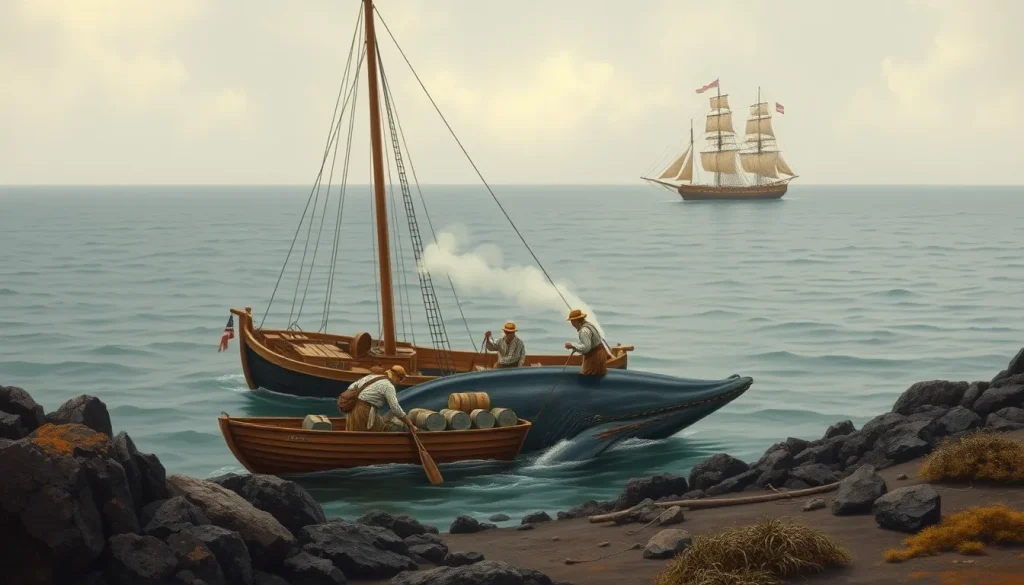
The economic impact of the War of 1812 on the Pacific whaling industry was both severely disruptive in the short term and formative in the longer term. When the United States declared war on Great Britain in June 1812, the whale fishery of the Pacific and South Seas was dominated by British vessels sailing from London under what contemporaries called the Southern Whale Fishery, while American whaleships worked mainly in the Atlantic. Between 1813 and 1815, American commerce raiding, the Royal Navy’s countermeasures, and the blockade of the American coast scattered the trade, destroyed or captured valuable ships and cargoes, and helped open the way for the American-dominated Pacific whaling of the 1820s and 1830s.
This article treats the “Pacific whaling industry” as the international commercial whale fishery of the Pacific and South Seas — principally British, with a small but growing American presence — rather than as the American industry alone. Its focus is the wartime and immediate postwar economy of that fishery and its direct connection to the War of 1812.
Historical Context
Whale products were essential commodities in the early nineteenth century. Spermaceti, taken from the case in the head of the sperm whale, was made into candles and fine oil; ordinary whale oil burned in lamps; and by this period whale oil was also being used as a lubricant for machinery, a function that recent scholarship treats as economically important alongside its use for light. Great Britain was the largest market, and the British government regarded the fishery as a strategic industry, both as a source of oil and as a training ground for seamen who might later serve in the Royal Navy.
British whaling in the Pacific and South Seas expanded after the voyages of James Cook, and London merchants organized long, expensive voyages to the Chilean and Peruvian coasts, the Galápagos Islands, and beyond. Parliament supported the trade with bounties on tonnage and oil, which made the Southern Whale Fishery a politically protected interest able to demand naval escorts in wartime. American whaling, based chiefly at Nantucket, New Bedford, New London and Sag Harbor, had grown rapidly since the 1780s, with Nantucket’s merchants supplying much of the capital and expertise. A few American whaleships had begun to appear in the Pacific in the 1790s, but on the eve of the war the great majority still worked the Atlantic, where voyages were shorter and the market for oil in Britain was more accessible.
The strategic setting made the Pacific an unusually exposed theater. The United States Navy possessed only a handful of frigates and sloops in 1812 and could protect neither its merchant marine nor its whaling fleet, whereas the Royal Navy could blockade the American coast and still detach ships to hunt raiders across the world. American policy therefore encouraged cruiser warfare against British trade, and the Pacific — distant from the main fleets, lightly defended, and full of valuable British whalers — was an attractive target. The Pacific coast of South America was also in upheaval: Chile and other Spanish colonies were in revolt after 1810, and ports such as Valparaíso were only loosely governed, giving belligerent warships room to operate. On the Northwest Coast, the British North West Company and the American Pacific Fur Company competed at Fort Astoria, linking the fur trade to the same maritime rivalry.
What Happened
American whaling felt the war almost at once. Nantucket, whose economy depended almost entirely on the fishery, petitioned Congress against war in May 1812 and warned that the island was defenceless. War came anyway. On 9 July 1812, within a month of the declaration, the Nantucket whaling schooner Mount Hope was burned at sea with 170 barrels of sperm oil aboard and her crew taken prisoner, and other vessels were captured in the Atlantic during 1812 and 1813. Because most American whaleships were already on long voyages when war was declared, owners could neither recall nor easily insure them. The Atlantic fishery contracted sharply, and Nantucket’s shipping and food supply came under threat.
The decisive offensive action in the Pacific came from the United States frigate Essex, commanded by Captain David Porter. Essex sailed from the Delaware in October 1812, rounded Cape Horn — the first American warship to do so — and reached the Chilean port of Valparaíso in March 1813. Between 17 April and 3 October 1813 Porter cruised the Galápagos Islands, capturing twelve British whalers and taking more than 300 prisoners. He manned one of the prizes, the whaler Atlantic, as the consort Essex Junior, and in October 1813 took his squadron to Nuku Hiva in the Marquesas Islands, where he refitted and claimed the island for the United States — a claim never ratified and soon abandoned. The captures removed a substantial part of the British South Seas fleet from service and stripped London merchants of ships and cargoes. One long-standing reference estimate put the damage to British South Pacific whaling at $6 million, though such figures are rough, derive from wartime claims, and should not be treated as an audited accounting.
Porter’s cruise provoked a British response. The Admiralty sent the frigate HMS Phoebe, commanded by Captain James Hillyar, and the sloop HMS Cherub to the Pacific to hunt Essex, detaching them from other duties. In February 1814 the two British ships arrived at Valparaíso and blockaded the American frigate. On 28 March 1814 Porter attempted to escape, lost his main topmast in a squall, and was brought to action close inshore; after a destructive engagement Essex surrendered. Reported American losses were 58 killed, 65 wounded, and 31 missing, against 5 killed and 10 wounded on the British side. Porter maintained that Hillyar had attacked a crippled ship in neutral waters; Hillyar and the Royal Navy maintained that Essex’s anchorage did not confer immunity. The dispute was widely publicized in the American press and became one of the war’s better-known controversies.
On the American coast the economic pressure intensified in 1814. After Napoleon’s abdication released British reinforcements for North America, Vice Admiral Alexander Cochrane issued a proclamation on 25 April 1814 extending the blockade to New England, which had previously been treated leniently. Nantucket was isolated: its whaling had already stopped, and the island depended on the mainland for food. In the late summer of 1814, island representatives opened negotiations with the Royal Navy without the consent of the Madison administration, and a local neutrality arrangement followed. The Treaty of Ghent of 24 December 1814 ended hostilities, but the whaling economy recovered slowly and unevenly, and several wartime losses of ships, cargoes and markets were never made good.
Why It Matters
Contemporaries understood the Pacific cruise chiefly as commerce warfare. Porter’s captures raised insurance costs, embarrassed the Admiralty, and forced the Royal Navy to send warships into a distant ocean. British naval activity in the Pacific in 1813–1814 served several purposes at once: hunting Essex, supporting the fur-trade venture connected with the capture of the American post at Fort Astoria in December 1813, and protecting the whaling and sealing trades. British whaling merchants, who had long lobbied for protection of the South Seas trade, pressed for convoys and escorts, and their losses became part of the wider wartime argument in Britain about the cost and purpose of the American war.
For the United States the immediate consequences were mostly negative. The Atlantic whaling fleet was broken up, Nantucket was nearly ruined, and a community that had opposed the war negotiated with the enemy. Yet the war also showed American shipowners where the remaining whales were and what the Pacific offered. When peace returned, American whaleships entered the Pacific in growing numbers; by the 1820s they were serious competitors to the British, and within a generation they dominated the fishery, with New Bedford displacing Nantucket as the industry’s capital.
Historians therefore disagree about how much of that shift should be credited to the war itself. The captures of 1813–1814 removed British ships from the Pacific and tied up British capital, and wartime voyages gave American mariners direct knowledge of Pacific grounds. But the American rise also rested on cheaper shipbuilding, larger and longer-ranging vessels, more flexible management, and a different labour system — factors that existed before 1812 and deepened after it.
Definition
The “Pacific whaling industry” in this period means the commercial hunting of whales in the Pacific Ocean and the South Seas for spermaceti, sperm oil and whale oil, carried on by vessels that sailed from Atlantic and European ports on voyages lasting a year or more. Economic impact here covers the loss and capture of vessels and cargoes, the cost of insurance and naval protection, the interruption of markets, the movement of capital and labour, and the resulting shift in the international balance of the trade.
Background
Britain’s Pacific fishery had been built partly on state support: bounties on tonnage and oil, together with naval protection, made the South Seas trade a favoured enterprise of London merchants. The American fleet grew largely without bounties, through the enterprise of Nantucket and the Connecticut and Massachusetts ports. When war began, Britain was the incumbent in the Pacific and the United States the challenger, and the two fleets competed for the same whales on the same grounds.
How It Worked
The war acted on the Pacific fishery through several connected mechanisms:
- Capture and destruction. Whaleships carried small crews and few guns, so a frigate or a lucky privateer could take them without a fight; captured vessels and oil were condemned as prize and sold, transferring value from one belligerent to the other.
- Blockade and port denial. The blockade of the American coast, extended to New England in April 1814, shut American whaling ports off from the sea and from their own food supply; Nantucket was the clearest case.
- Insurance and freight. Wartime risk raised premiums and made it harder to finance long voyages, so even ships that were never captured became more expensive to send out.
- Naval protection and its cost. Convoys and escort cruisers reduced losses but tied down warships; the Admiralty’s Pacific detachment was strength unavailable elsewhere.
- Markets. The British market for American oil was effectively closed, and disruption of London sales affected prices and merchant credit on both sides.
- Labour. Crews taken prisoner, voyages delayed, and skilled seamen drawn into privateering or naval service all reduced the efficiency of the fishery.
Competing Viewpoints
Three broad positions appear in the literature. The first treats the war as a decisive break: Porter’s cruise is said to have crippled British Pacific whaling and opened the ocean to American enterprise, a view often reflected in popular naval histories and in reference works that emphasize the scale of the prizes taken. The second stresses continuity: on this reading the war was a severe but passing disruption, and the American takeover of Pacific whaling rested mainly on productivity, cost structure and institutions, as argued in the economic study of Anglo-American whaling competition between 1817 and 1842. The third holds that the war was a net loss for the United States, devastating Nantucket and the Atlantic fishery, with whatever Pacific gains followed accruing largely to mainland ports such as New Bedford rather than to the prewar leader.
A further disagreement concerns evidence. Wartime claims of damage, including the frequently cited $6 million figure for losses to British South Pacific whaling, come from interested parties and are not supported by a complete surviving accounting; some historians accept them as broadly indicative of scale, while others treat them as unverifiable.
Role in the War of 1812
The Pacific was a peripheral theater, but the whaling economy was the reason it mattered. Commerce raiding was one of the few ways the United States could injure Britain, and whale oil was a valuable, insurable commodity moving in lightly defended ships. The British response combined warship patrols with a wider policy of protecting trade, and the hunt for Essex drew strength into the Pacific. The disputed status of neutral harbours, tested at Valparaíso, also connected the Pacific whaling war to questions of international law that arose simultaneously in the Atlantic.
Consequences and Historical Interpretation
In the short term, the war reduced the number of whaleships at sea, raised costs, transferred ships and cargoes between belligerents, and nearly destroyed one major American whaling community. In the longer term, it coincided with and accelerated a transfer of leadership in the Pacific fishery from Britain to the United States, a shift that was complete by the 1830s and that underpinned the so-called golden age of American whaling.
The historiography is uneven. The topic usually appears inside biographies of David Porter, histories of the British whaling trade, and economic studies of the American fishery rather than in general accounts of the war, which tend to concentrate on the Atlantic coast, the Great Lakes and the Gulf. Recent work on American whaling’s role in Pacific expansion has argued that the commercial importance of whale oil helped shape early United States interest in the ocean, though that interpretation is newer and less settled than the established naval narrative. Historians also caution that the war’s effects must be separated from longer-term ecological and market changes: whale populations near older grounds were already thinning, pushing vessels further afield whether or not a war was being fought. Precise totals of vessels lost, oil seized, and value destroyed cannot be recovered with confidence, because the surviving evidence is scattered among prize court records, newspapers and merchant papers, and much of it is incomplete.
Primary Sources
The most useful contemporary materials for this subject are naval, mercantile and local records, each with clear limitations.
- David Porter, Journal of a Cruise Made to the Pacific Ocean (1815; expanded edition 1822). Porter’s own narrative, written in part to defend his conduct. It provides the fullest firsthand account of the Galápagos captures and the action at Valparaíso, but it is self-justifying and highly polemical toward Hillyar and the Royal Navy.
- Porter’s official letters to the Secretary of the Navy, printed in the Navy’s documentary edition of the war. These report captures and prizes from the commander’s viewpoint; they were written for superiors and, in some cases, composed well after the events.
- British Admiralty correspondence, including Captain James Hillyar’s dispatches on the Valparaíso engagement and the protection of trade. These state the British case that Essex had forfeited the protection of a neutral anchorage and record Admiralty concern for the South Seas fishery; they present the Royal Navy’s perspective and its institutional interests.
- Nantucket town records and the island’s May 1812 petition to Congress, Kezia Coffin Fanning’s diary, and Matthew Clark’s letter of 23 August 1814 to General Henry Dearborn. These document the island’s distress and its unauthorized approach to the Royal Navy; they are local and partisan to Nantucket’s interests.
- Vice Admiral Alexander Cochrane’s blockade proclamation of 25 April 1814. An official British statement extending the blockade to New England; it records policy rather than the uneven reality of enforcement.
- Newspapers such as Niles’ Weekly Register of Baltimore, together with London shipping and prize reports. These carry prize lists, oil prices and merchants’ complaints, but items were frequently copied at second or third hand and are unreliable in detail. No verified verbatim transcript of Porter’s or Hillyar’s dispatches is reproduced here; readers should consult the published documentary edition or the holding archives for exact wording.
Further Reading
- David F. Long, Nothing Too Daring: A Biography of Commodore David Porter, 1780–1843 (Annapolis: United States Naval Institute, 1970).
- Edouard A. Stackpole, Whales & Destiny: The Rivalry between America, France, and Britain for Control of the Southern Whale Fishery, 1785–1825 (Amherst: University of Massachusetts Press, 1972).
- Gordon Jackson, The British Whaling Trade (London: Adam & Charles Black, 1978).
- Lance E. Davis, Robert E. Gallman and Karin Gleiter, In Pursuit of Leviathan: Technology, Institutions, Productivity, and Profits in American Whaling, 1816–1906 (Chicago: University of Chicago Press, 1997), especially chapter 12, “The Americans Replace the British.”
- The Naval War of 1812: A Documentary History, vol. 3 (Washington, DC: Naval Historical Center, 2002), chapter 3, “The Pacific Theater: January 1814–August 1815.”
- Nantucket Historical Association, “Nantucket’s Bid for Survival during the War of 1812.”
- Andrew J. Hiner, “The Whaler’s Empire: Industry, Environment, and American Expansion in the Pacific Ocean” (unpublished MA thesis, Clemson University, 2026), cited as a recent interpretive study.
References
- The Naval War of 1812: A Documentary History, vol. 3, chapter 3, “The Pacific Theater: January 1814–August 1815” (Naval Historical Center, 2002). http://ibiblio.org/anrs/docs/E/E3/dh_1812_v03c03.pdf
- “Essex, Actions of the,” Dictionary of American History, reprinted at Encyclopedia.com. http://encyclopedia-loadbalancer-1-1782916326.us-west-2.elb.amazonaws.com/history/dictionaries-thesauruses-pictures-and-press-releases/essex-actions
- Nantucket Historical Association, “Nantucket’s Bid for Survival during the War of 1812.” https://nha.org/research/nantucket-history/history-topics/nantuckets-bid-for-survival-during-the-war-of-1812/
- Lance E. Davis, Robert E. Gallman and Karin Gleiter, “The Americans Replace the British,” chapter 12 of In Pursuit of Leviathan (University of Chicago Press, 1997), National Bureau of Economic Research chapter file. https://www.nber.org/system/files/chapters/c8287/c8287.pdf
- Andrew J. Hiner, “The Whaler’s Empire: Industry, Environment, and American Expansion in the Pacific Ocean” (MA thesis, Clemson University, 2026). https://open.clemson.edu/cgi/viewcontent.cgi?article=5814&context=all_theses
FAQ
Did the War of 1812 destroy the Pacific whaling industry?
No. The war severely disrupted the fishery, particularly the British Southern Whale Fishery, which lost ships and cargoes to the Essex and to privateers, and it raised insurance and protection costs. But the trade continued and recovered, and American whaling in the Pacific expanded sharply after 1815 and eventually overtook the British.
How much damage did USS Essex do to British whaling?
Between 17 April and 3 October 1813 Porter reported capturing twelve British whalers in the Galápagos and taking more than 300 prisoners. One long-standing reference estimate puts total damage to British South Pacific whaling at $6 million, but that figure derives from wartime claims and no complete accounting survives, so historians treat it cautiously.
Why did Nantucket negotiate with the Royal Navy in 1814?
Nantucket's economy depended almost entirely on whaling, and the blockade extended to New England on 25 April 1814 cut the island off from both its fishery and its mainland food supply. Island representatives opened talks with the Royal Navy without authorization from the Madison administration, and a local neutrality arrangement followed late in the war.


Leave a Reply