
Short Answer
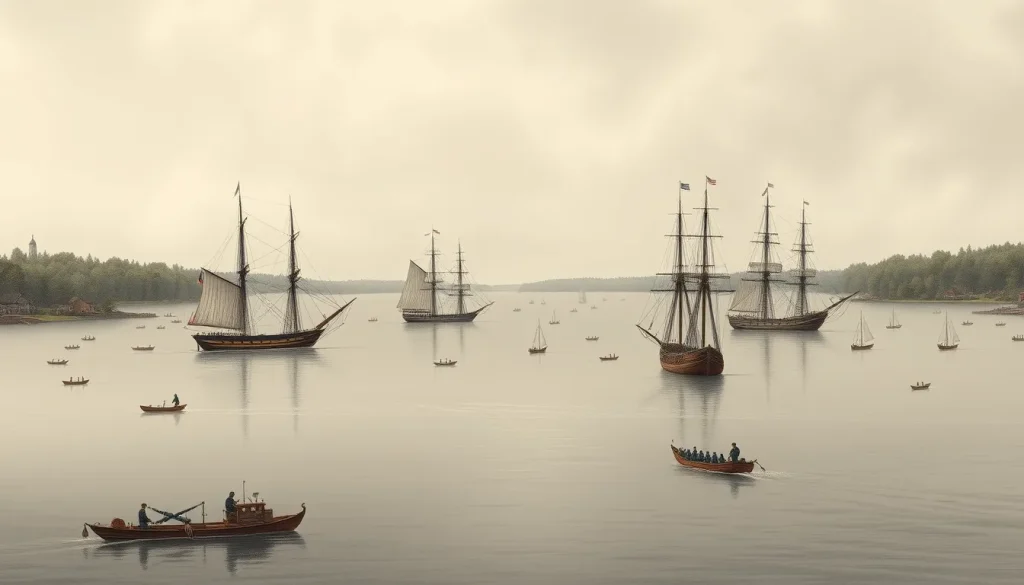
During the War of 1812, Lake Ontario was the most important inland waterway in the northern theater. American Commodore Isaac Chauncey and British Commodore Sir James Lucas Yeo commanded squadrons that could move armies, supplies, and naval stores between Kingston, Sackets Harbor, York, and the Niagara frontier. Although both sides built powerful fleets and several encounters occurred, neither sought a decisive fleet battle. The resulting stalemate shaped the war in Upper Canada and later contributed to the Rush-Bagot Agreement limiting armaments on the Great Lakes.
Historical Context
Lake Ontario lies between Upper Canada (modern Ontario) and New York. It connects to the St. Lawrence River at Kingston and to the Niagara River and Lake Erie via the Niagara peninsula. For both Britain and the United States, control of the lake meant control of the main supply route for land operations. An army on the Niagara frontier or at Kingston could not be sustained without ships and bateaux moving food, ammunition, and reinforcements.
When the United States declared war on 18 June 1812, the Madison administration hoped to conquer Canada. The Great Lakes became central to that strategy. Britain had an early advantage through the Provincial Marine, a quasi-naval force based at Kingston. On Lake Ontario the British had vessels such as Royal George, Prince Regent, Earl of Moira, and Duke of Gloucester. The United States had only the brig Oneida and a small yard at Sackets Harbor, New York. After the fall of Detroit, American leaders recognized that naval power on the lakes was essential.
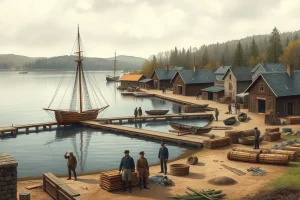
In September 1812 the Navy Department appointed Isaac Chauncey to command on Lakes Ontario and Erie, with broad authority to build and lead a fleet. Chauncey concentrated on Lake Ontario. The Royal Navy appointed Captain Sir James Lucas Yeo to command the lakes in 1813. Both sides then began a shipbuilding race. Kingston and Sackets Harbor became major naval bases, with shipwrights, riggers, carpenters, and ordnance stores gathered from Montreal, New York, and Britain. Indigenous nations allied to Britain, including Haudenosaunee and other groups, were important to land operations in Upper Canada, but they were not major participants in the fleet actions on Lake Ontario. Canadian militia, British regulars, and American soldiers and sailors were all affected by the naval stalemate.
What Happened
The first significant Lake Ontario action came on 19 July 1812, when Provincial Marine vessels attacked Sackets Harbor and were beaten off. In November, Chauncey pursued the Royal George into Kingston harbour but was repulsed by shore batteries and gunboats. Winter ice ended operations.
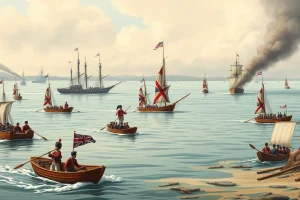
In 1813 Chauncey briefly held an advantage before Yeo and British seamen arrived. Instead of attacking Kingston directly—a decision later criticized—Chauncey and Major General Henry Dearborn took part in the amphibious attacks on York (modern Toronto) on 27 April and Fort George on 27 May. The British attacked Sackets Harbor on 29 May but were defeated. Through the summer and autumn the squadrons maneuvered and skirmished. The best-known encounter was the Burlington Races on 28 September 1813, when Chauncey chased Yeo’s squadron to the western end of the lake. Yeo escaped into Burlington Bay under the protection of shore batteries, and no decisive result followed.
In 1814 both sides escalated construction. The Americans launched the frigate Superior and the brig Mohawk at Sackets Harbor. The British launched HMS St. Lawrence, a 112-gun first-rate, at Kingston in September 1814. St. Lawrence gave Yeo clear superiority, but by then the war was ending and Chauncey declined to risk his remaining squadron. The ship never fought a fleet action. No single battle on Lake Ontario destroyed or captured either squadron.
Why It Matters
The lack of a decisive battle had immediate and long-term consequences. Neither side gained uncontested control of Lake Ontario. The British retained Kingston and their supply route; the Americans retained Sackets Harbor and could still move troops for limited operations. This helped produce a strategic stalemate in Upper Canada, where major land campaigns were constrained by the availability of naval transport and protection.
The shipbuilding race consumed enormous resources. Timber, guns, cordage, and thousands of workers were diverted to the lake. HMS St. Lawrence was the largest warship ever built on the Great Lakes, yet it was completed too late to change the war’s outcome. After 1815, the memory of this expensive competition contributed to the Rush-Bagot Agreement of 1817, which limited naval armaments on the lakes and became a lasting feature of Canadian-American border relations.
Historians have long debated why the campaign remained indecisive. Early writers such as Theodore Roosevelt, Henry Adams, and Alfred Thayer Mahan blamed Chauncey’s caution. Later scholars, including Charles E. Brodine Jr., have argued that structural conditions—administrative burdens, unreliable officers, difficult logistics, and the high risk of losing an entire fleet—made caution rational. Yeo faced similar restraints. Modern interpretations therefore treat the stalemate as the product of both command personalities and strategic circumstances.
Definition
A decisive battle on Lake Ontario would have been a fleet action that destroyed or captured the opposing squadron, leaving the victor with uncontested command of the lake. Such a result would have exposed enemy bases, protected friendly supply lines, and allowed land forces to operate with far greater freedom. No action in 1812–1814 achieved that outcome.
Background
Several conditions made a decisive battle unlikely. The lake was an enclosed theater with fortified harbours at Kingston and Sackets Harbor. A defeated squadron could often retreat under shore batteries. Both fleets were essential to army operations: they carried troops, provisions, and ordnance. Losing them would not merely be a naval defeat; it could cripple the entire land campaign. Weather, contrary winds, and sudden squalls also made it difficult to force a general engagement. Finally, neither side had a clear margin of superiority for most of the war. Each time one side built a stronger ship, the other responded.
How It Worked
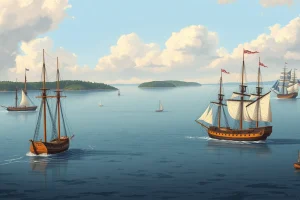
The campaign operated as a system of mutual deterrence and construction. Chauncey and Yeo sortied to protect convoys, transport troops, raid enemy positions, and test each other’s strength. They generally sought battle only when wind, position, and strength promised an advantage. If the odds shifted, they withdrew to their base. This produced a sequence of maneuvers, chases, and small engagements rather than a Trafalgar-style confrontation. The shipbuilding race became a substitute for battle: each side tried to overawe the other with ever-larger vessels. The arrival of HMS St. Lawrence ended the competition by giving Britain clear superiority, but not in time to produce a decisive fleet action.
Competing Viewpoints
Contemporary critics accused both commodores of excessive caution. American newspapers and later historians argued that Chauncey should have attacked Kingston in 1813 or supported Major General Jacob Brown more aggressively on the Niagara frontier in 1814. From this viewpoint, the stalemate reflected a failure of command nerve.
Other historians emphasize strategic logic. Chauncey was simultaneously administrator, squadron commander, and joint-operations partner. He had to build ships, manage unreliable officers, and cooperate with land generals. A defeat could have exposed Sackets Harbor and undone American operations on the lakes. Yeo faced comparable pressures: he had to support Governor General Sir George Prevost’s army, protect Kingston, and keep supplies moving. For both commanders, preserving a fleet in being was often more valuable than risking it in battle. The debate therefore turns on whether the stalemate was a failure of personality or a rational response to risk.
Role in the War of 1812
Lake Ontario was the central naval theater of the northern war. The American attacks on York and Fort George in 1813 depended on Chauncey’s ships. British control of Kingston allowed reinforcements and supplies to reach Upper Canada. The indecisive naval campaign helped ensure that neither side achieved a war-winning advantage in the province. It also tied down resources that might have been used elsewhere. In 1814, British naval superiority under Yeo supported the British offensive in the Niagara region, but the war ended before it could be exploited fully. The campaign thus contributed to the broader pattern of limited gains and negotiated peace.
Consequences and Historical Interpretation
The most visible consequence was the shipbuilding race and its postwar limits. The Rush-Bagot Agreement of 1817 reduced naval forces on the Great Lakes, creating a demilitarized border that lasted in modified form. For historians, Lake Ontario remains a case study in strategy, command, and the difficulty of forcing a decisive result in a theater where both sides depended on the same waterway. Older interpretations stressed individual caution; newer work stresses logistics, politics, and the mutual vulnerability of bases and armies. The question of why no decisive battle occurred therefore has no single answer. It arose from the intersection of personality, resource competition, geography, and the high stakes of losing an entire fleet.
Primary Sources
- Orders and letters of Secretary of the Navy Paul Hamilton and William Jones to Isaac Chauncey, 1812–1813, in the Isaac Chauncey Papers, William L. Clements Library, University of Michigan. These document the Navy Department’s expectation that Chauncey obtain command of Lakes Ontario and Erie, build a fleet, and cooperate with the army. They are essential but reflect official policy rather than the full experience of officers and crews.
- Isaac Chauncey letterbooks, including his March 1815 request to Secretary of the Navy Benjamin Crowninshield for funds to complete large ships at Sackets Harbor, Isaac Chauncey Papers, Clements Library. They show the scale of the shipbuilding program and Chauncey’s administrative burdens, but they are self-interested reports by a commander defending his decisions.
- Sir James Lucas Yeo’s dispatches to the Admiralty and to Governor General Sir George Prevost, in British Admiralty and colonial records at The National Archives (UK), printed in part in William Wood, ed., Select British Documents of the Canadian War of 1812. These give the British command perspective, including pressure to support land operations and protect Kingston. They should be read with awareness that commanders often justified caution after the fact.
- Maps and plans such as Patrick May, A Map of Sacketts Harbour with Explanatory Notes (1815), Clements Library, show the naval yard, fortifications, and fleet at Sackets Harbor. They are valuable for geography but not for the motives of commanders.
- Contemporary newspapers on both sides, including Kingston and New York papers, reported fleet movements and criticized or defended the commodores. They preserve public debate but often lacked reliable information and reflected partisan bias.
No verbatim transcript of a decisive fleet action exists because no such action occurred. The most reliable documentary record is therefore scattered across orders, letters, logs, and official returns rather than a single battle report.
Further Reading
- Robert Malcomson, Lords of the Lake: The Naval War on Lake Ontario, 1812–1814 (1998).
- Charles E. Brodine Jr., ‘The Cautious Commodore?’ Naval History Magazine 27, no. 5 (2013).
- Charles E. Brodine Jr., ‘The War’s Most Challenging Theater,’ Naval History Magazine 27, no. 5 (2013).
- William S. Dudley, ed., The Naval War of 1812: A Documentary History, 4 vols. (1985–2002).
- Donald R. Hickey, The War of 1812: A Forgotten Conflict, rev. ed. (2012).
- Andrew Lambert, The Challenge: Britain Against America in the Naval War of 1812 (2012).
- Alan Taylor, The Civil War of 1812 (2010).
- J.C.A. Stagg, The War of 1812: Conflict for a Continent (2012).
- William L. Clements Library, ‘The War of 1812: A Bicentennial Exhibition, Case 9: Ontario and Champlain.’
References
- Charles E. Brodine Jr., ‘The Cautious Commodore?’ Naval History Magazine 27, no. 5 (October 2013), https://www.usni.org/magazines/naval-history-magazine/2013/september/cautious-commodore.
- Charles E. Brodine Jr., ‘The War’s Most Challenging Theater,’ Naval History Magazine 27, no. 5 (October 2013), https://www.usni.org/magazines/naval-history-magazine/2013/september/wars-most-challenging-theater.
- ‘Engagements on Lake Ontario,’ Wikipedia, https://en.wikipedia.org/wiki/Engagements_on_Lake_Ontario.
- ‘The Lake Ontario Arms Race,’ The War of 1812, https://thewarof1812.org/battles/the-lake-ontario-arms-race/.
- William L. Clements Library, ‘The War of 1812: A Bicentennial Exhibition, Case 9: Ontario and Champlain,’ University of Michigan, https://clements.umich.edu/exhibit/the-war-of-1812/case-9/.
- Robert Malcomson, Lords of the Lake: The Naval War on Lake Ontario, 1812–1814 (Annapolis: Naval Institute Press, 1998).
- William S. Dudley, ed., The Naval War of 1812: A Documentary History, 4 vols. (Washington, DC: Naval Historical Center, 1985–2002).
- Donald R. Hickey, The War of 1812: A Forgotten Conflict, rev. ed. (Urbana: University of Illinois Press, 2012).
- Andrew Lambert, The Challenge: Britain Against America in the Naval War of 1812 (London: Faber and Faber, 2012).
- Alan Taylor, The Civil War of 1812: American Citizens, British Subjects, Irish Rebels, and Indian Allies (New York: Knopf, 2010).
- J.C.A. Stagg, The War of 1812: Conflict for a Continent (Cambridge: Cambridge University Press, 2012).
- William Wood, ed., Select British Documents of the Canadian War of 1812, 3 vols. (Toronto: Champlain Society, 1920–1928).
FAQ
Did the American and British fleets on Lake Ontario ever fight a major battle?
They fought several smaller or inconclusive actions, most notably the Burlington Races on 28 September 1813, but no single engagement destroyed or captured either squadron or gave uncontested control of the lake.
Who commanded the Lake Ontario squadrons?
The United States squadron was commanded by Commodore Isaac Chauncey, based at Sackets Harbor, New York. The British squadron was commanded by Commodore Sir James Lucas Yeo, based at Kingston, Upper Canada.
Why did neither commander force a decisive battle?
Both commanders feared losing their fleet, which was essential for moving troops and supplies and for protecting their bases. Fortified harbours, changing winds, rough weather, and a mutual shipbuilding race made a decisive result difficult and risky.
Leave a Reply