
Short Answer
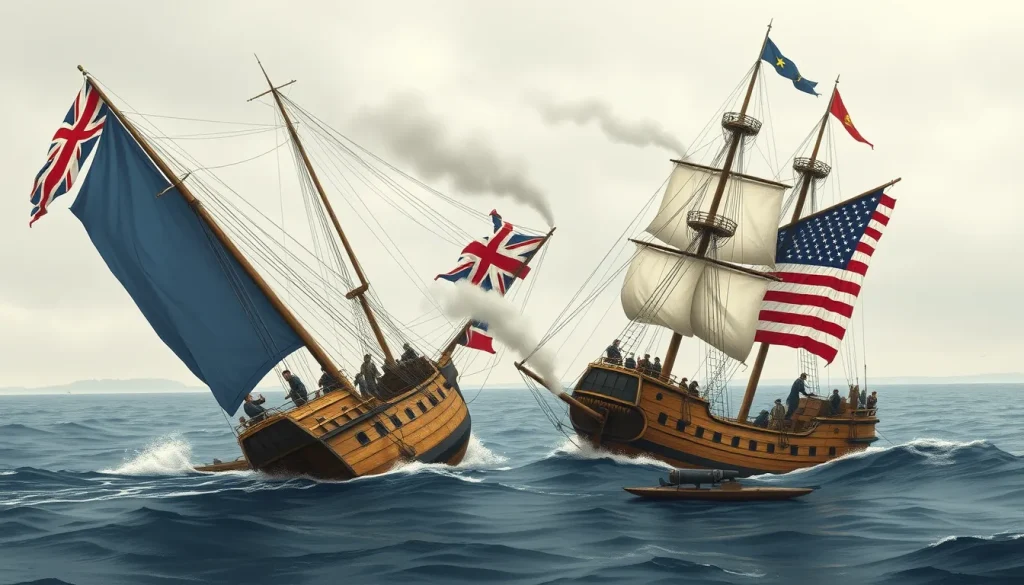
The Battle of Chesapeake and Shannon, fought on 1 June 1813 off the Massachusetts coast, was a single-ship duel between the United States frigate USS Chesapeake and the British frigate HMS Shannon during the War of 1812. The action lasted roughly a quarter of an hour and ended with Chesapeake disabled, boarded and captured, and her captain, James Lawrence, mortally wounded. It is also called the capture of USS Chesapeake and, in some accounts, the Battle of Boston Harbor; all three names refer to the same engagement, which is the subject of this article.
Historical Context
When the United States declared war in June 1812, the Royal Navy was the largest in the world and the United States Navy could not challenge it for command of the sea. American strategy therefore depended heavily on a small number of powerful frigates cruising independently. Between August 1812 and February 1813 the U.S. Navy won a celebrated sequence of single-ship actions: Constitution over HMS Guerriere, USS United States over HMS Macedonian, Constitution over HMS Java, and USS Hornet over HMS Peacock. These defeats were deeply embarrassing to British officers, and they encouraged Americans to expect victory whenever an American frigate met a British ship of similar rate.
Britain responded to the war with a tightening blockade of the American seaboard, including New England, where ports such as Boston saw trade disrupted and coastal towns preparing defences against raids. In this setting HMS Shannon cruised off Boston under Captain Philip Bowes Vere Broke, while USS Chesapeake lay in the harbour fitting out under a newly appointed captain, James Lawrence, who had won public acclaim in command of Hornet.
The two ships carried very different reputations into the fight. Chesapeake was one of the frigates authorised in 1794, but her career had been undistinguished, and in 1807 she had been fired on by HMS Leopard, struck her colours after minimal resistance, and allowed British officers to remove crewmen claimed as deserters. The affair ended the career of Captain James Barron and left the ship with a damaged name. Broke, by contrast, had commanded Shannon since 1806 and had spent years training his crew, fitting improved sights to his guns and drilling his gunners to fire quickly and accurately on marked bearings.
What Happened
Broke wrote to Lawrence challenging him to a ship-to-ship duel, but the letter never reached the American captain. Broke also detached the frigate HMS Tenedos, apparently hoping that a single opponent would tempt Chesapeake to sea. On 1 June 1813 Chesapeake sailed from Boston and stood out into the Atlantic; Shannon closed, and the two frigates fought at very short range. British gunnery proved decisive. In the opening broadsides Chesapeake lost her wheel and fore topsail halyards and became difficult to steer, while concentrated fire swept her quarterdeck, mortally wounding Lawrence and fatally wounding First Lieutenant William Ludlow. British boarders then crossed to the American deck and overcame disorganised resistance; Broke was severely wounded in the fighting. Within minutes Chesapeake was a British prize, taken to Halifax, Nova Scotia, under a prize crew. Lawrence died of his wounds on 4 June 1813.
Why It Matters
The capture ended a run of American frigate victories and restored British naval confidence after a series of humiliating single-ship defeats. It also gave the Royal Navy a much-publicised demonstration of the value of sustained gunnery drill, and it left the United States with a defeat that was difficult to explain because the two ships were so closely matched. Contemporary Americans, unused to naval failure and confident of victory on the day, sought explanations in the conduct of individuals rather than in the material conditions of the fight. The U.S. Navy punished several men, including a Black bugler, William Brown, who received 100 lashes, and Acting Lieutenant William Cox, who was court-martialled for carrying the wounded Lawrence below deck.
Later historians have generally treated those punishments as scapegoating. Robert E. Cray Jr. has argued that the defeat is better explained by the Chesapeake‘s hurried manning, an inexperienced crew and new officers, and the superior preparation of Shannon, while the ship’s earlier history and the public expectation of victory intensified the sense of humiliation. The engagement also produced one of the war’s most enduring phrases and made Halifax the destination of a celebrated prize.
Prelude
By May 1813 Chesapeake was fitting out at Boston under Lawrence, but recruiting was difficult: part of the crew declined to re-enlist until a pay dispute was settled, and Lawrence filled out his complement with less experienced men in order to get to sea. News that Shannon was waiting offshore, and that Broke had issued a challenge, circulated widely in Boston. Expectation of an American victory was so strong that local arrangements were reportedly made for a celebration dinner, and crowds gathered on coastal hills and rooftops while small craft accompanied the frigate out of the harbour, hoping to see the fight.
Forces and Commanders
Both ships were rated as 38-gun frigates. Chesapeake mounted about 49 guns and threw a broadside of roughly 581 pounds; Shannon mounted about 48 guns with a broadside of about 526 pounds. Chesapeake carried the larger crew, roughly 379 sailors and marines against about 330 in Shannon, but the British ship had been together far longer under the same commander.
Captain James Lawrence (1781–1813) had commanded Hornet in the capture of HMS Peacock earlier in 1813 and was known as an aggressive officer. Captain Philip Bowes Vere Broke had commanded Shannon for around seven years and had made gunnery his particular study, equipping his long guns and carronades with improved sights, grooved elevating quoins and marked deck bearings so that each gun could be laid on a target its crew could not even see.
Battlefield and Map Context
The action took place at sea, roughly 20 nautical miles (about 37 km) east of Boston Light, between Cape Ann and Cape Cod, in the vicinity of 42°39′N 70°34′W. There is no land battlefield. Because the fighting occurred within sight of elevated ground and was reported as having been watched from the Boston area, some accounts loosely describe it as having been fought in or off Boston Harbor; the engagement itself was fought in the open Atlantic.
Battle Chronology
Contemporary sources do not preserve a reliable clock-by-clock record, and modern accounts give differing durations, generally between about 11 and 25 minutes. The sequence of events is, however, consistently described:
- Chesapeake cleared Boston and stood out to sea; Shannon manoeuvred to intercept.
- The frigates closed to extremely short range — one modern summary puts the opening fire at about 35 metres — and exchanged broadsides.
- British fire disabled Chesapeake‘s steering and cut away rigging, while grape and round shot swept her upper decks, killing or wounding much of her command structure.
- Lawrence was mortally wounded and Ludlow was killed; the ship’s ability to organise resistance collapsed.
- Broke ordered boarders away, and the British party secured the deck after brief but hard fighting in which Broke was seriously wounded.
- Chesapeake was taken as a prize, and a British crew sailed her to Halifax.
Casualties and Losses
Casualties were heavy, and the totals are reported differently in different sources. Shannon‘s losses are consistently given as 23 killed and 56 wounded. For Chesapeake, one widely reproduced tally gives 48 killed, 99 wounded and 232 captured, while the Canadian Encyclopedia gives about 60 killed; contemporary reports circulated still other figures. What is not disputed is that the killed and wounded on both sides together came to well over 200 men, a very high proportion of those engaged and among the bloodiest outcomes of any frigate action of the war. Lawrence and Ludlow died of their wounds; Broke survived a severe sabre wound.
Result
The result was a clear British victory. Chesapeake was carried into Halifax, where she arrived with her captors on or about 6 June 1813 and was received with considerable public attention. Lawrence had died on 4 June and was buried at Halifax before his remains were later moved to Trinity Churchyard in New York City. Chesapeake was repaired and commissioned into the Royal Navy as HMS Chesapeake, serving until she was sold at Portsmouth in 1819 and broken up. Shannon remained in service for decades and was broken up in 1859.
Strategic Consequences
The immediate effect was psychological rather than territorial. The Royal Navy had been stung by American frigate victories, and Shannon‘s success was presented in Britain as proof that the service’s discipline and gunnery remained superior. In the United States, the loss checked the public assumption of naval invincibility and produced a search for scapegoats. The prisoners from Chesapeake were held in Nova Scotia, many at Melville Island near Halifax, for much of the remaining war, and their captivity formed part of the wider exchange and parole system. The engagement also confirmed a pattern later historians have emphasised: in single-ship actions of this period, prolonged training and coordinated fire control could outweigh modest differences in armament and crew numbers.
Primary Accounts
The most important British account is Broke’s official report to his superior at Halifax, which describes the closing manoeuvres, the effect of his broadsides and the boarding. On the American side, newspaper reports, private letters and the records of the subsequent courts-martial preserve what officers and men said about the fighting. Contemporary prints, including a well-known lithograph by Louis Haghe showing Shannon preparing to board, shaped how the battle was remembered visually, but they were composed for dramatic effect rather than as records.
The most famous words associated with the action, Lawrence’s reported exhortation not to give up the ship, do not survive in a verbatim contemporary transcript taken on deck. They circulated through early published American accounts and crew testimony and became a United States naval motto. The precise wording and the circumstances of its utterance should be treated as reported tradition rather than documentary fact.
Battlefield Today
There is no monument on the site, which remains open water off the Massachusetts coast. Commemoration is centred elsewhere. Graves of Shannon‘s crew are marked in Halifax, including the cemetery of the Royal Naval Dockyard and at St. Paul’s Church, and Shannon‘s bell is displayed at the naval museum in Halifax. Lawrence’s grave is in Trinity Churchyard in Manhattan. Chesapeake Mill at Wickham, Hampshire, in England, is traditionally said to incorporate timbers from the captured frigate, and neither ship survives as an accessible wreck site.
Primary Sources
The main contemporary materials for this engagement fall into several groups:
- Broke’s official report, written to his superior at Halifax after the action, setting out the British account of the closing manoeuvres, the boarding and the casualties. It is a formal naval document and reflects its author’s interest in presenting his ship and crew favourably.
- American newspaper reports and private letters from Boston in June 1813, which show how quickly the defeat was interpreted and how strongly the public had expected a victory.
- U.S. Navy court-martial records relating to officers of Chesapeake, which preserve testimony about conduct during the action but were produced in a climate of blame and must be read with that in mind.
- Contemporary printed images, such as the lithograph of Shannon boarding Chesapeake, which are useful for understanding how the battle was presented to the public rather than as factual records.
- British Admiralty correspondence for 1813, which supplies the administrative and logistical context for Shannon‘s cruise.
No verbatim transcript of Lawrence’s reported final order survives from the quarterdeck itself; the phrase is preserved through later testimony and publication. Where a reader needs the original wording of any document, the relevant national archive or published documentary edition should be consulted rather than a retranslation or paraphrase.
Further Reading
- Robert E. Cray Jr., “Explaining Defeat: The Loss of the USS Chesapeake,” Naval History 21, no. 4 (August 2007), U.S. Naval Institute.
- James H. Marsh, “HMS Shannon versus USS Chesapeake, War of 1812,” The Canadian Encyclopedia.
- National Park Service, “Capture of USS Chesapeake,” War of 1812 resource article.
- William S. Dudley, ed., The Naval War of 1812: A Documentary History, 3 vols. (Naval Historical Center, 1985–2002).
- Theodore Roosevelt, The Naval War of 1812 (1882).
- Alfred Thayer Mahan, Sea Power in Its Relations to the War of 1812 (1905).
- American Battlefield Trust, “Naval Engagements in the War of 1812.”
References
- National Park Service, “Capture of USS Chesapeake.” https://www.nps.gov/articles/000/capture-of-uss-chesapeake.htm
- “Capture of USS Chesapeake,” Wikipedia. https://en.wikipedia.org/wiki/Capture_of_USS_Chesapeake
- Robert E. Cray Jr. with J. M. Caiella, “Explaining Defeat: The Loss of the USS Chesapeake,” Naval History 21, no. 4 (August 2007), U.S. Naval Institute. https://www.usni.org/magazines/naval-history-magazine/2007/august/explaining-defeat-loss-uss-chesapeake
- James H. Marsh, “HMS Shannon versus USS Chesapeake, War of 1812,” The Canadian Encyclopedia. https://thecanadianencyclopedia.ca/en/article/hms-shannon-versus-uss-chesapeake-war-of-1812
- American Battlefield Trust, “Naval Engagements in the War of 1812.” https://www.battlefields.org/learn/articles/naval-engagements-war-1812
FAQ
Who won the Battle of Chesapeake and Shannon?
The Royal Navy won. On 1 June 1813 HMS Shannon, commanded by Captain Philip Bowes Vere Broke, captured the United States frigate USS Chesapeake under Captain James Lawrence, who was mortally wounded in the action.
Where was the battle fought?
It was fought at sea about 20 nautical miles east of Boston Light, between Cape Ann and Cape Cod, in the vicinity of 42°39′N 70°34′W. Although it was watched from the Boston area and is sometimes called the Battle of Boston Harbor, the engagement took place in open Atlantic water.
Why did USS Chesapeake lose?
Most modern accounts emphasise Broke's years of gunnery drill, the cohesion of an established crew, and the rapid destruction of Chesapeake's steering and command structure. The ship had also been manned hurriedly after a pay dispute and carried new officers and inexperienced recruits. Contemporary Americans often blamed individuals, but later historians generally regard those explanations as scapegoating.
What happened to the two ships afterwards?
Chesapeake was taken to Halifax and commissioned into the Royal Navy as HMS Chesapeake, then sold in 1819 and broken up; timbers are traditionally said to survive in Chesapeake Mill, Wickham. Shannon continued in service and was broken up in 1859.



Leave a Reply