
Short Answer
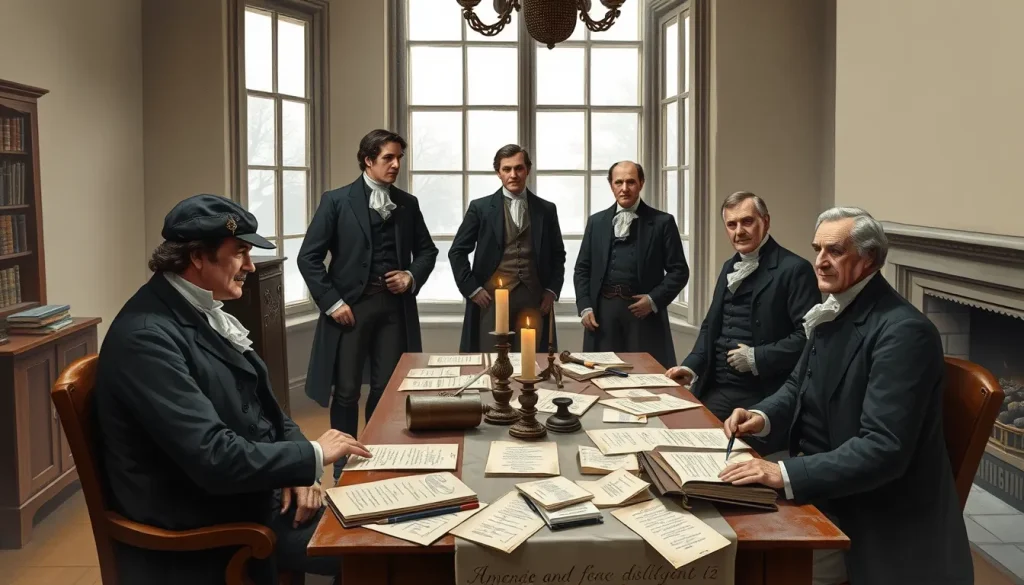
The American peace delegation at Ghent consisted of John Quincy Adams, Henry Clay, Albert Gallatin, James A. Bayard, and Jonathan Russell, who lived in the Flemish city of Ghent from late June until Christmas Eve 1814. Their task was to negotiate an end to the War of 1812 with Britain, and their daily life combined formal conferences, long stretches of waiting for news and instructions from across the Atlantic, shared lodgings, and an active social and cultural routine in a neutral European city. Because the treaty they signed on December 24, 1814, ended the war without resolving most of the issues that had caused it, the texture of the delegation’s ordinary days is a useful window into how early American diplomacy actually worked.
Historical Context
The negotiations grew out of a war that had reached a stalemate by 1814. The United States had declared war in June 1812 over maritime grievances — above all the Royal Navy’s impressment of American sailors — and over British support for Indigenous resistance to American expansion in the Old Northwest. Britain’s war with Napoleonic France long limited its ability to concentrate force in North America, but the defeat and abdication of Napoleon in the spring of 1814 freed seasoned British troops and ships for service across the Atlantic.
Earlier mediation efforts had failed. Tsar Alexander I of Russia offered to mediate, and Madison’s administration accepted, but the British government declined on the grounds that the conflict was in part an internal dispute within the empire. Britain then proposed direct negotiations instead. After an initial plan to meet at Gothenburg, Sweden, the site was shifted to Ghent, in the Austrian Netherlands and later part of the Kingdom of the United Netherlands and, after 1830, of Belgium.
Ghent was a practical choice: a neutral, accessible canal city with a large prewar trade in textiles, a French-speaking elite, and an established habit of hosting foreigners. Its population was roughly in the tens of thousands, and the American commissioners found a city of churches, art collections, theaters, and coffee houses — a setting quite different from the frontier and seaboard communities most of them represented in Congress.

What Happened
Adams and Russell arrived first, reaching Ghent from Antwerp on June 24, 1814 (some sources give June 23) and taking rooms at the Hôtel des Pays-Bas on the Place d’Armes. Bayard arrived within days, Clay followed, and Gallatin came on from Paris, where he had been serving as a peace commissioner abroad; by early July all five Americans were in the city. When it became clear the talks would be prolonged, the delegation moved out of the hotel into the Lovendeghem house, in the center of Ghent.
The British commissioners — Admiral Lord Gambier, Henry Goulburn, and William Adams — arrived in August. The first formal conference appears to have taken place on August 8, 1814, though some accounts give August 9. The British opened with demands the Americans rejected out of hand: continuation of the military occupation of territory already seized (uti possidetis), a permanent Indigenous buffer territory in the American interior, and control of the Great Lakes. For weeks the negotiations stalled.
The diplomatic picture shifted with news from America. The American naval and military success at Plattsburgh in September 1814 and the failure of the British attack on Baltimore the same month weakened Britain’s bargaining position, and the collapse of the British ministry’s more ambitious war aims removed the demand for a buffer territory. Through October and November the commissioners waited on dispatches that took weeks each way across the Atlantic. In December the two delegations converged on a settlement restoring prewar boundaries and saying nothing about impressment or neutral rights. The Treaty of Ghent was signed on December 24, 1814.
Why It Matters
Daily life at Ghent mattered because the delegation had no resident ambassador, no secure telegraph, and no instant communication with Washington. The commissioners’ ability to work together, endure delay, and manage personal friction under diplomatic pressure directly affected how the United States handled its strongest adversary. Contemporaries recognized the treaty as an honorable escape from a costly and unpopular war; later historians have debated whether it settled anything at all, given that it addressed none of the declared causes of the conflict. The treaty did establish a working framework for Anglo-American negotiation that contributed to later agreements, including the Rush–Bagot arrangement of 1817 limiting naval forces on the Great Lakes.
Definition
“Daily life” here means the ordinary routines of the American commissioners between June and December 1814: where they lodged, how they organized their working days and social hours, how they communicated with Washington and with each other, and how they passed long intervals when nothing could be decided. It is a question about practice rather than policy — the conditions under which diplomacy was performed rather than the terms it produced.
Background
The five commissioners reached Ghent by indirect routes. Gallatin and Bayard had sailed for St. Petersburg in 1813 for the Russian mediation that Britain rejected, spent months in Russia, and then traveled through Berlin and Amsterdam; Gallatin remained in Europe and crossed from Paris. Adams had been minister to Russia since 1809. Clay and Russell sailed from the United States to join a commission that had already been reorganized. They therefore arrived not as colleagues who knew each other well but as political rivals with different regional and partisan constituencies: Adams a Massachusetts Republican, Clay a Kentucky war hawk, Bayard a Delaware Federalist, Gallatin a Pennsylvania Republican of Swiss birth, and Russell a Rhode Island Republican. Christopher Hughes served as secretary to the commission, handling copying and much of the routine correspondence.
How It Worked
The commissioners’ working day revolved around internal meetings among themselves and periodic formal conferences with the British. Adams, the nominal head of the mission, kept a detailed diary that records his habits: early rising, reading, long walks through the city and surrounding countryside, attendance at church services, and careful notes on weather, sermons, and conversations. He read Scripture, studied languages, and toured churches, art collections, and civic buildings; other commissioners were drawn to the theater and to dinners in local society.
The delegates lived as a common household, sharing costs, meals, servants, and a table at which both business and quarrels occurred. Clay’s tastes for cards, conversation, and evening amusement contrasted sharply with Adams’s austerity, and their disagreements were sometimes as much about manners as about policy. Bayard, in chronically poor health, was frequently confined and homesick; Gallatin, the eldest in political experience and the most practiced European traveler, worked as the mission’s conciliator, drafting language and smoothing disputes between Clay’s Western priorities and Adams’s insistence on principle. Russell, the least prominent commissioner, handled supporting duties.
Communication structured everything. Letters to Secretary of State James Monroe were drafted, copied, and sent by packet or neutral vessel; replies took many weeks. News of military events in North America arrived in the same slow way. Between dispatches, the commissioners read European newspapers, entertained visitors, corresponded with their families, and negotiated the terms of their own expenses and allowances, a subject that recurs in their letters.
Social contact with the British delegation was limited but not absent, and the Americans were visible in Ghent’s civic and cultural life. Later descriptions of the five as entirely isolated “lonely Americans” simplify a stay that included theater, dining, worship, excursions, and local friendships.
Competing Viewpoints
Interpretations of the delegation’s life fall into two broad camps. One tradition, prominent in early twentieth-century popular accounts, emphasizes isolation, division, and hardship: five quarrelsome men far from home, waiting out a European winter in uncomfortable lodgings while their country’s fate was decided elsewhere. The other stresses adaptation and sociability, noting that the commissioners moved in Ghent’s intellectual and cultural circles, kept up correspondence and reading, and functioned as a coherent, if argumentative, team in the face of British pressure.
Historians also disagree about the significance of the internal divisions. Some read the Adams–Clay friction as a genuine threat to American bargaining power; others argue that the commissioners consistently presented a united front to the British, with Gallatin’s mediating role doing most of the work. These disagreements partly reflect the sources: Adams’s diary is extraordinarily detailed but self-justifying, while the other commissioners left fewer personal records.
Role in the War of 1812
The delegation’s daily routine was part of the war’s conduct, not a pause from it. Because the American government could not quickly change instructions, the commissioners had wide discretion within the limits set by Madison and Monroe. Their habits of meeting daily, of drafting and redrafting position papers, and of comparing intelligence from North America allowed them to adjust their stance as British fortunes shifted after Plattsburgh and Baltimore. Their willingness to remain in Ghent through the autumn, rather than breaking off talks, kept a diplomatic channel open when a renewal of the war seemed possible. On the British side, the commissioners were similarly bound by slow communications with London, and the timing of the final settlement in December owed much to how quickly dispatches and decisions could travel.
Consequences and Historical Interpretation
What the commissioners’ daily life produced was a treaty that restored the prewar status quo, said nothing about impressment, and deferred boundary questions to later commissions. Contemporaries in the United States generally welcomed it; the news reached America in February 1815 and the Senate ratified it on February 17. Later historians have read the Ghent experience as an early lesson in the institutional demands of American diplomacy — the need for instructions that anticipate delay, for delegations that balance regional interests, and for personal discipline in prolonged negotiation. The delegation’s months in Ghent are also a reminder that early American foreign policy was conducted by men living ordinary, improvised lives abroad rather than by a professional diplomatic service.
Primary Sources
The richest contemporary source is John Quincy Adams’s diary, later published as the Memoirs of John Quincy Adams (1874–1877), which records his daily routine, reading, worship, walks, and conversations in minute detail. It is indispensable but also self-justifying and written with an eye to posterity. The commissioners’ official dispatches to Secretary of State James Monroe, held in United States government records, show what the delegation wanted Washington to know; like all diplomatic correspondence, they are shaped by political calculation.
Private letters, including Adams’s letters to his wife Louisa Catherine Adams and the correspondence of Gallatin, Clay, and Bayard, fill in social detail and personal feeling, though they survive unevenly and often reflect the writer’s mood rather than the whole commission’s experience. British sources — the dispatches of Gambier, Goulburn, and William Adams to London — are essential for the negotiation but reveal comparatively little about day-to-day life in Ghent. The treaty text itself, the Treaty of Peace and Amity signed December 24, 1814, is the formal record of what the months of work produced. This article paraphrases these sources rather than quoting them; readers should consult the published editions and archival collections for verbatim text.
Further Reading
- Adams, John Quincy. Memoirs of John Quincy Adams, Comprising Portions of His Diary from 1795 to 1848. Edited by Charles Francis Adams. 12 vols. Philadelphia: J. B. Lippincott, 1874–1877.
- Perkins, Bradford. Castlereagh and Adams: England and the United States, 1812–1823. Berkeley: University of California Press, 1964.
- Hickey, Donald R. The War of 1812: A Forgotten Conflict. Urbana: University of Illinois Press, 1989.
- Engelman, Fred L. “The Peace of Christmas Eve.” American Heritage 12, no. 1 (December 1960).
- May, Henry F. “American Ghosts in Ghent.” The Atlantic, July 1962.
- Adams Papers, Massachusetts Historical Society; John Quincy Adams Papers, Library of Congress.
References
- Engelman, Fred L. “The Peace of Christmas Eve.” American Heritage 12, no. 1 (December 1960). https://www.americanheritage.com/peace-christmas-eve
- May, Henry F. “American Ghosts in Ghent.” The Atlantic, July 1962. https://www.theatlantic.com/magazine/archive/1962/07/american-ghosts-in-ghent/658452/
- Thomas, Emory M., and Randall Fegley. “Treaty of Ghent.” EBSCO Research Starters, 2023. https://www.ebsco.com/research-starters/history/treaty-ghent/
- Randall, Willard Sterne. “A Clumsy War, A Lasting Peace: The Treaty of Ghent.” HistoryNet, February 3, 2017. https://historynet.com/clumsy-war-lasting-peace-treaty-ghent/
- Hill, Frederick Trevor. “Adventures in American Diplomacy: III. The Treaty of Ghent.” The Atlantic, August 1914. https://www.theatlantic.com/magazine/archive/1914/08/adventures-in-american-diplomacy-iii-the-treaty-of-ghent/645461/
- Adams, John Quincy. Memoirs of John Quincy Adams, Comprising Portions of His Diary from 1795 to 1848. Edited by Charles Francis Adams. Philadelphia: J. B. Lippincott, 1874–1877.
- Perkins, Bradford. Castlereagh and Adams: England and the United States, 1812–1823. Berkeley: University of California Press, 1964.
- Hickey, Donald R. The War of 1812: A Forgotten Conflict. Urbana: University of Illinois Press, 1989.
- Treaty of Peace and Amity between His Britannic Majesty and the United States of America, signed at Ghent, December 24, 1814.
FAQ
Where did the American commissioners stay in Ghent?
Adams and Russell first took rooms at the Hôtel des Pays-Bas on the Place d'Armes, and the delegation later moved into the Lovendeghem house in the center of the city when it became clear the negotiations would last for months.
How long were the American commissioners in Ghent?
Adams and Russell arrived in late June 1814, the remaining commissioners joined them by early July, and the delegation remained until the Treaty of Ghent was signed on December 24, 1814 — roughly six months.
How did the commissioners spend their time between conferences?
They held internal meetings, drafted and copied dispatches, read European newspapers, and waited weeks at a time for replies from Washington. In between they walked, attended church and the theater, entertained and dined, and corresponded with their families.
Did the American commissioners get along with each other?
Not always. Adams's austerity and Clay's sociability clashed, and Bayard's poor health and homesickness added strain. Albert Gallatin generally acted as mediator, and the delegation nevertheless presented a united front to the British.


Leave a Reply