
Short Answer
The War of 1812 (1812–1815) pitted the United States against Great Britain, and Congress had to devise ways to pay for the conflict without a strong financial infrastructure. Lacking a national bank, a formal income tax, and with customs revenue collapsing, Congress relied on treasury notes, loans from private and state sources, and eventually direct taxes. These measures proved insufficient, leading to a fiscal crisis that influenced the war’s outcome and postwar financial reform.
Historical Context
Before the war, the U.S. federal government derived approximately 90% of its revenue from customs duties on imports, with additional funds from public land sales. However, the war disrupted trade, causing customs revenue to plummet and severely reducing the government’s income. The charter of the Bank of the United States had been allowed to expire in 1811, eliminating a central institution for credit and monetary management. Consequently, when war began in June 1812, the country had no established mechanism to finance a large-scale conflict. Treasury Secretary Albert Gallatin, who had reduced the federal debt from over $85 million in 1804 to $45 million in 1812, faced the challenge of funding a war while adhering to Jeffersonian principles of limited government and opposition to public debt.
What Happened
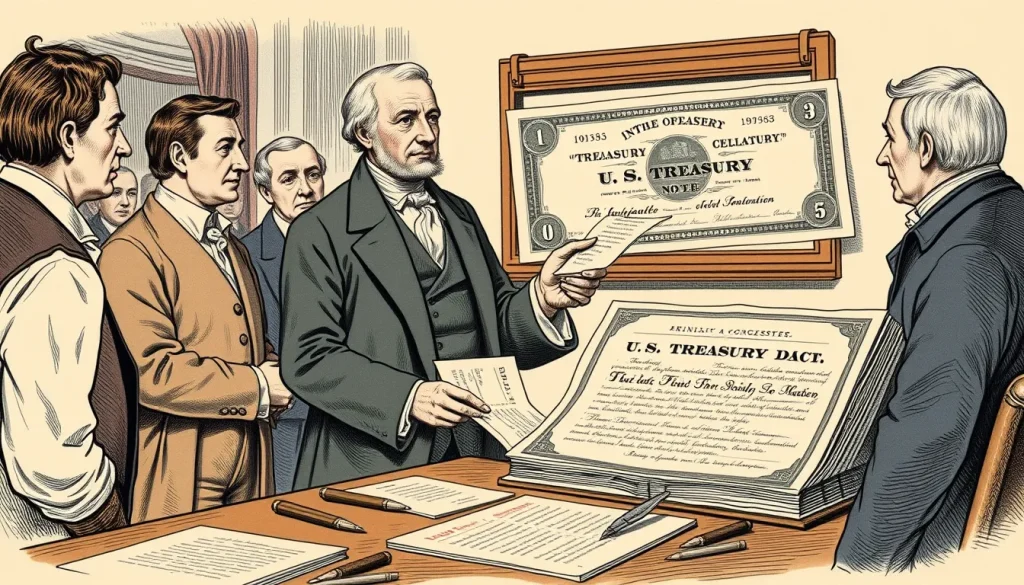
Congress took several steps to fund the war. On June 30, 1812, Congress authorized the first issue of treasury notes, a form of short-term paper currency that could be used to pay taxes and debts to the government. These notes were issued in denominations that allowed for circulation and were redeemable in specie. Throughout 1812 and 1813, Congress authorized additional treasury note issues and also sought loans from state banks and wealthy individuals. In July 1813, Congress passed a series of direct taxes on land and property, as well as taxes on transactions and products including auction sales, carriages, liquor distilleries, retail wine licenses, and refined sugar. These internal taxes marked a departure from the federal government’s previous reliance on customs duties. By spring 1814, Congress had authorized President James Madison to borrow $32.5 million to sustain the war effort, but the investment climate for U.S. Treasury bonds had become bleak. The government’s inability to borrow money hampered its ability to fund the defense of Washington, which was burned by British forces in August 1814.
Why It Matters
The financing of the War of 1812 exposed the weaknesses of the early American fiscal system. The government’s struggle to raise funds contributed to military setbacks and near-bankruptcy. The financial distress during the war prompted a reevaluation of federal taxation and banking policies, leading to the creation of the Second Bank of the United States in 1816 and a more structured internal revenue system. Historians argue that the war’s financial lessons shaped the nation’s approach to public credit and taxation for decades. The conflict also demonstrated the importance of a sound financial infrastructure for national security and economic stability.
Definition
Financing a war involves raising revenue through taxation, borrowing, issuing currency, or drawing on reserves. For the U.S. government in 1812, this meant choosing among limited constitutional options: tariffs (customs duties), excise taxes, direct taxes, loans, and paper money (treasury notes). The federal government had not used direct taxes since 1798, and the expiration of the Bank of the United States limited its credit options.
Background
Under Treasury Secretary Albert Gallatin, the U.S. had reduced its national debt and built a reputation for fiscal prudence. However, the war came at a time when customs revenue—the primary income source—declined sharply due to the British blockade. Gallatin, who was a central figure in financial planning, held an optimistic view that the nation could finance the war through loans and temporary measures, but the lack of a national bank and limited public confidence made borrowing expensive. Jeffersonian Republicans, who dominated Congress, were hostile to standing taxes and a large standing army, but the war forced them to reconsider. The plan to conquer Canada quickly, as Jefferson famously suggested, seemed to eliminate the need for long-term financial preparation, a miscalculation that proved costly.
How It Worked
Congress combined several methods. Treasury notes, first authorized on June 30, 1812, were short-term interest-bearing notes that could be used for payments to the government and were effectively a form of paper currency. These notes were issued in amounts that could be bought by individuals and banks, providing immediate funds. Loans were arranged through state banks and wealthy citizens, who subscribed to government bond issues. For example, in 1813, a group of financiers including John Jacob Astor and Stephen Girard helped underwrite a loan. Direct taxes, passed in 1813, imposed levies on land, improvements, and specific items like carriages and liquor distilleries, broadening the revenue base beyond tariffs. However, the enforcement of these taxes was cumbersome, and many states objected to federal taxation. The government also issued bonds and bills of credit, but as the war dragged on, public credit deteriorated, forcing higher interest rates on loans and eventually leading to a near-default by 1814.
Competing Viewpoints
Historians and contemporaries differed over the best way to finance the war. Gallatin advocated for a mix of loans and temporary taxes, but he resigned as Treasury Secretary in early 1813, partly due to Senate opposition to his confirmation as envoy to Russia. His successor, George W. Campbell, and later Alexander J. Dallas, faced increasing difficulties. Jefferson and other southern Republicans argued for a limited federal role and reliance on short-term loans, while Federalists and some northern representatives favored a national bank and more permanent internal taxes. The debate also included concerns about paper money; many feared that over-issuing treasury notes would lead to inflation and economic instability, a fear that materialized as the value of notes declined. The lack of a national bank meant that the government had to depend on state-chartered banks, which often issued their own banknotes, further complicating monetary conditions.
Role in the War of 1812
Financial constraints directly affected military operations. The government struggled to pay for troops, supplies, and equipment, and many soldiers served without adequate pay or provisions. At times, the U.S. Navy and army faced shortages that hindered campaigns, such as the invasion of Canada. The inability to borrow sufficient funds in 1814 contributed to the decision to defend Washington with inadequate forces, leading to the burning of the capital. The blockade by the Royal Navy effectively cut off customs revenue and further reduced trade, strangling the economy and reducing the tax base. The near-collapse of public credit in 1814 underscored the need for a more stable financial system, and discussions about a national bank gained momentum.
Consequences and Historical Interpretation
The war ended in 1815 with the Treaty of Ghent, leaving the U.S. with a substantial debt. Congress paid off arrears and restructured the debt, and in 1816, it chartered the Second Bank of the United States, which helped stabilize the currency and credit. The experience also led to increased use of internal taxes, though the direct taxes were repealed after the war. Historians like Lisa R. Morales argue that the war forced the U.S. to confront the necessity of a cohesive financial system, and that the financial innovations and failures of the period were foundational to American economic growth. The war exposed the limits of Jeffersonian agrarianism and contributed to the acceptance of a national bank and a more active fiscal role for the federal government. In the long term, the financing of the War of 1812 set precedents for federal taxation and borrowing that would be applied in later conflicts.
Primary Sources
Key primary sources include the Annals of Congress for debates on tax and loan bills, Treasury reports from Secretaries Gallatin and Dallas, and the text of the June 30, 1812 Treasury Note Act. The White House Historical Association provides an image of a U.S. Treasury note from the first issue. A notable document is the Letter from the Chairman of the Committee of Ways and Means to the Secretary of the Treasury (October 1814), which outlines the financial crisis and proposals for revival. This letter, along with Dallas’s response, provides insight into the government’s fiscal predicament. However, these sources reflect official perspectives and may omit the economic hardships faced by ordinary citizens or the political motives behind certain policies.
Further Reading
- Morales, Lisa R. The Financial History of the War of 1812. PhD diss., University of North Texas, 2009. Available online.
- White House Historical Association, “Funding the War of 1812,” at whitehousehistory.org.
- Hungerford, Thomas L. U.S. Federal Government Revenues: 1790 to the Present. Washington, DC: Congressional Research Service, 2006.
- Stagg, J.C.A. Mr. Madison’s War: Politics, Diplomacy, and Warfare in the Early American Republic, 1783–1830. Princeton University Press, 1983.
References
- White House Historical Association. “Funding the War of 1812.” Accessed via whitehousehistory.org.
- Morales, Lisa R. “The Financial History of the War of 1812.” PhD diss., University of North Texas, 2009.
- United States Congress. Annals of Congress (12th–13th Congresses).
- Committee of Ways and Means to the Secretary of the Treasury, October 18, 1814, Brock University Digital Repository.
- Hungerford, Thomas L. “U.S. Federal Government Revenues: 1790 to the Present.” Congressional Research Service, 2006.
FAQ
How did Congress initially raise money for the War of 1812?
Congress authorized the issuance of treasury notes on June 30, 1812, and also arranged loans from state banks and wealthy individuals. These measures provided immediate funds but were insufficient for long-term needs.
What were treasury notes and how were they used?
Treasury notes were short-term, interest-bearing IOUs issued by the U.S. Treasury. They could be used to pay taxes and were traded as currency. The first issue was authorized in June 1812, and subsequent issues followed.
Why did the government face difficulty borrowing during the war?
The expiration of the Bank of the United States, declining customs revenue due to the blockade, and concerns about the war's outcome eroded investor confidence, making bond sales difficult and costly by 1814.
What direct taxes did Congress impose?
In July 1813, Congress enacted direct taxes on land and property, along with taxes on auction sales, carriages, liquor distilleries, retail wine licenses, and refined sugar. These were the first federal direct taxes since 1798.



Leave a Reply