
Short Answer
During the early American republic, newspapers were explicitly partisan organs, with Federalist and Democratic-Republican papers advancing their respective parties’ political agendas. The War of 1812 intensified these divisions, as Federalist and Republican editors offered starkly different portrayals of the conflict’s causes, progress, and consequences. This article examines how reporting differed between these two press camps, focusing on their content, tone, and relationship to political power.
Historical Context
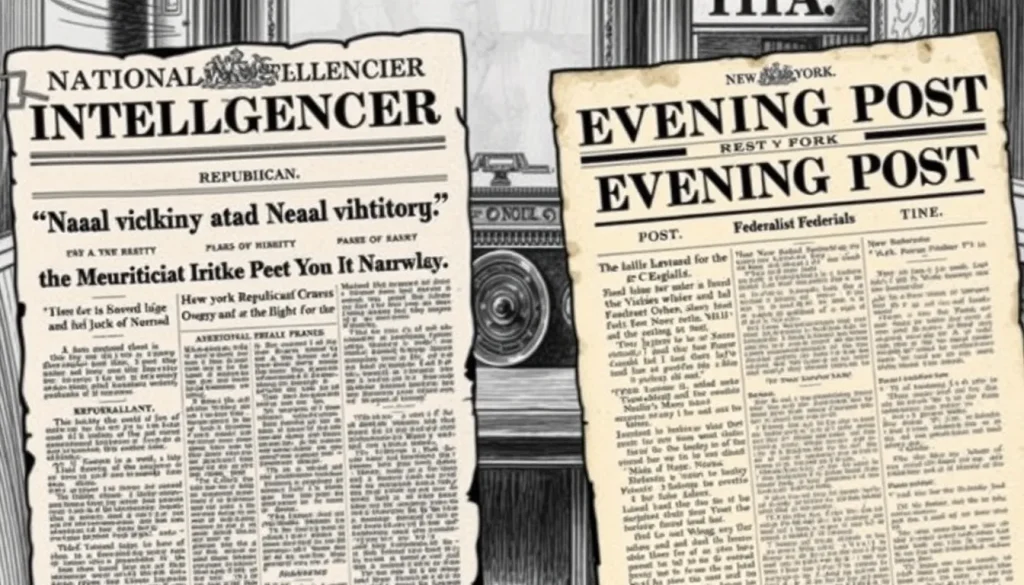
The First Party System emerged in the 1790s, creating a strong link between politics and the press. Federalists, led by Alexander Hamilton, favored a strong central government, commercial interests, and closer ties to Britain. Democratic-Republicans, led by Thomas Jefferson and James Madison, championed states’ rights, agrarian interests, and a stricter reading of the Constitution. Each party sponsored newspapers to sway public opinion and rally supporters. Notably, Philip Freneau’s National Gazette (1791–1793) countered the Federalist Gazette of the United States. By 1800, partisan papers were well established: Federalist papers thrived in New England, while Democratic-Republican papers dominated the South and West. In Washington, D.C., the National Intelligencer, founded by Samuel Harrison Smith with Jefferson’s encouragement, became the official voice of the Democratic-Republican party, while Hamilton encouraged William Coleman to start the New-York Evening Post in 1801 to counter it. These papers did not aim for objectivity; they existed to broadcast party views.
What Happened
Throughout the 1790s and into the 1800s, Federalist and Democratic-Republican newspapers engaged in heated rhetorical warfare. Their pages contained editorials, pseudonymous essays, and reprinted political speeches, often filled with personal attacks and accusations of treachery. During the War of 1812, these patterns continued but with added urgency. Federalist papers, such as the New-York Evening Post and Columbian Centinel, generally opposed the war as ruinous to commerce and favorable to Napoleon. They criticized President Madison and Democratic-Republican war policies, sometimes calling for peace and even discussing secession in New England. Democratic-Republican papers, notably the National Intelligencer and the Aurora, supported the war as a defense of American sovereignty and maritime rights. They framed the conflict as a Second War of Independence against British impressment and interference. These papers reported military battles and naval engagements, but each side selected and shaped details to support its narrative. For example, Federalist papers emphasized American defeats and the cost of the conflict, while Republican papers highlighted victories and moral triumphs. The newspapers also differed in their use of language: Federalist editors often employed satirical, elitist tones, while Republican editors sometimes adopted a more populist and strident style. Despite these differences, both sides used the same techniques: anonymous essays, ad hominem attacks, and selective reporting to bolster their partisan positions.
Why It Matters
The partisan press played a crucial role in shaping public opinion and political identity during the War of 1812. Federalist papers, by opposing the war, helped galvanize opposition in New England and contributed to the Hartford Convention of 1814. Democratic-Republican papers, meanwhile, rallied support for the war and helped sustain morale. This press war also influenced how the war was remembered: Republican papers helped craft the narrative of a successful “Second War of Independence,” while Federalist papers left a record of dissent and criticism. Historians have long debated the quality and impact of this partisan journalism. Some early scholars dismissed the era as a “dark age” of scurrility, but recent research, such as that by William David Sloan and Catherine O’Donnell Kaplan, argues that the press was more sophisticated and influential than previously recognized. The newspapers of this period set a precedent for the idea that a free press could serve as a partisan advocate, and they laid groundwork for the later development of more objective journalism.

Definition
Federalist newspapers were publications that aligned themselves with the Federalist Party, which favored a strong centralized government, mercantile interests, and a close relationship with Great Britain. Democratic-Republican newspapers were organs of the Democratic-Republican Party, which advocated states’ rights, agrarianism, and a more limited federal government, often sympathetic to France. Both types of papers were typically funded by party supporters, subscriptions, and government printing contracts. They operated as mouthpieces for party leaders and editors, often publishing essays and polemics rather than balanced news.
Background
The origins of the partisan press lie in the political struggles of the 1790s. When Alexander Hamilton’s financial program and foreign policy provoked opposition, Jefferson and Madison encouraged journalists like Philip Freneau to start a paper to counter the Federalist Gazette of the United States. This reciprocal pattern continued: each party established newspapers to promote its views. By 1800, the press was deeply enmeshed with party politics, with papers often receiving subsidies from politicians or government patronage. The National Intelligencer and the New-York Evening Post became leading examples of this partisan journalism. These papers were not “news” in the modern sense; they were vehicles for political argument, electioneering, and the defense of party doctrine.
How It Worked
Partisan newspapers operated by selecting and presenting information that favored their party. Editors reprinted speeches by their party’s leaders, published letters from pseudonymous correspondents, and attacked opponents with invective. They had small circulations, often a few hundred to a few thousand, but papers were passed hand-to-hand and read aloud in taverns and public gathering places. Editors were often political insiders or hired writers; for example, William Coleman, a former lawyer, edited the New-York Evening Post with Hamilton’s guidance. The newspapers also relied on exchanges—they reprinted articles from other papers, spreading party rhetoric across the nation. In terms of content, they covered political events, military news, and international affairs, but with a strong partisan bias. They did not separate news from opinion; the two were intertwined. Government printing contracts, particularly the lucrative job of printing congressional proceedings, provided financial support, and parties often awarded these contracts to friendly papers.
Competing Viewpoints
Federalist and Democratic-Republican papers diverged fundamentally in their worldview. Federalists saw the War of 1812 as a disastrous mistake, engineered by Democratic-Republicans to benefit France and Napoleon. They argued that the war would destroy American commerce, lead to invasion, and possibly dissolve the Union. Their papers emphasized the military unpreparedness, the burning of Washington, and the human and financial costs. Democratic-Republican papers countered that the war was forced on the United States by British impressment, seizure of American ships, and support of Indigenous attacks. They portrayed the war as a defense of republican liberty and national honor. These competing viewpoints also reflected broader differences in the parties’ constituencies: Federalists drew support from New England merchants and financiers, while Democratic-Republicans were stronger in the South and West, among farmers and planters. The press amplified these differences, often with vituperative language. For example, the Federalist Columbian Centinel might describe Madison as a “tyrant,” while the National Intelligencer would label Federalists as “traitors” and “British tools.”
Role in the War of 1812
During the War of 1812, the partisan press played a direct role in the conflict. Federalist papers often printed leaked or exaggerated reports of American defeats, which in turn could depress recruiting and morale. They also published criticism of military leadership and war financing, which contributed to the perception that the war was unpopular in New England. Democratic-Republican papers responded with patriotic appeals and censorship of negative reports when possible. For instance, Secretary of War John Armstrong was known to suppress unfavorable news. Both sides engaged in propaganda: Republican papers celebrated naval victories like those of USS Constitution (“Old Ironsides”), while Federalist papers sometimes downplayed such triumphs or attributed them to luck. The press also influenced diplomatic negotiations; the National Intelligencer kept up a drumbeat for peace terms that protected American rights, while Federalist papers pressed for an immediate end to hostilities. After the war’s conclusion with the Treaty of Ghent, the partisan press again diverged: Democratic-Republican papers hailed the peace as a victory, while Federalist papers pointed to the failure to address impressment, calling the treaty a “stain” on national honor.
Consequences and Historical Interpretation
The differences between Federalist and Democratic-Republican newspapers had lasting consequences. The bitter partisanship of the press contributed to the decline of the Federalist Party after the war—their opposition to the popular war appeared unpatriotic to many. Historians have also noted that the press of this era established a tradition of political advocacy that would continue into the Jacksonian period. However, the excesses of partisanship also led to a reaction; by the 1830s, a more commercial and less partisan press began to emerge. Historical interpretation has evolved. Early historians dismissed these papers as “scurrilous” and “dark ages” of journalism. More recently, scholars like William David Sloan and Jeffrey Pasley have argued that the partisan press was essential to the formation of the American party system and provided a model for political communication. Catherine O’Donnell Kaplan’s work highlights that Federalist papers were not merely reactive but were innovative in using literary and cultural means to build political community. The differing reporting styles thus both reflected and shaped the political divisions of the War of 1812 era, and they remain a rich source for understanding early American politics and media.
Primary Sources
Key primary sources include the newspapers themselves: the National Intelligencer (Washington, D.C.), the New-York Evening Post (New York), the Columbian Centinel (Boston), the Aurora (Philadelphia), and the Federal Republican (Baltimore). These papers contain editorials, letters, and news reports that illustrate their partisan stances. Also valuable are the writings of editors and politicians, such as Philip Freneau’s essays in the National Gazette and William Coleman’s editorials in the Evening Post. Personal correspondence, such as Jefferson’s letters about the press, and memoirs of editors like Frederic Hudson’s Journalism in the United States (1873) provide additional insight. However, these sources must be used with caution because they are themselves partisan and often anonymous; readers must weigh the biases inherent in each document. Nonetheless, they are indispensable for understanding the differences in reporting between Federalist and Democratic-Republican papers.
Further Reading
- Jeffrey L. Pasley, “The Tyranny of Printers”: Newspaper Politics in the Early American Republic (University Press of Virginia, 2001).
- William David Sloan, “Examining the ‘Dark Ages’ Concept: The Federalist-Republican Press as a Model,” Journal of Communication Inquiry 7, no. 2 (1982).
- Frank Luther Mott, American Journalism: A History of Newspapers in the United States Through 260 Years, 1690 to 1950 (Macmillan, 1941).
- Catherine O’Donnell Kaplan, “Was the Federalist Press Staid and Apolitical?” Commonplace (online).
- David Paul Nord, “Newspapers and American Nationhood, 1776–1826,” Proceedings of the American Antiquarian Society 101 (1991).
References
- OERTX, “U.S. History, Growing Pains: The New Republic, 1790–1820, Competing Visions: Federalists and Democratic-Republicans,” accessed 2023, https://oertx.highered.texas.gov/courseware/lesson/1298/student/?section=5.
- National Park Service, “Newspapers in the time of Lewis and Clark,” accessed 2023, https://www.nps.gov/articles/000/newspapers-in-the-time-of-lewis-and-clark.htm.
- William David Sloan, “Examining the ‘Dark Ages’ Concept: The Federalist-Republican Press as a Model,” Journal of Communication Inquiry 7, no. 2 (1982).
- Catherine O’Donnell Kaplan, “Was the Federalist Press Staid and Apolitical?” Commonplace, 2015, https://commonplace.online/article/was-the-federalist-press-staid-and-apolitical/.
- David Paul Nord, “Newspapers and American Nationhood, 1776–1826,” Proceedings of the American Antiquarian Society 101 (1991).
FAQ
Did Federalist and Democratic-Republican newspapers present different accounts of the same battle?
Yes, they often highlighted different outcomes or spins. For example, Federalist papers might emphasize losses while Republican papers focused on tactical successes or strategic justifications.
How did the newspapers fund themselves?
They relied on subscriptions, party subsidies, and government printing contracts. Many editors had direct political connections and received financial support from party leaders.
Why did Federalist papers oppose the War of 1812?
Federalists believed the war would harm trade, benefit Napoleon, and lead to national ruin. They argued that impressment was not worth war and that negotiation was preferable.



Leave a Reply