
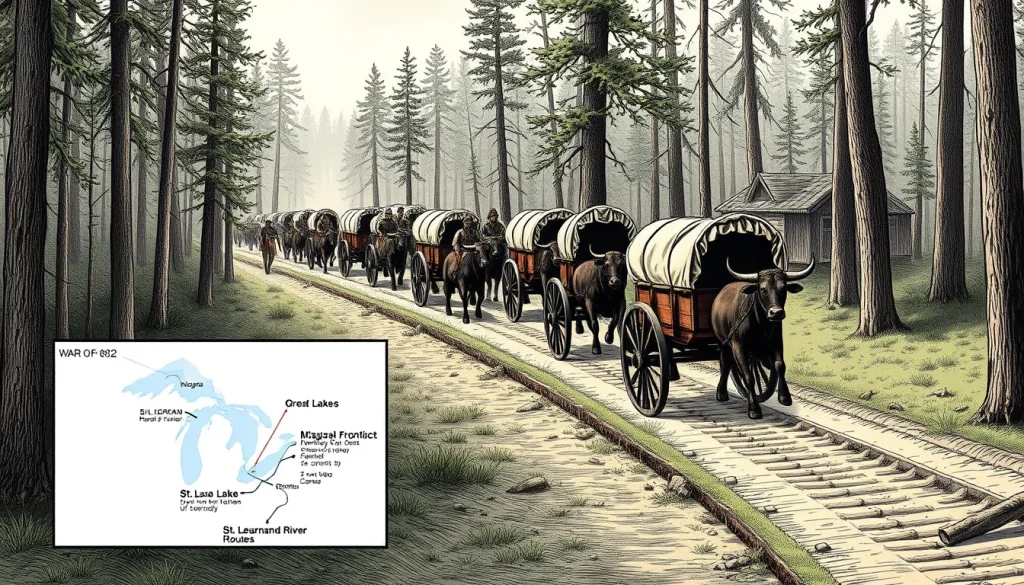
Short Answer
The American invasion of Canada during the War of 1812 (1812–1815) was a series of campaigns aimed at capturing British North American territories. Despite numerical superiority and initial strategic advantages, the United States failed to conquer Canada. Logistical breakdowns—shortages of food, munitions, and transportation—played a central role in this failure, as armies were unable to sustain themselves in the wilderness and frontier regions. This article examines how logistical limitations shaped the outcome of the northern campaigns.
Historical Context
The United States declared war on Britain in June 1812 over impressment, trade restrictions, and British support for Indigenous nations. The most viable American offensive was to invade Canada, hoping to cut off British supply lines and force concessions. However, the northern frontier was a vast, thinly populated region with poor roads, dense forests, and rugged terrain. The Great Lakes and St. Lawrence River provided waterways, but they were often hazardous and controlled by naval forces. The American population was concentrated on the eastern seaboard, while the frontier settlements were sparse. Both sides relied on long, fragile supply lines. The British had to ship virtually everything from the United Kingdom, while Americans had to move supplies from eastern depots across the Appalachians and through the Mohawk Valley to the Great Lakes. The Allegheny Mountains formed a significant barrier, and the few roads that existed were often impassable in wet seasons. These geographic realities made the movement of troops and supplies a central challenge of the war.
What Happened
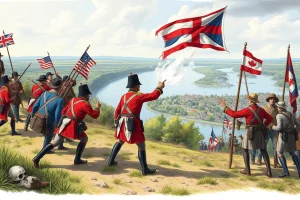
In 1812, American General William Hull’s invasion from Detroit failed due to supply shortages and fears of Indigenous attacks. His army lacked food and munitions, and he retreated to Michigan territory, eventually surrendering without a major battle. Other attacks along the Niagara frontier and toward Montreal also stalled. In 1813, American forces captured York (Toronto) and Fort George, but failed to consolidate gains and were repulsed at Stoney Creek. The attack on Montreal in late 1813 was called off when the army under General Wade Hampton failed to advance due to lacking supplies. In 1814, the Americans built a more effective force, but the campaign on the Niagara frontier ended with the Battle of Lundy’s Lane and the subsequent withdrawal of the American army. The U.S. Navy’s efforts to gain control of the Great Lakes were also hampered by shortages of shipwrights, guns, and naval stores. Throughout the war, American armies repeatedly outran their supply lines, lacked sufficient blankets, clothing, and food, and were forced to rely on local farmers or abandon positions. The British, though often better supplied, still faced severe difficulties, especially in the upper province, where a limited agricultural base and transportation problems plagued their forces.
Why It Matters
The immediate effect was that the United States failed to achieve its primary war aim—the conquest of Canada—and the border remained essentially unchanged. The long-term consequences included the creation of a distinct Canadian identity and the demonstration that military success depended on effective logistics. Historians have increasingly emphasized that logistical failures were as important as tactical defeats. The war exposed the weaknesses of the American supply system and led to post-war reforms, including the establishment of a permanent quartermaster department and the construction of military roads. For Britain, the defense of Canada became a symbol of British imperial resilience. The role of logistics in this outcome has been a subject of ongoing scholarly debate.
Definition
In military terms, logistics refers to the planning, delivery, and maintenance of forces—including food, ammunition, clothing, medical supplies, transportation, and infrastructure. During the War of 1812, logistics involved moving men and equipment over vast distances from supply depots to front lines. The term was not in common use at the time; instead, contemporaries spoke of supply, commissariat, or quartermaster services. Effective logistics were essential for any army to operate far from its bases.
Background
Both the United States and Britain entered the war with underdeveloped administrative systems for supply. The U.S. Army relied on a small quartermaster department and a system of contracts with civilian suppliers. The British had a more experienced Commissariat, but faced the challenge of operating in a distant colony. Geography dictated supply routes: American supplies came from the East Coast, moved up the Hudson River to Albany, then overland to Lake Ontario or Lake Erie. The Mohawk River had locks that could handle small boats, but portages were difficult. British supplies arrived from Great Britain to Montreal by ship, were transshipped to boats navigating the St. Lawrence rapids, and then to lake vessels. Both sides faced shortages of wagons, horses, and oxen. Roads were primitive, often just tracks, and in spring they were impassable due to mud.
How It Worked
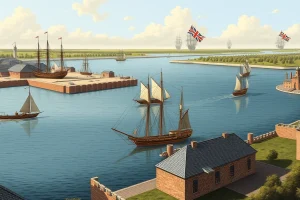
In practice, supply systems were fragile. American forces at Detroit and Niagara relied on convoys that could be delayed by weather, enemy raids, and the poor state of roads. Wagons frequently broke down, and pack animals died from overwork. The British, for their part, used the Corps of Voyageurs to navigate the St. Lawrence rapids, but even this experienced body could not guarantee timely delivery. The British also requisitioned supplies from local Canadian farmers, which often bred resentment. Both sides used Indigenous allies to some extent, but that also added to supply demands. Naval operations on the Great Lakes were critical: control of the lakes allowed the movement of troops and supplies, and both sides rushed to build warships. Shipbuilders had to import materials—British guns and rigging from the UK, American timber and iron from New York and Pennsylvania—creating another layer of logistical complexity.
Competing Viewpoints
Historians have debated the relative importance of logistics versus leadership, strategy, or naval power. Some argue that American military leadership and tactical errors were more decisive than supply problems. For instance, the failure of General Henry Dearborn’s 1812 campaign has been attributed to his cautiousness rather than to lack of supplies. Others maintain that logistics was the “limiting factor” that determined the course of the war, arguing that even competent commanders could not overcome the physical impossibility of moving an army across the frontier. There is also debate over whether the Americans could have conquered Canada with better logistics, given the strength of British naval forces and the loyalty of many Canadians. Some scholars point to British logistical deficiencies as well, noting that the British were often only able to sustain their forces through heavy expenditures and the use of military law to force supplies from civilians. The competing interpretations reflect different methodologies and priorities among historians.
Role in the War of 1812
Logistics were central to nearly every campaign. Hull’s invasion of Detroit in 1812 was compromised by insufficient supplies and the fear of being cut off. The 1813 attacks on Montreal and the Niagara frontier stalled as armies ran out of food and ammunition. The 1814 campaigns saw better logistics but still faced critical shortages. The burning of Washington in August 1814 was partly a consequence of a lack of adequate defense and supply, and the subsequent British advance on Baltimore was halted more by fortifications and naval guns than by American supply superiority. On the Great Lakes, the American naval victory on Lake Erie in 1813 was possible only because the fleet had been built with materials shipped from the east over difficult portages. The failure to sustain offensive operations consistently allowed the British to retain a defensive posture and eventually launch counteroffensives.
Consequences and Historical Interpretation
The consequences of the logistical failure were profound. The United States did not annex any territory, and the Treaty of Ghent in 1814 restored the pre-war status quo. The war highlighted the need for a professional quartermaster corps and for an improved transportation infrastructure, which inspired reforms in the U.S. Army after 1815. Historians have come to see logistics as a central factor in the war’s outcome. Donald Graves, in a review of Christopher Dishman’s book, noted that the logistics theme is often neglected in American historiography, but that the northern theater was where the war was won or lost. The role of logistics also underscores the importance of effective administration and planning in military operations.
Primary Sources
Contemporary primary sources include the official reports and correspondence of American commanders such as General William Hull and General Henry Dearborn, who repeatedly complained of shortages in their dispatches. The papers of Secretary of War John Armstrong and Commissary-General Callender Irvine document the struggles to supply the armies. On the British side, the records of the Commissariat in the Public Record Office (now The National Archives, UK) show the difficulties of provisioning troops in Upper Canada. The published collection The Documentary History of the Campaign upon the Niagara Frontier (1914) contains many relevant letters and orders. Also important is the public attitude reflected in Thomas Jefferson’s oft-quoted letter of August 4, 1812, where he dismissed the logistical challenge, claiming that the acquisition of Canada would be “a mere matter of marching.” Such statements illustrate the overconfidence that compounded the logistical failures.
Further Reading
- Dishman, Christopher D. Warfare and Logistics along the US-Canadian Border during the War of 1812. Lawrence: University Press of Kansas, 2021.
- Steppler, Glenn A. “A Duty Troublesome Beyond Measure: Logistical Considerations in the Canadian War of 1812.” MA thesis, McGill University, 1974.
- Beugoms, Jean-Pierre. “The Logistics of the United States Army, 1812–1821.” PhD diss., Temple University, 2018.
- Graves, Donald E. Review of Warfare and Logistics along the US-Canadian Border in Pennsylvania History 91, no. 1 (2024): 82–86.
References
- Dishman, Christopher D. Warfare and Logistics along the US-Canadian Border during the War of 1812. Lawrence: University Press of Kansas, 2021.
- Steppler, Glenn A. “A Duty Troublesome Beyond Measure: Logistical Considerations in the Canadian War of 1812.” MA thesis, McGill University, 1974.
- Beugoms, Jean-Pierre. “The Logistics of the United States Army, 1812–1821.” PhD diss., Temple University, 2018.
- Graves, Donald E. “Warfare and Logistics Along the US-Canadian Border during the War of 1812,” Pennsylvania History 91, no. 1 (2024): 82–86. doi:10.5325/pennhistory.91.1.0082.
FAQ
Why did the Americans fail to conquer Canada?
The primary reason was logistical failure. Armies could not be adequately supplied because roads were poor, distances were vast, and the transportation infrastructure was underdeveloped. This led to shortages of food, ammunition, and other essentials, weakening offensive operations.
How did geography affect logistics?
The Allegheny Mountains, the Great Lakes, and the St. Lawrence River created a challenging environment. American supplies had to cross the mountains and then traverse primitive roads or waterways with limited capacity. The British faced the obstacle of the St. Lawrence rapids and a harsh winter that froze the river, cutting off supplies for months.
What were the main supply problems for both sides?
For the United States, problems included a weak quartermaster system, lack of wagons and horses, and the difficulty of moving heavy artillery. For the British, the main problems were the long shipping distance from Britain, the short navigation season, and limited local agricultural resources in Upper Canada, which forced them to request supplies from civilians.

Leave a Reply