Short Answer
The War of 1812 (1812–1815) was one of the first major conflicts in which newspapers played a central role in shaping public opinion and documenting events as they unfolded. This research guide explains how historians and genealogists can use contemporary newspapers from the United States, Britain, and Canada as primary sources, and it highlights the major collections, digitized databases, and archival repositories available to researchers.
Historical Context
In the early 19th century, newspapers were the primary mass medium, but they were far from neutral. Most papers were explicitly partisan, often aligned with either the Federalist or Democratic-Republican Party. They were typically published weekly, and their content relied on letters from correspondents, reprinted articles from other papers, official documents, and occasionally firsthand reports. The War of 1812 coincided with a period of intense political division in the United States over the war itself, and newspapers reflected the fierce debate. British and Canadian papers, meanwhile, reported the war from a different perspective, often with a focus on imperial and colonial interests. Because newspapers were often the fastest way to spread news of battles, declarations, and treaty negotiations, they became crucial to both contemporaries and modern researchers.
What Happened
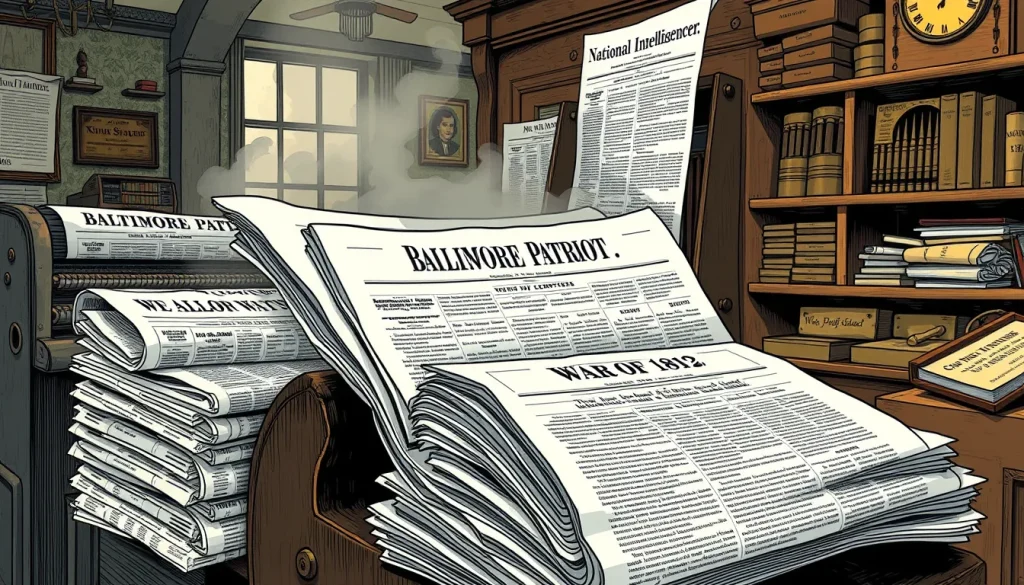
During the war, hundreds of newspapers were published across the United States, British North America (now Canada), and Britain. The Library of Congress’s “War of 1812: A Resource Guide” lists key subscription databases, including “America’s Historical Newspapers,” which provides cover-to-cover digitized reproductions of newspapers from 1690 to 1876, including many from the war years. The Readex collection specifically dedicated to the War of 1812 includes dozens of titles, such as the Albany Argus, Alexandria Gazette, Baltimore Patriot, and the Daily National Intelligencer, with hundreds of issues each. These papers carried news of American victories and defeats, British naval operations, Indigenous alliances, and political debates. They also served as vehicles for official proclamations and military reports. In the Chesapeake theater, papers like the Federal Gazette and American and Commercial Daily Advertiser covered the British raids and the attack on Baltimore. In Canada, newspapers such as the Kingston Gazette and the Montreal Herald reported on the war from a British colonial perspective. Because of the difficulty of verifying information and the speed of communication, newspapers often contained errors, rumors, and propaganda, which researchers must critically evaluate.
Why It Matters
For historians, War of 1812 newspapers are indispensable primary sources. They provide contemporaneous accounts of battles, political events, social conditions, and public sentiment. They also reveal the biases and perspectives of distinct communities—American, British, Canadian, and Indigenous—though Indigenous perspectives were rarely directly represented. Newspapers document the experience of civilians, the role of privateers, the impact of blockades, and the debates over the war’s legitimacy. They also show how the war was marketed to a domestic audience. Without these records, our understanding of the war’s social and cultural dimensions would be severely limited. Moreover, the digitization of these newspapers has made them accessible to a global community of researchers, democratizing historical inquiry.
Definition
War of 1812 newspapers are the periodicals published between 1812 and 1815 in the various regions affected by the conflict. They include daily, semi-weekly, and weekly publications, ranging from major city dailies to small frontier sheets. For research purposes, they are considered primary sources because they were produced contemporaneously, offering a snapshot of events as they were perceived at the time.
Background
The early 19th century was a golden age of print in the United States, with newspapers proliferating as literacy spread and political participation expanded. Most papers were funded by political parties or wealthy individuals, and editors were often prominent partisan figures. The technology of printing had not changed radically since Gutenberg, but the growth of the postal system allowed for wider distribution. In Britain, newspapers were more established but heavily taxed, limiting their audience. In British North America, small colonial papers served local communities. The War of 1812 was one of the first conflicts to be extensively covered in the American press, partly because of the intense partisan debate over the decision to go to war.
How It Worked
Newspaper editors gathered information from a variety of sources: correspondents in the field, letters from military officers, official dispatches, and stories reprinted from other papers. Because there were no news agencies, much content was copied from other publications, leading to the rapid spread of unverified claims. Speed was crucial; papers often printed “extras” when major news arrived. Distribution relied on postal routes, and the U.S. Post Office offered favorable rates for newspapers. This made it possible for news to reach rural areas within days or weeks. The physical format was typically four pages, with the first page devoted to political essays and the last to advertisements. The war news often appeared on the second or third page, sometimes with a “naval” or “army” column.
Competing Viewpoints
American newspapers were sharply divided along partisan lines. Federalist papers, such as the Boston Columbian Centinel and the New York Evening Post, often criticized the war as ruinous and unjust. Democratic-Republican papers, like the National Intelligencer and the Baltimore Patriot, supported the administration and often reported American victories with enthusiastic language. British and Canadian papers presented an imperial perspective, emphasizing British naval successes and the defense of Canada. Some papers attempted to be independent, but most had clear editorial stances. These competing viewpoints make it necessary for researchers to consult multiple papers to understand events from different angles.
Role in the War of 1812
Newspapers played a dual role during the war: they reported events and they helped shape them. The declaration of war itself was announced through newspapers, and they carried President Madison’s war message. They published official reports of battles, such as the U.S. Navy’s victories on the Great Lakes, which were celebrated in pro-administration papers. Newspapers also served as propaganda tools, exaggerating enemy threats and encouraging enlistment. Some papers were suppressed or mobbed for their opposition to the war; for example, the Federal Republican in Baltimore was attacked by a mob in 1812 because of its anti-war stance. In Canada, newspapers helped maintain morale among the colonial population and reported on British victories, such as the capture of Fort Detroit. For Indigenous nations, newspapers rarely gave voice to their perspectives, though some accounts of battles included Indigenous actions.
Consequences and Historical Interpretation
After the war, the newspapers remained as enduring records. In the 19th and 20th centuries, historians mined them for factual details, but also recognized their biases. Modern scholarship uses them to study public opinion, political culture, and the social history of the war. The digitization of newspapers beginning in the late 20th century has revolutionized access. Databases like “America’s Historical Newspapers” and the Library of Congress’s “Chronicling America” (which includes some war-era papers) allow full-text searching across thousands of titles. However, researchers must be aware of the limitations: not all newspapers have been digitized, and OCR (optical character recognition) errors can affect searches. Additionally, missing issues and the fragility of original papers mean that some content may be lost. Despite these challenges, newspapers remain a core source for understanding the War of 1812 from multiple perspectives.
Primary Sources
The most relevant primary sources are the newspapers themselves. Key repositories include the Library of Congress, which holds extensive original issues and offers access to subscription databases such as America’s Historical Newspapers from Readex. The Maryland State Archives and the Maryland Center for History and Culture in Baltimore have substantial collections, including the Federal Gazette, the American and Commercial Daily Advertiser, and the Baltimore Patriot, among others. The Readex “War of 1812, 1812-1815” collection provides a systematic compilation of over 100 newspaper titles from across the United States. The Baltimore City Archives also lists newspapers available on microfilm and in original. Researchers can also consult the list at the Brock University Library guide for periodicals from the era. When using these sources, it is important to note the publication date, the political affiliation of the paper, and the author of any signed article. Limitations include partisan bias, errors, and missing issues.
Further Reading
- Library of Congress, “War of 1812: A Resource Guide” – https://guides.loc.gov/war-of-1812
- Readex, “War of 1812, 1812-1815” – https://www.readex.com/titlelists/war-1812-1812-1815
- Maryland Center for History and Culture, “Guide to the War of 1812 Sources” – https://www.mdhistory.org/wp-content/uploads/2023/10/GuideToWarOf1812Resources_2020.pdf
- Baltimore City Archives, “War of 1812 in Baltimore” – https://msa.maryland.gov/bca/war-of-1812-in-baltimore/
- Brock University Library, “War of 1812: 1812 Era Periodicals” – http://researchguides.library.brocku.ca/c.php?g=99809&p=646608
References
- Library of Congress. “Subscription Databases – War of 1812: A Resource Guide.” Accessed via https://guides.loc.gov/war-of-1812/subscription-databases.
- Readex. “War of 1812, 1812-1815.” Accessed via https://www.readex.com/titlelists/war-1812-1812-1815.
- Maryland Center for History and Culture. “Guide to the War of 1812 Sources.” Accessed via https://www.mdhistory.org/wp-content/uploads/2023/10/GuideToWarOf1812Resources_2020.pdf.
- Baltimore City Archives. “War of 1812 in Baltimore.” Accessed via https://msa.maryland.gov/bca/war-of-1812-in-baltimore/.
- Brock University Library. “War of 1812: 1812 Era Periodicals.” Accessed via http://researchguides.library.brocku.ca/c.php?g=99809&p=646608.
FAQ
How can I access War of 1812 newspapers online?
Many digitized newspapers are available through subscription databases like America's Historical Newspapers (via Readex) and free resources like the Library of Congress's Chronicling America. Some state archives, such as the Maryland State Archives, also provide online access to specific titles.
What are the best databases for historical newspapers?
Key databases include America's Historical Newspapers, American Periodicals, and the Readex War of 1812 collection. The Library of Congress lists these and other subscription resources in its War of 1812 guide.
Why are newspapers considered valuable primary sources for the War of 1812?
Newspapers provide contemporary accounts of events, public opinion, political debates, and daily life during the war. They are essential for understanding how the conflict was perceived and reported as it happened.


Leave a Reply