
Short Answer
Propaganda during the War of 1812 (1812–1815) encompassed the deliberate use of newspapers, political cartoons, proclamations, and rumor to influence public opinion and morale on both sides of the conflict. In the United States, partisan newspapers fiercely debated President James Madison’s war policy, while in Upper Canada, colonial authorities employed propaganda to sustain loyalty among settlers and Indigenous allies. This wartime propaganda shaped political discourse, military recruitment, and the historical memory of the war, and it played a significant role in the evolution of a free press in America.
Historical Context
The War of 1812 emerged from long-standing tensions between the United States and Great Britain, including impressment of American sailors, trade restrictions, and British support for Indigenous resistance on the American frontier. By 1812, the United States had developed a vibrant partisan press, with Federalist and Republican newspapers often serving as organs of political factions. The Sedition Act of 1798 had raised questions about the limits of free speech, but it had expired by 1801. During the war, President Madison faced intense opposition from Federalists, particularly in New England, who condemned the conflict as “Madison’s War.” In Upper Canada (now southern Ontario), the colonial government—led by Lieutenant Governor Francis Gore and later by Sir Isaac Brock—saw propaganda as a vital tool to bind a diverse population of former Americans, British settlers, and Indigenous nations to the Crown against American invasion. Geographic isolation and limited literacy meant that newspapers, handbills, and word-of-mouth played critical roles in spreading messages.
What Happened
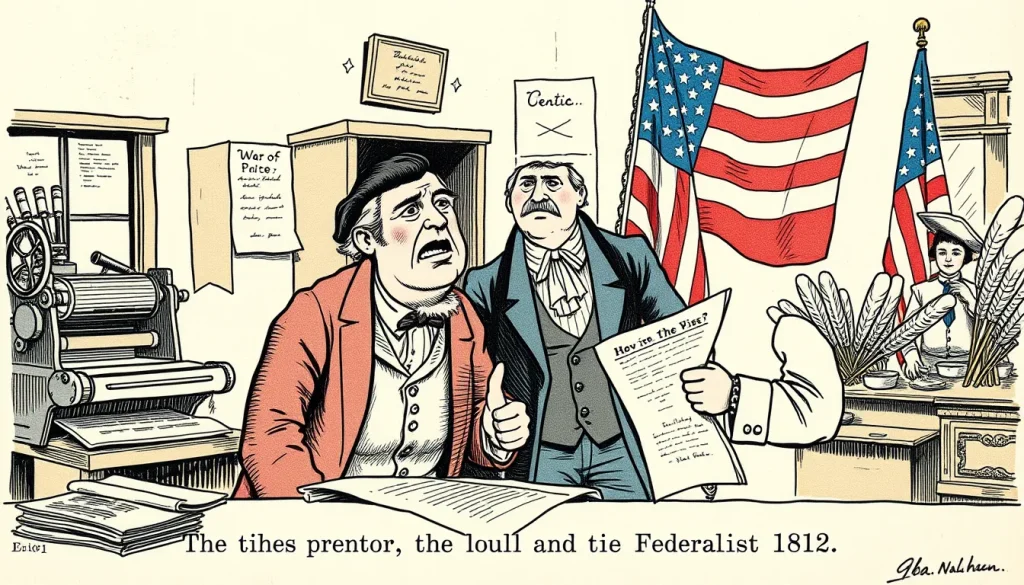
Propaganda took several forms during the war. In the United States, Federalist newspapers such as the Boston Gazette and the Connecticut Mirror attacked Madison’s administration with harsh rhetoric, accusing him of deception, incompetence, and even warmongering. These newspapers, as scholar Juhani Rudanko notes, used “face-threatening attacks” that ranged from criticizing specific policies to personal insults against the president. Republican papers, in turn, defended the war and vilified the Federalists, often labeling them as unpatriotic or even treasonous. Political cartoonist William Charles, based in Philadelphia, produced influential satirical prints that mocked the Federalist press and rallied support for the war. One famous cartoon, “The Tory Editor and His Apes,” depicted Federalist editors advising American sailors to avoid war, while the sailors rejected the advice with patriotic fervor. Charles’s cartoons were widely reproduced and became powerful symbols of pro-war sentiment.
In Upper Canada, propaganda was more centrally directed. Historian R. Arthur Bowler describes how the colonial government used proclamations, newspaper articles, and the pulpit to promote loyalty and to depict the American invasion as an unjustified attack. The government also spread stories of American atrocities, such as the alleged British bounty on American scalps (a claim later denied by British officials), to galvanize resistance. After the American capture of Detroit in 1812, British and Canadian propaganda exaggerated British military successes to boost morale. Conversely, American propaganda celebrated early naval victories and framed the war as a defense of national honor and maritime rights. The burning of Washington, D.C., by British troops in August 1814, and reports of the British attack on Baltimore, fueled American outrage and were used to rally public support.
Propaganda also extended to the Indigenous peoples involved in the war. Both the British and Americans sought Indigenous alliances, and each side used promises, threats, and diplomatic rhetoric to secure support. British propaganda emphasized the Crown’s role as a protector of Indigenous lands, while American propaganda depicted Indigenous nations as tools of British manipulation.
Why It Matters
The propaganda of the War of 1812 had immediate and lasting consequences. Domestically, it intensified political divisions and contributed to the decline of the Federalist Party. The Hartford Convention of 1814, at which Federalist delegates debated secession, was ridiculed in Republican newspapers, and the peace treaty’s arrival undercut Federalist claims that the war was unwinnable. More broadly, the war tested the limits of free speech. President Madison, despite facing vicious personal attacks, did not retaliate with sedition prosecutions, and his restraint helped to establish a tradition of tolerating opposition during wartime. This was a pivotal moment in the development of the American free press. In Canada, propaganda helped to foster a distinct sense of identity and unity among the diverse inhabitants of British North America, contributing to the emergence of a Canadian national consciousness. For historians, propaganda offers invaluable insight into the beliefs, fears, and aspirations of people during the war, and it remains a key lens for interpreting the conflict’s causes and legacy.
Definition
Propaganda, in the context of the War of 1812, refers to the systematic dissemination of information, ideas, or rumors—often biased or misleading—intended to influence the opinions, emotions, or actions of a target audience. It included official proclamations, newspaper editorials, political cartoons, pamphlets, sermons, and even street rumors. Propaganda was used to justify war aims, demonize the enemy, maintain civilian morale, and recruit soldiers. It was distinct from straightforward news reporting in its deliberate promotion of a particular cause or perspective.
Background
The origins of propaganda in the War of 1812 lay in the partisan newspaper culture of the early American republic. By 1800, newspapers like the Philadelphia Aurora and the New York Evening Post had become fiercely partisan, often blurring the line between news and advocacy. The Sedition Act of 1798, though expired, had demonstrated both the potential for and the limits of government control over the press. When war was declared in June 1812, President Madison’s administration and its supporters used propaganda to rally national support, while Federalists used it to condemn the war. In Britain, propaganda was largely managed by the colonial administration in Canada, which had a smaller, more controlled press. The Canadian population included many recent American immigrants who were ambivalent about the war, so British propaganda aimed to persuade them of the benefits of British rule and the dangers of American conquest.
How It Worked
Propaganda operated through multiple channels. Newspapers were the primary medium, with each side using established papers to print editorials, letters, and reprints of official documents. Editors often exchanged newspapers via postal riders, spreading stories quickly across regions. Political cartoons, though less common, were highly effective because they could be understood by illiterate audiences. William Charles’s prints, for example, combined crude visual symbolism with satirical dialogue to mock the Federalist press and boost patriotic fervor. Proclamations issued by military and political leaders were printed and distributed as handbills, read aloud at public gatherings, and published in newspapers. In Upper Canada, the government also used the pulpit, with clergy urging obedience to the Crown. Rumors and invented atrocity stories circulated as propaganda, such as the claim that the British offered bounties for American scalps—a charge that British authorities eventually denied. These rumors inflamed public anger and justified war effort.
Competing Viewpoints
American propaganda generally framed the war as a defense of “free trade and sailors’ rights” against British tyranny and impressment. Republican newspapers and pro-war figures like Henry Clay and John C. Calhoun depicted the conflict as a necessary reaffirmation of American independence. In contrast, Federalist propaganda portrayed the war as “Mr. Madison’s War,” an unjustified and ruinous enterprise that benefited only French interests. Federalists warned that the war would bring economic collapse and disunion. British and Canadian propaganda, particularly in Upper Canada, emphasized loyalty to the Crown, the protection of property, and the threat of American “republican” aggression. For Indigenous peoples, propaganda from both sides played on their fears of land loss and cultural destruction, with each side presenting itself as the more reliable ally. These competing viewpoints reflect the broad political and cultural divides of the era, and they demonstrate how propaganda both shaped and mirrored public sentiment.
Role in the War of 1812
Propaganda played a significant role in the war’s conduct and outcome. It helped to recruit soldiers, as patriotic appeals and atrocity stories motivated enlistment. In the United States, Republican newspapers praised volunteers and publicized British actions, such as the burning of Washington, to rally support. In Upper Canada, British propaganda helped to maintain a semblance of unity among the population, enabling the militia to resist American invasions. Propaganda also influenced international perceptions: British propaganda, for example, depicted the American declaration of war as a stab in the back while Britain was fighting Napoleon. The American victory in naval battles was heavily publicized, boosting national morale. Conversely, propaganda contributed to political turmoil, as Federalist attacks on Madison created a climate of division that sometimes hampered war efforts. The war’s end brought a wave of propaganda celebrating American victory, even though the Treaty of Ghent largely restored pre-war conditions.
Consequences and Historical Interpretation
The aftermath of the war saw a transformation in political communication. The Federalist Party’s decline was accelerated by its opposition to a war that many Americans eventually viewed as successful. The propaganda battles of the period also advanced the principle that a free press could criticize the government even during wartime—an idea that became central to American democracy. In Canada, the war’s propaganda helped forge a distinct colonial identity, with the conflict being remembered as a triumph of loyalty and perseverance. Historians have interpreted propaganda both as a reflection of popular attitudes and as a manipulative tool used by elites to shape those attitudes. Some scholars, like R. Arthur Bowler, emphasize the effectiveness of British propaganda in Upper Canada, while others, like Juhani Rudanko, point to the restraint of the Madison administration as a key factor in the development of free speech. The legacy of this propaganda persists in the national myths of both countries, underlining its enduring impact.
Primary Sources
Primary sources on propaganda during the War of 1812 include the extensive newspaper output of the era. The Boston Gazette and the Connecticut Mirror are representative Federalist papers that printed harsh attacks on President Madison; these were analyzed by Juhani Rudanko in his study of political impoliteness. On the Republican side, the National Intelligencer in Washington, D.C., served as the administration’s mouthpiece. The political cartoons of William Charles, such as “The Tory Editor and His Apes,” are preserved in various historical societies and reprintings. In Upper Canada, proclamations issued by Governor Brock and later administrators were published in local papers like the Kingston Gazette. The most comprehensive scholarly treatment of Canadian propaganda is R. Arthur Bowler’s 1988 article “Propaganda in Upper Canada in the War of 1812,” which examines official efforts to foster loyalty. A limitation of these sources is that they were often partisan, and the distinction between fact and rhetoric is not always clear. Nonetheless, they provide direct insight into the messages distributed to the public.
Further Reading
- Bowler, R. Arthur. “Propaganda in Upper Canada in the War of 1812.” American Review of Canadian Studies 18, no. 1 (1988): 11–32.
- Rudanko, Juhani. “‘[T]his most unnecessary, unjust, and disgraceful war’: Attacks on the Madison Administration in Federalist newspapers during the War of 1812.” Journal of Historical Pragmatics 12, no. 1-2 (2011): 82–103.
- Doherty, Prudence. “Vermont and the War of 1812: Politics and Propaganda.” UVM Libraries Research Guides. 2011. https://researchguides.uvm.edu/war_1812/politics.
- “History of American Journalism,” Chapter 10. Wikisource. Accessed 2025. https://en.wikisource.org/wiki/History_of_American_Journalism/Chapter_10.
- Hickey, Donald R. The War of 1812: A Forgotten Conflict. University of Illinois Press, 1989.
References
- Bowler, R. Arthur. “Propaganda in Upper Canada in the War of 1812.” American Review of Canadian Studies 18, no. 1 (1988): 11–32. doi:10.1080/02722018809480915.
- Rudanko, Juhani. “‘[T]his most unnecessary, unjust, and disgraceful war’: Attacks on the Madison Administration in Federalist newspapers during the War of 1812.” Journal of Historical Pragmatics 12, no. 1-2 (2011): 82–103. doi:10.1075/jhp.12.1-2.04rud.
- Doherty, Prudence. “Vermont and the War of 1812: Politics and Propaganda.” UVM Libraries Research Guides. 2011. https://researchguides.uvm.edu/war_1812/politics.
- “History of American Journalism,” Chapter 10. Wikisource. Accessed 2025. https://en.wikisource.org/wiki/History_of_American_Journalism/Chapter_10.
FAQ
What were the main forms of propaganda during the War of 1812?
Propaganda took the form of newspaper editorials and articles, political cartoons (e.g., by William Charles), official proclamations, handbills, sermons, and spread rumors, such as the false claim of British bounties on American scalps.
How did propaganda affect public opinion in the United States?
Propaganda deepened the divide between Federalists, who opposed the war, and Republicans, who supported it. It motivated enlistment, fueled outrage over British actions, and contributed to the decline of the Federalist Party after the war.
What role did propaganda play in Upper Canada?
In Upper Canada, British officials used propaganda to foster loyalty among a mixed population and counter American invasion. Proclamations, newspapers, and public appeals portrayed the British as protectors and emphasized the dangers of republicanism.


Leave a Reply