
Short Answer
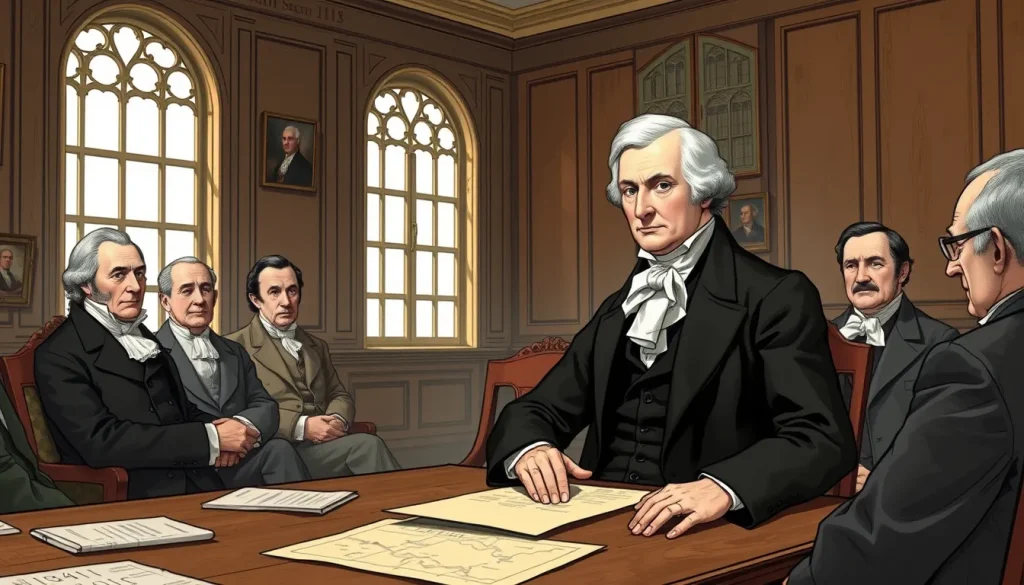
John Quincy Adams, then United States Minister to Russia, served as the senior member of the American peace commission at Ghent, where from June to December 1814 he and four colleagues negotiated the Treaty of Ghent that ended the War of 1812. Amidst a complex European diplomatic environment and sharp disagreements among his fellow commissioners, Adams’s insistence on the restoration of pre-war boundaries and his diligent record-keeping helped secure a treaty that left the United States and Britain without clear victor but with a durable peace. This article examines Adams’s role and significance in those negotiations.
Historical Context
The War of 1812 began in June 1812 over impressment, neutral rights, and territorial disputes between the United States and Britain, which was then locked in the Napoleonic Wars. By 1814, with Napoleon defeated, Britain could redirect resources to North America, raising the stakes for the United States. Both sides faced financial exhaustion and domestic pressures. The American government initially sought Russian mediation, but when that failed, direct negotiations were arranged in Ghent, in the Low Countries, neutral ground acceptable to both powers. President James Madison selected a delegation of leading political figures: John Quincy Adams, Albert Gallatin, Henry Clay, James A. Bayard, and Jonathan Russell, each with distinct backgrounds and perspectives.
What Happened
Adams arrived in Ghent in June 1814, but the British delegates, Lord Gambier, Henry Goulburn, and William Adams, did not appear until August. The American commissioners spent the interim debating instructions and drafting positions. Once talks opened, the British initially presented harsh demands—including a boundary that would give Indians a permanent barrier state in the Northwest and control of the Great Lakes—which the Americans rejected. Adams, with Gallatin’s moderation and Clay’s nationalist fervor, maintained a unified front. The negotiation dragged through the autumn, with exchanges of notes and drafts. Over time, the British, wearied by war and pressured by the Duke of Wellington’s advice against unrealistic demands, abandoned the Indian claims and agreed to return to the principle of status quo ante bellum. The treaty, signed on Christmas Eve 1814, restored all conquered territory and established commissions to settle boundary and commercial issues. The document contained no provisions on impressment, fisheries, or neutral rights—the war’s original causes—but it ended the conflict and began a lasting peace.
Why It Matters
The Treaty of Ghent, shaped significantly by Adams’s efforts, prevented the United States from losing territory and ended the war without the British recognizing American maritime rights. Adams regarded the treaty as the foundation of future Anglo-American relations, hoping it would be “the last treaty of peace between Great Britain and the United States.” The negotiations demonstrated to Americans the value of diplomatic persistence and helped elevate Adams as a national figure. Later historians see the peace as a turning point: both sides accepted the pre-war status quo, allowing the United States to pursue westward expansion without British intervention and moving British diplomacy toward a more conciliatory stance. Adams’s own meticulous diary provides an unmatched record of the negotiation process, illustrating the interplay of personalities and national interests.
Early Life
John Quincy Adams was born on July 11, 1767, in Braintree (now Quincy), Massachusetts, the eldest son of John and Abigail Adams. He accompanied his father on diplomatic missions to Europe as a teenager, earning fluency in French and Dutch. After graduating from Harvard in 1787, he studied law but found his calling in diplomacy and public service. His early career included posts as minister to the Netherlands and Prussia, and election to the U.S. Senate from Massachusetts.
Role Before the War
In 1809, President James Madison appointed Adams as the first United States Minister to Russia, where he served under Czar Alexander I. While in St. Petersburg, Adams maintained American interests amid the Napoleonic turbulence, and when the war with Britain broke out in 1812, he remained in Russia. The Czar offered to mediate the Anglo-American conflict, and Adams participated in preliminary talks in 1813, though those efforts faltered. His Russian experience positioned him as a senior diplomatic figure, and when direct negotiations were planned for 1814, Madison chose him to lead the American commission.
Role During the War
Adams’s role during the war itself was primarily diplomatic, not military. He remained in Europe, working to secure peace and protect American interests. When the Ghent commission assembled, he became the president of the American delegation, tasked with coordinating their strategy. His diary records his constant disagreements with Clay over issues like the fisheries and the Mississippi navigation, and his occasional frustration with Gallatin’s conciliatory instincts. Despite internal friction, Adams’s legal expertise and familiarity with European diplomacy allowed him to articulate and defend the American position, particularly the demand for the status quo ante.
Major Actions
At Ghent, Adams’s most significant action was his refusal to accept any British demands that would compromise American territory or sovereignty. He successfully pushed for the inclusion of an article securing restitution of slaves and other private property, though the final treaty was silent on impressment. He also worked with Gallatin to propose an article that would guarantee American fishing rights and British navigation of the Mississippi within the framework of a future negotiation, but the British ultimately dropped those clauses. Adams’s firmness on the principle of pre-war boundaries—against British proposals for a neutral Indian state—was crucial in ensuring the treaty did not cede the Northwest. He also managed the delegation’s correspondence with Washington and recorded every session in his diary, preserving an invaluable account.
Contemporary Accounts
Adams’s own diary is the primary contemporary account. It captures his impressions of colleagues: “Mr. Gallatin is for striking out any expression that may be offensive to the adverse party. Mr. Clay is displeased with figurative language which he thinks improper in State papers.” James Gallatin, son of Albert Gallatin, recalled the “everlasting bickering and matters delayed” among the American delegates, noting that Adams and Clay “object to everything except what they suggest themselves.” British delegate Henry Goulburn later remarked that the American team seemed less concerned with agreement than with posturing for domestic audiences. These accounts together show Adams as principled but sometimes inflexible, while still respecting his intellect.
Later Life
After Ghent, Adams briefly served as United States Minister to Britain from 1815 to 1817, a post he had held as his father’s son decades earlier. He went on to become Secretary of State under President James Monroe, where he authored the Monroe Doctrine, and was elected the sixth President of the United States in 1824. After his presidency, he famously served in the House of Representatives from 1831 until his death in 1848, advocating for science and expansion and opposing slavery. His later career reinforced his image as a dedicated public servant.
Historical Legacy
Historians consistently rank the Ghent mission as a key achievement in Adams’s career. The treaty’s longevity and the subsequent peaceful resolution of Anglo-American disputes validate his approach. Some scholars, however, note that Adams’s rigidity nearly scuttled the talks over issues like the fisheries, and that Gallatin’s flexibility saved the treaty. Yet Adams’s diplomatic record at Ghent helped establish him as a leading statesman, and his diary remains one of the most detailed sources for the entire War of 1812 diplomacy. His insistence on a treaty without British gains and his rejection of interference in American interests had lasting influence on American foreign policy.
Primary Sources
The most important primary source is Adams’s own diary, covering the entire negotiation from June to December 1814, published in modern editions and available online. The official treaty text is held by the U.S. National Archives and transcribed on the Senate website. Another key document is the American delegation’s report to the Secretary of State, which Adams drafted, summarizing the negotiations. Additionally, a report by Adams dated December 12, 1814, reveals specific exchanges with the British delegates on fisheries and navigation. Each source provides a different perspective: Adams’s diary is subjective but detailed; the treaty text is definitive; the report is official but self-censored. Together they allow historians to reconstruct the give-and-take of the talks.
Further Reading
- Donald R. Hickey, The War of 1812: A Forgotten Conflict (Urbana: University of Illinois Press, 1989).
- John Quincy Adams, Memoirs of John Quincy Adams, ed. Charles Francis Adams (Philadelphia: J.B. Lippincott, 1874–1877).
- Bradford Perkins, Castlereagh and Adams: England and the United States, 1812–1823 (Berkeley: University of California Press, 1964).
- Samuel Flagg Bemis, John Quincy Adams and the Foundations of American Foreign Policy (New York: Alfred A. Knopf, 1949).
- Alan Henrikson, “John Quincy Adams in Ghent: The Diplomacy of the War of 1812,” guest lecture, Adams National Historical Park, 2012.
References
- U.S. Senate, “Transcript: Treaty of Ghent,” https://www.senate.gov/about/powers-procedures/treaties/treaty-of-ghent/transcript-treaty-of-ghent.htm.
- “Guest Lecture: John Quincy Adams in Ghent: The Diplomacy of the War of 1812,” Adams National Historical Park, https://www.nps.gov/adam/planyourvisit/guest-lecture-april-2012.htm.
- John Quincy Adams, Diary entry, December 1814, John Quincy Adams Digital Diary, https://www.primarysourcecoop.org/publications/jqa/document/jqadiaries-v29-1814-12-p174–entry1.
- “Discussing the Terms of Peace,” report by John Quincy Adams, Original Sources, https://www.originalsources.com/Document.aspx?DocID=1CQRYEK1ILXQKTL.
- “Everlasting bickering and matters delayed: the American delegation and the 1814 Ghent peace negotiations,” On History, https://blog.history.ac.uk/2014/12/everlasting-bickering-and-matters-delayed-the-american-delegation-and-the-1814-ghent-peace-negotiations/.
- Alan Henrikson, “Guest Lecture: John Quincy Adams in Ghent,” 2012, as above.
- Donald R. Hickey, The War of 1812: A Forgotten Conflict (University of Illinois Press, 1989).
FAQ
What was John Quincy Adams's role at the Ghent negotiations?
Adams was the senior American plenipotentiary and led the commission. He coordinated the delegation's strategy, insisted on the status quo ante principle, and recorded the proceedings in his diary.
Why did the Treaty of Ghent not address impressment or maritime rights?
The treaty was a compromise that ended the war without settling the maritime grievances. Adams and the American delegation failed to secure British concessions on neutral rights, and the British dropped their Indian claims; both sides prioritized peace.
How did Adams's handling of the negotiations affect his career?
The successful negotiation at Ghent enhanced Adams's reputation as a diplomat, leading to his appointment as U.S. Minister to Britain, then Secretary of State, and ultimately his election as the sixth U.S. President.
Leave a Reply