
Short Answer
Laura Secord (née Ingersoll, 13 September 1775 – 17 October 1868) is a central figure in Canadian historical memory of the War of 1812. During June 1813, after American troops occupied the Niagara Peninsula, she walked from Queenston toward Beaver Dams to warn British Lieutenant James FitzGibbon of an impending American attack. The documentary record is thin and disputed, and later generations inflated her story into legend. This article separates the known facts, the evidence, and the mythology that surrounds her journey.
Historical Context
The Niagara frontier was one of the most contested regions of the War of 1812. After the American capture of Fort George on 27 May 1813, American forces occupied Queenston and much of the surrounding district. The British withdrew to positions farther inland, including a small outpost commanded by Lieutenant James FitzGibbon of the 49th Regiment. FitzGibbon used the stone house of John DeCew near present-day Thorold as his headquarters. Mohawk (Kanyen’kehà:ka) warriors from Kahnawake and other communities, together with other Indigenous allies, operated in the area and provided critical intelligence. Laura Secord, a Loyalist’s daughter-in-law, lived with her husband James Secord in occupied Queenston, where American officers were quartered in the family home.
What Happened
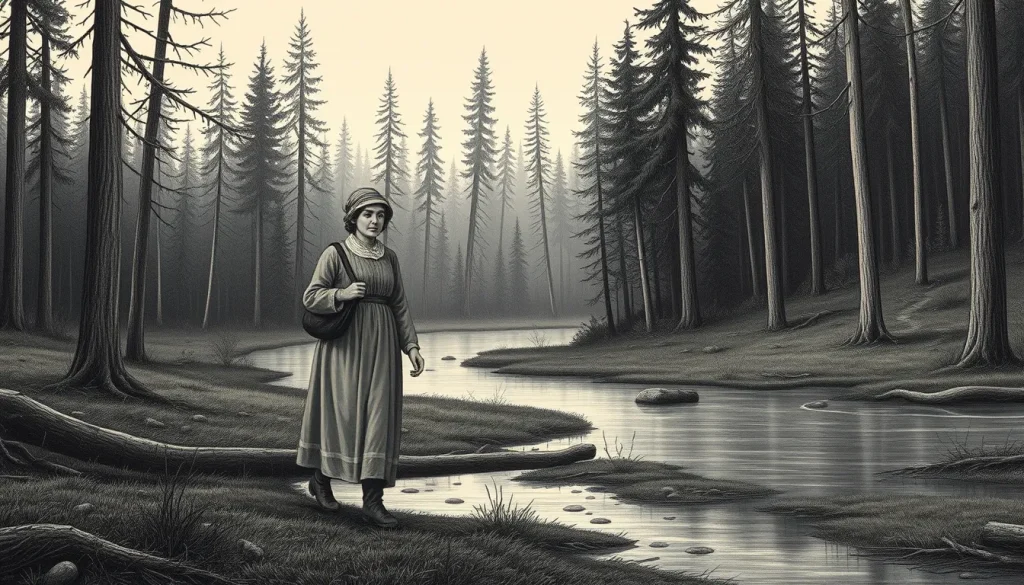
According to later testimony, Laura Secord learned of an American plan to surprise FitzGibbon’s outpost at Beaver Dams. The precise date is uncertain; it appears to have been around 21–22 June 1813. Because her husband James was still recovering from a wound suffered at the Battle of Queenston Heights the previous October, Laura decided to carry the warning herself. She left early in the morning, first walking to St. David’s, where her niece Elizabeth Secord joined her for part of the journey. They continued toward Shipman’s Corners and along the course of Twelve Mile Creek. Elizabeth eventually turned back, and Laura proceeded alone through fields and woods. She encountered a group of Indigenous men, who took her to FitzGibbon at the DeCew house. She probably arrived on 22 or 23 June.
On 24 June 1813, an American column under Colonel Charles Boerstler marched toward Beaver Dams. It was ambushed by a force of roughly 400 Indigenous warriors led by Dominion Ducharme and William Johnson Kerr. After sustained fighting, FitzGibbon arrived with a small detachment of British regulars and persuaded Boerstler to surrender his force of some 460 soldiers. The official reports of the battle did not mention Laura Secord. FitzGibbon, however, later wrote several certificates acknowledging that Secord had brought him news of the intended attack. The exact value of her information, and whether it arrived ahead of earlier intelligence from Indigenous scouts, remains a matter of historical debate.
Why It Matters
Laura Secord’s walk mattered little in 1813, at least as far as formal recognition is concerned. No official reward or pension followed in the post-war years. Her story began to be celebrated in the mid-19th century and grew dramatically after her death. By the early 20th century she had become a national heroine, used to promote patriotism, to encourage women’s participation in public causes, and even to sell chocolate. Historians have since investigated the sparse evidence and questioned the accuracy of the most colourful details. Secord’s account remains important both as a fragment of wartime civilian experience and as an example of how national myth can reshape history.
Early Life
Laura Ingersoll was born on 13 September 1775 in Great Barrington, Massachusetts, the eldest daughter of Thomas Ingersoll and Elizabeth Dewey. Her father had supported the American Patriot cause during the Revolutionary War. In the difficult post-war economy he decided to move to Upper Canada, where he had obtained a land grant. The family settled in the Niagara Peninsula in 1795; Thomas Ingersoll later ran a tavern at Queenston, and the settlement of Ingersoll, Ontario, grew from his grant. In 1797 Laura married James Secord, a Queenston merchant and the son of a Loyalist officer who had served in Butler’s Rangers during the Revolution.
Role Before the War
Laura and James Secord lived first at St. David’s and then established a home in Queenston. They had at least seven children, six daughters and one son, and James operated a store. Before the War of 1812, Laura’s life was typical of a respectable Upper Canadian housewife and mother. The community was heavily Loyalist, and the family’s ties were to the British crown. James Secord served with the 1st Lincoln Militia once war began.
Role During the War
In October 1812, James Secord was seriously wounded in the Battle of Queenston Heights. Laura went to the battlefield and is said to have brought her husband home, where she nursed him. In the spring of 1813, American forces occupied the Niagara frontier. British troops had withdrawn, and FitzGibbon’s detachment remained a target. American officers were billeted in the Secord home, and it was from their conversation that Laura reportedly learned of the planned attack on Beaver Dams.
Major Actions
Secord’s major recorded action was her journey from Queenston to the DeCew house in late June 1813. She walked through occupied territory, avoiding American patrols, crossing streams and swampy ground, and eventually meeting Indigenous warriors who escorted her to FitzGibbon. Her contribution is sometimes seen as saving FitzGibbon’s outpost, but the battle’s outcome depended heavily on the Indigenous ambush. Secord carried no message in writing, and no official record from the day of the battle credits her. The warning may have strengthened FitzGibbon’s readiness, but Indigenous scouts had already reported the American advance.
Contemporary Accounts
The earliest documentary mention of Laura Secord’s walk is in a 1820 petition from her husband James to the Lieutenant Governor of Upper Canada, asking for land. FitzGibbon provided a certificate confirming that Laura had come to Beaver Dams in June 1813 with information of an intended American attack. FitzGibbon wrote two later certificates, in 1827 and 1837, the latter from memory and without a precise date. In the 1827 certificate, he specified that Secord came “on the 22d day of June 1813.” No personal diary, letter, or journal by Laura Secord survives. The later certificates were written in support of petitions for financial assistance, so they must be read with an awareness that both Secord and FitzGibbon had an interest in presenting her action favourably.
Later Life
After the war, the Secords faced poverty. James received a small pension for his wound and eventually obtained appointed offices, including registrar of the Niagara Surrogate Court and later judge. He died in 1841, leaving Laura without a regular income. She ran a small school for a time. It was not until 1860, when the Prince of Wales visited Canada, that Laura Secord received any significant public recognition. She prepared a memorial describing her wartime service, and after his return to England the Prince sent her £100. She died on 17 October 1868 and is buried in Drummond Hill Cemetery.
Historical Legacy
Laura Secord’s story was transformed into a patriotic legend in the decades after her death. Tales arose that she had taken a cow with her for cover, or milked it in front of American sentries, or walked in her bare feet. None of these appear in her own accounts. In 1913 the Laura Secord Candy Shops adopted her name, cementing her status in Canadian popular culture. Monuments were erected at Lundy’s Lane in 1901 and on Queenston Heights in 1910. Historians such as W. Stewart Wallace argued in 1932 that she may have arrived too late for her information to be decisive, but later research and FitzGibbon’s 1827 certificate have complicated that view. Today Secord is widely regarded as a heroine, even while the precise details of her walk remain uncertain.
Primary Sources
The key primary sources are FitzGibbon’s three certificates of 1820, 1827, and 1837, and James Secord’s petitions to the provincial government. Each document must be interpreted in context: they were written to support applications for land, pensions, or appointments. FitzGibbon’s 1820 certificate stated that Laura “did in the Month of June, 1813, come to the Beaver dam and communicate to me information of an intended attack.” His 1827 certificate adds the date of 22 June. The 1837 certificate is less specific. There is also a later written account by Laura Secord herself, but it was produced around 1860 and contains errors and exaggerations. No contemporary diary or official report corroborates her walk. The official battle reports mention only the Indigenous ambush and FitzGibbon’s surrender negotiations.
Further Reading
- W. Stewart Wallace, The Story of Laura Secord: A Study in Historical Evidence (Toronto: Macmillan, 1932).
- Colin M. Coates and Cecilia Morgan, Heroines & History: Representations of Madeleine de Verchères and Laura Secord (Toronto: University of Toronto Press, 2002).
- Pierre Berton, The Invasion of Canada 1812–1813 (Toronto: McClelland and Stewart, 1980).
- Laura Neilson Bonikowsky, “Laura Secord,” The Canadian Encyclopedia, revised 24 June 2024.
- “Ingersoll, Laura (Secord),” Dictionary of Canadian Biography, vol. 9.
References
- Laura Neilson Bonikowsky, “Laura Secord,” The Canadian Encyclopedia, https://thecanadianencyclopedia.ca/index.php/en/article/laura-secord.
- “Ingersoll, Laura (Secord),” Dictionary of Canadian Biography, https://www.biographi.ca/en/bio/ingersoll_laura_9E.html.
- “Laura Secord,” U.S. National Park Service, https://www.nps.gov/people/laura-secord.htm.
- Alun Hughes, “Following in Laura’s Footsteps,” https://doczz.net/doc/5105121/following-in-laura-s-footsteps.
- Sandra Martin, “Creating the Cult of Laura Secord,” Friends of Fort York, https://www.fortyorkfoundation.ca/newsletter/creating-the-cult-of-laura-secord/.
FAQ
Did Laura Secord actually make the walk?
Yes, evidence from FitzGibbon's certificates and Secord's own petitions indicates she travelled from Queenston to the DeCew house, but exact details and effectiveness are debated.
Why is there controversy about Laura Secord's story?
No contemporary official report mentions her, and her account comes from later certificates and petitions. Later embellishments, such as the cow, were invented.
Did Laura Secord use a cow during her walk?
No. There is no evidence she took a cow; the story appears to have been invented by writer William F. Coffin in 1864.

Leave a Reply