
Short Answer
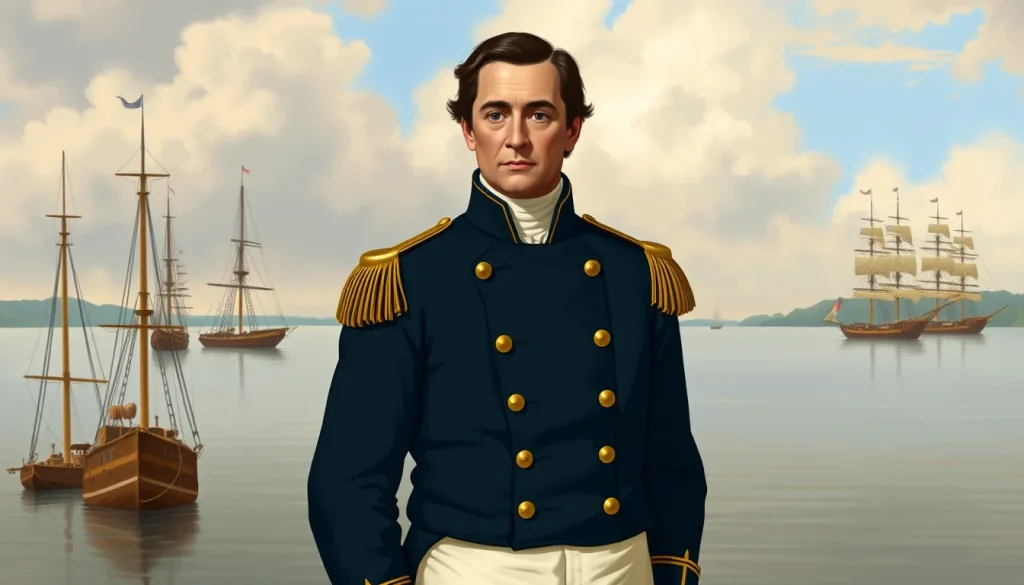
Thomas Macdonough (December 31, 1783 – November 10, 1825) was a United States Navy officer whose most notable achievement was the command of American naval forces on Lake Champlain during the War of 1812. His victory over a British squadron at the Battle of Lake Champlain, fought near Plattsburgh, New York, on September 11, 1814, prevented a British invasion of New York and Vermont, solidifying his reputation as a skillful naval tactician.
Historical Context
The War of 1812 saw the United States and Great Britain clash over maritime rights, impressment, and British support for Indigenous resistance along the American frontier. By 1814, with the fall of Napoleon in Europe, Britain reinforced its forces in North America and planned offensives against key American positions. The Lake Champlain valley was strategically vital because it offered a direct water route from Canada into the heart of New York State. Control of the lake would allow the British to supply an invading army and cut New England off from the rest of the republic. Both sides raced to build naval squadrons on these inland waters.
What Happened
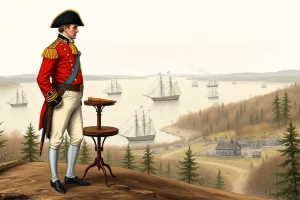
Macdonough was appointed to command the American naval force on Lake Champlain in October 1812. Over the next two years, he supervised the construction and outfitting of a small fleet at Whitehall and Otter Creek, using shipbuilding timber from local forests. By the summer of 1814, his squadron consisted of the flagship Saratoga, the corvette Eagle, the sloops Ticonderoga and Preble, and several gunboats. The British, under Captain George Downie, had built a more powerful squadron, including the frigate Confiance. On September 11, 1814, the two fleets met in Plattsburgh Bay. Macdonough anchored his ships in a carefully planned defensive line that forced the British to engage on his terms. During the battle, he used the anchor windlass to turn his ship around, bringing fresh guns to bear—a tactical innovation that helped turn the tide. The British flagship Confiance was disabled and struck its colors, and the British squadron was defeated. The British invasion army, watching from shore, retreated to Canada.
Why It Matters
The American victory at Lake Champlain had immediate and long-term significance. Militarily, it ended the British offensive in the northeastern United States and forced a retreat that weakened British negotiating posture. The victory likely contributed to the favorable terms for the United States in the Treaty of Ghent, which ended the war in December 1814. Macdonough’s tactics were studied by naval officers for decades. His decisive action prevented the possible loss of northern states and cemented his legacy as a key wartime hero.
Early Life
Thomas Macdonough was born in New Castle County, Delaware, to Thomas McDonough, a physician and Revolutionary War veteran, and Mary Vance McDonough. Orphaned at age twelve, he worked as a store clerk before obtaining a midshipman’s warrant in 1800. He served aboard the frigate Ganges during the Quasi-War with France. His family surname later was spelled Macdonough, and he adopted that form.
Role Before the War
Macdonough was commissioned a midshipman in 1800 and saw active service in the Barbary Wars. In 1804 he volunteered for the daring mission led by Stephen Decatur to destroy the captured U.S. frigate Philadelphia in Tripoli harbor, a successful covert operation. He was promoted to lieutenant in 1807 and later commanded gunboat flotillas along the Connecticut coast. In 1810 he made a merchant voyage and then returned to gunboat duty in New England.
Role During the War
In October 1812, the Navy Department ordered Macdonough to take command of naval forces on Lake Champlain. He spent much of the war building and equipping a fleet, often overcoming shortages of shipwrights, supplies, and crew. He established a shipyard at Vergennes, Vermont, and maintained a forward base at Plattsburgh. His leadership ensured that the American squadron was ready to confront the British when they advanced south in September 1814.
Major Actions
Macdonough commanded the American squadron at the Battle of Lake Champlain on September 11, 1814. His flagship, the Saratoga, engaged the British flagship Confiance. When the Saratoga was heavily damaged and unable to fire broadsides, Macdonough ordered the crew to pivot the ship using hawsers attached to anchors, presenting his unworn guns to the enemy. This maneuver enabled the Americans to outlast the British. The British flagship struck its flag after suffering heavy casualties, and the entire British squadron was captured or forced to retreat. Macdonough’s victory came in coordination with the American land defense at the Battle of Plattsburgh, which repelled the British army.
Contemporary Accounts
Macdonough’s official report to Secretary of the Navy William Jones, dated September 11, 1814, described the battle and praised his officers and crew. He wrote that the British fought with great courage but that the American squadron’s superior gunnery and positioning secured victory. British accounts, including reports from Captain Downie (who was killed) and other officers, acknowledged the strength of the American position. These reports, later published in newspapers, helped establish his heroism in the popular imagination.
Later Life
After the war, Macdonough was promoted to captain and received a Congressional Gold Medal. He commanded the Portsmouth Navy Yard from 1815 to 1818, then the Mediterranean Squadron. In 1824 he took command of the USS Constitution during a Mediterranean tour. His health, already weakened by tuberculosis, deteriorated, and he was relieved of command in October 1825. While returning home aboard a merchant vessel, he died on November 10, 1825, and was buried in Middletown, Connecticut.
Historical Legacy
Macdonough’s victory at Lake Champlain is often cited as one of the most decisive naval actions of the war. His tactical use of anchors to turn his flagship prefigured a technique that became standard in naval warfare. He is honored with monuments at Plattsburgh and elsewhere, and several U.S. Navy ships have been named after him. Historians generally agree that his leadership prevented a British advance that could have altered the war’s outcome, though some debate the extent of the strategic impact relative to other factors.
Primary Sources
Key primary sources include Macdonough’s official report to Secretary William Jones, written on September 11, 1814, which is preserved in the National Archives. It details the order of battle and the results. Another valuable source is the logbook of the USS Constitution from 1824–1826, which recounts his later command. Letters exchanged between Macdonough and his subordinates, housed in collections such as the New Jersey Historical Society, provide insight into his leadership. All sources must be used critically, as official reports often carry patriotic bias.
Further Reading
- Muller, Charles G. The Proudest Day: Macdonough on Lake Champlain. New York: John Day, 1960.
- Everest, Allan S. The War of 1812 in the Champlain Valley. Syracuse: Syracuse University Press, 1981.
- Burdick, Virginia M. Captain Thomas Macdonough: Delaware Born Hero of the Battle of Lake Champlain. Wilmington: Delaware Heritage Press, 1991.
- Macdonough, Thomas. Official report to Secretary of the Navy, Sept. 11, 1814. National Archives.
References
- USS Constitution Museum. “Thomas Macdonough.” Accessed 2025. ussconstitutionmuseum.org.
- Britannica Kids. “Thomas Macdonough.” Encyclopedia Britannica. kids.britannica.com.
- Burdick, Virginia M. Captain Thomas Macdonough: Delaware Born Hero of the Battle of Lake Champlain. Wilmington: Delaware Heritage Press, 1991.
- Encyclopedia.com. “Macdonough, Thomas.” encyclopedia.com.
- Library of Congress. “Macdonough, Thomas, 1783-1825.” LC Linked Data Service. id.loc.gov.
FAQ
What was Thomas Macdonough's most significant achievement?
His command of American naval forces at the Battle of Lake Champlain in 1814, where he defeated a larger British squadron and prevented a British invasion of the northeastern states.
How did Macdonough turn his ship during the battle?
He used anchors and winches to pivot the Saratoga while under fire, allowing fresh guns to face the enemy. This tactic helped him win the battle.
Did Macdonough receive any honors after the war?
Yes, he was promoted to captain and received a Congressional Gold Medal, and several U.S. Navy ships were later named in his honor.
Leave a Reply