
Short Answer
The end of the War of 1812 marked a turning point for Indigenous peoples of the Great Lakes and Ohio Valley. Despite promises in the Treaty of Ghent to restore lands to pre-war status, the United States pursued a policy of land cession treaties and removal, while Britain shifted its support, leading to significant loss of Indigenous territory and sovereignty. This article examines how Indigenous lands were affected by the war’s aftermath, the mechanisms of dispossession, and the varied responses of Indigenous nations.
Historical Context
Before the war, American westward expansion and treaty violations led to increased tensions. Tecumseh and Tenskwatawa’s confederacy sought to unite Indigenous nations to resist land cessions. The outbreak of war saw many Indigenous nations ally with Britain, viewing it as a defense against American expansion. The Treaty of Ghent, signed in December 1814, included articles (the 9th and 10th) that promised to restore to the Indigenous nations all possessions, rights, and privileges they enjoyed in 1811, and to cease hostilities against them. However, the treaty’s implementation was left to the discretion of the United States, which soon ignored these provisions.
What Happened
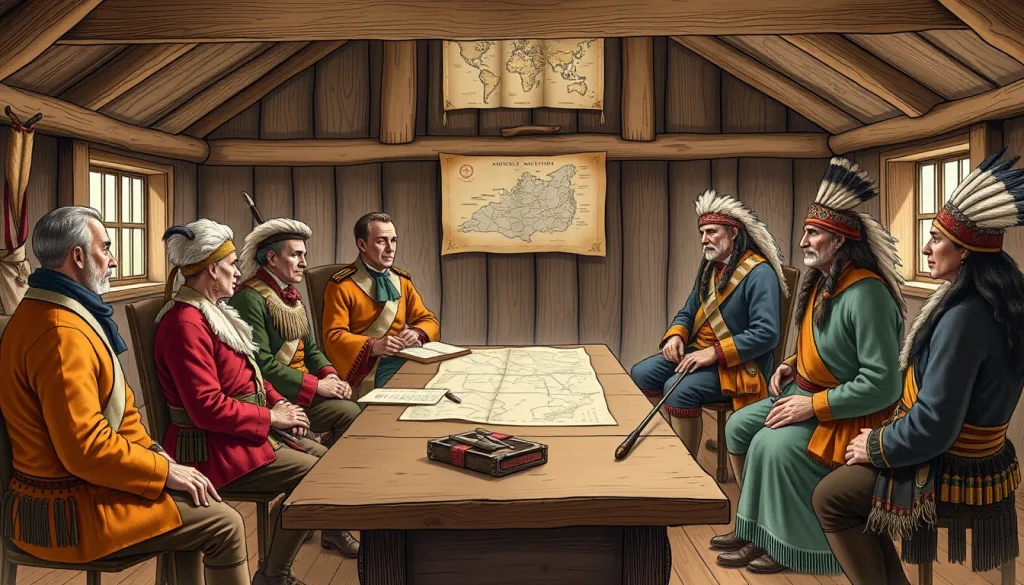
After the war, the United States acted quickly to secure land cessions from the weakened Indigenous nations. In 1815, President Madison’s treaty commissioners began negotiating new treaties, often under coercion. The Treaty of Fort Meigs (September 29, 1817) ceded over 4 million acres of land in Ohio, Indiana, and Michigan, with only small reservations retained. The Treaty of St. Mary’s (1818) further reduced Miami lands. Meanwhile, in Upper Canada, British authorities also sought to extinguish Indigenous title to facilitate settlement, but they adopted a policy of concentration on islands like Manitoulin rather than removal. Many Indigenous people, particularly from the south and east of the Great Lakes, migrated north to Canada to escape American expansion.
Why It Matters
The immediate effect was the rapid loss of Indigenous land base in the United States, leading to the Indian Removal Act of 1830 and forced removals west of the Mississippi. In Canada, Indigenous peoples were confined to smaller reserves, but they retained a recognized treaty relationship with the Crown. The war’s outcome also shattered the dreams of a unified Indigenous confederacy, and the death of Tecumseh in 1813 ended that movement. Historians view this period as the beginning of the reservation era and the systematic erosion of Indigenous sovereignty.
Definition
“Indigenous lands after the War of 1812” refers to the territory traditionally occupied by Indigenous nations in the Great Lakes and Ohio Valley that was affected by the war’s outcome. The war and subsequent treaties led to the transfer of millions of acres from Indigenous possession to the United States or the Crown, altering the map of Indigenous land ownership.
Background
Prior to the war, Indigenous nations had experienced decades of land loss through treaties, such as the Treaty of Greenville (1795). Tecumseh’s confederacy sought to halt this by asserting common land ownership among all Indigenous nations. The war gave Britain an opportunity to use Indigenous allies as a buffer against American expansion, but after Tecumseh’s death, the confederacy collapsed, leaving individual nations to negotiate from a position of weakness.
How It Worked
The United States used treaties, often negotiated with pliable factions, to acquire land. These treaties included provisions for annuities, reservations for specific groups, and sometimes grants to individuals. The Treaty of Fort Meigs demonstrates this, with several tribes ceding land in exchange for annual payments and small reservations. The U.S. also utilized “half-breed” or métis individuals as intermediaries, sometimes granting them land, to facilitate negotiations. In Canada, the British used the Royal Proclamation of 1763 to recognize Indigenous title, but after the war they negotiated “surrenders” of land, such as the 1836 Manitoulin Island purchase, concentrating Anishinaabeg on specific islands.
Competing Viewpoints
American officials saw the treaties as legal purchases and believed Indigenous peoples would eventually assimilate or move west. They often claimed that the sales were voluntary, though many were coerced. British officials viewed themselves as protectors of Indigenous rights, but they also sought to clear land for settlement, preferring to maintain Indigenous peoples as allies on reserves. Indigenous nations themselves held divergent views: some, like the Miamis under Jean Baptiste Richardville, sought to adapt to American landholding practices to retain a land base, while others, like the Odawas, migrated across the border to preserve their communities.
Role in the War of 1812
The war itself changed the power dynamics. British victories early on, with Indigenous help, raised hopes for a buffer state, but the American victory at the Battle of the Thames in 1813 led to the death of Tecumseh and the collapse of the confederacy. The Treaty of Ghent’s Article IX attempted to restore Indigenous rights, but the U.S. interpreted it minimally, and British negotiators did not press for enforcement, prioritizing peace and commerce. The war also displaced many Indigenous communities, destroying villages and crops, and weakening their ability to resist post-war pressures.
Consequences and Historical Interpretation
The long-term consequence was the forced removal of most Indigenous peoples from the eastern United States. The Trail of Tears and other removals are direct legacies of this era. In Canada, Indigenous peoples were confined to reserves, but they retained a treaty relationship and some autonomy, which later shaped Canadian Indigenous policy. Historians like Anthony Hall and Rebecca Kugel argue that the war was a pivotal moment in the dispossession of Indigenous lands, with both the U.S. and Britain prioritizing their own interests over Indigenous rights. Others, like Susan Gray, highlight the agency of Indigenous nations in negotiating and resisting removal, showing that they were not passive victims.
Primary Sources
The Treaty of Ghent (1814) contains the key international promises regarding Indigenous lands. The Treaty of Fort Meigs (1817) provides detailed land cessions and reservations, and its transcript is available from the National Archives. The Treaty of St. Mary’s (1818) further demonstrates the pattern of cessions. Additionally, the writings of Indian agents like Lewis Cass and the speeches of Indigenous leaders such as Tecumseh offer contemporary perspectives, though they must be critically evaluated for bias.
Further Reading
- Kugel, Rebecca. “Planning to Stay: Native Strategies to Remain in the Great Lakes, Post-War of 1812.” Middle West Review, 2016.
- Gray, Susan E. “The Border Difference: The Anishinaabeg, Benevolence, and State Indigenous Policy in the Nineteenth-Century Great Lakes Basin.” American Studies in Scandinavia, 2018.
- Hall, Anthony J. “Indigenous Title and the War of 1812.” The Canadian Encyclopedia, 2015.
- Sugden, John. Tecumseh: A Life. New York: Henry Holt, 1998.
References
- Hall, Anthony J. “Indigenous Title and the War of 1812.” The Canadian Encyclopedia. Accessed 2023. https://thecanadianencyclopedia.ca/en/article/aboriginal-title-and-the-war-of-1812.
- Kugel, Rebecca. “Planning to Stay: Native Strategies to Remain in the Great Lakes, Post-War of 1812.” Middle West Review 2, no. 2 (2016). doi:10.1353/mwr.2016.0005.
- Gray, Susan E. “The Border Difference: The Anishinaabeg, Benevolence, and State Indigenous Policy in the Nineteenth-Century Great Lakes Basin.” American Studies in Scandinavia 50, no. 1 (2018): 101-122.
- Treaty with the Wyandots, etc., 1817. Wyandot Heritage Digital Archive. Accessed 2023. https://www.wyandotte-archive.org/digital-heritage/treaty-wyandots-etc-1817.
FAQ
What did the Treaty of Ghent promise Indigenous peoples?
Article IX promised to restore to Indigenous nations all possessions, rights, and privileges they enjoyed in 1811, but the U.S. largely ignored this.
How did the War of 1812 change Indigenous land ownership?
The war weakened Indigenous nations, enabling the U.S. to impose treaties that ceded millions of acres, while Britain in Canada pursued a policy of reserving lands on islands.
Why did some Indigenous peoples move to Canada after the war?
Many migrated north to escape American land seizures and to maintain their communities under British protection, which offered a recognized treaty relationship and land reserves.
Leave a Reply