Short Answer
Tenskwatawa, also known as the Shawnee Prophet, was the younger brother of Tecumseh and a Shawnee religious leader whose teachings mobilized Indigenous opposition to American expansion in the decades before and during the War of 1812. Beginning in 1805, his prophetic vision of cultural renewal provided an ideological foundation for Tecumseh’s pan-Indian confederacy and for Indigenous alliance with Great Britain in the war. Tenskwatawa was present at the fall of Detroit in 1812 and retreated with British forces after the Battle of the Thames in 1813, but his reputation never fully recovered from the defeat at Tippecanoe in 1811.
Historical Context
After the American Revolution, the United States claimed land north of the Ohio River, but the region remained largely controlled by Indigenous nations. The Treaty of Paris (1783) transferred nominal sovereignty to the United States, and subsequent treaties and expeditions, including Anthony Wayne’s 1793–94 campaign, culminated in the Treaty of Greenville (1795), which forced many nations to cede territory. Meanwhile, William Henry Harrison, governor of Indiana Territory from 1801, negotiated a series of land cessions that threatened the Shawnee, Delaware, Potawatomi, Miami, and other peoples. The loss of land and the spread of settler culture, alcohol, and Christianity fueled resentment. In this context, Tenskwatawa’s religious revival appeared as a direct response: he called for rejection of Euro-American goods, alcohol, and intertribal conflict, and taught that the “Master of Life” had designated Indigenous peoples as his children and Americans as the children of the Evil Spirit.
What Happened
In 1808, Tenskwatawa and Tecumseh founded Prophetstown at the confluence of the Wabash and Tippecanoe Rivers, in present-day Indiana. The settlement became the heart of a growing intertribal confederacy, attracting warriors from the Shawnee, Delaware, Potawatomi, Ojibwe, Odawa, Kickapoo, and others. In November 1811, while Tecumseh was recruiting allies in the South, Harrison’s army approached Prophetstown. On the night of November 6 and the early morning of November 7, warriors associated with Tenskwatawa attacked the American encampment near the Tippecanoe River. Although the fighting was severe, the American troops repelled the attack and were able to burn Prophetstown and destroy its supplies. This engagement, known as the Battle of Tippecanoe, is often treated as a prelude to the War of 1812.
After the battle, Tenskwatawa and Tecumseh moved into British-allied territory in Upper Canada. When the war began in June 1812, they joined forces with British regulars and Canadian militia. On August 16, 1812, the combined British and Indigenous force led by Major General Isaac Brock and Tecumseh compelled the surrender of American General William Hull’s army at Detroit. Tenskwatawa was present at and has been reported to have participated in the victory ceremonies, although his exact role is less documented than his brother’s. The following year, after Tecumseh was killed at the Battle of the Thames on October 5, 1813, Tenskwatawa retreated with British commander Major General Henry Procter. He survived the war and remained in Canada until 1825.
Why It Matters
Tenskwatawa’s movement and the Battle of Tippecanoe made the western frontier a central theatre of Anglo-American conflict and contributed to the outbreak of the War of 1812 by deepening American fears of a British-supported Indigenous alliance. Although the Battle of Tippecanoe was a military defeat and severely damaged Tenskwatawa’s prophetic reputation, the war itself demonstrated the continuing importance of Indigenous military power. At Detroit, Indigenous warriors under Tecumseh helped force the surrender of a much larger American force. Tenskwatawa’s religious teachings, however, were overshadowed by his brother’s leadership, and his role in the war has been largely remembered as a failure. In the long term, the destruction of the confederacy and the death of Tecumseh meant that Indigenous nations in the Northwest lost a powerful military advocate and were increasingly subject to American expansion after the Treaty of Ghent (1814).
Early Life
Tenskwatawa was born Lalawethika (“Noisemaker”) in about 1775 in Shawnee territory near the Great Lakes, the son of Puckeshinwa, a Shawnee war chief, and Methoataske, a Creek woman. His father died in the Battle of Point Pleasant in 1774, and his mother left the family in 1779. Lalawethika was never a skilled warrior or hunter; he lost his right eye in an accident while nocking an arrow. As a young man he became known for heavy drinking and lived on the margins of his community. His transformation began in April 1805 when, after falling into a deep trance, he reported a vision from the “Master of Life” that commanded him to preach a purifying message of resistance.
Role Before the War
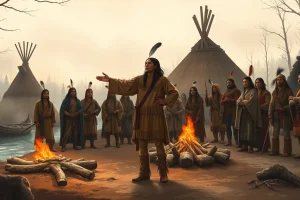
After his visions, Lalawethika took the name Tenskwatawa, which is often translated as “The Open Door.” He travelled through Indigenous communities, calling on converts to stop using alcohol, discard Euro-American goods, and return to traditional ceremonies. He also argued that all Indigenous peoples shared a common interest and should set aside old rivalries to protect their lands. His message complemented Tecumseh’s political vision of a united pan-Indian confederacy. Together they established Prophetstown in 1808 as the political and spiritual centre of that movement, and Tenskwatawa served as its spiritual leader, while Tecumseh handled military and diplomatic affairs. By 1811, the settlement had become a symbol of Indigenous resistance to American expansion.
Role During the War
During the War of 1812, Tenskwatawa’s direct military roles were secondary to those of Tecumseh. He did, however, accompany the Shawnee forces and British allies in the campaign that led to the surrender of Detroit. After that victory, Tenskwatawa remained with British-Indian forces in Upper Canada. He was present in the autumn of 1813 when Procter’s army retreated northward from Lake Erie along the Thames River. At the Battle of the Thames, Tecumseh was killed, and Tenskwatawa retreated with Procter’s column. Some accounts suggest that Tenskwatawa attempted to rally warriors after Tecumseh’s fall, but his influence was declining.
Major Actions
Tenskwatawa’s most significant public actions included: proclaiming the 1805 vision and new religious doctrine; participating in the founding and establishment of Prophetstown in 1808; orchestrating the attack on Harrison’s army at the Battle of Tippecanoe in November 1811; supporting the British alliance and accompanying Tecumseh to Detroit in 1812; and joining Procter’s retreat after the Battle of the Thames in 1813. After the war, he returned to the United States and assisted in the removal of the Shawnee people to Kansas in the 1820s.
Contemporary Accounts
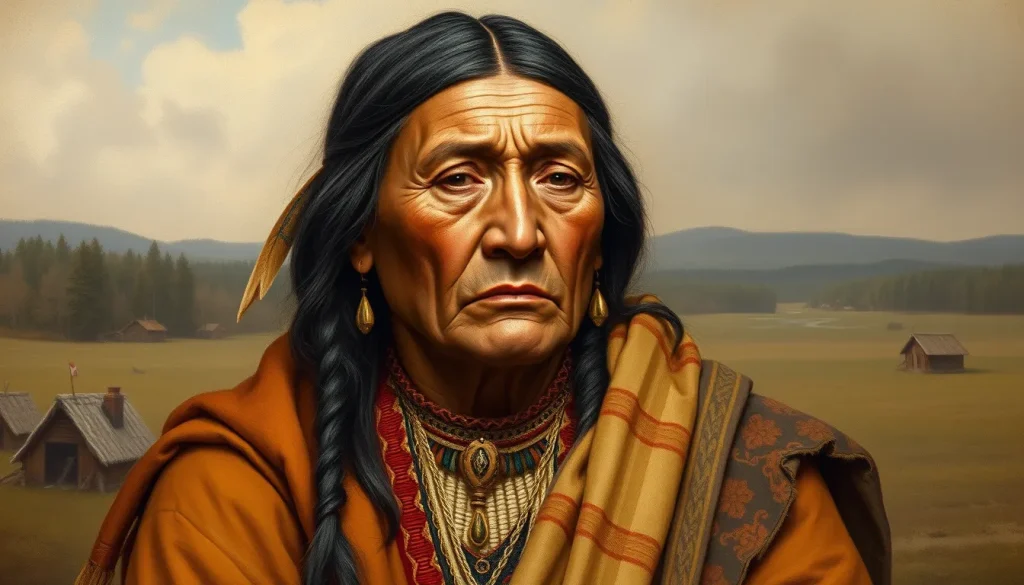
Contemporary observers interpreted Tenskwatawa very differently. American officials such as Governor Harrison portrayed him as a fraud and a danger; American official reports described the Prophet and his community as instruments of British intrigue and frontier unrest. British officials and military commanders, by contrast, valued Tenskwatawa’s ability to mobilize Indigenous warriors alongside Tecumseh. The most frequently quoted statement attributed to Tenskwatawa from 1805 asserts: “The Great Spirit bids me to address you in his own words … The Americans I did not make. They are not my children but the children of the Evil Spirit.” This wording appears in later publications and must be treated as a transcription rather than a verbatim record, but it illustrates the confrontational tone of his preaching. Visual evidence of his appearance survives in portraits by Charles Bird King (c. 1820) and George Catlin (1830), held by the Smithsonian American Art Museum.
Later Life
After the war, Tenskwatawa remained in Upper Canada for about a decade. In 1825 he returned to the Shawnee homelands and cooperated with American officials and missionaries in negotiating Shawnee removal west of the Mississippi River. He established a new Prophetstown near present-day Kansas City, Missouri, where he died in 1836, largely forgotten.
Historical Legacy
Historians have debated whether Tenskwatawa was a genuine religious visionary or an opportunistic manipulator. In the short term, his prophecy failed at Tippecanoe, and his reputation never recovered. In the broader perspective, his movement gave Indigenous peoples a powerful ideological basis for resistance—a basis that survived his personal defeat and helped shape the military alliance with Britain. Modern scholars often treat him as a significant, if flawed, figure in the history of the War of 1812, emphasizing that the war in the Northwest cannot be understood without considering the spiritual and political movement he and Tecumseh led.
Primary Sources
The most useful primary sources for studying Tenskwatawa include contemporary government and military correspondence, published versions of his teachings, and visual portraits. Among these are:
- The 1805 statement quoted above, as preserved in Canadian Museum of History online resources, which illustrates the prophetic message and its anti-American rhetoric.
- William Henry Harrison’s official correspondence with the United States Secretary of War, particularly concerning the Prophetstown settlement and the Battle of Tippecanoe. These letters are held in the National Archives and appear in the territorial papers of Indiana.
- The portraits by Charles Bird King (c. 1820) and George Catlin (1830), which provide visual documentation of Tenskwatawa’s appearance in later life and are housed at the Smithsonian Institution.
- The accounts of later travellers and journalists who interviewed Tenskwatawa in Kansas in the early 1830s, which describe his diminished status and his memories of his brother Tecumseh. Some of these appear in the publications of the American Pioneer and similar series, but should be read critically.
Important limitations: the 1805 speech is a later transcription and may have been embellished; American government sources are hostile to Tenskwatawa; and the interviews of the 1830s were recorded long after the events.
Further Reading
- Davis, D.S. “Tenskwatawa (The Prophet).” The Canadian Encyclopedia. https://thecanadianencyclopedia.ca/en/article/tenskwatawa-the-prophet
- American Battlefield Trust. “Tenskwatawa.” https://www.battlefields.org/learn/biographies/tenskwatawa
- The Canadian Encyclopedia. “First Nations and Métis Peoples in the War of 1812.” https://prod-front.thecanadianencyclopedia.ca/en/article/first-nations-in-the-war-of-1812
- Sugden, John. Tecumseh: A Life. New York: Henry Holt, 1997.
- Edmunds, R. David. The Shawnee Prophet. Lincoln: University of Nebraska Press, 1983.
References
- Davis, D.S. “Tenskwatawa (The Prophet).” The Canadian Encyclopedia. Accessed 2025. https://thecanadianencyclopedia.ca/en/article/tenskwatawa-the-prophet
- American Battlefield Trust. “Tenskwatawa.” Accessed 2025. https://www.battlefields.org/learn/biographies/tenskwatawa
- Canadian Museum of History. “Tenskwatawa” (1812 Virtual Exhibition). Accessed 2025. https://www.warmuseum.ca/war-of-1812/content_assets/tenskwatawa/
- American Experience (Smithsonian), “Tecumseh and the War of 1812.” PDF. Accessed 2025. https://americanexperience.si.edu/wp-content/uploads/2014/10/Tecumseh-and-the-War-of-1812_.pdf
- The Canadian Encyclopedia. “First Nations and Métis Peoples in the War of 1812.” Accessed 2025. https://prod-front.thecanadianencyclopedia.ca/en/article/first-nations-in-the-war-of-1812
FAQ
What was Tenskwatawa's role in the War of 1812?
Tenskwatawa was a Shawnee religious leader and Tecumseh's brother. He helped build the Prophetstown alliance, was present at the surrender of Detroit in 1812, and retreated with British forces after Tecumseh was killed at the Battle of the Thames.
Why is Tenskwatawa called The Prophet?
In 1805 he underwent a spiritual transformation and took the name Tenskwatawa, often translated as 'The Open Door' or 'The Prophet.' He preached a message of cultural renewal and resistance to American expansion.
Did Tenskwatawa die in the War of 1812?
No. He survived the war, remained in Canada for several years, then returned to the United States and aided in the removal of the Shawnee to Kansas, where he died in 1836.

Leave a Reply